Table of Contents
ToggleDigital Agriculture Platforms: Introduction
Agriculture remains one of Kenya’s most important economic sectors, supporting millions of households and contributing significantly to national food security. However, farming today is becoming increasingly complex. Farmers must manage labor, livestock, crops, farm inputs, equipment, finances, weather risks, and market access while remaining profitable in a competitive environment.
For decades, many farms relied on notebooks, spreadsheets, manual records, and memory to manage operations. While these methods may work for small-scale activities, they often become inefficient as farms grow. Missing records, delayed decisions, inaccurate inventory counts, and poor communication can affect productivity and profitability.
This is why Digital Agriculture Platforms are becoming increasingly important across Kenya. These platforms allow farmers to manage operations using centralized digital systems that provide visibility, accountability, and real-time information.
When reviewing leading providers offering Digital Agriculture Platforms, a common trend emerges. Many websites promise “higher yields,” “increased profits,” or “revolutionary growth” without clearly explaining how those results are achieved. The truth is that software alone does not create higher yields. Instead, Digital Agriculture Platforms help farmers make better decisions, improve planning, reduce waste, and strengthen operational efficiency.
For modern agricultural businesses, adopting digital technology is rapidly becoming a competitive necessity rather than an optional improvement.
What Are Digital Agriculture Platforms?
Digital Agriculture Platforms are software systems designed to help farmers manage agricultural activities through digital tools and centralized information.
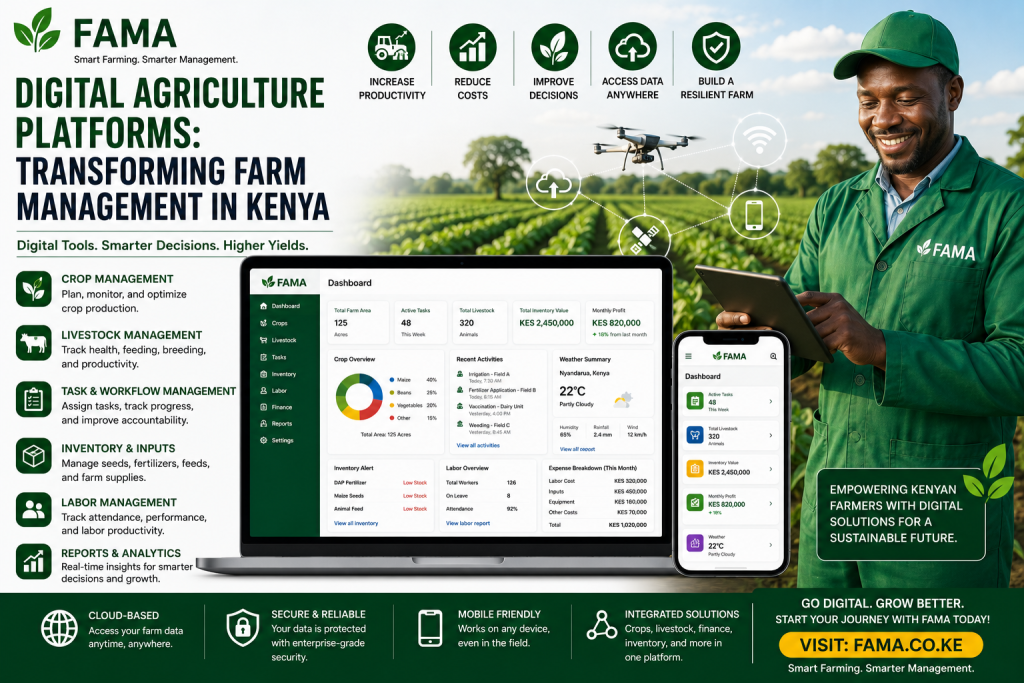
These platforms combine multiple functions including farm record management, livestock tracking, crop monitoring, inventory control, labor management, equipment maintenance, reporting, and financial oversight.
Instead of using separate notebooks, spreadsheets, and paper files, farmers can access all operational information from a single system.
Modern Digital Agriculture Platforms often include mobile applications, cloud-based access, automated reporting, and real-time dashboards.
The primary objective is to improve decision-making while simplifying farm management.
Why Kenya Is Embracing Digital Agriculture Platforms
Kenyan agriculture faces several challenges including rising production costs, labor shortages, climate variability, input management issues, and increasing competition.
Farmers are under pressure to improve efficiency while maintaining profitability.
Digital Agriculture Platforms help address these challenges by providing accurate information that supports better planning and resource allocation.
A dairy farmer can monitor animal records digitally. A crop farmer can track fertilizer applications and harvest schedules. A farm manager can monitor labor productivity and equipment utilization.
This visibility allows managers to identify problems early and respond more effectively.
As smartphone usage and internet access continue expanding across Kenya, adoption of Digital Agriculture Platforms is accelerating.
Digital Agriculture Platforms for Farm Record Keeping
Accurate record keeping is one of the most important aspects of farm management.
Unfortunately, many farms still struggle with incomplete or inconsistent records.
A Digital Agriculture Platforms solution centralizes information and makes record management easier.
Farmers can maintain records related to:
- Crop production
- Livestock performance
- Inventory usage
- Equipment maintenance
- Labor activities
- Input purchases
- Sales transactions
Having accurate records improves operational visibility and supports better decision-making.
It also simplifies reporting requirements for lenders, investors, and agricultural partners.
Improving Crop Management Through Digital Agriculture Platforms
Crop farming involves numerous activities that require careful coordination.
Planting schedules, irrigation activities, fertilizer applications, pest management, harvesting operations, and post-harvest handling must all be properly managed.
Digital Agriculture Platforms help organize these activities within a structured workflow.
Managers can schedule tasks, assign responsibilities, track completion status, and review historical performance data.
This improves operational consistency and reduces the likelihood of missed activities.
Better planning often leads to improved resource utilization and stronger production outcomes.
Livestock Management Using Digital Agriculture Platforms
Livestock operations generate large volumes of information.
Farmers must monitor animal identification, breeding records, vaccinations, feed consumption, milk production, health treatments, and sales activities.
Managing this information manually becomes increasingly difficult as herd sizes grow.
Digital Agriculture Platforms help farmers maintain accurate livestock records and monitor performance more effectively.
For dairy farms, production records become easier to analyze. For poultry operations, inventory and flock management improve. For beef producers, growth and health monitoring become more structured.
Centralized livestock management contributes to stronger operational control.
Inventory Management and Input Control
Farm profitability often depends on effective management of agricultural inputs.
Seeds, fertilizers, feeds, veterinary medicines, pesticides, fuel, and packaging materials all represent significant operational costs.
A Digital Agriculture Platforms solution helps farmers monitor inventory levels and usage patterns.
Managers can track stock movements, identify shortages, and forecast future requirements.
This reduces emergency purchases and helps prevent wastage.
Better inventory visibility also supports stronger financial management.
Digital Agriculture Platforms and Equipment Tracking
Farm equipment represents a major investment.
Tractors, irrigation systems, harvesters, generators, pumps, and transport vehicles require ongoing maintenance and monitoring.
A Digital Agriculture Platforms platform allows managers to track equipment performance, maintenance schedules, and operational history.
Preventive maintenance becomes easier to manage because reminders and service records are stored digitally.
This reduces downtime and helps extend equipment lifespan.
Equipment visibility also supports more informed replacement and investment decisions.
Labor Management and Workforce Productivity
Labor remains one of the largest expenses for many agricultural businesses.
Managing workers effectively requires clear communication, task allocation, attendance monitoring, and performance tracking.
Digital Agriculture Platforms help organize workforce activities and improve accountability.
Managers can assign tasks digitally and monitor progress throughout the day.
This structured approach reduces misunderstandings and improves productivity.
For farms employing seasonal workers, digital labor management can significantly improve operational efficiency.
Financial Visibility Through Digital Agriculture Platforms
Many farms understand production volumes but struggle to evaluate profitability accurately.
Without proper financial visibility, decision-making becomes difficult.
A Digital Agriculture Platforms solution helps connect operational activities with financial information.
Managers can monitor spending patterns, evaluate resource utilization, and identify opportunities for cost control.
Better financial visibility contributes to stronger budgeting and investment planning.
This information becomes increasingly important as farms expand and operations become more complex.
Supporting Multi-Farm Operations
Many agricultural enterprises manage multiple locations.
Without centralized systems, coordination across farms can become challenging.
Digital Agriculture Platforms provide visibility across all operational units from a single dashboard.
Managers can compare performance, allocate resources strategically, and monitor activities across multiple sites.
This scalability makes digital systems particularly valuable for growing agricultural businesses.
Expansion becomes easier because operational information remains organized and accessible.
Digital Agriculture Platforms and Data-Driven Decisions
Successful farming increasingly depends on accurate information.
A Digital Agriculture Platforms solution collects data from various operational areas and converts it into actionable insights.
Managers can review production trends, inventory reports, equipment utilization data, labor performance metrics, and financial summaries.
Rather than relying entirely on experience or intuition, decisions can be supported by reliable information.
Data-driven management helps reduce uncertainty and improve operational outcomes.
Technology Integration and the Future of Farming
Agricultural technology continues evolving rapidly.
GPS systems, weather monitoring tools, smart irrigation systems, livestock sensors, drones, and automated equipment are becoming more common.
Modern Digital Agriculture Platforms act as central management hubs that integrate these technologies.
This allows farmers to consolidate information and improve decision-making.
As digital agriculture continues advancing, integrated platforms will play an increasingly important role in farm management.
Farms that adopt digital systems today will be better positioned to benefit from future innovations.
Internal Business Technology Solutions
Agricultural businesses often benefit from complementary digital platforms.
Useful solutions include:
- https://fama.co.ke
- https://jaat.co.ke
- https://dexa.co.ke
- https://vega.co.ke
- https://pawa.co.ke
- https://rentaldesk.co.ke
- https://ratibu.co.ke
- https://churchesadmin.com
- https://kayapro360.com
- https://prim.co.ke
- https://dereva.co.ke
- https://vota.co.ke
- https://zivo.co.ke
- https://wito.co.ke
- https://musamusic.ai
These platforms demonstrate how digital transformation is improving operations across multiple industries.
Risks and Challenges of Digital Agriculture Platforms
While Digital Agriculture Platforms provide significant benefits, implementation challenges can occur.
One common issue is poor user adoption. Employees may resist changing from familiar manual processes to digital systems.
Training and ongoing support help address this challenge.
Another risk involves inaccurate data entry. Software quality depends heavily on data quality. Farms should establish clear procedures for maintaining records.
Internet connectivity may also affect cloud-based systems in some rural locations. Choosing solutions with offline capabilities can help reduce disruptions.
Finally, selecting software without strong agricultural functionality may limit long-term value.
Careful vendor evaluation is essential.
Is This Worth It? Honest Verdict
For most commercial farms, the answer is yes.
The primary value of Digital Agriculture Platforms is not automation alone. Their value comes from improved visibility, stronger accountability, better planning, and more informed decision-making.
Small farms may initially manage operations manually, but growing agricultural businesses often benefit significantly from digital systems.
Farms managing livestock, crop production, inventory, labor, equipment, and multiple operational units typically experience the greatest returns.
Success depends on selecting the right platform and ensuring consistent adoption across the organization.
How Digital Agriculture Platforms Improve Agricultural Planning
One of the biggest reasons farms struggle to achieve consistent performance is poor planning. Agricultural operations involve dozens of activities that must happen at the right time. Planting, irrigation, fertilization, spraying, harvesting, livestock feeding, vaccinations, maintenance, and inventory replenishment all require proper coordination.
Without structured planning, farms often face delays that affect productivity. Fertilizer may arrive late, workers may not be assigned efficiently, or equipment may be unavailable when needed. These issues may seem small individually, but collectively they can reduce operational performance significantly.
Digital Agriculture Platforms help solve these challenges by providing centralized planning tools. Farm managers can create activity schedules, assign responsibilities, monitor progress, and receive alerts about upcoming tasks. Instead of relying on memory or scattered notes, the entire operation becomes organized through one system.
Planning visibility becomes especially valuable during peak farming seasons. Whether managing maize, vegetables, dairy cattle, poultry, or mixed farming operations, digital planning improves coordination and helps reduce costly mistakes.
Digital Agriculture Platforms and Agricultural Traceability
Consumers, processors, exporters, and regulators increasingly demand transparency regarding agricultural production.
Questions such as where crops were grown, which inputs were used, when products were harvested, and how livestock were managed are becoming more common.
Digital Agriculture Platforms help farms maintain detailed production histories and traceability records.
Every activity can be recorded within the system, creating a complete operational history that can be referenced whenever needed.
For export-oriented farms, traceability is often a critical requirement. Buyers may require documentation demonstrating compliance with quality and safety standards.
Maintaining these records manually can be time-consuming and error-prone. Digital systems simplify the process and improve record accuracy.
As agricultural supply chains become more sophisticated, traceability capabilities will continue growing in importance.
Strengthening Decision-Making Through Real-Time Data
Many farm decisions are still based largely on intuition and experience.
While practical experience remains extremely valuable, modern agriculture generates large amounts of operational data that can support more informed decisions.
Digital Agriculture Platforms collect information from multiple operational areas and transform it into useful reports and dashboards.
Managers can analyze trends related to:
- Crop performance
- Livestock productivity
- Inventory consumption
- Equipment utilization
- Labor efficiency
- Financial performance
Having access to real-time information allows farms to respond more quickly to emerging challenges.
Rather than waiting until problems become severe, managers can identify issues early and take corrective action.
This proactive approach often leads to stronger operational outcomes and better resource utilization.
Digital Agriculture Platforms for Cooperative Farming Groups
Agricultural cooperatives play an important role in Kenya’s agricultural sector.
Many cooperatives manage large numbers of members, extensive inventories, processing facilities, transportation assets, and financial transactions.
Coordinating these activities manually can become increasingly difficult as membership grows.
Digital Agriculture Platforms help cooperatives improve organization and transparency.
Member records, deliveries, payments, inventory movements, and production information can all be managed through a centralized platform.
This visibility strengthens accountability and helps improve trust among members.
Digital systems also support more efficient communication between management teams and cooperative members.
For agricultural organizations seeking long-term growth, centralized digital management provides a strong operational foundation.
Improving Customer Relationships Through Digital Agriculture Platforms
Agriculture is ultimately a business that depends on customers.
Whether selling milk, eggs, vegetables, fruits, grains, livestock, or processed products, maintaining strong customer relationships is essential.
Digital Agriculture Platforms help farms provide better service by improving inventory visibility, production forecasting, and order management.
Managers gain better insight into product availability and can communicate more accurately with buyers.
This reduces misunderstandings and improves customer satisfaction.
Farms that consistently meet delivery commitments often develop stronger relationships with buyers and gain access to more stable markets.
Customer confidence becomes easier to maintain when operational information is accurate and readily available.
Supporting Agricultural Financing and Investment
Access to financing remains one of the biggest challenges facing many farmers.
Banks, investors, development agencies, and agricultural lenders increasingly expect accurate operational records before providing funding.
A farm using Digital Agriculture Platforms can often provide detailed information regarding production history, inventory levels, livestock records, financial performance, and operational efficiency.
This transparency improves credibility and demonstrates professional management practices.
Lenders generally prefer working with businesses that maintain organized records and can clearly explain operational performance.
For farms seeking growth capital, digital management systems can strengthen financing opportunities by improving reporting quality.
Digital Agriculture Platforms and Climate Resilience
Climate variability continues affecting agricultural productivity across Kenya.
Unpredictable rainfall patterns, drought conditions, flooding events, and temperature fluctuations create significant challenges for farmers.
While software cannot control weather conditions, Digital Agriculture Platforms help farms improve preparedness and resilience.
Historical production records, weather-related observations, and operational data provide valuable insights that support future planning.
Managers can evaluate how previous seasons performed and identify practices that improved resilience.
This information helps farms make better decisions regarding crop selection, planting schedules, irrigation planning, and resource allocation.
Over time, digital records become an important asset for adapting to changing environmental conditions.
Why Digital Agriculture Platforms Are Becoming Essential
The agricultural sector is undergoing a major transformation.
Technology adoption is increasing across every aspect of farm management. From mobile payments and digital marketplaces to precision agriculture and automated equipment, digital tools are becoming standard business resources.
Digital Agriculture Platforms sit at the center of this transformation by connecting operational activities into one management system.
As farms grow larger and supply chains become more demanding, relying solely on manual processes becomes increasingly difficult.
Digital systems provide the visibility and control needed to manage modern agricultural businesses effectively.
The farms that embrace digital management today are likely to be better positioned for future growth and competitiveness.
Future Trends in Digital Agriculture Platforms
The future of Digital Agriculture Platforms will likely involve deeper integration with emerging technologies.
Artificial intelligence may help identify production trends and predict resource requirements. Machine learning systems may improve forecasting accuracy. Automated sensors may provide real-time updates regarding equipment, livestock, and environmental conditions.
Drone technology, satellite imagery, and precision agriculture tools are also becoming more accessible.
As these technologies continue evolving, farms will need centralized platforms capable of organizing and interpreting large volumes of data.
Digital agriculture platforms are expected to become increasingly intelligent, helping farmers make faster and more accurate decisions.
This evolution will further strengthen the role of technology in agricultural management.
Additional Final Thoughts
The adoption of Digital Agriculture Platforms is no longer limited to large commercial farms. Small and medium-sized agricultural businesses are increasingly recognizing the value of digital management tools.
From record keeping and inventory control to livestock management and operational planning, these platforms provide practical solutions to everyday challenges.
The greatest benefit is often not automation itself but the visibility it creates. When farmers have accurate information, they make better decisions. Better decisions lead to improved efficiency, stronger financial performance, and more sustainable growth.
As Kenya’s agricultural sector continues modernizing, Digital Agriculture Platforms will play an increasingly important role in helping farmers remain competitive, productive, and resilient.
For farms preparing for the future, investing in digital management capabilities today can create a strong foundation for long-term success in an increasingly technology-driven agricultural environment.
Frequently Asked Questions
What are Digital Agriculture Platforms?
Digital Agriculture Platforms are software systems that help farmers manage operations, records, inventory, livestock, labor, equipment, and reporting digitally.
Are Digital Agriculture Platforms suitable for small farms?
Yes. Many solutions are scalable and can support farms of various sizes.
Can Digital Agriculture Platforms manage livestock operations?
Yes. Most modern platforms include livestock management capabilities.
Is cloud-based farm software secure?
Reputable providers use secure hosting, backups, encryption, and access controls.
How quickly can farmers see benefits?
Many farms experience improvements in organization, reporting, planning, and operational visibility within the first few months.
Start Your Digital Agriculture Journey Today
Agriculture is becoming increasingly data-driven, competitive, and technology-focused. Farmers who embrace digital tools gain better visibility into operations and make more informed decisions.
Modern Digital Agriculture Platforms help manage crops, livestock, labor, equipment, inventory, finances, and reporting from a centralized system.
If you want to improve efficiency, strengthen accountability, and prepare your farm for future growth, now is the time to adopt digital farm management.
Start your transformation today with https://fama.co.ke and discover how digital systems can help your agricultural business operate smarter, faster, and more profitably.