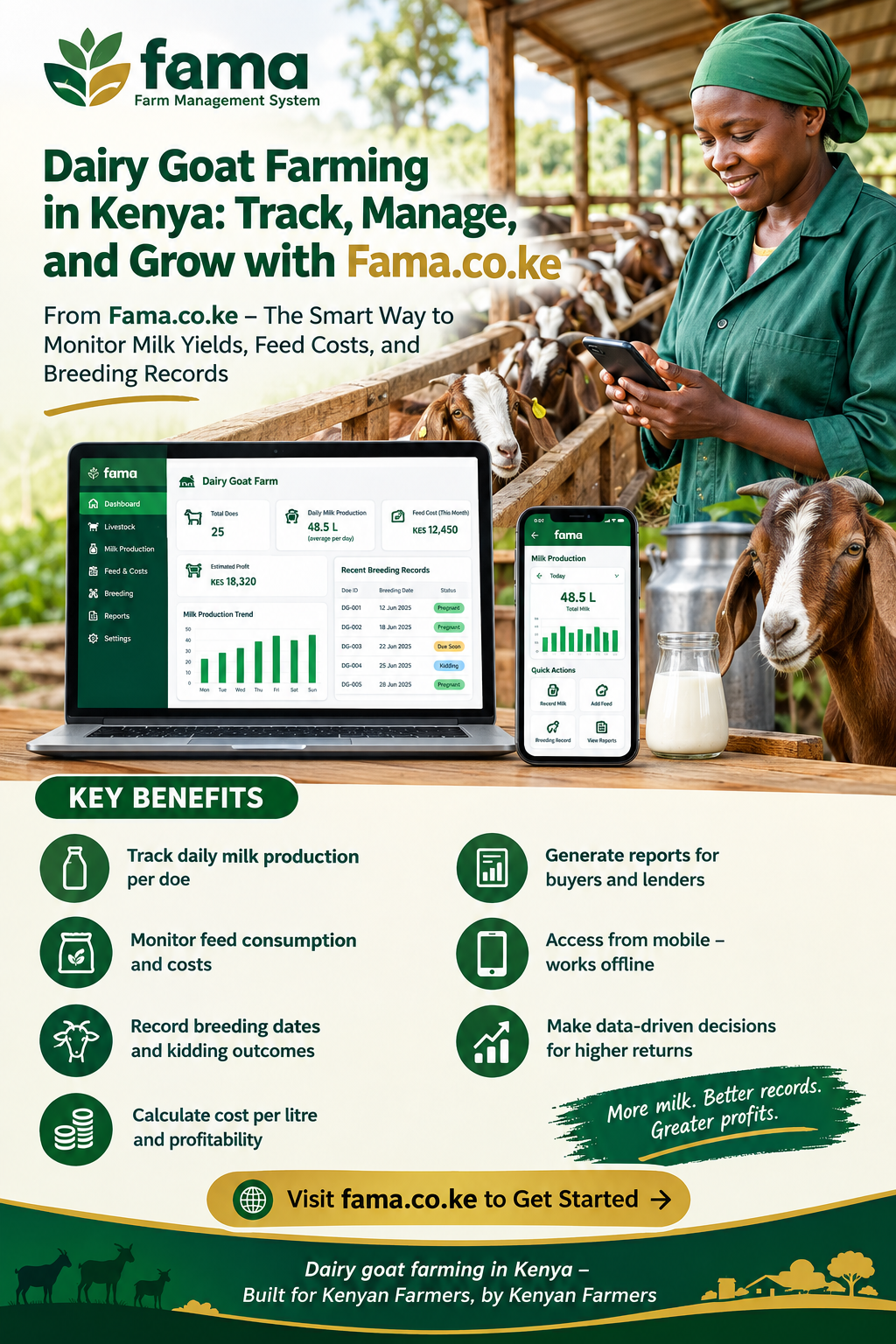
Dairy goat farming in Kenya has emerged as one of the most accessible and profitable livestock ventures for smallholder farmers, particularly those with limited land and capital. Fama.co.ke provides an innovative farm management platform that helps farmers track dairy goat farming in Kenya through disciplined record-keeping, feed cost monitoring, and data-driven herd management. With Kenya now home to approximately 35 million goats and 1.8 million dairy goats contributing to the national dairy landscape, the potential of dairy goat farming in Kenya continues to expand. The dairy goat sub-sector contributes 15.2 per cent to the total livestock sector and 4.8 per cent to overall household incomes, yet annual goat milk production sits at just 6.3 million kilograms—a fraction of what the market demands.
The financial case for dairy goat farming in Kenya is compelling and well-documented. Rearing five dairy goats for milk requires low maintenance and can earn a farmer Sh280,560 monthly, compared to a dairy cow which can earn Sh155,400 monthly but demands far higher maintenance. For Kiringai Kamau, a farmer from Murang’a County, this comparison became a business decision. He spends Sh1,500 a week feeding his 12 goats, against the Sh3,000 he used to spend on a single cow. Understanding dairy goat farming in Kenya begins with recognising that goats convert feed into milk more efficiently than cattle on the same land.
The market environment supports dairy goat farming in Kenya strongly. A litre of goat milk sells for approximately Sh200—double the price fetched for cow’s milk—and demand continues to outstrip supply. Charles Wathobio, a vet who sells 40 litres of goat milk weekly, describes the demand as “insatiable.” Mwendia Gitonga, a University of Nairobi graduate, gets at least 25 litres of milk from 13 goats, selling at Sh65 per litre and earning Sh48,750 monthly. His running costs are between Sh18,000 and Sh20,000 monthly. This is what dairy goat farming in Kenya looks like in practice: consistent daily income from a manageable herd.
Artificial insemination has become a major driver of dairy goat farming in Kenya by improving genetics at low cost. The Kenya Animal Genetic Resources Centre’s goat AI facility in Kirinyaga, with an annual production capacity of 100,000 semen doses, provides AI services at approximately Sh500, making quality genetics affordable to small-scale farmers. Farmers who previously relied on communal breeding bucks suffered widespread inbreeding and reproductive diseases such as brucellosis. Access to superior genetics through AI is now lifting milk yields and reducing disease, directly improving dairy goat farming in Kenya across central Kenya and beyond.
The cost side of dairy goat farming in Kenya is favourable. Goats are hardy browsers that feed on most types of vegetation, including shrubs and twigs, making feeding affordable. Kiringai Kamau’s 12 goats consume feed worth Sh1,500 weekly, versus Sh3,000 for one dairy cow. In IFAD dairy goat models, production and investment costs excluding labour are estimated at KES 52,400, with average revenue that comfortably exceeds that figure. For meat goat models, production costs excluding labour are around KES 4,165 per goat, with average revenue of KES 46,000 in well-managed systems. These economics explain why dairy goat farming in Kenya is achievable even at small scale.
Record-keeping is the discipline that determines whether dairy goat farming in Kenya profitability is realised or lost. Without records, a farmer cannot identify which does produce the most milk, which bucks sire the best offspring, or what the true cost per litre of milk is. KALRO encourages farmers to keep meticulous breeding records to avoid inbreeding and track productivity. Digital tools make dairy goat farming in Kenya measurable rather than speculative, turning every breeding decision and feed change into testable management action.
The market for goats and goat products is expanding, reinforcing dairy goat farming in Kenya. Goat milk is increasingly recommended for children, the elderly, and people with digestive sensitivities, creating a growing niche market. The Dairy Goat Association of Kenya coordinates a model where seven to ten farmers jointly own a KALRO pedigree buck, sharing it among the group and then passing it to another group. A 15-month pedigree Toggenburg or Alpine buck costs Sh15,000 from KALRO. This shared model reduces the capital barrier that previously kept improved genetics out of reach, and it strengthens dairy goat farming in Kenya for smallholders who could not individually afford quality breeding stock.
Climate resilience is another reason dairy goat farming in Kenya holds up under drought. The Galla goat is described as the hardiest small stock breed, adapting to a wide variety of pasture and climatic conditions, surviving longer than most animals without supplementary feeding. During drought conditions, goats continue producing, while cattle lose condition and value. In Tharaka Nithi, women are turning to dairy goat farming as a coping mechanism to increasingly erratic rainfall and shrinking land sizes. Dairy goats are helping women earn income, improve household nutrition and slowly claim their space in a farming system that has long been dominated by men. This demonstrates that dairy goat farming in Kenya is not dependent on favourable rainfall alone.
For farmers who want a complete digital system to track goat production, feed costs, health records, breeding dates, and sales, Fama.co.ke offers daily farm records software designed for Kenyan livestock farmers. The platform captures daily milk yields, feed consumption, health events, and breeding outcomes in one system that works offline and on basic smartphones. Reports generated from this data show cost per litre, feed conversion efficiency, and profitability trends that guide informed management. As this guide to dairy goat farming in Kenya has shown, the returns are real and attainable. What separates profitable goat farms from struggling ones is consistent execution, supported by records that make progress visible and problems detectable before they become losses.
Dairy goat farming in Kenya is not without challenges. High costs of pure breeds, weak extension services, and male control of assets limit scaling for many farmers. Pure dairy kids below three months cost between Sh15,000 and Sh30,000, which is beyond the reach of many rural women. Interbreeding with local he-goats dilutes stock quality, reducing milk yields and market value. Diseases, fluctuating feed prices, and unpredictable weather patterns are among the biggest hurdles. Yet despite these obstacles, the benefits of dairy goats remain clear. A good goat produces between one and two litres of milk a day, and even selling one and a half litres at Sh100 per litre makes a meaningful difference to household income.
The future of dairy goat farming in Kenya is bright. KALRO has embarked on a program to multiply and deliver superior goat genes to smallholder farmers, with high-producing breeds such as Toggenburg, Saanen, German, and British Alpine being made readily available. Purebred Saanen and Alpine goats have the production potential of 3.5 to 4 litres daily—three to four times more than farmers get from crossbreeds and the widely reared Kenya Dual Purpose Goat. The project targets small-scale dairy goat keepers in Kakamega, Tharaka Nithi, and Nyeri Counties. With diminishing land for dairy cows, dairy goat rearing continues to gain momentum across the country.
For farmers seeking comprehensive digital tools to support their journey, dairy goat farming in Kenya from Fama.co.ke provides the infrastructure to plan, track, and grow a successful dairy goat enterprise. The platform helps farmers monitor milk yields per doe, track feed costs, record breeding dates, and calculate profitability per animal. Visit fama.co.ke to learn more about how farm management software can support your dairy goat farming venture. With the right breeds, disciplined feeding, and proper record-keeping, dairy goat farming in Kenya transforms from a question into a measurable business outcome.
Why Dairy Goat Farming in Kenya Outperforms Many Alternatives
Dairy goat farming in Kenya compares favourably against other livestock ventures for several structural reasons. Goats require less land, less feed, and less capital than cattle, while producing milk that sells at nearly double the price. A goat consumes about 3.5 percent of its body weight in dry matter daily, meaning five goats can be kept in the space and budget required for one cow. The dairy goat sub-sector contributes 15.2 percent to the total livestock sector and 4.8 percent to overall household incomes in Kenya, yet annual goat milk production sits at just 6.3 million kilograms, showing a large unbridged gap in national demand. That gap is precisely where dairy goat farming in Kenya is strongest.
Meat production also drives returns. Goat meat makes up 63 percent of red meat consumed worldwide, and Kenyan exports have been the fastest-growing agricultural sector, rising at 21.72 percent annually from 2009 to reach Sh17 billion in 2023. Domestically, a farmer selling nyama choma goats in Nairobi and Nakuru sells animals of four to 25 kilograms for Sh4,000 to Sh8,000 each, depending on size, health, and breed. These channels give dairy goat farming in Kenya multiple outlets rather than reliance on a single buyer. For farmers committed to building a profitable enterprise, dairy goat farming in Kenya offers a proven path to steady income. With the right knowledge and the right tools, dairy goat farming in Kenya can become a rewarding business reality.
Choosing the Right Breeds for Dairy Goat Farming in Kenya
Breed selection is the single most influential decision in dairy goat farming in Kenya. The Saanen is the highest-producing dairy breed, with the potential for up to 7 litres of milk per day under optimal conditions. The Toggenburg produces up to 5 litres daily with higher butterfat content and is known for its hardiness. The German and British Alpine produce up to 3 litres per day and adapt well to highland conditions. The Anglo-Nubian produces up to 5 litres with high butterfat content, making its milk excellent for cheese production.
Indigenous goats, which make up 98 percent of Kenya’s goat population, produce only 0.5 litres of milk daily and mature slowly, limiting their contribution unless upgraded through crossbreeding. Farmers should acquire stock from KALRO or from breeders certified by the Directorate of Veterinary Services to avoid buying half breeds. A 15-month pedigree Alpine or Toggenburg buck purchased from KALRO costs Ksh15,000. Investing in certified genetics is a foundational step because it determines the production ceiling of the entire herd.
Feeding and Management for Dairy Goat Farming in Kenya
Feed is the largest controllable cost in dairy goat farming in Kenya. Goats are browsers by nature and thrive on a diet of shrubs, green leaves, desmodium, lucerne, calliandra, and mineral salt licks. Kiringai Kamau feeds his 12 goats on a diet rich in these protein sources, keeping feed costs at Sh1,500 weekly while maintaining strong milk yields. Mwendia Gitonga reduces dairy meal to about 70 kilograms per week because green matter enriches the nutrient content of milk, spending between Sh1,800 and Sh2,100 weekly on feed.
Housing should be dry, well-ventilated, and raised off the ground to reduce disease. Zero grazing is practical for smallholders with limited land and allows close monitoring of feed intake and health. Regular deworming, vaccination against common diseases, and hoof trimming keep goats productive. Goats rarely fall prey to diseases when well-fed and watered, which is a major reason dairy goat farming in Kenya remains favourable even for beginners.
Marketing Channels That Support Dairy Goat Farming in Kenya
Multiple marketing channels support dairy goat farming in Kenya. Direct sales to neighbours and local consumers capture the highest margins, with goat milk selling at Sh60 to Sh200 per litre depending on location and demand. Cooperatives and processors like Kibidav Dairies, which specialises in goat milk products such as yoghurt and fresh milk under the Toggs brand, provide consistent off-take. Online platforms are emerging, with marketers creating digital marketplaces that help farmers find ready buyers.
Breeding stock sales command the highest margins. A mature Toggenburg buck sells for Sh70,000, and Galla males reach Sh50,000 at full maturity. A Kirinyaga breeder who supplies an average of 50 goats per week notes that veterinary services are easily accessible and goats rarely get sick when managed properly. For farmers targeting premium markets, value addition through yoghurt and cheese production offers additional income streams and extends shelf life.
Making Dairy Goat Farming in Kenya a Reality
Dairy goat farming in Kenya is proven, repeatable, and accessible. The evidence is in the daily milk sales, the breeding stock prices, and the household incomes built from small herds. Goats offer faster maturity, lower feed costs, and higher milk prices than cattle, while remaining resilient under drought. Improved breeds and affordable artificial insemination have removed the genetic barriers that once limited production.
Fama.co.ke provides the digital infrastructure to track every litre of milk, every kilogram of feed, every breeding date, and every sale. Start your journey with the right tools and the right knowledge. Visit fama.co.ke to learn more about how farm management software can support your dairy goat farming venture.