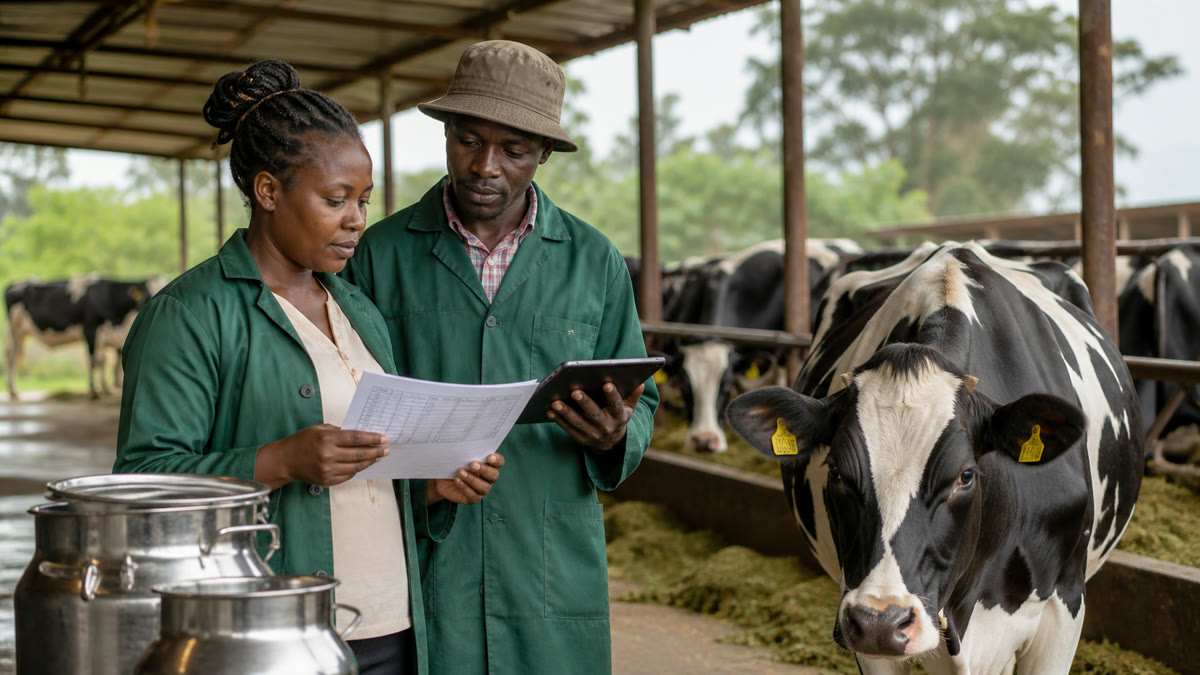
A dairy farm records software Kenya exists to solve the problem that decides success in this country’s most demanding livestock enterprise: the cow that cannot speak for herself. Dairy is the only farm enterprise where the product is harvested daily, the animals are individually valuable, and the biology runs on a calendar nobody can see from the outside — the twenty-one-day heat cycle, the 280-day gestation, the lactation curve that peaks and falls on its own schedule. A dairy farmer managing all of that on memory is running a daily-income business blind.
Walk through any zero-grazing unit in Kiambu, Uasin Gishu, or Nyandarua and you will find the same scene: cows known by sight and name, yields remembered roughly, breeding dates pencilled on a wall calendar, treatments written on a card folded behind the drug shelf, and feed issued by the scoop. The owner works from before sunrise to after dark, yet cannot answer the questions that decide everything — which cow earns her feed, what a litre truly costs, which animal is due for service, and whether the co-op’s payment this month matched the litres delivered. A dairy farm records software Kenya converts all of that scattered knowledge into one system that never forgets.
What has changed is that dairy has become a documented trade. Co-operatives record every litre delivered and pay against deductions and quality bonuses; buyers of breeding stock demand vaccination and treatment histories before paying premiums; lenders now finance cows against documented milk income; and feed prices have climbed to the point where a cow whose yield never covered her ration is a loss compounding every single day. The farmer holding a dairy farm records software Kenya answers every one of these demands in minutes, while the memory-based farmer negotiates from guesswork at every counter.
The cost of not knowing is specific and painful. The missed heat that silently costs twenty-one days of an empty lactation; the cow kept for sentiment whose yield has never justified her feed; the mastitis treated with no record of the withdrawal period, putting an entire can of milk at risk of rejection; the heifer reared for two and a half years whose true rearing cost nobody can state. A working dairy farm records software Kenya surfaces each of these losses while they are still small enough to fix.
This guide examines dairy farm records software Kenya in full: why the timing is no accident, why records decide everything in dairy, what the software actually is, the core features that separate genuine tools from gimmicks, the benefits farms report, who needs it most, what each scale of operation demands, the single number that changes everything, paper versus digital, records and financing, and how to choose, implement, and afford a system without disrupting the milking routine. By the end, managing a dairy herd becomes a system rather than a scramble.
The proven dairy farm records software Kenya principle is simple: every litre tells a story, and only records can read it. Everything in this guide serves that single discipline.
Why the Timing Is No Accident
The urgency behind adopting dairy farm records software Kenya is no accident. Kenyan dairy has professionalised from every direction at once — co-operatives digitising their collections, processors imposing quality deductions and bonuses, feed prices climbing relentlessly, and lenders finally willing to finance dairy but only against records. The farm that once ran on the herd book and the wall calendar now operates inside a market that asks for evidence.
Feed economics have sharpened the need. Dairy meal, silage, and concentrates now represent sixty to seventy percent of milk production cost, which means a ration issued by the scoop without measurement is the largest uncontrolled expense on the farm. Farmers who manage feeding through dairy farm records software Kenya records routinely cut feed spending visibly within one lactation — without a single cow eating less.
The tools completed the shift. Affordable smartphones reached every dairy zone, offline-capable apps handle the zero-grazing unit where signal fails, and software priced for Kenyan farmers puts systems once reserved for estates within reach of a three-cow homestead. A dairy farm records software Kenya deployment now costs less than one month’s dairy meal — against losses it routinely prevents that dwarf the price.
Why Records Decide Everything in Dairy
Dairy biology runs on a timetable humans cannot see from the outside, and every missed date converts directly into money lost. A missed heat is twenty-one days of empty days; a missed drying-off compromises the entire next lactation; a missed vaccination can cost the cow herself. A dairy farm records software Kenya system carries this calendar so the farmer does not have to — alerting on every date that memory would inevitably drop.
The second reason is the cow herself. A crop tells you how it is doing at harvest; a cow tells you nothing unless someone measured her along the way. Records are how livestock speak: yield per cow per day, feed consumed per litre produced, treatments survived, calves delivered. With dairy farm records software Kenya, every animal’s economics become visible — and the difference between the herd’s stars and its passengers becomes a matter of data rather than impression.
The third reason is the milk cheque. Co-op payments arrive with deductions, bonuses, and sometimes unexplained shortfalls, and the farmer who never reconciled deliveries against payments has been absorbing errors silently for years. Farms that reconcile through dairy farm records software Kenya records routinely recover the gap within the first months — litres delivered that were never paid for, discovered because someone finally counted.
The fourth reason compounds across generations. Breeding decisions made this season echo through the herd for five years, and genetics compounded on records move visibly while genetics compounded on hope do not move at all. Herds steered through dairy farm records software Kenya data report calving intervals and weaning weights climbing steadily within three seasons — compound interest in animal form.
What the Software Actually Is
At its core, dairy farm records software Kenya is a digital system — usually a mobile application, increasingly paired with a web dashboard — that manages the entire life of every cow: identification, production, breeding, health, feeding, and finance, connected in one record per animal. Think of it as the herd’s biography and the farm’s accountant combined: always available, never too busy, and never too tired at the end of a long day to write down what actually happened.
The architecture follows one principle: one cow, one record, for life. From birth or purchase to sale or culling, every event — every weight, treatment, service, calving, and litre — attaches to the same identity, so the animal’s full economics accumulate in one place instead of scattering across books that never meet. A serious dairy farm records software Kenya platform is engineered so nothing is recorded twice and nothing is ever forgotten once.
The daily workflow shows the design intent. Morning milking ends with yields entered per cow — thirty seconds of tapping — and the system updates each animal’s lactation curve. Feed issued from the store is charged to the herd; a cow treated for mastitis is logged with her drug, dose, cost, and withdrawal clock; a heifer observed on heat is flagged for service.
By evening, the owner opens the dairy farm records software Kenya and sees the whole herd — every animal, every event, every shilling — in one coherent picture no collection of notebooks ever produced.
The intelligence layer is what elevates the platform from a filing system to a management partner. Quality systems compute continuously: calving intervals per cow, cost per litre including feed and labour, feed conversion per animal, and the projected milk income of the month ahead. Alerts watch the biological calendar — a service overdue, a vaccination due, a withdrawal ending, feed stock running low — so the dairy farm records software Kenya carries the deadlines that memory would inevitably drop.
Core Features That Matter
Not every app deserves space on the phone that runs a milking herd. When evaluating dairy farm records software Kenya, these are the features that genuinely separate the useful from the frustrating — each tested against the realities of Kenyan dairy.
Individual Cow Profiles
The spine of the whole system is the cow profile: identification by ear tag or name, breed, date of birth or purchase, parentage, lactation number, and the complete event history beneath. A dairy farm records software Kenya built on strong profiles makes every other feature possible — because production, health, breeding, and finance all hang from the same identity, and nothing about any animal ever has to be remembered twice.
Milk Production Recording
For dairy, the milk record is king. Yields captured per cow per day or per milking, organised into lactations, and displayed as curves that make problems visible within days — the cow whose production is drifting downward, the fresh cow peaking below expectation, the animal whose yield no longer covers her feed. A dairy farm records software Kenya that pairs yields with feed data turns every milking into a profit measurement rather than just a chore.
Breeding and Reproduction Records
Reproduction is the engine of every dairy, and the records must carry its full calendar: heat dates, services with the bull or straw identity, pregnancy diagnoses, expected calvings, actual births, and the resulting intervals. A dairy farm records software Kenya with a strong breeding module alerts on overdue services and approaching calvings — converting the twenty-one-day cycle from a memory test into a managed schedule with a target of twelve to thirteen months.
Health and Treatment Records
Every treatment logged the moment it happens: diagnosis, drug, dose, cost, who administered it, and — critically — the withdrawal period governing when her milk can re-enter the market. A dairy farm records software Kenya with treatment tracking also builds the cow’s medical history, exposing recurring problems — the cow with repeat mastitis — that justify culling decisions grounded in evidence.
Vaccination and Deworming Calendars
Prevention is cheaper than treatment, but only if it happens on time. The system should maintain vaccination schedules — FMD, lumpy skin, blackquarter — with due dates alerted in advance, plus deworming intervals for the whole herd. A dairy farm records software Kenya that carries the prevention calendar protects the enterprise from the outbreaks that wipe out a year of work in a fortnight.
Feed and Ration Management
Feed is the largest cost in dairy, so the software must treat it with financial seriousness: rations defined per cow class, feed issued from inventory and charged to the herd, and the daily cost of feeding each animal calculated as a running figure. A dairy farm records software Kenya with feed management also tracks silage, hay, and concentrate stocks against consumption — so the dry season’s feed is planned in advance rather than bought in panic.
Milking and Quality Records
Beyond volume, quality decides the cheque: butterfat content, protein, and the rejection events that follow mastitis or poor hygiene. Recording daily quality alongside daily volume shows which cows, which shifts, and which hygiene lapses cost money. Farms that track quality through dairy farm records software Kenya records connect the bonus and deduction lines on the co-op statement to specific, fixable causes.
Calving and Heifer Rearing Records
The heifer is the largest hidden cost in most dairy businesses — two years of feed, treatments, and labour before her first litre. When dairy farm records software Kenya accumulates rearing costs from birth to first calving, the farm finally knows what its own replacements truly cost, and can compare rearing against buying with numbers instead of habit.
Sales, Milk Delivery and Payment Reconciliation
Every litre delivered to the co-op or buyer recorded against the payment received reconciles the farm’s most important transaction. Deductions itemised, bonuses attributed, shortfalls exposed — a dairy farm records software Kenya with payment reconciliation turns the monthly statement from a mystery into a verification, and recovers the litres that were delivered but never paid.
Financial Records per Herd
Every shilling tied to the cows — feed, drugs, AI services, labour, transport — and every shilling they earn should sit in one ledger. A dairy farm records software Kenya with integrated finance tags each transaction automatically, producing cost per litre without manual arithmetic, and presenting the bank-ready accounts that dairy lending now requires.
The Benefits Farms Report
The first benefit is per-cow clarity — the discovery, almost without exception, that the herd’s internal economics differed from everyone’s impressions. Two or three cows carried the milking; several never earned their shed space; one bloodline out-yielded the others every time. Owners who see their first complete per-cow report from dairy farm records software Kenya describe it as the most consequential document their farm ever produced.
The second is breeding progress. With services, sires, and calvings recorded and compared, the herd’s fertility starts moving deliberately — calving intervals tightening, silent heats caught, the AI programme directed by evidence. Farms that steer breeding through dairy farm records software Kenya records report the twenty-one-day cycle becoming a managed rhythm rather than a lottery.
The third is feed savings. Rations measured against yields expose the cows being fed at a loss and the rations wasting their concentrate. Units running feed discipline through dairy farm records software Kenya typically cut feeding costs by a visible share within one lactation — money that returns without a single animal eating less.
The fourth is milk payment recovery. Reconciled deliveries against payments routinely surface litres never credited, deductions never itemised, and quality bonuses never received. Farmers who audit through dairy farm records software Kenya records describe the first reconciliation as quietly earning back months of the software’s cost.
The fifth is culling discipline. Nothing improves a herd faster than removing the animals that do not pay, and nothing makes that decision harder than sentiment. With yields, costs, and histories documented by dairy farm records software Kenya, culling becomes evidence rather than emotion — and herds typically change composition visibly within two lactations.
The sixth is market power. Buyers of breeding stock pay premiums for documented health and production histories, and the farmer selling through dairy farm records software Kenya records presents each animal as a verified asset rather than a stranger — frequently earning ten to twenty percent above the undocumented market.
The seventh compounds longest: continuity. Herd knowledge — which cow line produces, which bull’s daughters hold their yield — has always lived in the owner’s head, and it leaves with them. A farm whose animals live inside dairy farm records software Kenya inherits differently: the successor receives a database rather than a mystery, and the herd compounds instead of restarting.
Who Needs It Most
Smallholder dairy families — the backbone of Kenya’s milk — benefit most proportionally. A family milking two or three cows is running a biological business on one phone and one memory, and dairy farm records software Kenya gives that family the management infrastructure of a much larger operation: every cow profiled, every litre recorded, every deadline carried by the system.
Commercial dairy farms need the software as operational necessity. An operation milking fifty cows coordinates workers, treatments, services, and feeding across a scale where manual books cannot survive — and dairy farm records software Kenya delivers control at that scale: every cow attributed, every worker’s section visible, and the consolidated picture assembled automatically.
Dairy co-operatives and groups sit at the centre of the recording economy, because they pay against records and their trust depends on them. The member whose deliveries, treatments, and yields are documented through dairy farm records software Kenya becomes the supplier everyone backs for premiums and contracts.
New dairy farmers benefit immediately, because they have no accumulated memory to fall back on. For them, dairy farm records software Kenya is not a transition from notebooks but the founding document of the herd — every entry from day one compounding into the history their older competitors must struggle to reconstruct.
Veterinarians, AI technicians, and farm managers serving multiple clients complete the list. A professional responsible for five herds cannot hold five herds’ details in memory, and platforms consolidating every client behind one login have redefined the profession: advice grounded in measured economics, delivered from dairy farm records software Kenya data the professional and the client both trust.
Dairy by Scale: What Each Operation Demands
The one-to-three-cow homestead needs simplicity above all: daily yields, the breeding calendar, treatment logs, and the co-op reconciliation — nothing more. A dairy farm records software Kenya deployment for this scale works when entries take seconds and the alerts do the remembering, because the owner’s time is the scarcest input on the farm.
The ten-to-fifty-cow commercial unit needs the full system: individual profiles, lactation curves, feed costing, worker attribution, and integrated finance. At this scale, dairy farm records software Kenya records are what separate a managed dairy from a busy one — and the margin difference between the two is typically the farm’s entire profit.
Large farms and estates need the system as governance: multiple sheds, multiple milkers, section-level reporting, and owner oversight consolidated live. Deployments of dairy farm records software Kenya at this tier turn supervision across sheds into a dashboard and give every milker a documented record of the work they actually did.
Dairy groups and co-operative members need shared standards: the records that co-ops increasingly request — yields, treatments, herd health — assembled as a by-product of daily entries rather than a pre-delivery scramble. Members aligned through dairy farm records software Kenya documentation consistently qualify for the quality bonuses their neighbours forfeit.
The Number That Changes Everything: Cost per Litre
The single most clarifying figure in dairy is the true cost of producing one litre — feed, drugs, AI, labour, and the cow’s share of everything else, divided by the litres she actually gave. Farmers who compute this through their dairy farm records software Kenya records are consistently surprised: the cost is almost always higher than the gut estimate, and for several cows it exceeds the milk price entirely.
The second number is income per cow per lactation — and the comparison between the two is the herd’s whole economics in one line. A cow whose maintenance exceeds her contribution is not livestock; she is a liability eating concentrates, and only dairy farm records software Kenya records reveal which animals earn their shed space and which quietly consume the season.
The third is the trend across lactations, because one season is weather and three are truth. Rising cost per litre against flat milk prices signals a herd structure or feeding problem developing — and the farmer who sees it through dairy farm records software Kenya trends corrects the course while correction is still cheap.
Paper Records vs Digital Systems
Paper is familiar, cheap, and better than nothing — but it fails dairy structurally. The milk book, the treatment card, the breeding calendar, and the feed notebook live in four places that never reconcile, and the questions that matter — cost per litre, withdrawal status, calving interval — require all four at once. The dairy farm records software Kenya alternative answers those questions in seconds because the entries were connected the moment they were made.
Paper also cannot compute or survive. Calving intervals, conversion ratios, and lactation totals must be worked by hand with errors compounding quietly — and one rain-soaked book in the parlour erases a lactation’s history. A dairy farm records software Kenya system calculates continuously, backs itself up beyond the farm, and never loses a treatment record to the weather.
Records and Financing
Ask any lender why dairy credit remains expensive, and the answer is always the same: applicants cannot demonstrate that the cows generate the income the loan assumes. A dairy farm records software Kenya record base changes that conversation completely — yields reconciled, sales documented, costs itemised — presented from data that matches the animals in the shed by construction.
Insurance follows the same logic. Livestock cover prices its risk on visibility, and the farmer with documented production and health histories pays better premiums and settles claims faster. Operations running dairy farm records software Kenya systems describe the insurance conversation as transformed: the underwriter’s questions meet files that already exist.
How to Choose the Right System
Start with the farm’s actual needs rather than the feature list’s ambitions. List the three problems that hurt most — perhaps heat detection, feed cost, or co-op reconciliation — and test whether the dairy farm records software Kenya candidate handles those three brilliantly, because a tool that does everything poorly is worse than one that does your priorities well.
Then insist on a trial during real milking, not a demonstration. Hand the phone to whoever actually milks, run one genuine week of entries, and verify that offline capture works at the shed where signal dies — a dairy farm records software Kenya system that only functions in good signal will die within a month, no matter how impressive its demo.
Implementing Without Disrupting the Milking Routine
Begin with the baseline: every cow entered with age, breed, stage, and status, pregnant animals flagged with due dates, and opening feed and cash balances counted once. A few days on this foundation saves a season of corrections, because dairy farm records software Kenya records are only as trustworthy as the numbers beneath them.
Then launch from today forward rather than reconstructing years of history, and anchor entries to routines that already exist — after morning milking, at evening feeding, when the co-op statement arrives. A dairy farm records software Kenya deployment that rides existing habits sustains itself; one that demands new habits dies with the first busy week.
Costs and Return on Investment
Pricing follows recognisable models: free tiers for smallholdings, modest monthly subscriptions scaled to herd size for commercial units, and custom licensing for estates — with setup and training sometimes quoted separately. Model the total annual cost of each dairy farm records software Kenya candidate at your actual herd size, and weigh it against what it will recover — feed savings, recovered litres, breeding gains — rather than against zero.
The Future of Dairy Record Keeping
The technology is still accelerating. Artificial intelligence is beginning to read the records farms already keep — detecting oestrus in yield dips, flagging mastitis days before the milk changes, and predicting calving dates within narrower windows. Farms feeding clean data into today’s dairy farm records software Kenya platforms are building the histories that will make tomorrow’s advisory tools accurate for their specific animals — and that history cannot be bought retroactively at any price.
Frequently Asked Questions
Do I need to tag every cow before the software works? Not immediately — the system works with names, descriptions, and photos, and most farms tag progressively while the dairy farm records software Kenya profiles keep identities and records connected as tagging advances.
How much time does daily recording actually take? Two to four minutes: yields after milking, feed at the store, and any treatment when it happens. Farmers who anchor entries to the milking routine sustain the habit for years without effort, and the dairy farm records software Kenya does everything else automatically.
Can it track both the co-op milk and my direct customers? Yes — and it should. Both channels are recorded side by side with payments reconciled against each, so the farm always knows exactly which litres were delivered, to whom, and what actually arrived in return.
What happens when a cow is sold or dies? It is recorded as an exit with date, price or cause, and her complete history stays in the system — preserving the herd’s institutional memory, the sales evidence for buyers, and the mortality data that guides future prevention.
How long before I see real benefits? The first benefits arrive within weeks — known yields, organised treatments, visible feed costs. The deeper returns — breeding gains, cost per litre, better prices, cheaper credit — build across one to two lactations of consistent dairy farm records software Kenya records, and compound from there.