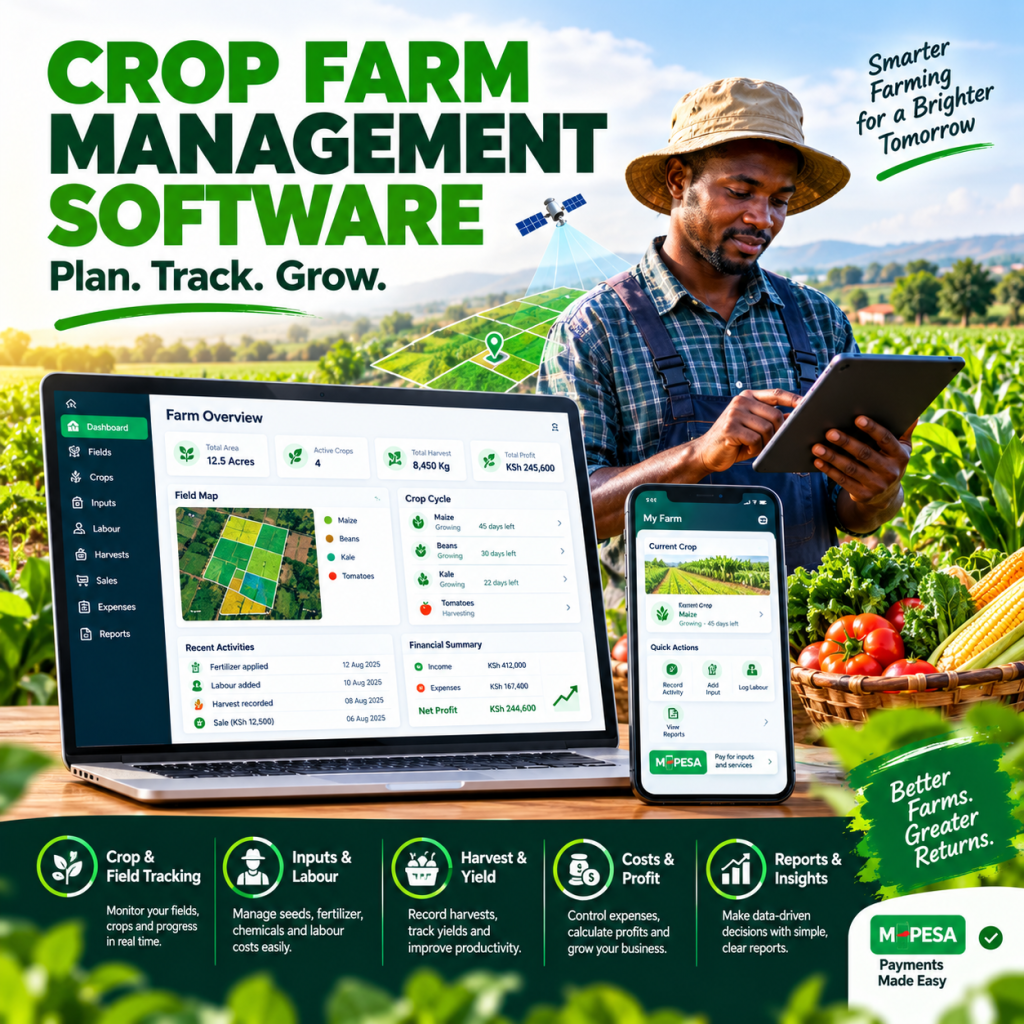
Crop farm management software has become the dividing line between farms that operate on evidence and farms that operate on memory, and the gap between the two widens with every passing season.
Growing crops is a data-rich business disguised as a physical one: every field holds a history of what was planted, what was sprayed, what was fed, what was harvested, and what went wrong — and the farmer who can retrieve that history in seconds makes better decisions than the farmer reconstructing it from fading recollection.
A dedicated crop farm management software solution captures that history automatically as a by-product of daily work, turning every planting, treatment, and harvest into a permanent, searchable record that compounds in value year after year. The result is a new kind of farming: one where variety choices are guided by your own field data, input spending is tracked to the square metre, and the question “what actually made money last season?” has a precise answer instead of a shrug.
This guide examines crop farm management software in full — what it does, which features matter, how it differs from generic tools, what it costs, how to implement it without disruption, and how to choose the right system for your operation, whether you grow half a hectare of vegetables or five hundred hectares of grain.
Why Crop Farming Needs Dedicated Software
The case begins with the sheer number of variables a crop farm juggles simultaneously.
A single season involves dozens of fields, multiple crop varieties with different maturities, a calendar of planting windows, a schedule of sprays and fertiliser applications with waiting periods, a labour force moving between tasks, and a stream of purchases, harvests, and sales — all interacting with each other.
Generic record-keeping tools were never designed for this web of dependencies, which is why purpose-built crop farm management software exists: it models the actual structure of crop production, with fields, crops, activities, inputs, and yields as connected objects rather than rows in unrelated lists.
Timing is the second reason. Crop farming punishes lateness more than almost any other business — a spray delayed by a week can cost half a harvest, a planting window missed cannot be recovered until next season, and an irrigation schedule that slips shows up in the yield months later.
Quality crop farm management software functions as a timing engine: it reminds, schedules, and alerts based on the crop calendar and the actual state of each field, catching the deadlines that memory-based management inevitably drops as the operation grows.
Costing is the third reason, and for commercial growers it is decisive. The only way to know your true cost of production — per hectare, per crop, per variety — is to track every input and every hour of labour against the specific field that consumed them.
This granular attribution is precisely what crop farm management software is engineered to do, and the farms that achieve it price their produce with confidence while their competitors estimate and hope.
Finally, the market itself is demanding records. Buyers, certification schemes, exporters, and lenders increasingly require documented spray histories, traceability from plot to pallet, and auditable production data as a condition of doing business.
A farm running proper crop farm management software produces this documentation as a by-product of ordinary operations, while a farm running on paper faces each audit as a crisis. In modern crop markets, the records are no longer optional — and software is how they get produced at scale.
Core Features Every Good System Should Include
Field Mapping and Plot Records
The foundation of any serious system is the digital map of the farm: every field, block, greenhouse, and plot drawn to scale with its area, soil type, and history attached. With this foundation in place, a crop farm management software platform can tag every activity, input, and harvest to the exact piece of land where it happened, which is what makes per-plot profitability analysis possible later.
Look for systems that measure areas automatically from the map, because hand-estimated acreages are one of the most common sources of error in farm records.
Crop Planning and Rotation Management
Planning tools let the farmer lay out the whole season before it begins: which crop goes in which field, which variety, what planting date, what expected harvest window, and what rotation rules should govern the sequence. Good crop farm management software enforces rotation logic automatically — flagging when a planned crop follows a disease-hosting relative, or when a field’s history recommends a rest or a legume break — turning agronomic best practice from a memory test into a built-in safeguard.
Input and Inventory Tracking
Seed, fertiliser, chemicals, and fuel are the largest controllable costs in crop production, and their tracking deserves module-grade attention.
A capable crop farm management software system records every purchase into store and every application onto a field, maintaining live balances, reorder alerts, and a complete usage trail that exposes waste and pilferage the moment they occur rather than at season’s end.
The best implementations also link application records to product labels and pre-harvest intervals automatically, so compliance comes free with every entry.
Task and Labour Management
Crop work is a schedule of tasks — planting, weeding, spraying, irrigating, harvesting — and the software should treat it that way: tasks assigned to workers or crews with deadlines, completion confirmed from the field with timestamps and photos, and labour hours accumulating against the field and activity they served.
Farms that run daily work through the task module of their crop farm management software gain something paper systems never provide: an objective productivity record per worker and a true labour cost per activity, both of which feed directly into costing and supervision.
Irrigation Scheduling and Water Records
Water is both a cost and a yield determinant, and the software should manage it deliberately: scheduled irrigation events per field, recorded volumes, and — where hardware allows — live data from moisture sensors feeding the schedule.
Systems that integrate irrigation planning with weather forecasts adjust recommendations automatically when rain intervenes, and growers using this feature of crop farm management software consistently report water savings alongside yield stability, because the crop receives water by need rather than by habit.
Scouting, Pests, and Treatment Records
Weekly field scouting generates observations — pest counts, disease symptoms, weed pressure, nutrient deficiencies — that deserve structured capture, not scattered notes.
A well-designed crop farm management software module lets scouts log findings against specific field zones with photos, then links those findings directly to the treatment decisions and spray records that follow, creating a closed loop from problem to intervention to outcome.
Reporting and Analysis
The final feature is the layer that converts records into decisions: dashboards, season comparisons, yield maps, cost-per-hectare breakdowns, and exportable reports for banks, buyers, and auditors.
This is where crop farm management software repays every minute of data entry — because the reports most growers need at season’s end, at the bank, or in the buyer’s office are the ones it generates in seconds rather than the ones a bookkeeper rebuilds over weeks.
The Major Benefits Growers Gain From Going Digital
Complete Visibility Across the Operation
The first benefit is simply seeing everything: what is planted where, what is due when, what has been spent, and what has been harvested — updated live as events happen.
Owners using crop farm management software describe this visibility as transformative, because problems surface while they are still cheap to fix: a missed spray, a draining input store, a block falling behind its yield curve. The end-of-season surprise, that signature of paper-based farming, effectively disappears.
True Cost of Production at Last
When every input and labour hour is attributed to its field, the software can compute cost per hectare, per crop, and per kilogram with an accuracy no estimation achieves. Growers who adopt crop farm management software for this capability routinely discover that some of their long-standing enterprises lose money invisibly — and that others earn far more than assumed — and the reallocation of land and budget that follows is often the single most profitable event of the decade for the farm.
Consistency Across Seasons and Managers
Farms change managers, workers rotate, and memory departs with them; software does not.
A farm whose practices, histories, and lessons live inside crop farm management software retains its operational intelligence permanently, so each season starts from accumulated knowledge rather than from zero — and new managers get productive in weeks instead of seasons, because the system itself carries the institutional memory.
Compliance and Market Access Made Routine
Spray diaries, pre-harvest intervals, traceability records, and audit reports emerge automatically from well-kept digital records, converting certification from an annual ordeal into a formality.
Growers supplying export chains and formal markets through crop farm management software documentation consistently win and keep contracts that paper-based competitors lose on paperwork alone — a quiet but decisive commercial advantage.
Better Decisions, Season After Season
The compounding benefit is analytical: variety comparisons across fields, planting-date effects on yield, input responses by soil type, and profitability by block all become visible once several seasons of data accumulate.
Farmers who have run crop farm management software for three or more seasons describe a step-change in decision quality — because they are no longer choosing between this year’s impressions, but between years of their own evidence.
Who Needs Crop Farm Management Software Most?
Smallholder and Small Commercial Growers
At small scale, the software’s job is discipline and visibility: one place for activities, inputs, costs, and reminders, replacing the scatter of notebooks and mental notes.
A small grower running crop farm management software from a single phone gains cost-per-crate clarity that was once the preserve of large estates — and that clarity is what converts subsistence habits into commercial performance, often for the first time in the farm’s history.
Commercial Field and Horticulture Operations
At commercial scale, the software becomes the coordination backbone: multiple managers, dozens of fields, seasonal crews, and constant reporting obligations.
Operations of this size adopt crop farm management software primarily for control and accountability — every activity recorded, every input attributed, every harvest weighed against its block — which is what allows a large farm to run on systems rather than on the owner’s permanent presence.
Outgrower Schemes and Aggregation Businesses
Buyers and aggregators coordinating hundreds of contracted smallholders face a traceability challenge that manual systems cannot survive.
A shared crop farm management software platform tracks each outgrower’s plots, inputs, and harvests to the consignment level, satisfying export audits while giving the scheme genuine production visibility — and the schemes that digitised this way report both smoother audits and stronger grower relationships.
Agronomists, Consultants, and Farm Managers
Service professionals advising multiple farms multiply their effectiveness when every client’s fields, histories, and alerts sit behind one login.
Consultants who run their client portfolios through crop farm management software deliver recommendations grounded in each farm’s own data rather than general rules — and the measurable improvement in outcomes is why data-backed advisory is rapidly becoming the industry standard.
Crop Planning: Turning the Season Into a System
Effective planning starts with the field-by-field cropping plan, and software makes it a living document rather than a sketch.
Within a good crop farm management software planning module, the farmer assigns crops to fields across the season, sees the calendar of planting windows and expected harvests, and watches the plan update automatically as reality intervenes — a field planted late shifts everything downstream, and the software shows the consequences immediately instead of at harvest.
Seed and input requirements flow from the plan automatically.
Once crops, areas, and planting dates are set, a quality crop farm management software system computes the seed quantities, fertiliser programmes, and chemical requirements by field and by week, so procurement happens early and deliberately rather than in panicked planting-week purchases at whatever price the market demands. This single workflow — plan to procurement — is among the highest-return habits the software installs.
Budgeting integrates with planning in the same move. With activities, inputs, and labour requirements estimated per field, the software produces a season budget before a single shilling is spent, and then tracks actuals against it as the season unfolds.
Growers who plan their seasons inside crop farm management software catch cost overruns in week three, where paper-budget farms discover them in week twenty when the money is already gone.
Rotation and risk management complete the planning picture. The system’s memory of what grew where — and what diseases or pests visited which fields — lets it recommend sequences that break pest cycles and protect soil health automatically.
Farms that let crop farm management software inform their rotation decisions report measurably lower disease pressure over successive seasons, which is the quiet, compounding reward of planning with full historical data.
Field Records: The Daily Discipline That Powers Everything
The daily record is the software’s fuel, and its capture must be effortless or it will not happen.
Well-designed crop farm management software reduces a field record to seconds: pick the field, pick the activity, enter quantities, attach a photo, done — with workers recording from their phones in the field rather than transcribing at the office hours later, when details have already blurred.
Every successful implementation lives or dies on this capture discipline, which is why usability matters more than feature count.
What gets recorded matters as much as how. The essential record set covers plantings with varieties and seed lots, every input application with product, rate, and operator, irrigation events with volumes, scouting observations, labour deployed, and harvests with weights and grades.
A crop farm management software deployment capturing this core set consistently produces every report the farm, the bank, and the buyer will ever ask for — while partial capture produces partial answers at exactly the moments full answers are needed.
Photos and attachments turn records into evidence. A picture of a disease symptom at first sighting, a damaged input delivery, or a completed spray operation converts the record from a claim into documentation — and disputes with suppliers, insurers, or buyers resolve very differently when crop farm management software records carry photographic proof timestamped at the moment of events.
The audit trail completes the value: every entry carries its author and its time, so the record is attributable as well as accurate.
This attribution quietly transforms workforce behaviour — activities logged against names are logged carefully — and it gives management an objective basis for supervision that paper systems, which record nobody and nothing reliably, never provided.
Farms that run a season on disciplined crop farm management software records describe the change as cultural as much as technical: the whole operation becomes more precise because precision has become visible.
Pests, Diseases, and Treatments: Managing the Crop’s Enemies
Pest and disease management is where digital records earn their sharpest returns, because these threats are timing-critical and history-dependent.
When scouts log findings into crop farm management software against specific field zones with photos and counts, the farm gains an early-warning system: pressure maps emerge across the property, hotspots are visible before they spread, and interventions happen in week one of an outbreak rather than week four, when the difference is measured in tonnes.
Treatment records close the loop. Every spray logged — product, rate, volume, operator, field, weather — becomes both a compliance document and a performance dataset: which treatments worked, at what cost, with what outcome at the next scouting round.
Growers who analyse two or three seasons of this data inside crop farm management software steadily optimise their programmes, dropping treatments that never paid and standardising the ones that did, which cuts chemical spending while improving control.
Pre-harvest interval management deserves special mention, because it is both a food-safety obligation and a market-access requirement. The software tracks every application against every block’s expected harvest date and flags any conflict automatically — a protection that manual diaries, however careful, cannot guarantee across dozens of fields.
This automated safety net is among the most cited reasons commercial growers give for adopting crop farm management software, because a single interval violation can forfeit an entire consignment and a season’s reputation with it.
Harvest and Yield: Measuring What Actually Matters
Harvest recording is where the season’s story resolves into numbers, and the software should capture them with commercial precision: weights per field, per variety, per picking date, with grades where relevant.
A crop farm management software system receiving clean harvest data can then compute the figures that drive next season’s decisions — yield per hectare by variety, quality percentages by block, and harvest curves across the season — turning the harvest from an ending into an analysis.
Reconciliation closes the loop between field and market. Harvested weights recorded in the software should reconcile against deliveries to buyers and payments received, and the gaps between them — shrinkage, losses, unrecorded sales — become visible and manageable for the first time.
Operations that reconcile through crop farm management software routinely recover several percentage points of revenue that were previously leaking invisibly between the field and the payment.
Post-harvest performance feeds the record too: storage conditions, losses in store, and quality at sale all belong in the system, because the harvest’s value is not secured until the produce is sold.
Growers who track the full chain in crop farm management software learn precisely where their value is lost — at harvest handling, in transit, or in storage — and invest their improvement effort where the data says it will pay, rather than where habit suggests.
Crop Software vs Spreadsheets and Generic Tools
Spreadsheets deserve honest credit: they are free, flexible, and universally understood, and a disciplined grower can travel surprisingly far on them.
Their failure is structural, not procedural — fields in one file, inputs in another, labour in a third, with every connection maintained by manual re-entry that collapses under commercial volume.
This fragmentation is exactly what crop farm management software eliminates: one database where every object connects to every other, and no number is ever entered twice.
The second difference is mobility. Spreadsheets live on a computer; crop work happens in fields where computers cannot go, so spreadsheet records are always transcriptions of something that happened hours or days earlier.
Mobile-first crop farm management software captures events at the moment and place they occur, with photos and GPS, and the difference in accuracy between captured and transcribed records is one of the most consistent findings among farms that have run both systems.
The third difference is intelligence. A spreadsheet stores what you type; software computes what you need — seed requirements from planting plans, spray schedules from crop stages, cost per kilogram from linked records, alerts from due dates.
This active layer is why farms report that crop farm management software feels like an additional staff member: it watches the calendar, remembers the histories, and raises the flags that a document, however well built, will never raise.
The final difference is growth. A spreadsheet system has a quiet complexity ceiling — version chaos, formula breakage, and single-person dependency arrive together, usually at exactly the moment the farm expands.
Software scales by adding fields, crops, and users as records rather than as architecture, and growers who digitised early on crop farm management software foundations avoided the painful mid-growth migrations that caught the farms which scaled first and systematised later.
How to Choose the Right Crop Farm Management Software
Fit to Your Crops and System Comes First
Start by testing the software against your actual operation, not a demonstration farm. Walk your three most important recurring processes — your planting workflow, your spray programme, your harvest recording — through the candidate system end to end, because the crop farm management software that handles your real crops, your real field structure, and your real labour patterns is worth more than one with a longer feature list that does not match how you grow.
Offline Capability and Mobile Reality
Field conditions decide what works: networks fail, sun glares on screens, and users work with gloves and hurried hands. Insist on genuine offline capture — tested in a real no-signal location, not claimed in a brochure — and judge the mobile experience by whether a field supervisor can complete a day’s logging naturally.
The crop farm management software systems that survive on real farms are the ones designed for field reality first and office review second.
Ease of Use for the People Who Will Feed It
The system’s data will come from your workers, not from you, so their experience is the adoption question. Run a trial in which the people who will actually use it daily log real activities, and watch whether it feels natural or like a burden — because a crop farm management software deployment succeeds or fails on this single variable more than any other, and the failed deployments are almost always the ones chosen for the owner’s dashboard rather than the worker’s thumbs.
Support, Training, and Local Understanding
Software is a multi-year service relationship, so evaluate the supplier as seriously as the product: responsiveness, training quality, support hours, and understanding of your region’s crops, seasons, and languages.
Ask every shortlisted crop farm management software provider for customers at your scale whom you can call without their staff present — what those growers say about support after go-live predicts your next three years better than any demonstration.
Transparent Pricing and Data Ownership
Finally, read the two documents most buyers skip: the full pricing schedule and the data terms. Pricing should state clearly what the subscription covers, what costs extra, and what the total will be at your scale in year three; data terms should confirm the farm owns its records, that exports are complete and usable, and that departure is possible without hostage terms.
A crop farm management software vendor unclear on either point is telling you something — and the growers who listened avoided the lock-in traps that caught an earlier generation of buyers.
Implementing Your System: A Practical Roadmap
Step 1: Map Your Processes Before Configuring the Software
Begin with a written map of how the farm actually runs: fields and their current records, who does what, where the paperwork lives, and where the gaps hurt most.
This map becomes the configuration blueprint, and it prevents the classic failure of digitising a disorganised operation. The crop farm management software implementations that go live cleanly are invariably the ones where process design preceded software configuration, never the reverse.
Step 2: Set Up the Foundation Carefully
Load the farm’s structure with care: every field drawn and measured accurately, current crops entered, opening input stock counted and recorded, and worker accounts created with appropriate roles.
This foundation determines everything built on it, and a week spent getting it right saves a season of corrections. Treat the setup phase of your crop farm management software deployment as an audit of the farm itself — because counting the input store and measuring the fields is work the farm needed to do anyway.
Step 3: Start With Core Workflows, Then Expand
Launch with the essential loops — daily activity records, input issues, and harvest capture — and defer advanced features until the basics are habitual.
Farms that attempt full activation in week one overwhelm their teams and stall by month two, while farms that phase their crop farm management software rollout build momentum through early wins, and momentum is what carries adoption through the uncomfortable first weeks of any change.
Step 4: Train on Real Work and Supervise the First Month
Training succeeds when it uses the farm’s real transactions — today’s spray, this week’s harvest — rather than demonstration examples, and when every user is trained on exactly their role.
Then supervise the first thirty days closely: review entries daily, correct habits immediately, and celebrate the good ones visibly. The first month of a crop farm management software implementation sets the data culture for years, and it deserves disproportionate leadership attention for exactly that reason.
Integrations That Extend the System’s Reach
The first extension tier is hardware: soil moisture probes, weather stations, and water meters feeding live readings into the platform, converting the software’s views from manually updated summaries into live instruments.
Every year this hardware gets cheaper and more standard, and the crop farm management software deployments that planned for device integration from the start are absorbing the wave at a fraction of the effort their retrofitting competitors spend.
The second tier is the commercial ecosystem: mobile money reconciling against sales, accounting exports reaching bookkeepers and banks, and traceability records feeding certification audits and buyer portals.
A crop farm management software system connected at this level stops merely describing the operation and starts operating it — shortening the path from harvest to payment and from records to credit, and positioning the farm for the data-verified trading that the crop market is steadily becoming.
Costs, Pricing, and the Return on Investment
Pricing follows recognisable models: subscriptions per user per month, tiers by farm size or module set, or enterprise licensing for larger groups — with setup, training, and data migration sometimes quoted separately. Entry tiers for small growers are typically modest, while commercial deployments scale with fields and users.
When comparing options, model the total annual cost of each crop farm management software candidate at your projected scale in two years, and treat any quotation that cannot state its totals plainly as one planning to find its revenue in your experience instead.
The return arrives through named, measurable channels: shrinkage recovered through input tracking, losses prevented through timing alerts, revenue recovered through harvest reconciliation, premiums won through compliance documentation, and the management hours returned by automated reporting.
Across these channels, growers consistently report that a well-run crop farm management software deployment pays for itself within the first one to two seasons — and that the compounding value of multi-season data, once accumulated, becomes impossible to price because nothing else in the business delivers the same decision quality.
The honest comparison is not against zero but against the status quo’s invisible invoice: the pilferage nobody traces, the spray window missed, the contract lost on paperwork, and the planting decisions made on impressions.
Totalled across a season, that invoice usually dwarfs the subscription of crop farm management software many times over — which is why the growers who run the numbers properly rarely remain undecided for long.
The Future of Crop Farm Management Software
Artificial intelligence is moving from promise to practice, trained on exactly the records disciplined farms have been accumulating: yield predictions by field, disease pressure forecasts from weather and history, planting-window recommendations, and anomaly detection that flags problems before humans notice them.
Farms feeding quality data into crop farm management software today are building the training sets that will make these predictions accurate for their specific soils and practices — early data discipline is quite literally tomorrow’s advantage.
Imagery is the second wave: drone and satellite crop-health maps landing inside the same system as the field records they explain, so a stress signature visible from above connects instantly with the planting date, variety, and spray history beneath it.
The crop farm management software platforms already integrating imagery are turning remote sensing from a novelty into a weekly management tool — and the gap between farms that see their crops from above and farms that do not is widening every season.
Common Implementation Mistakes to Avoid
The first killer is buying sophistication the farm cannot feed: every module activated, every metric tracked, and dashboards nobody reads, until data entry becomes a burden the team quietly abandons.
Choose the crop farm management software configuration for the decisions it will change this season and expand only when a genuine new decision appears — the system should chase the farm’s needs, never the reverse.
The second is winning the software and losing the team: rollout imposed without explanation, training rushed, and the people closest to the data left feeling surveilled rather than supported.
Adoption succeeds when workers understand what the records are for and see problems solved through them — the owners who succeed with crop farm management software treat implementation as leadership work, while the ones who fail treat it as an IT purchase and discover that in agriculture, the technology was never the hard part.
Frequently Asked Questions
What is the difference between crop farm management software and general farm management software?
General systems cover the whole farm — livestock, equipment, finances — while crop-focused platforms go deeper on the growing side: field mapping, rotation logic, spray and fertiliser programmes with pre-harvest interval tracking, scouting records, and yield analysis by plot.
Growers whose operation is primarily cropping should choose a dedicated crop farm management software solution for the agronomic depth, and add general modules later if their enterprise mix demands them.
How long does it take to see value after implementing crop farm management software?
Most farms see immediate value in visibility and timing — missing spray windows caught, input levels tracked — within the first weeks, while the deeper returns in cost-per-unit analysis and variety decision-making arrive after one to two full seasons of data.
The variable that determines speed is capture discipline from day one, because crop farm management software returns exactly what the records feed it, and half-used systems return half-valued insight.