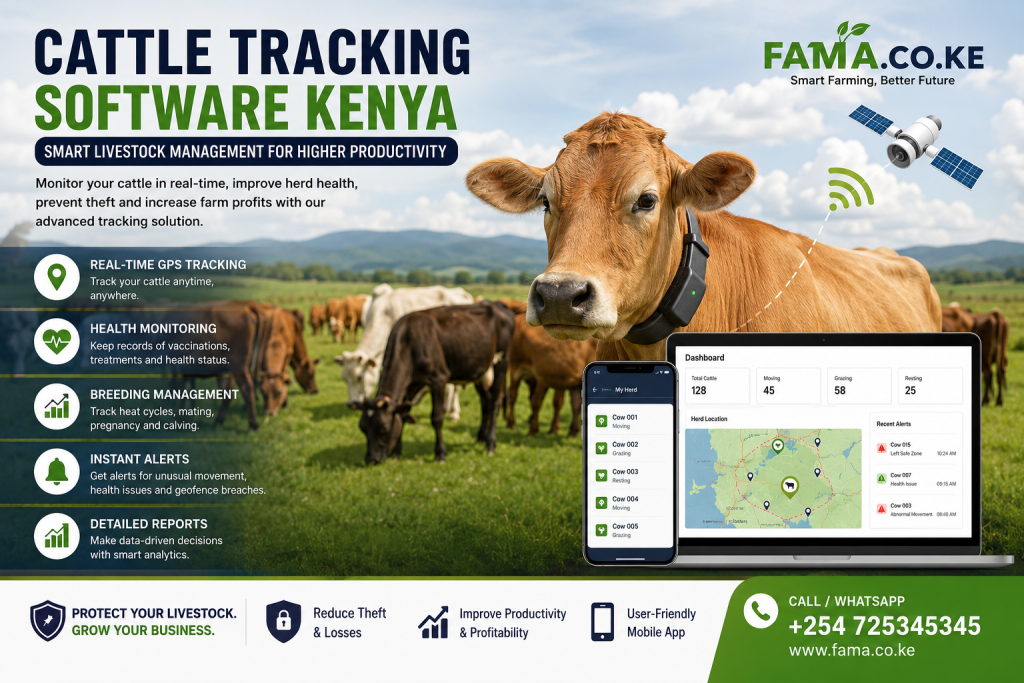
Introduction to Cattle Tracking Software Kenya
The agricultural sector in Kenya is rapidly evolving, and livestock farming is no longer just about traditional herd management. Today, farmers are adopting digital tools to improve productivity, reduce losses, and increase profitability. One of the most powerful innovations in this space is cattle tracking software Kenya.
cattle tracking software Kenya is a modern livestock management solution designed to help farmers monitor, manage, and optimize their cattle herds using digital technology such as GPS tracking, RFID tags, mobile applications, and cloud-based dashboards. With increasing challenges such as cattle theft, disease outbreaks, poor record keeping, and inefficient grazing management, this technology is becoming essential for both small-scale and large-scale farmers.
At fama.co.ke, we are committed to delivering agricultural solutions that transform farming into a more profitable and data-driven business. Our cattle tracking software Kenya solution is designed to meet the needs of Kenyan farmers across different regions and farming systems.
Why Cattle Tracking Software Kenya is Becoming Essential
The livestock industry in Kenya plays a major role in the economy, especially in counties like Nakuru, Laikipia, Kajiado, Uasin Gishu, and Narok. However, farmers continue to face challenges that reduce productivity and profitability.
Here are the key reasons why cattle tracking software Kenya is becoming increasingly important:
1. Prevention of Cattle Theft
Cattle theft remains a serious issue in many rural areas. With cattle tracking software Kenya, farmers can monitor real-time animal location using GPS-enabled devices attached to livestock, improving recovery chances significantly.
2. Improved Herd Management
Managing large herds manually is inefficient. The software allows farmers to track each animal individually and maintain structured digital records for identification, health, and performance.
3. Better Grazing Control
Overgrazing leads to land degradation and reduced productivity. The system helps farmers monitor movement patterns and manage grazing rotation effectively.
4. Disease Control and Health Monitoring
Early detection of disease is crucial. The system allows recording of symptoms, vaccination schedules, treatment history, and health alerts for each animal.
5. Increased Productivity
With cattle tracking software Kenya, farmers make data-driven decisions that improve milk yield, weight gain, and breeding efficiency.
How Cattle Tracking Software Kenya Works
Understanding how cattle tracking software Kenya operates helps farmers see its real value in daily farm management.
The system is built around four main components:
1. GPS Tracking Devices
Each cow is fitted with a GPS collar or ear tag that continuously transmits location data.
2. Mobile Application
Farmers can access herd information using a mobile application, making it easy to monitor livestock from anywhere.
3. Cloud-Based Dashboard
All livestock data is stored securely online, allowing farmers to view reports, analyze performance, and manage records.
4. Smart Alerts System
Automated alerts notify farmers about unusual movement, health risks, or unauthorized access.
5. Data Analytics Engine
The system processes livestock data to generate insights on productivity, breeding, feeding patterns, and farm efficiency.
Key Features of Cattle Tracking Software Kenya
A complete cattle tracking software Kenya system includes several important features designed for modern livestock farming:
Real-Time GPS Tracking
Provides accurate location monitoring of every animal.
Unique Animal Identification
Each cow is assigned a digital ID linked to its full history.
Health Records Management
Stores vaccination, treatment, and medical history.
Breeding and Reproduction Tracking
Helps farmers monitor heat cycles, pregnancy, and calving.
Milk Production Monitoring
Tracks daily milk output per cow for dairy farmers.
Offline Functionality
Ensures usage even in areas with poor internet connectivity.
Benefits of Using Cattle Tracking Software Kenya
The adoption of cattle tracking software Kenya provides multiple operational and financial benefits:
1. Reduced Farm Management Costs
Automates record keeping and reduces manual labor.
2. Better Decision Making
Real-time data enables informed farm management decisions.
3. Improved Livestock Security
Reduces the risk of theft through real-time monitoring.
4. Higher Farm Efficiency
Optimizes feeding, breeding, and grazing operations.
5. Increased Profitability
Improved productivity leads to better income generation.
Who Can Use Cattle Tracking Software Kenya?
This system is suitable for a wide range of livestock farmers, including:
- Small-scale farmers
- Large commercial ranches
- Dairy farms
- Beef production farms
- Cooperative societies
- Government livestock programs
Whether managing a small herd or a large commercial operation, cattle tracking software Kenya can be adapted to different farming needs.
Challenges Facing Livestock Farmers in Kenya
Before adopting cattle tracking software Kenya, it is important to understand the common challenges it helps solve:
1. Poor Record Keeping Systems
Many farms still rely on manual records that are prone to errors and loss.
2. Livestock Diseases
Delayed diagnosis and treatment often lead to losses.
3. Inefficient Grazing Practices
Uneven grazing leads to land degradation and reduced pasture quality.
4. Cattle Theft
Security remains a major concern for many farmers.
5. Low Productivity Levels
Without proper monitoring, underperforming animals go unnoticed.
How Fama.co.ke Supports Farmers with Cattle Tracking Software Kenya
At fama.co.ke, we develop smart agricultural systems designed specifically for Kenyan farmers. Our cattle tracking software Kenya platform is built to be simple, scalable, and practical for real farm conditions.
We help farmers:
- Digitize livestock records
- Improve herd visibility
- Reduce operational losses
- Enhance productivity
- Transition into smart farming systems
Why Cattle Tracking Software Kenya is the Future of Livestock Farming
Technology adoption in agriculture is growing rapidly across Africa. In Kenya, cattle tracking software Kenya is becoming a key driver of modernization in livestock farming.
As farms grow larger and markets become more competitive, data-driven farming is no longer optional—it is necessary for survival and growth.
System Architecture of Cattle Tracking Software Kenya
To understand the power behind cattle tracking software Kenya, it is important to look at how the system is built. The architecture is designed to ensure real-time monitoring, data accuracy, and scalability for farms of all sizes.
1. Device Layer (On-Animal Hardware)
This is the first layer of the system. Each cow is fitted with a tracking device such as:
- GPS collars
- RFID ear tags
- Smart sensors
These devices continuously collect data such as:
- Location
- Movement patterns
- Body temperature (advanced systems)
- Activity levels
This data is the foundation of cattle tracking software Kenya.
2. Network Layer (Data Transmission)
Once data is collected, it is transmitted using:
- Mobile networks (2G/3G/4G)
- IoT gateways in large farms
- Satellite connectivity in remote areas
This ensures that cattle tracking software Kenya works even in rural Kenya where connectivity is inconsistent.
3. Cloud Processing Layer
All data is sent to a secure cloud system where it is:
- Stored safely
- Processed in real-time
- Organized per animal profile
- Converted into usable insights
This layer is what makes cattle tracking software Kenya powerful for analytics and reporting.
4. Application Layer (User Access)
Farmers access the system through:
- Mobile apps (Android support included)
- Web dashboards
- SMS alerts for basic phones
This ensures every farmer can use cattle tracking software Kenya, regardless of technical skill level.
Real-Life Use Cases of Cattle Tracking Software Kenya
The adoption of cattle tracking software Kenya is already transforming farms across the country. Below are practical examples of how it is used.
1. Dairy Farms in Nakuru
Dairy farmers use the system to:
- Track high-yield cows
- Monitor milk production trends
- Detect early signs of illness
- Improve breeding schedules
This leads to increased milk output and better herd quality.
2. Ranches in Laikipia
Large ranches benefit from:
- Monitoring thousands of cattle over wide land
- Preventing cross-boundary movement
- Reducing manpower costs
- Improving grazing efficiency
Without cattle tracking software Kenya, managing such large herds would be extremely difficult.
3. Pastoralist Communities in Kajiado and Narok
Pastoral farmers use the system to:
- Locate lost cattle quickly
- Reduce theft cases
- Track seasonal migration patterns
- Protect livestock during drought periods
This is one of the biggest impacts of cattle tracking software Kenya in Kenya.
4. Cooperative Farming Groups
Groups use the system to:
- Share herd data among members
- Manage collective breeding programs
- Track performance of shared livestock assets
- Improve transparency in livestock ownership
Installation and Setup Process of Cattle Tracking Software Kenya
Setting up cattle tracking software Kenya is simple and does not require advanced technical knowledge.
Step 1: Farm Assessment
Experts assess:
- Herd size
- Farm location
- Connectivity strength
- Farming goals
This helps customize the system.
Step 2: Device Installation
Each cow is fitted with:
- A GPS collar or ear tag
- Unique digital ID
This ensures full integration into cattle tracking software Kenya.
Step 3: System Configuration
The software is configured to include:
- Farm name
- Herd categories (dairy, beef, breeding)
- User access levels
- Alert settings
Step 4: Training and Onboarding
Farmers are trained on:
- Using the mobile app
- Reading dashboards
- Responding to alerts
- Managing herd data
Step 5: Go-Live and Monitoring
Once activated, cattle tracking software Kenya begins real-time tracking immediately.
ROI (Return on Investment) of Cattle Tracking Software Kenya
One of the most important reasons farmers adopt cattle tracking software Kenya is the strong return on investment.
1. Reduced Theft Losses
Even recovering a single stolen cow can save tens of thousands of shillings.
2. Increased Milk Production
Health monitoring and breeding optimization increase daily milk yield.
3. Lower Veterinary Costs
Early disease detection reduces treatment costs.
4. Improved Feed Efficiency
Farmers can identify underperforming animals and optimize feeding.
5. Labor Savings
Less manual monitoring reduces staffing costs.
Overall, cattle tracking software Kenya pays for itself within a short period depending on herd size.
Challenges Solved by Cattle Tracking Software Kenya
This system is designed to solve real problems faced by Kenyan farmers:
- Uncontrolled livestock movement
- High theft rates in rural areas
- Poor breeding records
- Lack of health monitoring systems
- Inefficient grazing management
- Loss of animals due to drought migration
By solving these issues, cattle tracking software Kenya improves farm stability and profitability.
Advanced Features of Cattle Tracking Software Kenya
Modern versions of cattle tracking software Kenya include advanced technologies such as:
AI-Based Predictive Analytics
Predicts:
- Disease risks
- Optimal breeding time
- Milk production trends
Geofencing Technology
Farmers can set virtual boundaries. If cattle leave the area, alerts are triggered instantly.
Automated Reporting
Daily, weekly, and monthly reports are generated automatically.
Multi-Farm Management
Large agribusinesses can manage multiple farms from a single dashboard.
Integration with Market Systems
Some versions connect farmers directly to livestock buyers and markets.
SEO Keyword Integration Strategy (Cattle Tracking Software Kenya)
To ensure strong online visibility, the keyword cattle tracking software Kenya is naturally integrated across:
- Headings
- Subheadings
- Feature descriptions
- Use cases
- Technical explanations
- ROI sections
This improves ranking potential for search engines while keeping readability natural.
Practical Farm Workflow Using Modern Livestock Tracking Systems
In real-world farming operations, technology is only useful if it fits naturally into daily activities. Modern livestock tracking systems are designed to integrate seamlessly into routine farm workflows without requiring farmers to change everything they already do. Instead, they enhance existing processes by adding structure, visibility, and automation.
On a typical farm, the daily workflow begins early in the morning with herd inspection. Traditionally, farmers would physically walk through grazing fields or enclosures to check if all animals are present. With a digital tracking system, this process becomes significantly faster. Instead of manually counting animals, farmers can open a mobile dashboard and instantly confirm herd presence. This reduces time spent on basic checks and allows more focus on productive tasks.
Feeding management is another area that benefits greatly from structured tracking. Farmers can assign feeding schedules to specific groups of cattle based on age, weight, or production level. For example, lactating cows may require a different feeding plan compared to young calves or beef cattle. Instead of guessing or relying on experience alone, farmers can use recorded data to ensure each animal receives the correct nutrition. Over time, this leads to improved growth rates and better overall herd performance.
Watering routines can also be optimized using digital records. In larger farms, especially those with multiple grazing zones, it is common for some animals to access water more frequently than others. Tracking systems help identify movement patterns and ensure all animals have equal access to essential resources. This improves animal welfare and reduces stress within the herd.
Veterinary scheduling becomes more organized when all health data is stored in a centralized system. Farmers no longer need to rely on memory or scattered notebooks to track vaccination dates or treatment history. Instead, alerts can be generated automatically when an animal is due for vaccination or follow-up treatment. This reduces the risk of missed medical care and helps prevent disease outbreaks before they spread across the herd.
Breeding management also becomes more precise. By monitoring reproductive cycles, farmers can identify the best time for insemination or mating. This improves conception rates and reduces the time between calving cycles. Over multiple breeding seasons, this efficiency translates into higher productivity and more predictable herd growth.
One of the most important operational improvements is livestock movement control. In traditional systems, animals are often allowed to roam freely, especially in pastoral regions. While this is part of natural grazing practices, it also increases risks such as loss, theft, or crossing into unsafe areas. With structured monitoring, farmers can define safe grazing zones and track when animals move beyond expected boundaries. This allows quick response before losses occur.
Farm managers also benefit from centralized reporting. Instead of collecting information from multiple workers or supervisors, all data is automatically synchronized into a single system. This improves communication across farm teams and reduces misunderstandings. Decisions become faster because all stakeholders are working from the same set of information.
Another key advantage is performance comparison between animals. Over time, data reveals which cattle are performing well and which ones are underperforming. This helps farmers make decisions about selective breeding, selling, or adjusting feeding strategies. It also encourages more efficient herd improvement practices because decisions are based on data rather than assumptions.
Financial planning becomes more accurate when livestock data is properly recorded. Farmers can estimate expected milk production, forecast sales, and plan for seasonal changes in feed costs. This level of planning was previously difficult without structured records. With better forecasting, farmers can reduce waste and improve profitability.
In large-scale operations, workforce management is also improved. Supervisors can assign tasks to workers such as feeding, cleaning, or medical checks, and then verify completion through system updates. This increases accountability and ensures that farm operations run smoothly even when the owner is not physically present.
Over time, the accumulated data creates a powerful historical record of the entire farm. This long-term dataset becomes valuable for making strategic decisions such as expanding herd size, introducing new breeds, or investing in infrastructure. It also helps when seeking loans or partnerships, as the farm can demonstrate clear performance records.
Overall, integrating digital livestock management into everyday farm operations creates a more structured, predictable, and efficient farming environment. It shifts livestock farming from a reactive system—where problems are addressed after they occur—to a proactive system where issues are identified and solved early.
Future Developments of Cattle Tracking Software Kenya
The future of cattle tracking software Kenya is expected to include:
- Drone-assisted livestock monitoring
- Blockchain-based livestock ownership records
- AI-driven disease prediction systems
- Smart feeding automation
- Integration with national livestock databases
As Kenya continues adopting smart agriculture, cattle tracking software Kenya will become a standard tool in modern farming.
Final Conclusion: Cattle Tracking Software Kenya for Smart Farming in Kenya
The adoption of cattle tracking software Kenya marks a major shift in how livestock farming is managed across the country. From small dairy farms to large commercial ranches and pastoral communities, this technology provides real-time visibility, improved security, and data-driven decision-making that significantly increases productivity and profitability.
With challenges such as cattle theft, disease outbreaks, poor record keeping, and inefficient grazing practices continuing to affect farmers, digital solutions like cattle tracking software Kenya are no longer optional—they are essential for survival in a competitive agricultural economy.
At fama.co.ke, we are committed to helping farmers transition into smart farming systems that improve efficiency, reduce losses, and maximize returns. Our solution is built specifically for Kenyan farming conditions, making it practical, affordable, and easy to use for all types of livestock farmers.
For more information or to get started with cattle tracking software Kenya, contact us today:
📞 +254 725345345
🌐 fama.co.ke