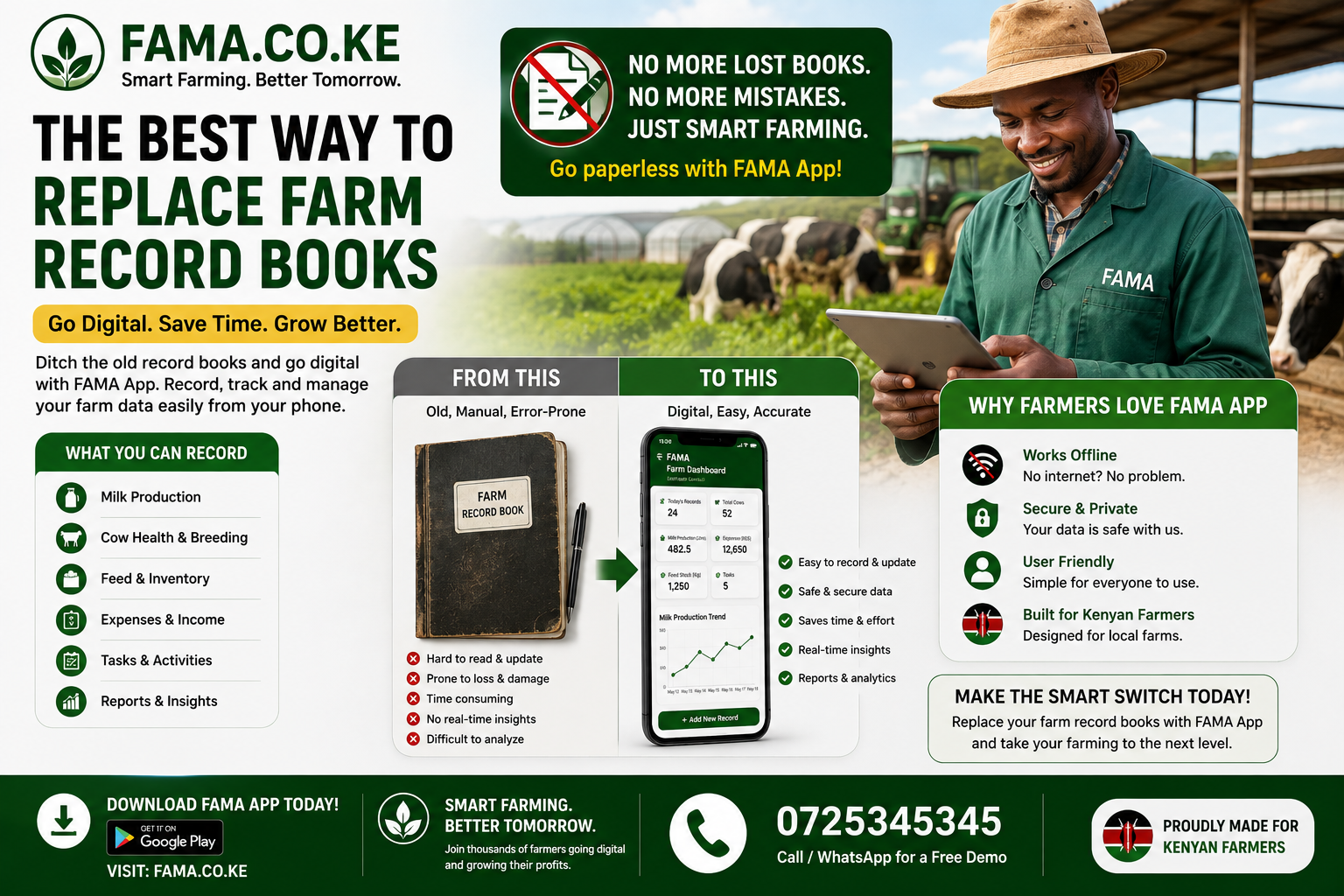
Managing a farm involves hundreds of small activities. Seeds are purchased, fertilizer is issued, workers are assigned tasks, machinery is used, livestock is monitored, crops are harvested, produce is sold, and expenses are paid. When all these activities are written in notebooks, store books, diaries, receipt books, or loose sheets of paper, managing the information becomes increasingly difficult as the farm grows.
The traditional farm record book has served farmers for many years. It provides a simple way to write down what happened on the farm. However, paper records can become difficult to search, compare, update, secure, and use for management decisions.
Modern farmers are therefore looking for practical ways to move from paper records to organized digital systems.
A digital farm management system can bring operational and financial information into one workspace. FAMA, for example, is designed to manage crop and livestock records, inputs, stock, machinery, labour, salaries, harvests, production, sales, accounting, and reports from a centralized farm workspace.
The transition does not mean that a farmer must abandon good record-keeping practices. Instead, it means moving the same useful information into a system that makes it easier to organize, retrieve, analyze, and share.
This guide explains how Kenyan farmers can make that transition, what records should be digitized first, how to prepare farm staff, and how a digital farm management system can improve visibility and accountability.
best way to replace farm record books: Why Paper Records Become Difficult as Farms Grow
Paper records are not necessarily bad.
For a very small farm with limited activities, a notebook can be affordable and easy to understand. A farmer can write down purchases, harvest quantities, worker attendance, sales, and expenses.
The challenge begins when the number of records increases.
A growing farm may have separate books for:
- Input purchases
- Fertilizer usage
- Seed purchases
- Worker attendance
- Labour payments
- Harvest quantities
- Produce sales
- Buyer balances
- Livestock records
- Machinery
- Fuel
- Expenses
- Income
- Leased land
- Supplier information
The farmer may eventually have several notebooks covering different periods.
Finding one specific transaction can then take time.
For example, imagine an owner wants to determine how much fertilizer was purchased during the previous season. The information may be spread across several pages, supplier invoices, receipts, and notebooks.
A digital system changes the process by allowing structured information to be stored in one location.
The objective is not simply to eliminate paper. The objective is to make farm information more accessible and useful.
best way to replace farm record books: Identify Which Records Need to Move First
Farmers should not attempt to digitize every historical document on the first day.
A better approach is to identify the records that are most important to daily management.
These commonly include:
Farm activity records
These show what happened on the farm and when.
Input records
These cover seeds, fertilizer, chemicals, animal feed, and other inputs.
Labour records
These show who worked, when they worked, and what they were paid.
Harvest records
These show what was produced, the quantity, and the relevant field or farming period.
Sales records
These show buyers, quantities sold, prices, and payment status.
Expense records
These capture the money spent on farm operations.
Inventory records
These show what is available, what has been used, and what needs replenishment.
Livestock records
These can include animals, groups, health activities, production, buyers, and livestock sales.
FAMA currently provides modules covering these major operational areas, including inputs, inventory, staff, harvests, livestock, accounting, and reports.
best way to replace farm record books: Start With Current Farm Records
One of the easiest ways to begin is to digitize current records rather than trying to immediately enter many years of historical information.
Choose a specific starting date.
From that date onward, every major farm activity should be entered into the digital system.
For example, if a farm starts digital record keeping on January 1, the team can begin recording:
- January input purchases
- January labour
- January expenses
- January harvests
- January sales
- January livestock activities
- January stock movements
This approach creates a clean starting point.
Older records can then be retained for reference or gradually entered when necessary.
The farm does not need to wait until every old notebook has been digitized before beginning.
best way to replace farm record books: Create a Farm Record Digitization Plan
A transition plan makes the process easier for everyone.
The farm owner should identify:
- Which records are currently used.
- Who maintains each record.
- How frequently the record is updated.
- Which records are most important.
- Which records should be digitized first.
- Who will enter information into the new system.
- Who will review the records.
- How often reports will be checked.
A simple plan might look like this:
Week One: Set up the farm, fields, crops, livestock, and users.
Week Two: Add inputs, suppliers, inventory, and current stock.
Week Three: Start recording workers, attendance, expenses, and payments.
Week Four: Add harvests, sales, buyers, and reporting routines.
The exact timeline depends on the size of the farm.
The important point is to introduce the system in a controlled manner rather than overwhelming the farm team.
best way to replace farm record books: Move Input Records From Paper to Digital
Inputs are among the most important records to digitize.
A farm may purchase:
- Fertilizer
- Seeds
- Chemicals
- Animal feed
- Veterinary supplies
- Packaging materials
- Tools
- Other agricultural supplies
Paper records can show that something was purchased, but they may not clearly show where the input was used.
Digital records can connect purchases with stock and usage.
FAMA’s current features include input purchases, supplier details, stock balances, and input usage for owned fields or rented leases.
This creates better accountability.
If fertilizer is purchased, the farm can record the quantity received.
When fertilizer is issued, the farm can record how much was used.
The remaining stock can then be monitored.
This makes it easier to identify unusual consumption, shortages, or over-issuing.
best way to replace farm record books: Digitize Worker Attendance and Labour Records
Labour can represent a significant farm expense.
Many farms employ permanent workers, casual labourers, supervisors, drivers, security personnel, and specialized workers.
Paper attendance books can become difficult to reconcile with payments.
A digital system can organize staff information and attendance in one place.
FAMA includes staff profiles, attendance, salaries, advances, and payroll reporting within its farm management functionality.
This can help answer questions such as:
- How many workers were present?
- How many days did a worker work?
- What salary is due?
- Was an advance given?
- What labour cost was associated with a particular period?
When labour information is structured, payroll administration becomes easier to review.
best way to replace farm record books: Replace Harvest Notebooks With Digital Harvest Records
Harvest information is another area where paper records can create challenges.
A farm may harvest hundreds or thousands of kilograms of produce.
The team may record quantities in different books.
The buyer may have another record.
The owner may receive a WhatsApp message with the final quantity.
These fragmented records make reconciliation difficult.
Digital harvest records can organize:
- Farming period
- Crop
- Harvest quantity
- Remaining stock
- Buyer
- Sales
- Value
FAMA’s current platform includes harvest records, harvest stock, harvest sales, buyers, and reporting.
This helps the farm connect production with sales.
best way to replace farm record books: Connect Sales With Buyer Records
A farm does not simply produce crops or livestock.
It also needs to sell them.
Buyer management becomes increasingly important when the farm works with several customers.
For example, a horticultural farm may sell to:
- Local traders
- Supermarkets
- Exporters
- Processors
- Cooperatives
- Brokers
- Direct consumers
Paper records can make it difficult to determine which buyer has paid and which buyer still owes money.
A digital record can provide a clearer history of sales and balances.
The farmer can then review transactions by date, buyer, product, quantity, and value.
This makes follow-up easier and improves financial visibility.
best way to replace farm record books: Digitize Farm Expenses
Expenses are often underestimated when records are kept manually.
Small purchases can be forgotten.
Transport payments may not be recorded immediately.
A worker may receive an advance that is documented separately from the payroll book.
Fuel may be recorded in another notebook.
These small gaps can eventually create significant differences.
A digital expense record can organize spending by:
- Date
- Expense category
- Amount
- Description
- Supplier
- Farming period
- Relevant farm activity
FAMA includes expenses, income, cashbook entries, profit/loss information, and financial reports.
This makes it easier to compare money coming into the farm with money leaving the farm.
best way to replace farm record books: Use a Centralized Farm Management System
The biggest limitation of using several notebooks is fragmentation.
One book contains expenses.
Another contains workers.
Another contains inputs.
Another contains harvests.
Another contains sales.
A centralized farm management system brings these records together.
FAMA describes its Farm Management System as an operational record center that brings together information that would otherwise be scattered across notebooks, Excel files, WhatsApp messages, receipts, invoices, payroll lists, store books, and memory.
This centralized approach is useful because farm activities are connected.
Inputs affect production.
Labour affects costs.
Harvests affect sales.
Sales affect income.
Expenses affect profitability.
When the records are connected, the owner gets a broader picture of farm performance.
best way to replace farm record books: Give Each Farm Worker a Clear Role
Digital transformation works best when responsibilities are clear.
The owner does not necessarily need to enter every transaction.
Different people can manage different parts of the farm.
For example:
Farm Manager
Can supervise fields, leases, inputs, machinery, harvests, and daily operations.
Accountant
Can manage income, expenses, salaries, advances, and financial reports.
Store Keeper
Can manage stock, purchases, and stock issues.
Staff Supervisor
Can manage attendance and labour records.
FAMA currently supports role-based access for farm owners, managers, accountants, store keepers, and staff supervisors.
This reduces the need for one person to handle every record.
best way to replace farm record books: Train Employees Before Making the Change
Some workers may initially resist digital systems.
This does not necessarily mean that the system is unsuitable.
They may simply be accustomed to notebooks.
Training should therefore be practical.
Show workers:
- How to access their assigned area
- How to enter information
- How to review an entry
- How to identify an error
- Who to contact when something is unclear
- Why accurate records matter
Training should use actual farm examples.
Instead of explaining a feature abstractly, demonstrate how a fertilizer purchase is recorded or how attendance is entered.
This makes the transition easier.
best way to replace farm record books: Establish Daily Digital Recording Habits
The transition will only succeed if records are maintained consistently.
A farm should establish a routine.
For example:
Morning
Record attendance and planned activities.
During the day
Record input usage, machinery activities, and other important transactions.
After work
Update labour and activity records.
At harvest
Record quantities.
After sales
Record buyers, quantities, prices, and payments.
End of day
Review missing records.
This routine creates discipline.
Digital software is most useful when it reflects actual farm activity.
best way to replace farm record books: Preserve Important Historical Information
Replacing notebooks does not mean destroying them.
Older farm books may contain valuable historical information.
They can show:
- Previous crop performance
- Historical input prices
- Past yields
- Buyer relationships
- Previous expenses
- Livestock history
- Seasonal patterns
Farmers can keep old records safely while starting a new digital system.
Important historical information can then be entered gradually.
This is particularly useful when comparing current performance with previous seasons.
best way to replace farm record books: Avoid Digitizing Bad Information
One important point is often overlooked.
Digitizing information does not automatically make it accurate.
If the old notebook contains incorrect quantities, duplicate entries, missing dates, or unclear transactions, simply copying those records into software will transfer the same problems.
Before migrating historical records, review them.
Check:
- Dates
- Quantities
- Names
- Prices
- Totals
- Duplicates
- Missing information
Clean information creates better digital records.
best way to replace farm record books: Standardize Units and Categories
Different workers may use different descriptions.
One person might write:
“DAP”
Another might write:
“DAP fertilizer”
Another might write:
“Fertilizer DAP.”
Digital systems work better when the farm establishes standard names.
The same applies to:
- Kilograms
- Litres
- Acres
- Bags
- Crates
- Animals
- Crops
- Expense categories
Standardization makes reports easier to interpret.
It also reduces confusion when comparing different periods.
best way to replace farm record books: Replace Loose Receipts With Organized Expense Records
Receipts are important evidence of spending.
However, receipts can fade, tear, disappear, or become mixed together.
A farm should establish a process for recording each expense promptly.
For example:
- Purchase is made.
- Receipt is collected.
- Expense is recorded.
- Relevant farm activity is identified.
- Receipt is stored appropriately.
- Expense appears in the financial records.
This creates a stronger audit trail.
It also makes it easier for the owner to understand where money is being spent.
best way to replace farm record books: Track Machinery Digitally
Machinery records can become complicated.
A farm may have:
- Tractors
- Harvesters
- Motorbikes
- Pumps
- Vehicles
- Implements
- Other equipment
Paper records may not provide a clear picture of service history and operating costs.
FAMA’s machinery module supports tractors, harvesters, drivers, service records, spare parts, fuel, and maintenance-related information.
Digital machinery records can help farmers monitor:
- Service dates
- Fuel use
- Repairs
- Drivers
- Spare parts
- Operating costs
This can reduce the risk of missed maintenance.
best way to replace farm record books: Monitor Inventory Without Store Books
The farm store is another area that can benefit significantly from digitization.
The store may contain:
- Fertilizer
- Seeds
- Chemicals
- Tools
- Spare parts
- Packaging
- Animal feed
A store book can record purchases and issues, but manual calculations can become difficult as activity increases.
Digital inventory management can make it easier to see:
- Current stock
- Purchases
- Usage
- Low-stock items
- Stock value
- Remaining quantities
FAMA’s current feature set includes inventory, stock balances, low-stock alerts, tools, spare parts, and harvest stock.
best way to replace farm record books: Use Reports Instead of Searching Through Notebooks
One of the greatest benefits of digital records is reporting.
Instead of opening several books, a farm owner can review summarized information.
Useful reports can include:
- Input reports
- Stock reports
- Harvest reports
- Sales reports
- Expense reports
- Income reports
- Labour reports
- Machinery reports
- Fuel reports
- Profit/loss reports
FAMA’s current reporting module includes lease, stock, usage, machinery, service, fuel, staff, salary, attendance, expense, income, profit/loss, harvest, and seasonal reports.
Reports transform raw records into information that can support decisions.
best way to replace farm record books: Compare Seasons Using Digital Data
A farmer should not only ask whether the farm made money.
The farmer should ask why.
Digital records can help compare seasons.
For example:
Season One
- Input cost: high
- Harvest: moderate
- Selling price: low
- Profit: limited
Season Two
- Input cost: controlled
- Harvest: higher
- Selling price: improved
- Profit: stronger
The comparison may reveal which management changes contributed to better performance.
This is much harder to do with disconnected paper records.
best way to replace farm record books: Make Farm Records Accessible to Authorized Users
Paper notebooks usually exist in one physical location.
If the farm manager has the book, the owner may need to wait to see it.
If the book is lost, access is interrupted.
A digital platform can provide authorized users with access to relevant information according to their roles.
This is particularly useful for farms where owners live away from the farm.
The owner can review reports while the farm manager handles daily activities.
FAMA is designed with role-based access and farm-account isolation.
best way to replace farm record books: Improve Accountability Between Farm Teams
Accountability is difficult when records are unclear.
Suppose fertilizer is missing from the store.
A paper book may show that fertilizer was issued, but the information may be incomplete.
A digital record can provide a structured history of purchases and usage.
The same principle applies to:
- Fuel
- Machinery
- Labour
- Harvests
- Sales
- Cash
- Stock
When responsibilities and records are clear, it becomes easier to identify where an issue occurred.
best way to replace farm record books: Reduce Dependence on Memory
Farm management involves many decisions.
An owner may remember that a particular field performed well last season.
But memory may not accurately show how much fertilizer was used, how many labour days were required, or how much the harvest sold for.
Digital records provide evidence.
Instead of asking:
“Was this field profitable?”
the owner can review:
- Inputs
- Labour
- Harvest
- Sales
- Expenses
- Profit
This moves farm management from memory-based decision-making toward evidence-based management.
best way to replace farm record books: Improve Communication Between Farm Owners and Managers
Many farms rely on phone calls and messaging applications for updates.
Communication tools are useful, but they are not always ideal for permanent records.
A message such as:
“Today we harvested 400 bags.”
may be buried in a long conversation.
A structured digital record remains associated with the relevant farm activity.
Communication can still happen through messaging, but the official record should be maintained in the farm management system.
This creates a stronger source of truth.
best way to replace farm record books: Use Digital Records for Remote Farm Supervision
Remote farm supervision is one of the areas where digitization can have a significant impact.
An owner who lives in Nairobi while the farm is located elsewhere may not visit every day.
Without structured records, the owner may depend heavily on verbal reports.
A digital system can provide access to:
- Farm activity
- Stock
- Harvests
- Sales
- Expenses
- Staff
- Reports
FAMA is designed to give farm teams a centralized workspace for operational and financial records.
This can make remote supervision more practical.
best way to replace farm record books: Keep Farm Data Secure
Farm records contain commercially valuable information.
They may show:
- Production
- Costs
- Sales
- Suppliers
- Buyers
- Employee information
- Financial performance
- Land arrangements
Security should therefore be considered during digitization.
FAMA states that it uses authenticated access, role-based access, validated forms, and tenant isolation to keep farm accounts separated.
Farm owners should also ensure that employees use appropriate passwords and that access is removed when someone leaves the organization.
best way to replace farm record books: Keep a Transition Backup
During the transition, do not immediately destroy old notebooks.
Keep them safely until the farm is confident that important information has been captured digitally.
A sensible transition process is:
Paper records → Review → Clean information → Digital entry → Verification → Continued digital recording
This creates a safety net.
Once the digital process has been tested and the farm is satisfied with its records, older documents can be archived according to the farm’s needs.
best way to replace farm record books: Explore FAMA’s Farm Management Features
FAMA’s current feature set covers multiple areas of farm operations.
These include:
- Farming periods
- Fields
- Leases
- Crops
- Livestock
- Harvests
- Inputs
- Input usage
- Machinery
- Fuel
- Staff
- Attendance
- Salaries
- Inventory
- Accounting
- Income
- Expenses
- Reports
The platform connects these areas within one farm account.
This makes it possible for a farm to move beyond replacing one notebook at a time and instead create a complete digital record environment.
best way to replace farm record books: Learn Which Farm Records Matter Most
Farm records should not exist simply because someone says farmers need records.
Each record should serve a management purpose.
A useful record should help answer a question.
For example:
Input record: What did we buy and where was it used?
Labour record: Who worked and what did the labour cost?
Harvest record: How much did we produce?
Sales record: What did we sell and to whom?
Expense record: Where did money go?
Inventory record: What do we still have?
Financial report: Are we making or losing money?
FAMA’s published farm-record guidance emphasizes land and field records, input and labour records, harvests, sales, buyer balances, expenses, and practical digital accountability.
best way to replace farm record books: Turn Farm Records Into Management Reports
Recording information is only the beginning.
The farm should regularly turn records into reports.
Reports can show:
- Spending
- Production
- Harvest
- Sales
- Buyer balances
- Labour
- Inventory
- Profitability
- Seasonal performance
FAMA’s farm reports guide explains that reports help owners see patterns and act on information from inputs, workers, harvests, sales, expenses, machinery, and buyer balances.
This makes digital records much more valuable than simply storing information.
best way to replace farm record books: Understand the Difference Between Software and a Spreadsheet
A spreadsheet can be useful for some farms.
However, a farm management system is designed around farming workflows.
A spreadsheet may require the farmer to create formulas, tables, categories, and reports manually.
A farm management platform provides structured modules for activities such as:
- Inputs
- Stock
- Staff
- Harvests
- Livestock
- Machinery
- Accounting
- Reports
FAMA describes its system as a centralized operational record center for farms, helping connect information that would otherwise be scattered across notebooks, spreadsheets, messages, receipts, and other sources.
The appropriate choice depends on the farm’s size and complexity.
best way to replace farm record books: Know When Your Farm Has Outgrown Paper
Certain signs indicate that paper records are becoming difficult to manage.
These include:
- Multiple farm notebooks
- Frequent missing records
- Difficulty finding old information
- Unclear stock balances
- Unexplained expenses
- Confusion about worker payments
- Difficulty calculating profitability
- Delayed reports
- Buyer balances that are not followed up
- Frequent disagreements about quantities
- Owner dependence on verbal updates
When these problems become common, digitalization may be worth considering.
The purpose is not technology for its own sake.
The purpose is to improve control.
best way to replace farm record books: Consider the Cost of Manual Record Keeping
Farmers often compare the cost of software with the subscription price.
However, the true cost of paper records can include:
- Time spent searching
- Duplicate data entry
- Lost records
- Incorrect calculations
- Stock losses
- Unrecorded expenses
- Missed buyer payments
- Poor planning
- Management time
FAMA’s current pricing page lists a Standard Plan at KES 3,750 per month when billed quarterly at KES 11,250, with the plan covering one farm workspace and modules including leases, inputs, machinery, staff, harvests, inventory, and reports.
Farmers should review the current pricing and included features before making a subscription decision.
best way to replace farm record books: Make the Digital System Simple for Workers
A complicated process is unlikely to survive on a busy farm.
Workers should not have to navigate unnecessary steps to record a routine activity.
The farm should define simple procedures.
For example:
Input issued
Select input → enter quantity → select destination → save.
Harvest recorded
Select crop → enter quantity → select farming period → save.
Expense recorded
Select category → enter amount → add description → save.
Simple workflows encourage consistent use.
best way to replace farm record books: Review Records Weekly
Even with software, management review remains important.
The owner or manager should schedule a weekly review.
Check:
- New expenses
- Input usage
- Stock balances
- Worker attendance
- Harvest quantities
- Sales
- Buyer balances
- Machinery activity
Weekly review catches mistakes early.
It also prevents the digital system from becoming another place where information is stored but never used.
best way to replace farm record books: Use Farm Reports for Better Planning
Once records are digital, the farm can use historical data for planning.
Before planting, review previous input costs.
Before hiring labour, review previous labour requirements.
Before purchasing machinery, review machinery expenses.
Before selecting buyers, review previous sales and payment history.
Before expanding livestock, review production and operating costs.
This creates a cycle:
Record → Review → Learn → Plan → Act → Record Again
That cycle is one of the strongest benefits of organized farm management.
best way to replace farm record books: Digitize Farm Transport and Fuel Records
Transport costs can be overlooked.
A farm may pay for:
- Produce transportation
- Input delivery
- Fuel
- Vehicle maintenance
- Tractor operations
- Driver services
These costs should be recorded because they contribute to production expenses.
FAMA’s machinery and fuel features include tractors, drivers, service records, spare parts, fuel, and related reports.
This helps the owner understand the cost of moving inputs and produce.
best way to replace farm record books: Keep Digital Records for Livestock Operations
Crop farms are not the only operations that benefit from digitization.
Dairy, poultry, beef, and mixed farms also have many records.
These may include:
- Animal identification
- Herd groups
- Health activities
- Production
- Buyers
- Sales
FAMA includes livestock management covering animal records, groups, health activities, production quantities, buyers, and sales value.
This allows farms with both crop and livestock operations to manage different activities from the same workspace.
best way to replace farm record books: Digitize Leased Land Records
Some farmers operate on rented land.
Lease records may include:
- Field name
- Acreage
- Landlord
- Price per acre
- Total lease value
- Amount paid
- Balance
- Location
- Season
- Expiry
Keeping these details in a notebook can make payment and expiry monitoring difficult.
FAMA’s current lease module supports rented field information, acreage, pricing, payments, balances, locations, years, seasons, and expiry alerts.
This makes land management another area where digital records can reduce confusion.
best way to replace farm record books: Track Remaining Produce After Harvest
Harvesting does not always mean immediate sale.
Produce may remain in storage.
The farm therefore needs to distinguish between:
Harvested quantity
and
Quantity sold
and
Remaining stock
This is important for crops that can be stored.
A digital system can help the farmer understand how much produce remains available for future sale.
FAMA includes harvest stock and harvest sales within its current farm-management functionality.
best way to replace farm record books: Monitor Farm Performance From One Dashboard
A dashboard can provide a quick overview of the farm.
Instead of checking multiple notebooks, the owner can review key figures such as:
- Net profit
- Stock value
- Active staff
- Lease balances
- Input readiness
- Machinery service status
- Low-stock alerts
FAMA’s current dashboard provides operational indicators and alerts for farm management.
This is particularly useful for owners who want a quick understanding of the farm before examining detailed reports.
best way to replace farm record books: Make Digital Records Part of Farm Culture
Technology alone cannot improve a farm.
The farm team must develop a culture of recording.
Workers should understand that:
If it was purchased, record it.
If it was issued, record it.
If someone worked, record it.
If something was harvested, record it.
If something was sold, record it.
If money was spent, record it.
If money was received, record it.
This simple discipline can transform the quality of management information.
best way to replace farm record books: Keep Financial and Operational Records Together
A common weakness of traditional farm management is separating financial records from operational records.
The accountant may know how much was spent.
The farm manager may know how much was produced.
The storekeeper may know how much stock remains.
The owner may know how much was sold.
But if these records are disconnected, no one sees the complete picture.
A centralized system can connect the different responsibilities.
FAMA combines operational modules with accounting and reporting functionality.
This supports a more complete understanding of farm performance.
best way to replace farm record books: Keep Farm Records Ready for Growth
A farm may begin with ten workers and later have fifty.
It may begin with one field and later operate across multiple fields.
It may sell to one buyer and eventually supply several customers.
The record-keeping system should be able to accommodate growth.
If the farm continues adding notebooks every time operations expand, administration becomes increasingly difficult.
Digital systems can provide a more scalable structure.
FAMA is designed to support multiple farm roles and broad operational modules within a structured farm account.
best way to replace farm record books: Know the Benefits Farmers Should Expect
A successful transition should produce measurable improvements.
Farm owners should expect better:
- Record accessibility
- Accountability
- Stock visibility
- Expense tracking
- Labour management
- Harvest tracking
- Sales tracking
- Financial reporting
- Seasonal comparison
- Decision-making
The goal should always be better management.
If digitization creates more work without improving visibility, the process needs to be reviewed.
best way to replace farm record books: Create a Simple Digital Record Policy
A farm can create a short internal policy.
For example:
Rule One: Record transactions on the day they happen.
Rule Two: Do not share user accounts.
Rule Three: Use approved names and units.
Rule Four: Review records weekly.
Rule Five: Report errors immediately.
Rule Six: Keep supporting documents for major transactions.
Rule Seven: Restrict access according to responsibilities.
A simple policy helps workers understand what is expected.
best way to replace farm record books: Make the Transition Gradual
Some farmers may worry that moving from paper to digital systems will disrupt operations.
A gradual transition can reduce that risk.
Start with one area.
For example, begin with input and inventory management.
Once the team becomes comfortable, add labour.
Then add harvests and sales.
Then accounting and reports.
This allows employees to learn gradually.
Eventually, the farm can operate with a much more complete digital record system.
best way to replace farm record books: Build One Reliable Farm Information Center
The long-term objective is to have one trusted place for farm information.
Instead of asking:
“Where is the notebook?”
“Who has the spreadsheet?”
“Did the manager record that payment?”
“Where is the stock book?”
“Which WhatsApp message had the harvest figure?”
the owner should be able to access the relevant record from the farm system.
FAMA is designed around this centralized approach, bringing crop and livestock operations, stock control, machinery, staff, accounting, sales, production, and reports into one farm workspace.
That is the real value of digital farm management.
best way to replace farm record books: Start the Transition From Paper Today
Replacing paper-based records does not require changing every farm process overnight.
The process can start with one record.
Choose the most important activity.
Set a standard procedure.
Train the responsible worker.
Begin recording consistently.
Review the information every week.
Then expand the system to other parts of the farm.
Farmers who want to explore a centralized digital system can review the FAMA Farm Management System, FAMA Features, FAMA Farm Records guide, FAMA Farm Reports guide, and current FAMA Pricing.
The transition from notebooks to digital records is ultimately about improving visibility.
A farm that knows what it purchased, what it used, what it produced, what it sold, what it spent, what it still owns, and what it earned is in a much stronger position to make informed decisions.
Paper books can document the past.
A well-organized digital farm management system can help farmers use that information to manage the present and plan what comes next.