Beekeeping record keeping is the habit of writing down everything that happens in your apiary, from the day you hang your first hive to the day you bank the money from your last honey sale. Many Kenyan beekeepers own productive hives yet cannot state their cost per kilogram of honey, their yield per hive, or which apiary sites outperform the rest. Without written numbers, every decision rests on memory, and memory fails quickly once you manage more than a handful of colonies.
This is why beekeeping record keeping separates commercial honey farmers from hobbyists. It tells you which colonies to split, which queens to replace, which sites to avoid, and whether the enterprise is actually paying you. Honey is one of the few farm products you can store and sell without a cold chain, yet the business still collapses quietly when hives abscond and nobody knows why.
This guide explains beekeeping record keeping in full: what to record, why each record matters, how to design templates you will actually use, and how digital tools can carry the workload for you. The principles fit five traditional log hives in Baringo just as well as five hundred Langstroth boxes in Kiambu.
Cost is the other silent killer. Frames, feed, transport, jars and labour leak money in small amounts that feel harmless, yet the season’s account can still close at a loss. Written numbers make those leaks visible while they are still repairable.
1. What Should You Record When You Keep Bees?
Beekeeping record keeping covers every piece of information you collect about colonies, equipment, people and money. It includes hive inventories, inspection notes, harvest weights, treatment logs, feeding dates, sales receipts and expense vouchers. Together, these documents form the memory of your apiary.
A complete system tracks four areas: the colonies themselves, the inputs you apply, the outputs you harvest, and the cash moving in and out. When beekeeping record keeping covers all four, you can trace any jar of honey back to the hive, the season and the worker who handled it.
The right level of detail depends on scale. A hobbyist with three hives can manage with a notebook and a simple harvest log. A commercial operator, however, needs structured beekeeping record keeping so that employees, inspectors and buyers can all read the same data without asking you.
Think of your records as the management brain of the apiary. The bees make the honey, but the records tell you whether that honey made money. Without them you are farming blindfolded and celebrating harvests you cannot cost.
2. Why Written Records Matter in Apiculture
Bees hide their problems, which is the strongest argument for beekeeping record keeping. A colony can stay queenless for weeks before a casual eye notices, and absconding bees leave no warning signs. Written inspection notes expose patterns that memory never catches.
Records also protect your income. When you know your average yield per hive per season, you can price honey correctly, plan cash flow and detect theft immediately. Farmers who commit to beekeeping record keeping often discover that a minority of hives produces most of the harvest, which shows exactly where to concentrate effort.
Documentation also opens doors. Honey buyers, exporters, county trade officers and microfinance lenders all ask for evidence before they commit money, and beekeeping record keeping supplies that evidence in a form they trust. A complete paper trail makes certification, loans and supply contracts possible instead of painful.
Consider the farmer in Kitui who lost twelve colonies to absconding over two seasons and blamed the drought. His neighbour, who kept dated inspection notes, discovered the losses followed every harvest taken without leaving adequate stores. Same drought, different information, different outcome.
3. Hive and Apiary Inventory Records
Start with a master list of every hive you own. For each hive record a unique ID, the hive type (Langstroth, Kenya top bar or log hive), date installed, source of the colony, apiary site and current status. Beekeeping record keeping starts here, because you cannot track what you have not listed.
Keep an apiary map alongside the list. Note distances between hives, water sources, shade, wind exposure and nearby flowering plants. A mapped apiary makes beekeeping record keeping faster during inspections, because every observation can be pinned to an exact hive instead of “the box near the tree”.
Update the inventory whenever anything changes: a colony absconds, you split a hive, you move boxes between sites, or pests destroy a hive. An inventory that is updated lazily defeats the purpose of beekeeping record keeping, so make every update on the same day the change happens.
Include the small details that seem obvious today and mysterious next year: which stand the hive sits on, whether it carries a queen excluder, and when the combs were last replaced. Wood rots, boxes crack and stands tilt, so the register should reflect reality rather than the original purchase list.
4. Colony Inspection Records
Inspection records are the heartbeat of the system. During every visit capture colony strength, brood pattern, queen presence, eggs, stored nectar and pollen, comb condition, and any signs of pests or disease. Consistent beekeeping record keeping at inspection time turns a quick look into usable data.
Use a one-page inspection card per hive, or a mobile form if you work digitally. Score colony strength on a simple one-to-five scale so trends stay visible across months. Structured notes make beekeeping record keeping comparable between workers, seasons and apiaries.
Frequency matters more than depth. Inspect every seven to fourteen days during active seasons and monthly in dearth periods. Skipping inspections and then reconstructing events from memory is the most common failure of beekeeping record keeping among smallholders.
Photographs strengthen inspection notes enormously. A picture of a spotty brood pattern or a beetle running across comb gives you evidence to compare over time. Date-stamped hive photos also protect you when workers inspect in your absence.
Keep doubtful observations in the notes too. Writing “not sure whether the queen is present” is better data than leaving the field blank, because doubt recorded today becomes the specific question answered at the next inspection.
5. Queen and Colony Multiplication Records
The queen determines the productivity of the colony, so track her individually: source, date introduced, marking colour, temperament, brood pattern and replacement date. Detailed beekeeping record keeping at queen level shows you which bloodlines are aggressive, which swarm often, and which deliver honey.
Record every split, catch and swarm capture. Note the parent colony, the date, the new hive location, and how the daughter colony performs later. Colony multiplication data turns beekeeping record keeping into a breeding programme instead of a guessing game.
Plan queen replacements on evidence, not emotion. Most commercial beekeepers replace queens every twelve to twenty-four months or immediately after poor performance. With beekeeping record keeping you can schedule replacements in advance instead of reacting after a bad season.
Aggressive colonies produce nervous bees that are harder to work and slower to build, so temperament data directly affects your labour costs. A simple queen register per colony is enough to capture this.
6. Feeding and Supplement Records
Feeding happens during drought, after heavy harvesting, when building new colonies, and during pollen shortages. Record the date, hive, type of feed (sugar syrup, pollen patty or honey reserve), quantity and cost. Feeding entries make beekeeping record keeping honest, because supplementary feed has a real cost that must appear in your margins.
Track how long colonies take to build comb on new foundation. This tells you whether your feeding programme pays for itself in faster colony growth. Comparing fed and unfed colonies is one of the clearest insights beekeeping record keeping can give an expanding apiary.
Record water sources too. Bees need water to cool the hive and dilute honey, and lack of water causes absconding in dry areas. Notes on water points complete the feeding side of beekeeping record keeping.
Cost every kilogram of feed you give. Sugar prices in Kenya fluctuate sharply, and feeding that quietly consumes your margin must be visible in the books. Records will show you when a dearth-season bridge becomes a permanent drain.
7. Pest, Disease and Treatment Records
Kenyan beekeepers battle ants, hive beetles, wax moths, honey badgers, varroa mites and occasional pesticide drift from neighbouring farms. Record every incident: date, hive, pest identified, treatment applied, dosage and outcome. Treatment logs are the compliance core of beekeeping record keeping, because every chemical that touches a hive must be documented.
Withdrawal periods matter for honey safety. If you treat a colony, you must know exactly when it is safe to harvest again. Only beekeeping record keeping with dated treatment entries can guarantee that contaminated honey never reaches a buyer.
Track recurring patterns across seasons. If ants invade every July or beetles explode after the rains, you can prepare defences in advance. Pattern spotting is exactly the advantage beekeeping record keeping gives you over a beekeeper who relies on memory.
Note weather and spraying activity in the neighbourhood as well. Bee kills from pesticide drift are common near tomato and onion schemes, and dated observations help you claim compensation or renegotiate site placement before the next spraying season.
8. Honey Harvest and Yield Records
For every harvest, record the date, hive ID, frames or combs taken, gross weight, extraction method, net honey weight and moisture reading if available. Harvest entries are the reward side of beekeeping record keeping, turning each visit into a yield figure you can compare.
Record per-hive and per-apiary yields, not just total buckets. Per-hive numbers expose your star performers and your dead weight. Within a single season, beekeeping record keeping will usually reveal a threefold difference between your best and worst hives.
Also note the conditions around each harvest: flowering plants active, rainfall received, colony strength at harvest and any visible stress signs. Context turns raw numbers into knowledge, which is the entire point of beekeeping record keeping.
Weigh combs before extraction and record container weights afterwards so net yields stay honest. Estimates from memory always drift upward, and inflated harvest figures make your cost per kilogram look better than it really is. A simple hanging scale costs less than one jar of premium honey.
Compare sites across the same season as well. An apiary on acacia woodland may outyield one near cultivated fields, or the reverse during different flowering periods. Site-level yield data tells you where to place new hives and which locations to abandon.
9. Honey Quality and Testing Records
Quality data protects your brand. Record moisture content, colour grade, taste profile and any laboratory results for every batch. Batch-level beekeeping record keeping lets you isolate a quality problem to one harvest instead of recalling your entire stock.
Moisture above roughly nineteen to twenty per cent invites fermentation, so log refractometer readings before sealing any container. Track filtration, settling time and storage conditions as well. Quality checks woven into beekeeping record keeping keep your honey within KEBS limits and buyer specifications.
Store a labelled sample from each batch, marked with the batch number and date. If a dispute arises months later, the sample and its record settle the argument. Sample archives are a small habit that makes beekeeping record keeping commercially defensible.
Record buyer and laboratory feedback against each batch code too. When a supermarket flags fermentation in one batch out of twenty, your moisture and storage notes will show whether the fault was wet honey at harvest or heat in the store.
10. Sales and Customer Records
Record every sale: date, customer name, product, quantity, unit price, total and payment method. Note repeat customers, their preferred jar sizes and their order cycles. Sales records connect beekeeping record keeping to the market, showing which products and pack sizes actually move.
Track rejected or returned batches and the reasons given. Refunds point to quality or storage issues you must correct. A sales log with complaint notes turns beekeeping record keeping into an early warning system for your reputation.
Keep customer contacts organised so you can notify buyers the moment the next harvest is ready. Many beekeepers find that beekeeping record keeping of customer details pays for itself the first time they sell out a harvest to repeat buyers.
Track prices by channel as well. Farm gate, institutional buyers, health shops and online orders all pay differently, and many beekeepers discover that a smaller volume sold direct earns more than bulk sales to brokers. Your sales log is the evidence base for that shift.
11. Equipment and Asset Records
List every asset: hives, stands, protective gear, smokers, extractors, refractometers, tanks, buckets and vehicles. Record purchase date, cost, condition and maintenance done. Asset registers give beekeeping record keeping a depreciation view, so you know when gear must be replaced before it fails mid-season.
Track hive losses explicitly. Absconded colonies, dead-outs and stolen boxes all reduce your productive base. Knowing your annual loss rate is one of the most sobering outputs of beekeeping record keeping, and it drives smarter replacement budgets.
Log repairs against each asset so you can see which equipment drains money. An asset ledger turns beekeeping record keeping into a tool for deciding between repairing an old extractor and buying a new one.
Photograph equipment and file receipts and serial numbers where they exist. Extractors, tanks and refractometers are attractive, portable assets, and a valued asset register is exactly what an insurance assessor or the police will ask for after a theft.
12. Financial Records: Income, Expenses and Profit
Separate bee money from household money. Record every input purchase: frames, foundation, feed, medication, transport, packaging, labels and labour. Clean books are the business core of beekeeping record keeping, because profit only becomes visible when income and costs sit side by side.
Assign costs to batches or seasons so you can compute your true cost per kilogram of honey. Include hidden costs such as transport to market and phone data for customer coordination. Farmers are often shocked by the real cost per jar that beekeeping record keeping reveals, and that shock is the beginning of better pricing.
Reconcile cash, mobile money and bank statements every month. A monthly reconciliation habit keeps beekeeping record keeping accurate and catches leakage while it is still small.
Record non-cash movements too: honey consumed at home, jars given as gifts and barter trades. These withdrawals are real output, and leaving them out makes your yields and profitability look worse than they are.
Use the finished numbers to test your prices against reality. If your cost per kilogram sits close to your selling price, no amount of hustle will save the margin, and either costs must fall or prices must rise. Records turn that uncomfortable truth into an early decision instead of a year-end surprise.
13. Labour and Task Records
If workers help with inspections, harvesting or processing, record who did what and when. Note daily rates, piece rates for harvesting and any commissions on sales. Labour entries complete beekeeping record keeping for farms where the owner is not the only pair of hands.
Task records also protect quality. Knowing which worker harvested which batch helps you trace mistakes and reward careful staff. Accountability is a quiet benefit of beekeeping record keeping that improves discipline without constant supervision.
Where casual labour helps during harvest, record the kilograms handled per person per day. This gives you a fair basis for piece-rate pay and exposes handling errors that cause fermentation later.
Plan training from the data too. Repeated errors in the same task show exactly where skills are missing. Workforce notes round out beekeeping record keeping for commercial apiaries.
14. Certification, Traceability and Export Records
Buyers beyond your village demand documentation: traceability from hive to jar, treatment histories, moisture certificates and hygiene records. Traceability is where beekeeping record keeping stops being optional and starts being your licence to trade.
For export ambitions, align your records with KEBS requirements and keep batch codes that link every container to harvest dates and apiaries. Export-grade beekeeping record keeping follows one jar backwards through extraction, ripening, harvest and inspection without a single broken link.
Keep copies of certificates, laboratory results and buyer contracts together with your batch records. Auditors move faster, and audits cost less, when beekeeping record keeping is organised before the auditor arrives.
Keep training and hygiene records alongside the batch data: water quality at the processing site, protective clothing used and staff health checks. Auditors increasingly inspect the people and the premises, not just the paperwork.
15. Common Mistakes Farmers Make With Hive Records
The first mistake is recording only harvests. Harvest numbers without inspection, feeding and treatment context explain nothing. Partial beekeeping record keeping gives false confidence, because the missing data is exactly where the answers hide.
The second mistake is inconsistency: detailed notes in June, silence in September. Irregular gaps destroy trend analysis. A fixed inspection calendar is what keeps beekeeping record keeping scientifically useful instead of anecdotal.
The third mistake is complicated templates nobody fills in. The best beekeeping record keeping system is the simplest one your team completes every single time, even if it captures fewer fields.
A fourth mistake is burying records in a dozen notebooks, WhatsApp chats and loose papers. Scattered information cannot be totalled, compared or defended. Consolidation into one dated system, whether a binder or an app, is what converts scribbles into management data.
16. Paper Notebooks vs Digital Farm Apps
Paper is cheap, works offline and needs no training. For a beginner with a few hives, a well-ruled notebook plus printed templates is a genuine start. Many successful beekeepers began their beekeeping record keeping with a pencil and an exercise book.
Digital tools win at scale. Search, automatic totals, photo storage, reminders and multi-user access become essential once hives multiply or workers join. At commercial scale, beekeeping record keeping on paper collapses under its own weight, while a farm app keeps everything searchable.
A hybrid phase works well: capture in the field on paper or a phone form, then sync everything to a central system weekly. Whatever you choose, consistency beats sophistication in beekeeping record keeping.
Cost is the usual objection to going digital, yet data loss is expensive too. Rain-ruined pages, lost exercise books and illegible handwriting erase years of observation. A phone-based system with cloud backup removes that risk for less than the price of one hive.
17. How to Start Keeping Records Step by Step
Step one: number every hive and build your master inventory. Step two: design a one-page inspection card with ten fields or fewer. Step three: set an inspection calendar and stick to it. Starting simple is the only reliable way to launch beekeeping record keeping without overwhelming yourself.
Step four: add harvest and sales logs, then expense receipts. Step five: review everything monthly, looking for trends in yields, losses and costs. A monthly review, even with yourself, is what turns beekeeping record keeping into decisions rather than filing.
Step six: adjust templates as the apiary grows, deleting fields nobody uses and adding ones you keep asking for. Living templates are the mark of mature beekeeping record keeping.
Do not try to digitise three years of paper memory in one weekend. Start recording from today and back-fill only what you can verify. Accurate current data is worth more than an uncertain archive.
Involve everyone who touches the bees in the system from day one. A record culture survives when workers understand why the notes matter and see them used in real decisions. A system that lives only in the owner’s head dies during the first busy week.
18. How Fama Supports Bee Farmers
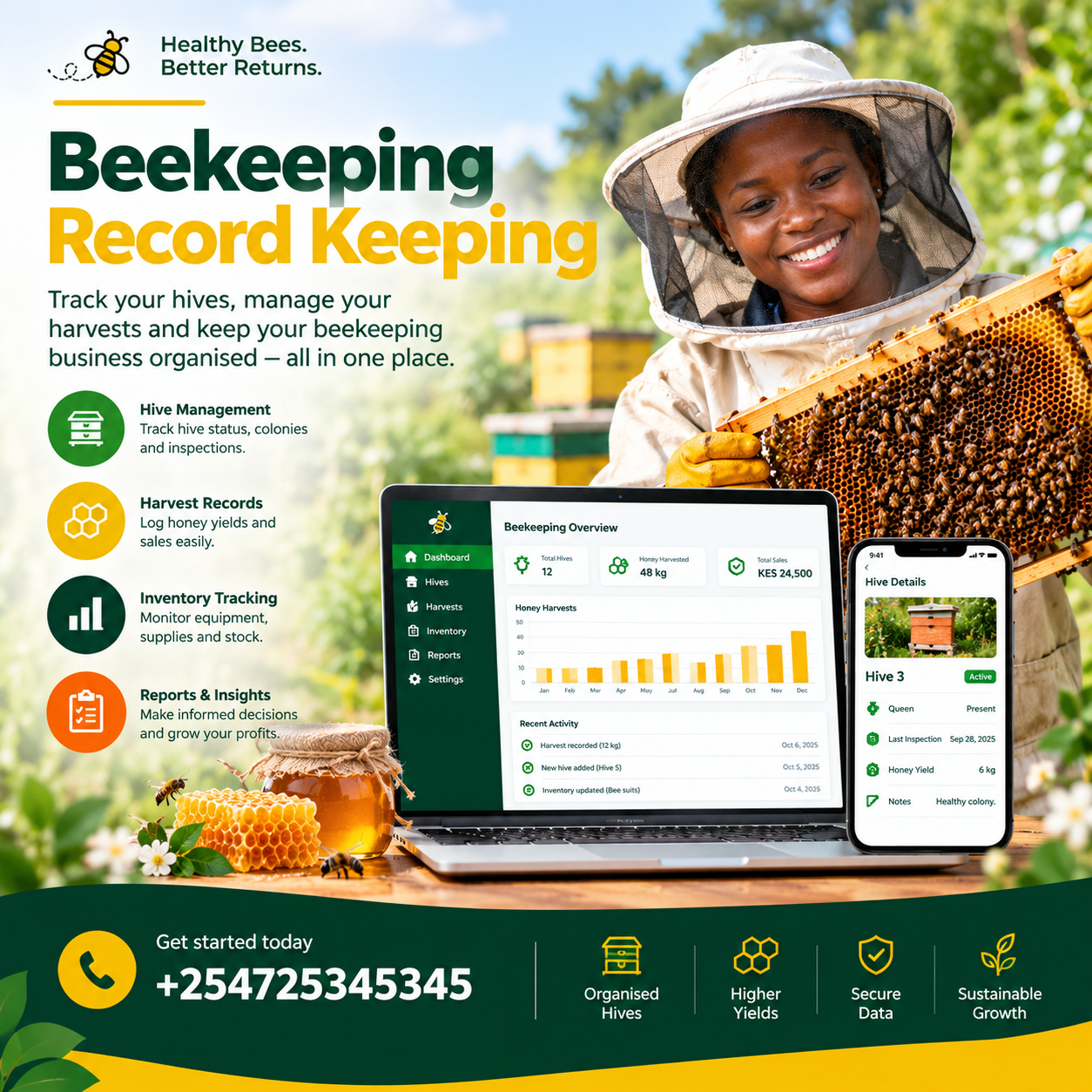
Fama is built for Kenyan farm enterprises, including apiaries. You can register every hive, log inspections from a phone, attach photos, record harvests by batch, and track sales and expenses in one place. For farmers who want beekeeping record keeping without building spreadsheets, Fama offers ready-made structures that mirror the practices in this guide.
Because Fama also handles livestock, crops, payroll and inventory, your apiary sits inside your whole farm business rather than in a separate notebook. Integrated beekeeping record keeping means honey income appears in the same reports as your other enterprises, giving you one honest profit figure.
Reports can be shared with buyers, auditors and lenders directly from the system. When a buyer asks for a batch history, beekeeping record keeping in Fama answers in seconds instead of days.
Because inspection dates, treatment records and harvest weights sit together, preparing for a certification audit or a loan application becomes a download rather than a scramble. Your data should work for you while you work the bees.
19. Turning Records Into Better Decisions
Records earn their keep only when they change behaviour. Compare hives, replace weak queens, drop unproductive sites, adjust prices and cut feeding that shows no return. Decision-driven beekeeping record keeping pays for its own effort within the first honest season.
Set yearly targets from your data: hives to add, colonies to split, kilograms to harvest and revenue to reach. Forward-looking beekeeping record keeping turns last season’s numbers into next season’s plan.
Start where you are, with what you have, and improve the system every month. The beekeepers who win in Kenya are not the ones with the most hives, but the ones whose beekeeping record keeping tells them the truth about every hive they own.
Share a short monthly summary with anyone who matters to the business: partners, lenders, buyers and serious workers. Records that stay private protect nobody, while shared numbers build the trust that brings contracts and capital.
Benchmark yourself once a year against neighbouring beekeepers or county averages, where such data exists. Benchmarks show whether weak yields come from your management or from broader conditions like drought, and that distinction determines whether the right response is effort or patience.
Frequently Asked Questions
1. I keep only five hives. Is a full record system really necessary? Yes, and it will take you less than ten minutes a week. Start with one inspection card per hive and one harvest log. Small systems built now become the database that carries you when you scale to fifty hives, and the habits are far easier to form early than to retrofit later.
2. What is the minimum information I should capture at every inspection? Record the date, hive number, colony strength, queen presence, brood condition, stores of nectar and pollen, signs of pests, and the action you took. Nine fields are enough for reliable trend analysis. Anything beyond that is optional detail you can add once the habit is solid.
3. How long should I keep old apiary records? Keep colony histories for at least three years so you can compare seasons, and keep financial records for at least five years to satisfy tax and audit requirements. Batch quality records should match your buyers’ retention rules, which for export markets often means five years or more.
4. Can I manage my apiary records together with my other farm enterprises? Yes, and you should. Platforms like Fama let you run bees, dairy, poultry and crops in one account, so labour, equipment and money are shared correctly between enterprises. That single view is what reveals which part of the farm truly funds your household.
5. Do honey buyers really ask for traceability documents? Increasingly, yes. Institutional buyers, supermarkets and exporters ask for batch codes, treatment histories and moisture results before signing contracts. Farmers with organised documentation sign those contracts; farmers without them are forced to sell raw honey cheaply at the farm gate.