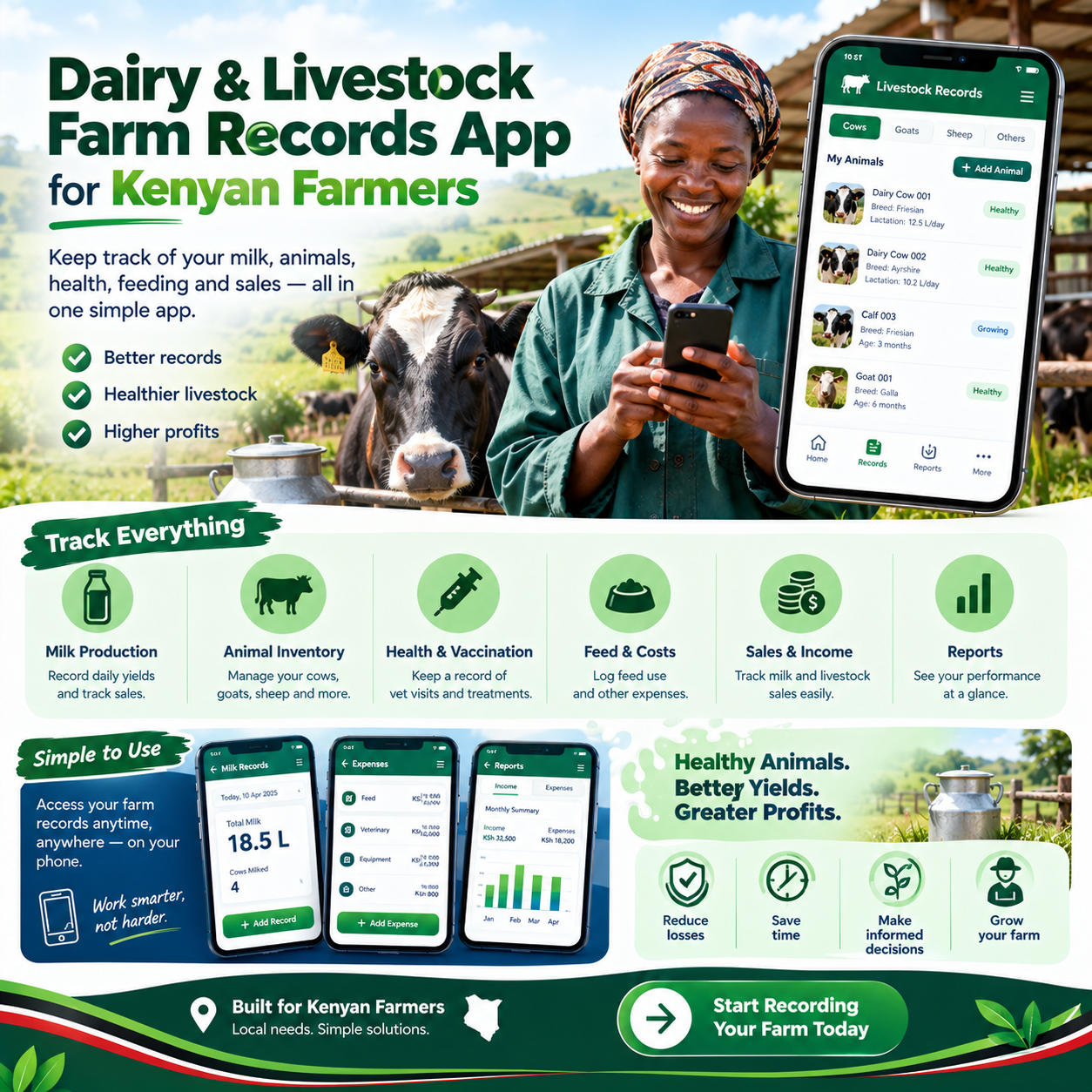
Animal health records are the written and digital history of every treatment, vaccination, and observation made on your livestock, and they are the difference between guessing at a sick herd and managing one. From the first dewormer to the last vet visit, they turn each animal into a story you can actually read.
Kenyan farmers lose animals every year to diseases that earlier treatment would have caught, and the pattern is almost always the same: nobody could say when the coughing started, or which animals were already dosed. Careful animal health records close that gap permanently.
The paperwork also follows the animals out of the gate. Buyers, processors, and export certification increasingly demand proof of vaccination and withdrawal periods, and complete animal health records provide that proof on demand.
Money is a further reason. Vets diagnose faster, insurers pay claims faster, and lenders lend against healthier herds when animal health records document the preventive care behind them.
This guide explains what to record, how to build a simple system that works at the boma, and how dairy, poultry, beef and small ruminant, and pig farms should each keep their documentation. The emphasis throughout is on cheap, durable discipline rather than expensive tools.
The principles hold for a three-cow zero-grazing unit in Kiambu and a five-hundred-head ranch in Taita alike: identify every animal, capture every treatment, note every withdrawal, and review the file each season. Farmers who keep this discipline lose fewer animals, pass more audits, and command better prices at the gate.
What Animal Treatment Documentation Covers
Complete animal health records follow each animal from birth or purchase through every event that touches its body, and knowing that scope is the first step to a useful system.
The first block is identification: an ear tag or name, breed, age or date of birth, sex, and parentage where known. Every serious animal health records system begins here, because a treatment attached to the wrong animal is worse than no treatment at all.
The second block is the treatment log: the date, the drug or vaccine, the dose, the route, the person who administered it, and the cost. Precise animal health records in this block let a vet see a full history in one page instead of interrogating a worried farmer.
The third block is the withdrawal and hold register: milk withheld, eggs withheld, or slaughter delayed after treatment, with clear dates. This is the part of animal health records that protects consumers and shields a farm from catastrophic liability.
The final block is observations and outcomes: temperatures, weights, feeding changes, recoveries, deaths, and post-mortem findings where they occur. Complete animal health records pair every treatment with its result, which is what turns history into better decisions.
Photographs earn their place here too. A swelling photographed on Monday and Thursday tells a vet more than a paragraph of recall, and the pictures cost nothing.
Keep one file or page per animal where numbers allow, and one per batch where they do not. The test is simple: any treatment for any animal found within a minute, even during a night emergency.
Do not let the file sprawl, either. Five blocks cover ninety-five percent of what buyers, vets, and insurers ever ask; a system trying to document everything usually documents nothing well.
Why Treatment Documentation Pays
The first benefit is faster, cheaper treatment. Vets working from complete animal health records diagnose from history rather than hypotheses, which shortens illness and cuts repeat visits.
The second is market access. Milk processors, egg buyers, abattoirs, and exporters audit supplier animal health records before signing, because residue violations now follow the offending farm for years.
Third, documentation protects you legally. If treated milk or meat ever causes harm, animal health records showing correct doses and observed withdrawals demonstrate that you followed the rules and did your duty of care.
Fourth, the numbers expose patterns. Repeat mastitis in one cow, recurring worms in one paddock, or vaccines that never seem to hold — animal health records reveal the patterns behind chronic losses that memory smooths over.
Fifth, insurance and finance respond to evidence. Livestock cover is priced and settled against documented care, and lenders read disciplined animal health records as proof of a managed, insurable operation.
Finally, records cut the medicine bill itself. Dosing by weight from recorded weights, avoiding duplicate treatments, and culling chronic cases identified in animal health records all shrink what the farm spends on drugs each season.
There is a breeding angle too. Mating dates, services, and calving or kidding outcomes recorded alongside treatments give the whole herd picture, and healthier mothers mean heavier weaners.
None of this requires a large operation. A village flock of ten goats gains exactly the same protections from one exercise book as a dairy of a hundred cows; only the rows change.
The Building Blocks of a Practical System
A system that survives real farm life needs five components, none expensive, and animal health records built on them from the start will scale cleanly as the herd grows.
Component one is identification done properly: tags that stay in, numbers that do not repeat, and a written master list of every animal on the farm. Sound identification is the foundation of animal health records, because every other entry hangs on it.
Component two is the treatment book kept where treatment happens — at the crush, the parlour, or the brooder room. Location is why animal health records actually get written, because a book in the house is a book that stays empty.
Component three is a medicine inventory with purchase dates, batch numbers, and expiry dates. The inventory side of animal health records prevents the two expensive errors of dosing from an expired bottle and reordering what the store already holds.
Component four is the withdrawal calendar, a single visible sheet where every treated animal’s clearance date is written the moment the syringe is used. Auditors treat this part of animal health records as the sharpest test of a responsible operation.
Component five is the monthly review: treatments, losses, costs, and repeat cases lined up on one page. This is where animal health records stop being paperwork and start deciding culls, purchases, and paddock rotations.
Store the medicine cabinet and the file together, locked, dry, and away from children. A soggy exercise book beside a leaking dip tank protects nobody.
Number your books as well. A register numbered page by page, with every sheet accounted for, proves completeness to auditors in a way loose sheets never can.
Rule the templates once and never redesign them mid-season. A consistent page — one line per treatment, fixed columns — means any family member or vet can read yesterday’s entry at a glance.
Setting Up Step by Step
Step one is to number every animal you already own and write the master list. Beginnings are the hardest page, and complete animal health records are impossible while animals remain anonymous.
Step two is to design the one-line treatment page: date, animal, drug, dose, route, operator, cost, and withdrawal date. Farmers who keep compact animal health records fill them in at the crush; those who copy hospital forms give up by the first rain.
Step three is to place the book and the withdrawal calendar at the point of treatment, with a pencil tied on. Animal health records fail most often because the person dosing had to walk to the house first.
Step four is to brief everyone who handles stock — the herder, the milker, the night watchman. Animal health records written only by the owner miss half of what happens at 5 a.m.
Step five is to file daily and reconcile monthly: treatments against the medicine inventory, costs against the budget, and clearances against the calendar. This is where animal health records turn from notes into control.
Step six is to review with your vet each quarter. Fifteen minutes over the quarter’s animal health records usually exposes one repeatable problem — a vaccine timing, a paddock, a contaminated water trough — worth more than the consultation fee.
Start the file with a baseline: weight where possible, body condition score, and any existing conditions. A future entry means most when it can be compared to a starting point.
Ask your county vet officer for the vaccination calendar for your zone and staple it inside the cover; the schedule then plans the file rather than reacting to it.
Finally, write a one-page procedure for emergencies: who calls the vet, where the file lives, and which drug stock is on hand. Night emergencies are exactly when a written plan beats a distracted memory.
Advice for Different Enterprises
Dairy
Milk is tested at the processor, so residues are traced to the farm that shipped them, and animal health records showing doses, quarters treated, and full withdrawal observation are the dairy farmer’s licence to keep supplying.
Mastitis and lameness dominate the cost lines, so record cases per cow per lactation. Dairy animal health records with per-cow histories justify culling the chronic offenders, which usually pays for the whole system in one season.
Poultry
Broiler and layer flocks are treated as batches, so file by hatch or intake: vaccinations given, water treatments, mortality per day, and the lab results when disease strikes. Batch-based animal health records are what processors and breeders ask to see before contracts.
Egg withdrawal discipline matters just as much. A written hold register inside animal health records prevents the single mistake — treated hens back on the packing line too soon — that can close a buyer’s door permanently.
Beef and small ruminants
Cattle, sheep, and goats move through markets where diseases travel with them, so dip and deworming dates plus vaccination certificates are the core of animal health records for these herds.
Weight records change behaviour too. Dosing by actual weight from recorded weights, instead of guessing, makes animal health records pay for themselves in the first pack of medicine bought.
Pigs
Pig farms run on farrowing-to-finish batches, so record sow vaccinations, litter treatments, and grower-stage medication separately. Structured animal health records of that kind are what certification schemes and premium pork buyers require.
Residue discipline completes the pig file: withdrawal dates for every injection written into animal health records before the animal leaves the pen, because abattoir traceback now reaches the individual farmer.
Whatever the species, pair the file with basic biosecurity notes: visitor log, quarantine pen use, and where new animals came from. The day disease arrives, those pages trace the introduction in minutes.
Whatever the enterprise, keep the vaccination schedule printed on the barn wall and the record book beside it. A calendar everyone can see turns prevention into routine rather than a vet’s reminder.
Vets, Rules and Tools
Know the rules that apply to you. Veterinary medicines are regulated, milk and meat residues are tested, and movement permits exist for a reason, so animal health records kept to those standards double as your compliance file.
Bring your vet into the system deliberately. Ask them to write back into your animal health records after every visit — diagnosis, prescription, and instructions — so the professional history and the farm copy stay one and the same.
Laboratory results deserve a home too. Pinning test reports to animal health records pages turns a vague suspicion of disease into documented fact, which changes insurance, breeding, and culling decisions.
Paper still works: a treatment book, a master list, and a withdrawal calendar cost a few hundred shillings and keep animal health records safe through power cuts and dead batteries.
Spreadsheets and farm platforms come next. One row per treatment in a cloud sheet, or a livestock module in a farm app, backs up animal health records automatically and totals costs without arithmetic.
Whichever mix you choose, keep one rule: a single source of truth. Books, sheets, and apps can coexist, but animal health records must have one authoritative version, agreed by everyone who treats, or audits will find the gaps.
Photograph the big moments — the tagged ear, the finished course, the vaccinated batch — and file the pictures with the entries. A simple naming rule for photo files, using date, animal number, and symptom, keeps the digital pile searchable when the vet asks for Monday’s picture.
And train one backup person completely. Stock does not get sick by appointment, and a treatment history only one mind understands is a history one absence can lose.
Common Mistakes That Cost Keepers Money
The commonest mistake is treating first and writing later, or never. Animal health records reconstructed from memory a week later conflict with receipts and lab reports, and in any conflict the written page wins.
The second is ignoring withdrawal dates. Milk or meat sold inside a clearance period risks lives and licences alike, and animal health records without a working withdrawal calendar invite exactly that mistake.
Third, farmers dose by guesswork — same bottle, same dose, every animal regardless of weight. Guessing wastes medicine, underdoses the big ones, and leaves animal health records recording numbers that were never true.
Fourth, expired and unlabelled medicines fill the cabinet. Storing loose syringes and faded bottles makes even honest animal health records meaningless, because the treatment recorded cannot be verified.
Fifth, records stop when the vet leaves. Buyers re-audit without warning, and animal health records that end mid-season read worse than none at all.
Sixth, dead animals vanish without notes. Deaths, with dates and suspected causes, are the most valuable lines in animal health records, because they show which prevention failed and what next season must change.
Avoid over-design too. A page with twelve columns per treatment breeds shortcuts at the crush, and shortcuts breed the very gaps disputes later find. Keep the line short enough to finish before the animal leaves.
And never let one person become the whole system. The owner who spot-checks the book weekly and quotes it at family meetings tells every handler the record matters, and that message keeps the pages honest.
What It Costs and What It Returns
The starting cost is small: ear tags, two exercise books, a calendar, and a locked box come to a few thousand shillings, and animal health records kept on that budget already meet most buyer and county expectations.
Digital tools add modest subscriptions, and tagging systems cost per head. Even fully equipped, animal health records rarely cost more than one treated animal per season on a working livestock unit.
The returns arrive through four doors: shorter illnesses caught early, medicines not wasted on duplicates, contracts kept because animal health records passed the audit, and premiums earned on produce sold with a clean treatment history.
There is also the avoided loss, which farmers rarely count. One residue rejection, one herd quarantine, or one preventable outbreak costs more than a decade of books, and animal health records are best judged by the disasters that never happen.
Measure your own return after two seasons. Compare mortality, medicine spend, and contract renewals before and after the system, and let those numbers decide how far to take it.
Ask your processor or buyer for their audit checklist and use it as the system’s report card; it costs nothing and aligns you with exactly what is tested.
Share the results with everyone who handles stock too. When the book shows which paddock keeps making animals sick, the team stops seeing entries as a chore and starts seeing them as the early warning system.
Frequently Asked Questions
These are the five questions livestock keepers ask most often about starting and sustaining their files, answered briefly.
1. What is the minimum documentation a smallholder should keep?
A master list of animals, a one-line treatment book, and a withdrawal calendar. Those three pages give you working animal health records from the first week, and everything else can grow around them.
2. Do I need documentation for village chickens or a few goats?
Yes, though it can be simple. One exercise book per flock or herd gives you the same protections as a large unit, and buyers of indigenous stock increasingly ask for animal health records showing vaccination history.
3. How long should treatment files be kept?
Keep them at least three years, and longer for breeding animals and contractual supply. Photographed animal health records survive rain, dust, and lost books, so digitise as you go.
4. Will processors really pay more for documented livestock?
Increasingly yes. Processors and exporters pay premiums and renew contracts for suppliers whose animal health records show clean withdrawals and complete vaccination, because their own licences depend on it.
5. Can I start in the middle of an outbreak?
Start anyway, today. A file begun during trouble is worth more than a perfect one planned for later, and the treatments you log now become the baseline your animal health records will rely on next season.
Notes
This guide reflects common practice among Kenyan livestock keepers as of 2026 and is offered for general information, not veterinary or legal advice. Medicine regulations, residue testing, and export requirements change, so treat any animal health records obligations written into your buyer contracts as the minimum standard.
For tools that connect treatment logs with the wider farm — feed, breeding, sales, and finances — look for farm management platforms whose animal health records modules link each entry to the animal, the batch, and the ledger, and choose the one that fits your scale and network.