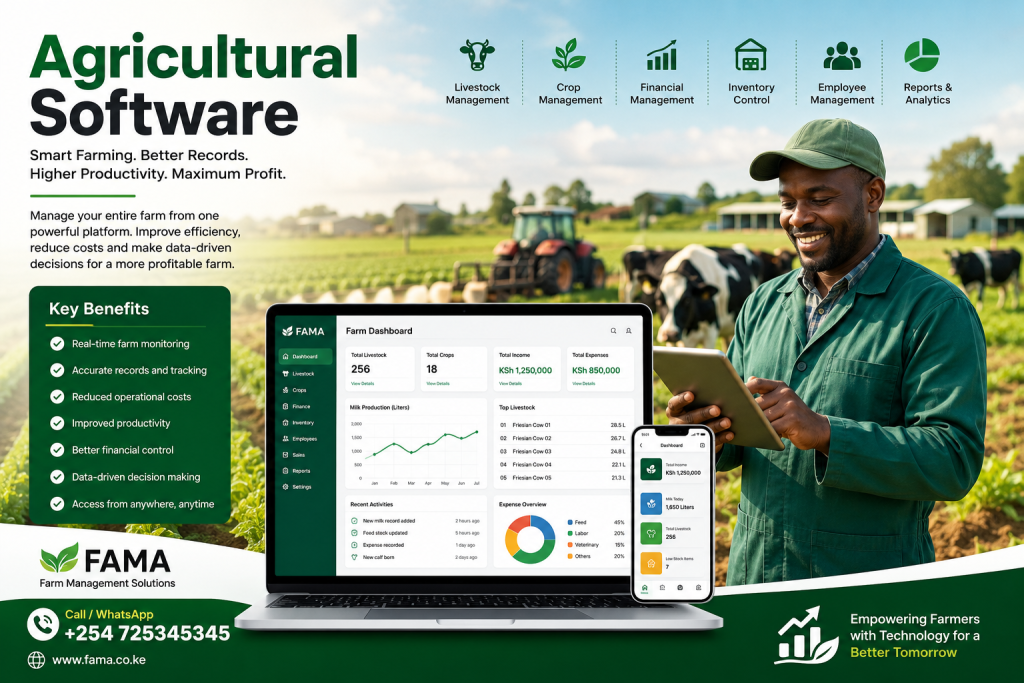
Agricultural Software: Transforming Modern Farming in Kenya
Agriculture remains one of the most important sectors of Kenya’s economy. From small-scale family farms to large commercial agricultural enterprises, farmers are continually searching for better ways to improve productivity, reduce operational costs, and maximize profits. This is where agricultural software has become an essential tool for modern farming.
Today, agricultural software is revolutionizing how farms are managed. Instead of relying on notebooks, spreadsheets, and manual calculations, farmers can use advanced digital platforms to monitor every aspect of their farming operations. Whether you operate a dairy farm, poultry business, horticultural farm, fish farm, or mixed farming enterprise, the right agricultural software helps you make informed decisions backed by accurate data.
At FAMA (fama.co.ke), we provide comprehensive agricultural system designed specifically for farmers in Kenya and East Africa. Our solution simplifies farm management while helping farmers increase efficiency, improve productivity, and maximize returns.
For inquiries or demonstrations, call +254 725345345 today.
What is Agricultural Software?
Agricultural software is a digital farm management system that enables farmers to organize, monitor, and manage all farming activities from one centralized platform.
Instead of handling records manually, agricultural system stores information securely and provides real-time insights that help farmers make better business decisions.
The software can manage:
- Crop production
- Livestock management
- Financial records
- Employee management
- Farm inventory
- Equipment maintenance
- Input purchases
- Harvest records
- Sales management
- Customer management
- Supplier records
- Farm profitability
Modern agricultural software transforms farming from guesswork into data-driven management.
Why Agricultural Software is Important
Agriculture is becoming more competitive every year. Farmers face numerous challenges including:
- Rising production costs
- Unpredictable weather
- Disease outbreaks
- Labour shortages
- Market price fluctuations
- Poor record keeping
- Resource wastage
Using agricultural system helps farmers overcome these challenges through automation, monitoring, and intelligent reporting.
Instead of making decisions based on assumptions, farmers use real data collected by the agricultural system.
Benefits of Agricultural Software
1. Better Farm Record Keeping
One of the biggest advantages of agricultural software is organized record management.
Every farming activity can be recorded including:
- Planting dates
- Harvest dates
- Vaccinations
- Animal births
- Feed purchases
- Fertilizer applications
- Sales
- Expenses
- Income
Since all records are stored digitally, farmers no longer worry about losing notebooks or paperwork.
2. Increased Farm Productivity
Successful farming depends on timely decision-making.
Agricultural software enables farmers to:
- Schedule activities
- Monitor production
- Track daily operations
- Identify inefficiencies
- Improve planning
With proper planning, productivity naturally improves.
3. Better Financial Management
Many farmers struggle because they cannot accurately determine whether their farms are making profits.
A good agricultural software automatically tracks:
- Income
- Expenses
- Cash flow
- Outstanding payments
- Customer balances
- Supplier balances
This allows farmers to understand their financial position at any time.
4. Improved Livestock Management
Livestock farming requires continuous monitoring.
Agricultural software helps manage:
- Dairy cattle
- Beef cattle
- Poultry
- Goats
- Sheep
- Pigs
- Rabbits
- Fish farming
Important records include:
- Birth dates
- Vaccination schedules
- Medical treatments
- Milk production
- Weight gain
- Feed consumption
- Breeding history
This information helps improve herd performance.
5. Crop Management
Crop farmers benefit significantly from agricultural software.
The system records:
- Farm plots
- Crops planted
- Seed varieties
- Fertilizer applications
- Irrigation schedules
- Pest control
- Harvest quantities
- Storage records
This enables farmers to compare seasons and continuously improve production.
Features of Agricultural Software
An ideal agricultural software should include several powerful modules.
Farm Dashboard
The dashboard provides a complete overview of the farm.
Farm owners can instantly view:
- Current livestock
- Active crops
- Daily income
- Expenses
- Pending tasks
- Sales
- Inventory status
Everything is available in one place.
Livestock Management Module
The livestock module helps farmers manage every individual animal.
Information stored includes:
- Animal identification
- Breed
- Age
- Weight
- Medical records
- Pregnancy status
- Milk production
- Parent history
This improves breeding and production planning.
Crop Management Module
Crop production becomes easier with agricultural software.
Farmers can manage:
- Field mapping
- Planting schedules
- Fertilizer programs
- Spray schedules
- Harvest planning
- Yield analysis
Historical records also help identify the most profitable crops.
Inventory Management
Agricultural businesses use many inputs.
The software manages:
- Seeds
- Fertilizers
- Chemicals
- Animal feeds
- Veterinary drugs
- Equipment
- Packaging materials
Inventory alerts help prevent shortages.
Employee Management
Managing farm workers manually can be difficult.
Agricultural software tracks:
- Attendance
- Salaries
- Assigned duties
- Productivity
- Overtime
- Leave
This improves workforce accountability.
Equipment Management
Farm machinery represents a major investment.
The software tracks:
- Tractors
- Irrigation systems
- Generators
- Milk machines
- Harvesters
- Pumps
Maintenance reminders reduce equipment breakdown.
Agricultural Software for Dairy Farming
Kenya has one of Africa’s largest dairy industries.
Dairy farmers require specialized agricultural software to monitor production.
The software records:
- Daily milk production
- Individual cow performance
- Lactation cycles
- Artificial insemination
- Pregnancy diagnosis
- Dry periods
- Feed consumption
- Veterinary treatments
Managers can identify the highest-producing cows while quickly detecting health issues.
Agricultural Software for Poultry Farming
Poultry farmers manage thousands of birds.
Without proper agricultural software, keeping accurate records becomes nearly impossible.
The software manages:
- Chick placement
- Mortality
- Feed usage
- Egg production
- Vaccination schedules
- Medication
- Sales
- Stock movement
Reports help improve profitability.
Agricultural Software for Crop Farming
Crop production involves multiple stages.
Agricultural software helps manage:
- Land preparation
- Seed selection
- Planting
- Fertilizer application
- Weed control
- Pest management
- Irrigation
- Harvesting
- Storage
- Marketing
Every stage is recorded for future reference.
Agricultural Software for Mixed Farming
Many Kenyan farmers combine crops and livestock.
Instead of using separate systems, integrated agricultural software manages the entire farm.
This includes:
- Dairy
- Poultry
- Fish farming
- Goat farming
- Crop production
- Farm finances
- Labour
- Machinery
- Inventory
Everything is connected within one platform.
Cloud-Based Agricultural Software
Cloud technology has changed agriculture.
Cloud-based agricultural software offers many advantages:
- Access anywhere
- Automatic backups
- Multiple users
- Mobile compatibility
- Real-time synchronization
- Improved security
- Easy software updates
Farm managers can monitor operations even while away from the farm.
Mobile Agricultural Software
Smartphones have become essential farming tools.
Mobile agricultural software allows farmers to:
- Record farm activities instantly
- Capture field photos
- Monitor livestock
- Check reports
- Approve transactions
- Receive reminders
- Track farm performance
This increases efficiency and eliminates delays in data entry.
How Agricultural Software Reduces Farm Costs
Many farmers assume software is an added expense. In reality, agricultural software is an investment that often pays for itself by reducing unnecessary costs.
Some of the biggest savings come from:
- Eliminating duplicate purchases through accurate inventory tracking.
- Reducing feed wastage by monitoring daily consumption.
- Preventing crop losses through timely reminders for spraying and irrigation.
- Minimizing equipment breakdowns with scheduled maintenance.
- Reducing paperwork and administrative workload.
- Improving labour productivity through better task assignment and attendance tracking.
- Preventing financial leakages by accurately recording every transaction.
Over time, these improvements translate into significant cost savings and higher profitability.
Agricultural Software for Precision Farming
Precision farming has become one of the most significant advancements in modern agriculture. Rather than treating an entire farm as one unit, agricultural system allows farmers to monitor each field, crop, animal, and resource individually. This data-driven approach leads to improved efficiency, higher yields, and better resource utilization.
With advanced agricultural system, farmers can:
- Monitor soil conditions
- Record fertilizer applications
- Schedule irrigation
- Track pest and disease outbreaks
- Compare yields across different seasons
- Analyze production trends
- Optimize input usage
Instead of relying on assumptions, precision farming supported by agricultural software enables farmers to make informed decisions based on accurate and timely information.
Agricultural Software for Farm Financial Management
Financial management is one of the biggest challenges facing many farmers. While some farms generate substantial revenue, poor financial planning often leads to low profitability.
A reliable agricultural system helps farmers manage every financial aspect of their business.
The software records:
- Daily income
- Sales revenue
- Operational expenses
- Employee salaries
- Supplier payments
- Loan repayments
- Asset purchases
- Production costs
- Cash flow
- Profit margins
With automated financial reports, farm owners can quickly identify areas where costs can be reduced while increasing profitability.
Agricultural Software for Inventory Control
Farm inventory includes much more than seeds and fertilizers. Every agricultural enterprise depends on efficient stock management.
An effective agricultural software helps manage:
- Seeds
- Fertilizers
- Animal feeds
- Vaccines
- Veterinary drugs
- Chemicals
- Fuel
- Farm tools
- Machinery spare parts
- Irrigation equipment
- Packaging materials
Inventory alerts notify farmers before supplies run out, reducing production interruptions.
Historical inventory reports also reveal consumption patterns, making budgeting much easier.
Agricultural Software Improves Decision Making
Every successful farmer relies on accurate information.
Without proper records, it becomes difficult to answer important questions such as:
- Which crop generated the highest profit?
- Which dairy cow produces the most milk?
- How much feed is consumed every month?
- Which field performs better?
- How much money was spent on fertilizers?
- What is the average production cost?
Agricultural software automatically generates reports that answer these questions within seconds.
This enables better planning for future seasons.
Agricultural Software for Livestock Breeding
Breeding management is critical for dairy, beef, goat, sheep, and pig farming.
Agricultural software helps monitor:
- Heat detection
- Artificial insemination
- Pregnancy diagnosis
- Expected calving dates
- Birth records
- Breeding history
- Genetic records
- Fertility performance
These records improve herd quality while reducing breeding errors.
Agricultural Software for Disease Management
Disease outbreaks can significantly affect farm productivity.
With agricultural software, farmers can schedule:
- Vaccinations
- Deworming
- Medical treatments
- Health inspections
- Veterinary visits
Health records remain available throughout the animal’s lifetime.
If a disease outbreak occurs, farmers can quickly identify affected animals and implement control measures.
Agricultural Software for Harvest Planning
Harvesting requires proper timing.
Agricultural software helps farmers:
- Estimate harvest dates
- Monitor crop maturity
- Allocate labour
- Schedule transportation
- Prepare storage facilities
- Coordinate buyers
This minimizes post-harvest losses.
Agricultural Software for Sales Management
Selling farm produce involves more than receiving payments.
Agricultural software records:
- Customers
- Products sold
- Sales quantities
- Selling prices
- Payment status
- Delivery records
- Customer balances
- Sales trends
Farm owners can easily identify their best customers and most profitable products.
Agricultural Software Reporting and Analytics
One of the greatest strengths of agricultural software is reporting.
Reports provide valuable insights into farm performance.
Common reports include:
Production Reports
Monitor:
- Milk production
- Egg production
- Crop yields
- Livestock growth
- Harvest quantities
Financial Reports
View:
- Profit and loss
- Income statements
- Expense summaries
- Cash flow
- Revenue analysis
Inventory Reports
Track:
- Available stock
- Low inventory alerts
- Consumption history
- Purchase history
- Stock valuation
Employee Reports
Review:
- Attendance
- Productivity
- Payroll
- Assigned duties
Animal Reports
Generate reports for:
- Vaccinations
- Breeding
- Births
- Deaths
- Sales
- Treatments
- Milk production
Agricultural Software Enhances Farm Planning
Planning is essential for long-term success.
Agricultural software assists farmers by helping them:
- Plan seasonal activities
- Budget expenses
- Forecast production
- Estimate profits
- Schedule labour
- Manage resources
- Prepare expansion strategies
The result is a well-organized farming operation with fewer surprises.
Agricultural Software Supports Sustainable Agriculture
Sustainability is becoming increasingly important in agriculture.
Using agricultural software helps reduce waste by ensuring resources are used efficiently.
Farmers can:
- Apply fertilizers accurately
- Reduce water wastage
- Optimize feed usage
- Monitor chemical applications
- Improve soil management
- Reduce environmental impact
Sustainable farming practices not only protect the environment but also improve long-term profitability.
Why Small Farms Need Agricultural Software
Some people believe agricultural software is only suitable for large commercial farms.
This is not true.
Small-scale farmers also benefit through:
- Better record keeping
- Improved budgeting
- Increased productivity
- Easier livestock management
- Organized crop planning
- Accurate financial tracking
Even farms with a few animals or a few acres can experience significant improvements.
Why Large Farms Need Agricultural Software
Large agricultural enterprises manage complex operations involving:
- Hundreds of employees
- Thousands of animals
- Multiple farm locations
- Large inventories
- Expensive machinery
Agricultural software centralizes all information, making management easier and more efficient.
Managers can monitor multiple departments from one dashboard.
Choosing the Best Agricultural Software
Not every software solution is suitable for every farm.
When selecting agricultural software, consider:
Ease of Use
The system should have a simple, user-friendly interface.
Farm workers should learn it quickly without extensive technical training.
Mobile Accessibility
Choose software that works on smartphones, tablets, and computers.
Mobile access allows farmers to update records directly from the field.
Customization
Different farms have different needs.
The best agricultural software should adapt to:
- Dairy farms
- Poultry farms
- Crop farms
- Fish farms
- Mixed farming
- Commercial agriculture
Reporting
Comprehensive reports help farmers monitor performance continuously.
Security
Farm data should remain secure through:
- Password protection
- User permissions
- Automatic backups
- Cloud storage
Customer Support
Reliable technical support ensures uninterrupted farm operations.
Training, updates, and assistance should always be available.
Why Choose FAMA Agricultural Software?
At FAMA, we understand the unique challenges faced by farmers across Kenya and East Africa. Our Agricultural Software has been designed to simplify farm management while helping farmers maximize productivity and profitability.
FAMA Agricultural Software offers:
- Comprehensive farm management
- Livestock management
- Crop management
- Financial management
- Inventory control
- Employee management
- Sales management
- Expense tracking
- Production reports
- Cloud-based access
- Mobile compatibility
- Secure data storage
- Easy-to-use interface
- Scalable features for both small and large farms
Whether you manage a dairy farm in Nyeri, a poultry farm in Kiambu, a maize farm in Trans Nzoia, or a mixed farm anywhere in Kenya, FAMA Agricultural Software provides the tools you need to run your farm more efficiently.
Frequently Asked Questions
What is agricultural software?
Agricultural software is a digital platform that helps farmers manage farm operations, livestock, crops, finances, inventory, labour, and production records from one centralized system.
Who can use agricultural software?
Agricultural software is suitable for:
- Individual farmers
- Commercial farms
- Cooperatives
- Agribusinesses
- Agricultural institutions
- Farm managers
Can agricultural software manage livestock?
Yes. It manages dairy cattle, beef cattle, goats, sheep, pigs, poultry, rabbits, fish, and other livestock.
Can agricultural software manage crops?
Absolutely.
The software tracks planting, irrigation, spraying, fertilization, harvesting, and crop yields.
Is agricultural software suitable for small farms?
Yes.
Small farms benefit from improved organization, better record keeping, and increased profitability.
Is cloud-based agricultural software secure?
Yes.
Cloud systems provide secure backups, encrypted data storage, and controlled user access.
The Future of Agricultural Software
Technology continues to transform agriculture at an incredible pace. The future of agricultural system will include even more advanced capabilities such as artificial intelligence, machine learning, drone integration, satellite monitoring, Internet of Things (IoT) sensors, and predictive analytics. These innovations will help farmers detect diseases earlier, forecast weather impacts, optimize irrigation schedules, and make more accurate production forecasts.
As digital agriculture continues to evolve, farmers who adopt agricultural software will gain a significant competitive advantage. They will be able to respond faster to market demands, reduce operational risks, improve food quality, and increase overall farm profitability.
Investing in modern agricultural software today is an investment in the future success and sustainability of your farming business.
Building a Data-Driven Farming Culture
One of the greatest advantages of adopting digital technology on the farm is the ability to build a culture of informed decision-making. Rather than relying solely on memory or assumptions, farm owners and managers can make choices based on historical records and measurable performance. Over time, this approach leads to more consistent production, better budgeting, and improved accountability across every department.
A data-driven farming culture also encourages continuous improvement. By reviewing past seasons, farmers can identify which practices delivered the best outcomes and which areas require adjustment. They can compare planting dates, production levels, labour efficiency, and operating costs to discover opportunities for increased productivity. These insights help eliminate guesswork and support smarter long-term planning.
Training employees to record activities accurately also creates a sense of responsibility. Workers understand that every task contributes to the overall success of the farm, whether they are feeding livestock, applying fertilizer, harvesting crops, or maintaining equipment. Managers, in turn, gain better visibility into daily operations and can provide support where it is needed most.
Another important aspect of modern farm management is collaboration. Farms often involve multiple stakeholders, including owners, managers, accountants, veterinarians, agronomists, suppliers, and buyers. When information is organized and easily accessible, communication becomes more effective. Everyone works with the same set of accurate records, reducing misunderstandings and improving coordination.
Digital transformation also supports business growth. As farming operations expand, manual systems become increasingly difficult to manage. More land, additional employees, larger herds, and higher production volumes all create greater administrative demands. A well-organized management system makes expansion much easier by providing structured processes that can scale alongside the business.
Risk management is another area where organized information provides tremendous value. Agriculture is influenced by many unpredictable factors, including weather changes, market fluctuations, pest infestations, and disease outbreaks. While these risks cannot always be prevented, maintaining detailed operational records helps farmers respond more effectively. Historical information makes it easier to identify trends, evaluate previous responses, and prepare better contingency plans for future challenges.
Good documentation also improves relationships with financial institutions and investors. Banks, lenders, and development organizations often require reliable records before approving loans or funding agricultural projects. Farms with organized production, financial, and operational records demonstrate professionalism and financial discipline, increasing confidence among potential financiers and business partners.
In addition, accurate documentation simplifies compliance with government regulations and industry standards. Many agricultural businesses are required to maintain records related to production, employee management, food safety, environmental practices, or taxation. Having these records readily available reduces administrative stress and saves valuable time during inspections or audits.
Customer confidence is equally important. Buyers increasingly want assurance that products have been produced responsibly and consistently. Well-maintained operational records help demonstrate quality standards, traceability, and reliability. This can strengthen relationships with wholesalers, retailers, exporters, processors, and other commercial buyers who value dependable suppliers.
Technology adoption should also be viewed as an ongoing journey rather than a one-time investment. As farming methods evolve and new innovations become available, businesses that embrace continuous improvement are better positioned to remain competitive. Regularly reviewing operational performance, updating management practices, and adopting new tools can help ensure that the farm continues to meet changing market demands.
Another often-overlooked benefit of digital record management is the preservation of institutional knowledge. Many family farms rely heavily on the experience of a single individual. If that person retires or becomes unavailable, valuable information may be lost. Maintaining comprehensive records ensures that important knowledge is preserved and can be passed on to future generations or new managers, supporting business continuity.
Planning for the future also becomes much easier when reliable historical data is available. Expansion projects, equipment purchases, staffing decisions, and production targets can all be based on measurable performance rather than estimates. This reduces uncertainty and increases the likelihood of successful investments.
Ultimately, successful farming requires more than hard work—it requires organization, consistency, and the ability to make timely decisions. By embracing structured management practices and maintaining accurate records, farmers create a stronger foundation for sustainable growth. They become better equipped to adapt to changing conditions, seize new market opportunities, improve operational efficiency, and build resilient agricultural businesses capable of thriving for many years to come.
Conclusion
Agriculture is no longer just about planting crops or raising livestock—it is about managing a profitable business. The increasing complexity of modern farming requires accurate records, timely decisions, efficient resource management, and reliable financial tracking. Agricultural system provides all these capabilities in one integrated platform.
Whether you operate a small family farm or a large commercial enterprise, adopting agricultural system can help you streamline operations, improve productivity, reduce costs, and maximize profits. From livestock and crop management to inventory control, employee management, financial reporting, and sales tracking, the benefits of agricultural software are substantial.
If you are looking for a reliable, user-friendly, and feature-rich Agricultural Software in Kenya, FAMA is your trusted partner. Our solution is designed to empower farmers with the tools they need to make smarter decisions and achieve sustainable growth.
Contact FAMA today to schedule a demo or learn more about how our Agricultural Software can transform your farming business.
Website: fama.co.ke
Phone: +254 725345345
Start your journey toward smarter farming with FAMA Agricultural Software and experience the future of modern agriculture today.