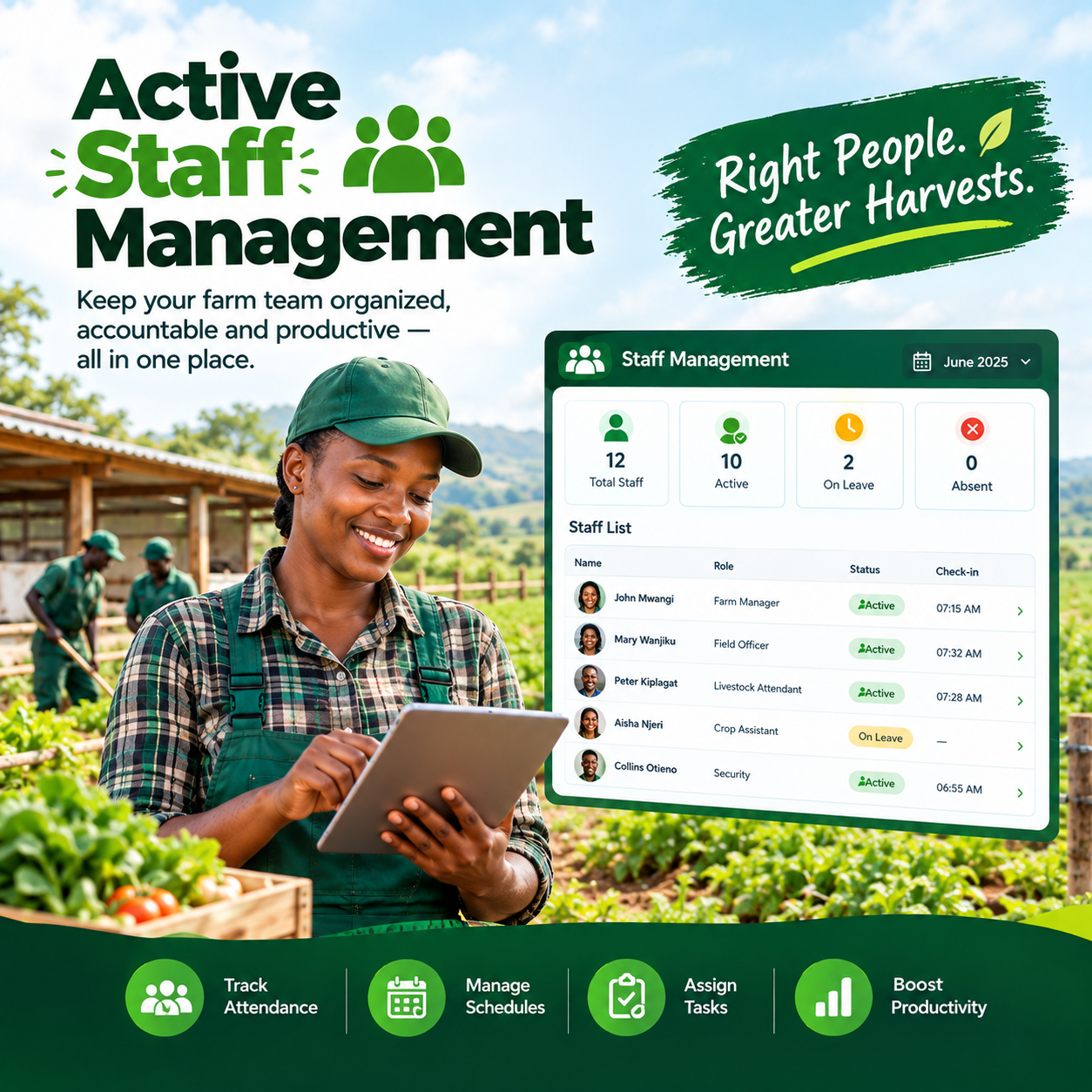
Active staff management is the difference between a workforce that works and a workforce that performs — and the distinction costs farms more money than any input price ever will. Most farms employ people; far fewer manage them. The employees exist on a register, wages go out at month-end, and between those two bookends the farm hopes for effort it never verifies, output it never measures, and problems it only discovers when they have already cost a season.
The gap between employing and managing is where absenteeism hides, where low productivity survives unchallenged, where good workers go unrecognised and drift to competitors, and where disputes multiply because nothing was ever written down.
Active management closes that gap structurally. It means knowing at any moment who is working, on what, with what output — attendance tracked, tasks assigned and confirmed, performance visible, payroll accurate, and every decision grounded in records rather than impressions. It is the difference between “I think we have enough people on the beans today” and knowing exactly who checked in, what they were assigned, what they completed, and what it cost.
This guide examines active staff management in full: what it means to manage actively rather than passively, the systems that make it possible at any scale, the daily routines that keep a workforce coordinated, the performance and payroll disciplines that keep it honest, the records that protect both farm and worker, and the culture that turns managed staff into a competitive advantage rather than a permanent headache.
The timing for this discipline has never been better. Labour costs rise every year and now rival inputs as the largest controllable expense on commercial farms. Statutory obligations — NSSF, SHIF, housing levy, minimum wage — have made undocumented employment a compounding liability rather than a convenience. And the workforce itself has changed: younger workers expect clarity, fairness, and to be managed with the same professionalism their urban peers experience.
Farms that answer these pressures with active systems attract the best workers in their areas; farms that answer with memory and goodwill recycle the same problems every season, paying for them repeatedly.
What Active Staff Management Actually Means
At its core, active staff management is the shift from managing by presence to managing by evidence. Passive management assumes work happens because workers are present; active management verifies what was actually done — who checked in, what was assigned, what was completed, and how well — and it does so continuously, not at month-end when reconstruction is the only option.
The active model has four pillars, and each replaces a passive habit. Attendance: not a register page someone may or may not have signed, but check-ins recorded with time and place, from the block or the gate. Assignment: not verbal instructions that evaporate, but tasks issued with deadlines, fields, and expected outputs — visible to the worker and the supervisor alike.
Confirmation: not the supervisor’s belief that work was done, but completion recorded from the field, with quantities and photos where they matter. Performance: not the vague sense of who works hard, but measured output per worker and per crew — the data that makes recognition, correction, and reward all evidence-based rather than political.
The fourth pillar deserves emphasis because it is where active active staff management diverges completely from passive employment. When output is measured, the best workers become visible — and visible excellence can finally be rewarded, retained, and multiplied. When it is not, the farm pays its best and its worst the same, and watches the best leave for farms that notice.
Why Passive Staff Management Costs So Much
The first cost is unverifiable time. Attendance on trust — or in a register that records a signature rather than a presence — lets paid-but-unworked hours accumulate invisibly. Studies of farm labour costs repeatedly find a double-digit share of wage bills paying for time that was never actually worked, and no passive system can separate real hours from claimed ones. Active active staff management attendance does exactly that, with timestamps and locations that no argument can rearrange.
The second cost is unmeasured productivity. Two crews of the same size can differ by thirty to fifty percent in daily output — a gap invisible without measurement and unaffordable at scale. The farm paying per day for its slowest pace while its fastest crew could do the same work in half the time is subsidising inefficiency with every payslip.
The third cost is dispute exposure. Undocumented employment — no contracts, no recorded terms, no payslips, no leave records — converts every disagreement into a contest of memory, and Kenyan labour law awards such contests to the documented side or the absent side, never to the verbal one. Active active staff management practice generates the contracts, payslips, and records that make disputes short and defences strong.
The fourth cost is the compounding one: turnover of the best people. Good workers leave farms where effort is invisible and fairness is accidental. Every departure of a skilled, reliable hand costs recruitment, retraining, and the seasonal output gap while a replacement learns — costs that dwarf anything active management requires. The retention dividend is the quietest and largest return the discipline delivers.
The Daily Rhythm of Active Staff Management
The Morning Assignment
The active day begins with a short structured meeting — five to ten minutes — where the day’s work is laid out: who works where, on what task, to what standard, and what counts as done. This single habit converts a farm’s labour from a scatter of intentions into a coordinated plan, and it is the operational heart of active staff management practice.
The assignment should be issued through the system where the farm runs one: tasks with fields, quantities, and deadlines, visible on each worker’s phone or the supervisor’s sheet. Verbal instruction has its place, but the record is what makes the instruction enforceable — and the worker’s clarity about what “done” means is what makes quality enforceable too.
Attendance at the Point of Work
Check-in happens where work happens — at the block, the dairy, the packhouse — recorded with time and location, offline-capable where networks fail. The record serves both directions: the farm verifies presence, and the worker builds their own documented attendance, which protects them in every leave, overtime, or dispute conversation that follows.
Midday Monitoring Without Micromanagement
Active management is not surveillance theatre; it is obstacle removal. The supervisor’s midday round asks one question: what is slowing my crews? A missing tool, an empty water point, a blocked weighing station — each solved within the hour is worth more than any pep talk. The best supervisors spend their rounds on active staff management in exactly this mode — and their crews’ output shows it.
The Evening Close-Out
The day ends the way it began: structured. Completion confirmed against the morning’s assignments — quantities recorded, quality checked, deviations noted — so tomorrow’s plan starts from facts. The fifteen-minute close-out, kept daily, is what makes the weekly performance review possible and the monthly payroll effortless.
Task Assignment and Tracking
Task management is where active management becomes concrete, and the discipline is a loop: assign, support, confirm, review. Tasks carry their specifications — the field, the crop, the standard, the quantity, the deadline — because a task defined precisely can be completed precisely, while a task defined as “weed the beans” invites every interpretation in the field.
The loop’s confirming step is where paper systems die and systems earn their keep. Completion recorded from the field — quantities, photos, timestamps — feeds performance data, payroll for piece work, and the farm’s production records simultaneously. Operations that run their whole task loop through structured active staff management systems report the same discovery: the work they thought was being done and the work actually being done were different quantities — and closing that gap was worth more than any efficiency project they had ever run.
Piece work integrates into the same loop naturally. Counts recorded at the point of achievement — crates, beds, trees — reconcile against store receipts and feed payrolls directly. Where tallies once generated disputes, recorded counts generate payslips, and the farm’s fastest, most reliable crews finally out-earn its loudest ones.
Performance Management: Measurement With Fairness
Performance measurement begins with the right metrics per role: output per day for field crews, quality pass rates for packers and pickers, attendance reliability across all. Three or four metrics per role — measured consistently, visible to the worker — are enough. Metric overload is passive management wearing a data costume; the active staff management discipline is few metrics, honestly kept.
Fairness requires context alongside numbers: block conditions, weather, tool availability, and crew composition all affect output, and a measurement system that ignores context measures excuses rather than performance. The supervisor who can explain a crew’s slow week with recorded facts — a saturated field, a broken pump — keeps the data credible.
The review rhythm completes the system: brief weekly check-ins per crew, monthly one-to-ones for key staff, and a quarterly performance summary per worker — all brief, all recorded, all feeding recognition and development. Workers who see their numbers discussed fairly return the favour with effort; workers measured unfairly or never measured at all drift to whoever notices them next.
Recognition belongs inside the system, not outside it: the top performers named publicly, small rewards — preferred blocks, a bonus, a public credit — delivered consistently. Farms that institutionalise recognition through their active staff management routines report the same compounding effect season after season: the crew upgrades itself, because visible excellence attracts imitation.
Payroll Integration: Where Management Meets Money
The payroll is where every management promise meets arithmetic, and active systems make the meeting clean. Attendance feeds daily wages automatically. Piece-work counts feed piece earnings. Leave balances adjust automatically. Overtime accumulates by rule. Statutory deductions — PAYE, NSSF, SHIF, housing levy — compute per current law without anyone relearning anything.
The integration removes the classic farm payroll pathologies: hours reconstructed from memory, tallies argued at payday, deductions miscalculated mid-season, and payslips that explain nothing. Operations running payroll from their active staff management records issue itemised payslips that every worker can verify — and verifiable payslips end payroll disputes more permanently than any manager’s patience ever did.
Payslip delivery completes the loop: every worker receives their itemised slip — on paper, by SMS, or WhatsApp — showing what they earned, how it was computed, and what was deducted. The payslip is simultaneously a legal obligation and the trust instrument of the entire employment relationship, and the farms that treat it that way retain the workforces that treat the farm seriously.
Leave, Absence and Compliance Management
Leave deserves structure, not notebooks: entitlements accrued per policy and law, applications from phones, approvals recorded, balances visible to worker and supervisor alike, and absences connected to attendance so unapproved absence affects pay correctly. The leave calendar also protects operations — crews thinning for holidays are visible weeks ahead, and harvest staffing is never ambushed by an exodus nobody planned around.
Compliance rides the same records: contracts on file for every worker, terms documented, statutory registrations complete, and engagement-type conversions — the casual drifting into continuous service — flagged before they become obligations nobody planned. Operations that run their active staff management compliance through structured records face labour inspections as file retrievals rather than reconstructions, and the difference between those two experiences is the entire value of the discipline.
Communication and Team Culture
Systems record; culture delivers. The active manager communicates deliberately: the morning meeting that orients the day, the weekly crew briefing that shares plans and wins, the monthly all-staff session where results, changes, and recognition are aired together. Communication is what converts managed data into managed people — and farms that skip it run systems their workers quietly route around.
Feedback runs both directions in the healthy version. Workers see their own attendance, counts, and payslips; they also get heard — on tools that fail, on blocks that need attention, on standards that seem unfair. The farms whose active staff management culture listens report lower turnover than their neighbours, and lower turnover is the compounding asset every farm is really competing for.
Training and Development
Active management invests in capability, not just effort. Skills training before each season — spraying safety, picking technique, animal handling, equipment basics — raises both output and safety simultaneously, and every efficiency gained in training is income to the worker and schedule to the farm at once.
Progression completes the development pillar: the best field hand trained toward supervisor, the reliable crew leader given more responsibility and pay. Farms that grow their own supervisors from proven workers build loyalty no wage premium can buy — and they keep the institutional knowledge that departing hires would otherwise walk away with.
Managing Seasonal Workforce Swings
Farm workforces breathe with the seasons, and active systems handle the breathing deliberately. The seasonal plan maps the year’s labour curve against its crop calendar: when crews swell for planting, thin for mid-season, and surge for harvest — with recruitment, training, and piece-work rates prepared before each swell rather than improvised during it.
The records make the swelling manageable: returning seasonal workers re-onboard in minutes from their histories, proven pickers are re-engaged first, and the farm’s best crews are booked before the neighbours realise the season is near. Operations that treat their active staff management seasonal data as a recruitment asset fill their peaks with proven crews — while the farms recruiting from scratch each season start every year at the bottom of the learning curve.
Records: The Foundation Everything Stands On
Every practice in this guide generates records, and the record system is what makes them durable: attendance histories, task completions, piece-work counts, leave balances, performance reviews, payroll registers, contracts, and statutory filings — all attributable, timestamped, and retrievable.
Manual records hold this at small scale; structured systems hold it at any scale, and the difference compounds with every worker added. Operations that consolidated their active staff management records digitally describe the same transformation: what was once a drawer of notebooks became a queryable history — every worker’s story, every crew’s output, every season’s lessons — available in minutes and trusted by everyone, including the workers themselves.
Who Needs Active Staff Management Most
Commercial farms above roughly ten workers need the discipline structurally, because below that threshold memory and goodwill can stretch; above it, they tear. The farms that crossed the threshold with systems in place scaled smoothly; the ones that crossed without them paid for the missing discipline in disputes, turnover, and payroll chaos until they finally installed it.
Horticulture, floriculture, and harvest-driven farms need it most urgently of all, because their piece-work-heavy labour economics are exactly where passive management fails most expensively — counts disputed, quality sacrificed, and the best pickers demoralised. Operations running active staff management systems through their harvest peaks convert their most chaotic seasons into their most profitable ones.
Multi-site operations and outgrower schemes complete the constituency. Crews across several properties, schemes coordinating hundreds of smallholders’ labour — these are management problems that memory cannot hold and paper cannot reconcile. The operations that industrialised their active staff management across sites run their distributed workforces with a coordination smaller operations cannot imagine, and their investors and buyers increasingly expect exactly that coordination.
Active Staff Management vs Passive Employment: The Comparison
The comparison runs cleanly across every dimension that matters. On attendance: passive trusts a register; active verifies presence with time and place. On productivity: passive pays for days; active measures output and pays the fast more than the slow.
On disputes: passive argues from memory; active answers from records. On payroll: passive reconstructs hours and tallies at month-end; active computes from verified data continuously. On retention: passive loses its best to invisibility; active keeps them through recognition grounded in measurement.
On compliance: passive accumulates undocumented exposure; active generates contracts, payslips, and statutory records as by-products of ordinary management. Across every dimension, the active model wins — and the win is not marginal. Operations that made the switch describe it as the single largest management upgrade of their business careers, which is the consistent verdict of active staff management practice everywhere it has been installed.
Common Mistakes That Undermine Workforce Systems
The first mistake is measuring without explaining — rolling out attendance and output tracking as surveillance rather than as evidence, and watching workers route around a system they experience as distrust. The farms that succeed frame the system correctly from day one: it protects accurate pay, makes good workers visible, and puts every worker’s own record in their own hands.
The second is data without action — collecting attendance and output that nothing ever uses, which teaches the workforce that measurement is theatre. The weekly review that acts on the data is what gives the records their power, and the active staff management systems that fail are almost always the ones whose data never fed a decision.
The third is fairness failure — metrics applied unevenly, recognition delivered by favouritism, deductions explained to nobody. The system’s credibility is its entire asset, and credibility survives only where rules are written, published, and applied identically to everyone.
The Future of Farm Workforce Management
Technology is moving the discipline forward on both measurement and intelligence: biometric and phone-based check-ins becoming standard, output capture integrating with production systems, and analytics that forecast staffing needs against the farm’s own seasonal curves. The operations building clean workforce records today are training tomorrow’s planning systems on their own history.
The deeper wave is verified employment across the agricultural economy — buyers and certification schemes increasingly auditing labour practices, lenders reading payroll discipline as management quality, and workers carrying portable, documented employment histories between farms. The operations whose workforce lives inside structured active staff management records will meet that economy with evidence while others reconstruct what they can.
Frequently Asked Questions
What does active staff management actually mean in practice?
Managing by evidence rather than presence: attendance verified with time and place, tasks assigned with clear standards, completion confirmed from the field, output measured per worker, and payroll computed from that verified data — continuously, not reconstructed at month-end. The shift from passive to active active staff management is the single largest upgrade most farms can make to their labour economics.
How do I start managing staff actively on a small farm?
Begin with three habits: a five-minute morning assignment where every worker knows their task and standard, attendance recorded daily with times, and a brief evening close-out confirming what was done. Add piece-work counts and performance notes as these settle — the active staff management discipline scales from three habits upward, and small farms often adopt it fastest because the habit loop is short.
Does active staff management mean surveillance?
No — it means evidence, applied fairly and transparently, with workers holding the same visibility into their own records that management holds. The farms that frame their active staff management systems as protection for accurate pay and recognition — and run them that way — report workers becoming the system’s strongest defenders rather than its circumventers.
How does it handle piece work and seasonal crews?
Natively: counts recorded at the point of achievement reconcile against store receipts, feed payroll directly, and accumulate per worker per season — so returning crews re-onboard from history and proven pickers are re-engaged first. Seasonal workforce management is where structured active staff management systems repay their cost fastest, because the peak-season chaos they prevent is the most expensive chaos farms experience.
What records does active management require me to keep?
Attendance, task assignments and completions, piece-work counts, leave balances, performance notes, payroll registers, contracts, and statutory filings — all attributable and retrievable. At small scale a disciplined notebook system holds these; beyond a handful of workers, structured active staff management platforms hold them automatically and make every audit, dispute, and review a retrieval rather than a reconstruction.
Can it help reduce labour disputes?
Decisively — disputes feed on undocumented memory, and active systems replace memory with timestamped, attributed records that both sides can see. Operations running full active staff management records report paydays becoming announcements rather than arguments, and the rare dispute that remains settles from the file in minutes.
How does it improve productivity?
Through three mechanisms: verified attendance removes paid-but-unworked time, measured output lets the fast earn visibly more than the slow, and obstacle-clearing supervision replaces presence-checking. Farms that measured their crews after installing active staff management systems routinely found thirty to fifty percent output differences hiding between crews the farm had been paying identically.
Is it worth it for a farm with just a few workers?
Yes — the habits cost minutes per day and the disciplines scale with the farm, while the payroll accuracy, dispute prevention, and retention of good workers matter proportionally more at small scale. The smallholder who runs three workers on structured active staff management habits is practising the exact system the estates use — and is building the discipline that scaling will require anyway.