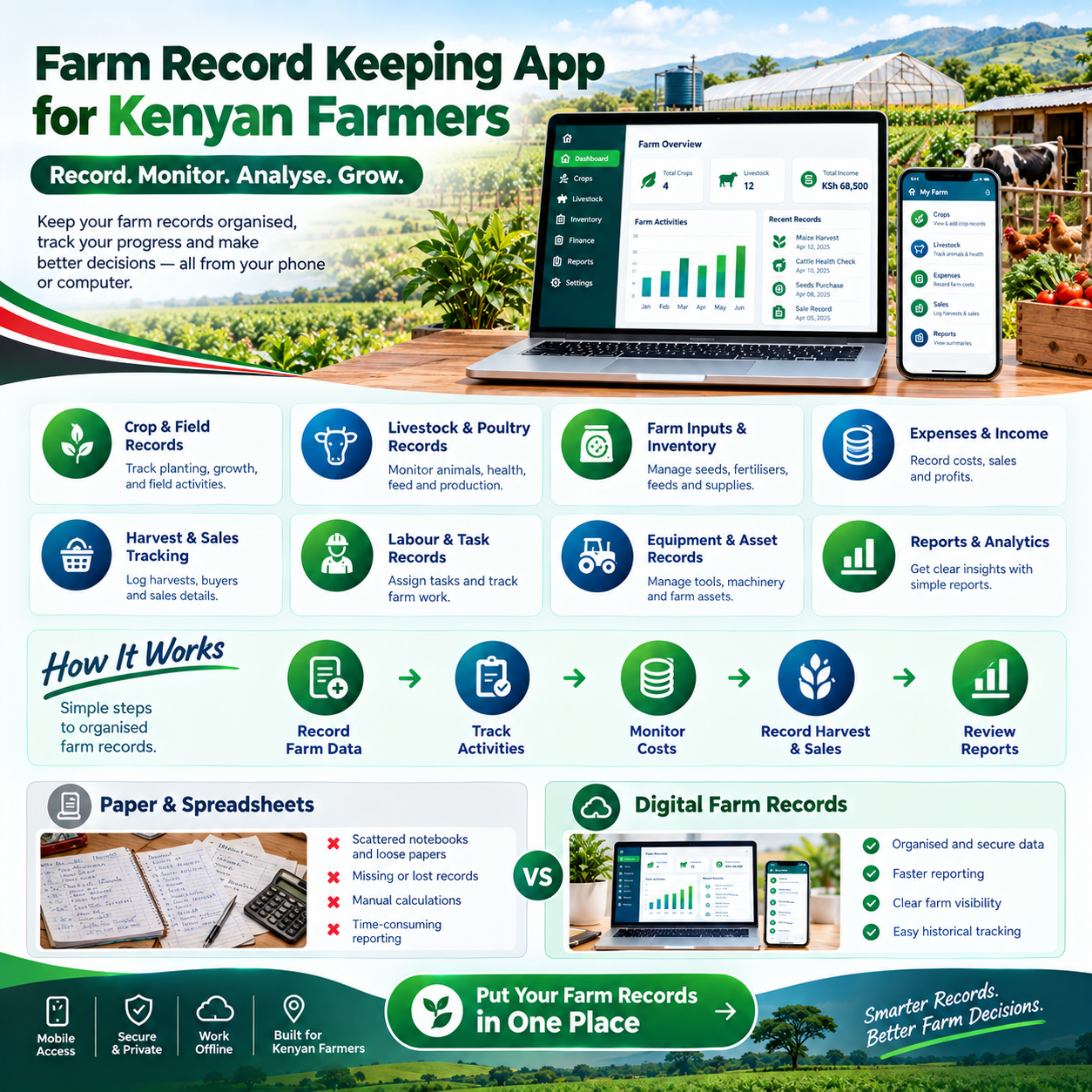
Accountable farm record system is a record keeping approach built around one structural property: every entry in the system carries its author, its timestamp, and its evidence — so every number on the farm can be traced back to the person who recorded it and the moment it was recorded. This single property changes everything.
Ordinary farm records answer “what happened.” Accountable records answer the harder questions that follow: who recorded it, who did the work, who issued the inputs, who approved the exception, and whether the record agrees with physical reality. Those are the questions every dispute, every audit, and every loss investigation actually turns on.
Farms without accountability pay for the gap continuously. Inputs vanish without a trail. Sales drift out of the books. Attendance is a matter of memory. Payday becomes an argument. And when something goes wrong, the investigation finds no trail — because none was ever created.
A structured accountable farm record system creates the trail permanently and automatically. Every activity logged against a named worker. Every input issued against a storekeeper’s login. Every sale recorded by the person who made it. Every figure verifiable against physical counts.
The result is not surveillance — it is fairness and protection running in both directions. Workers gain records that defend their attendance, their tallies, and their pay. The farm gains records that expose losses, satisfy auditors, and win financing.
This guide examines the accountable farm record system in full: what it is, the five pillars that make records accountable, the features that deliver them, what unaccountable records actually cost, who benefits most, how to choose and implement one, and the verification routines that keep the whole system honest.
Table of Contents
ToggleWhat an Accountable Farm Record System Actually Is
At its core, an accountable farm record system is a digital record platform engineered so that every entry is attributable, timestamped, evidence-backed, and verifiable — four properties that paper notebooks and shared spreadsheets structurally cannot deliver.
Attribution means every record carries its creator: the worker who logged the harvest, the storekeeper who issued the feed, the manager who approved the purchase. Identity is the foundation — without it, nothing else in the system means anything.
Timestamping means every record carries its moment: entered in the field at the time of the activity, not reconstructed days later from memory. The timestamp is what separates a record from a recollection.
Evidence means records carry their proof: photographs of deliveries, receipts attached to purchases, photos of completed work, and batch numbers on every chemical issue. An accountable accountable farm record system converts claims into documentation at the moment of capture.
Verifiability means records reconcile against physical reality: store counts against system balances, harvest tallies against store receipts, payroll figures against attendance records. Where reconciliation is designed in, errors and losses surface within days instead of never.
The contrast with conventional record keeping is structural, not cosmetic. A notebook records a number; an accountable accountable farm record system records a number plus its author, its time, its evidence, and its reconciliation status — and that difference is what turns record keeping from a filing exercise into a control system.
What Unaccountable Records Actually Cost
The first cost is invisible input leakage. When inputs are issued without attribution — “the cows got feed this morning” — nothing prevents the same bag being issued twice, the same jerrican going to two destinations, or the store quietly shrinking. Farms that introduce accountability into their accountable farm record system stores routinely discover leakage running several percent of input spending, previously invisible, now traceable and correctable.
The second cost is unverifiable labour. Attendance recorded on trust lets paid-but-unworked hours accumulate silently, and the accumulation across a year of paydays is substantial. Attribution — who checked in, where, when — is what converts labour spending from a matter of faith into a matter of record.
The third cost is unprovable payments. Sales recorded in one notebook and receipts stored in another drawer mean the farm cannot prove its own income history when a dispute, a lender, or an audit asks. The documented accountable farm record system income history answers those questions from a file.
The fourth cost is dispute exposure. Undocumented employment and unrecorded tallies convert every disagreement into memory versus memory — and Kenyan labour practice, lender assessment, and buyer audits all award such contests to the documented side. The farm without accountability negotiates every dispute from weakness.
The fifth cost is the deepest one: institutional amnesia. When records carry no author, no farm ever learns who performs well, which store leaks, which supplier short-delivers, or which block underperforms. The lessons exist but belong to nobody — and the farm re-pays the same tuition every season. An accountable farm record system converts those lessons into owned, searchable history.
The Five Pillars of Accountability
Pillar One: Individual Identity
Accountability begins with logins: every user of the system is a named person with their own credentials, and shared logins are refused outright. Where workers lack personal devices, a single device still carries individual logins, so the person recording is always identified. This is the first configuration rule of any accountable farm record system deployment, and it is non-negotiable.
Pillar Two: Timestamped Capture
Every entry records when it was made — and where it was made, where devices allow. Field capture with automatic timestamps means the record describes the event, not the memory of the event. The gap between the two is where most record distortion lives, and timestamped accountable farm record system capture closes it permanently.
Pillar Three: Evidence Attachment
Records that can carry proof should carry proof: photographs of deliveries before signing, receipts attached to purchases, batch numbers scanned at issue, photos of completed tasks. Evidence costs seconds at capture and settles disputes for years. The accountable farm record system deployments with evidence discipline hold the strongest positions in every audit and claim.
Pillar Four: Approval and Verification
Sensitive entries route through verification before they count: tallies confirmed by supervisors, store issues validated by the storekeeper, expense claims approved by managers. Approval workflows add a quality gate without adding friction — and they teach the farm’s data culture faster than any training session ever has.
Pillar Five: Reconciliation
The final pillar closes the loop with reality: recorded balances checked against physical counts, recorded tallies checked against store receipts, recorded attendance checked against rotas. Reconciliation is where an accountable farm record system proves itself — because reconciled records are trusted records, and unreconciled ones are only an alternative set of claims.
Core Features That Deliver Accountability
The Complete Audit Trail
The audit trail is the system’s memory of itself: every entry logged with author, time, device, and — where an entry is later edited — the original value and the editor of the change. Nothing is silently altered and nothing is erased without a trace. This property is what makes an accountable farm record system defensible in any dispute, because the record’s history is as visible as its current state.
Role-Based Access
Access follows role: workers see their own tasks and records, supervisors see their crews, managers see operations, and sensitive financials stay owner-only. Role design serves two purposes simultaneously — data protection and worker comfort — because staff engage more willingly with a system that shows them their own work without exposing everything else.
Photo and Document Attachment
The evidence pillar runs on attachment capability: photos at capture, receipts filed against transactions, delivery notes stored against purchases. Systems that treat attachments as a core feature rather than an afterthought are the ones whose records carry weight — and weight is exactly what an accountable farm record system exists to add.
Offline Capture With Sync
Accountability must survive the field, and the field has no signal. Genuine offline capture — entries recorded on the device, synced automatically on reconnection — keeps the record complete where work actually happens. Test this specifically during any trial, in a real no-signal corner of your own farm.
Stock Issue and Reconciliation Modules
The store is where accountability earns its money fastest. Issue records against named storekeepers and named destinations, live balances, and periodic reconciliation against physical counts expose leakage within days. Operations running disciplined accountable farm record system store modules report the same first-quarter discovery: the gap between recorded issues and physical stock was real, measurable, and closable.
Attendance and Piece-Work Capture
Labour accountability runs on the same engine: check-ins with time and location, tallies recorded at the point of achievement, and payroll computed from the verified data. The attendance and piece-work modules of an accountable farm record system remove the two most disputed areas of farm life — presence and payment — from the realm of argument entirely.
Approval Workflows
Where verification matters, entries route through named approvers before they count: supervisor confirmation of tallies, manager approval of purchases above thresholds. The workflow creates a second layer of attribution — who verified, as well as who recorded — which doubles the trail every sensitive entry carries.
Automated Reports and Exports
Accountable records should serve their audiences automatically: lender-ready statements, audit packs, worker histories, and enterprise reports generated from the attributed data on demand. A system whose accountable farm record system outputs require manual assembly has only half delivered — the records exist, but their value still depends on someone’s weekend.
The Benefits Farms Report After Going Accountable
The first benefit is leakage control, and it arrives within the first quarter. Attributed inputs, reconciled stores, and verified tallies close the gaps through which inventory and labour money had been draining — and the recovery typically exceeds the system’s annual cost before any other benefit is counted.
The second is dispute elimination. Payday arguments, attendance disputes, tally disagreements, and deposit conflicts all resolve from the record rather than from volume — and the farms running complete accountable farm record system trails report paydays becoming announcements rather than arbitrations.
The third is workforce trust. Workers who can see their own attendance, their own counts, and their own payslips stop suspecting the system — because they can verify it. Verification flowing toward workers is what makes accountability self-enforcing, and it is the reason transparent accountable farm record system deployments are defended by staff rather than routed around.
The fourth is audit and financing readiness. Certification inspections, lender assessments, and buyer audits all demand documented, attributable records — and farms producing them from a live system pass while undocumented competitors reconstruct and fail. The accountable farm record system evidence file has become, in practice, a market-access credential.
The fifth is performance visibility. Attribution makes good work nameable: the picker whose counts are verified and strong, the storekeeper whose reconciliations always balance, the crew whose outputs lead the farm. Recognition grounded in records retains the people records prove — and retention is the compounding return beneath all the others.
Who Needs an Accountable Record System Most
Farms with more than a handful of workers need accountability structurally, because attribution collapses informally somewhere around the third or fourth hand touching the records. Operations that crossed that threshold on an accountable farm record system platform scaled cleanly; operations that didn’t relearn the lesson through losses every season.
Farms with heavy input flows — crop chemicals, fertiliser, feed — need it most urgently, because inputs are where leakage concentrates and where documentation requirements are strictest. The store module of an accountable farm record system is typically the first component to repay its cost.
Harvest-driven farms running piece work need accountability at its sharpest, because tallies are payroll and payroll is trust. Systems that record counts at the collection point, reconcile them against store receipts, and feed payroll directly have converted the sector’s most disputed process into its most disciplined one.
Multi-site operations and outgrower schemes complete the constituency: distributed crews, distributed stores, and owners who cannot be everywhere make attribution the only practical control. The operations that industrialised accountability across sites run coordination that manual management never achieves — and their buyers and investors increasingly require exactly that evidence.
Accountable Systems vs Notebooks and Spreadsheets
The notebook is where farm recording begins, and its accountability ceiling is zero: no authors, no timestamps, no verification, and no survival. Every dispute it cannot settle traces to those absences — and none of them can be fixed by writing more neatly.
Spreadsheets climb slightly higher and stop at the same wall: a shared file has no reliable identity, no audit trail, and no reconciliation engine — and every edit overwrites the previous truth invisibly. The farms that migrated from spreadsheets to a structured accountable farm record system describe the same threshold: the first serious dispute the spreadsheet could not settle was the migration’s true start date.
The decisive difference is evidentiary weight. A notebook number and a spreadsheet cell are assertions; an attributed, timestamped, evidence-attached, reconciled record is documentation. When a farm needs its numbers believed — by a labour officer, a lender, a buyer’s auditor, or its own workforce — only the documented accountable farm record system version carries full weight.
Trust completes the comparison in both directions. Workers trust records they can inspect; owners trust records they can reconcile; and both trusts are structural properties of accountable systems rather than habits that paper never quite builds.
How to Choose the Right Accountable System
Individual identity comes first: verify during the trial that every user logs in as themselves, that entries carry authors visibly, and that shared logins are impossible or refused. Any accountable farm record system candidate that tolerates shared credentials is telling you its accountability is cosmetic.
Audit-trail depth is the second test: ask to see what happens when an entry is edited — whether the original survives visibly and the change carries its editor. Systems that answer confidently here were built for accountability; systems that hesitate were built for convenience with accountability words attached.
Evidence and reconciliation capability complete the functional tests: demonstrate a photographed delivery, a verified tally, and a store reconciliation during the trial — with your real scenarios, not demonstrations. The accountable farm record system that handles your actual verification flows is the one that will hold in production.
Ease for the least technical user decides adoption, and adoption decides everything: hand the trial phone to your least tech-comfortable worker and watch a real entry being made. Support quality, local understanding, transparent pricing, and data ownership terms complete the checklist — and any vendor unclear on the last one is describing a lock-in problem before it happens.
Implementing Without Disrupting Operations
Begin with the accountability audit: where the farm’s records live today, who records what, and which activities currently escape attribution entirely. This map becomes the configuration blueprint — roles, permissions, approval thresholds, and verification points defined before the first entry.
Load the foundation honestly: every user named with their role, every store counted once with its opening balance entered, every worker registered with correct engagement terms. An accountable farm record system is only as trustworthy as its opening data, and the opening stocktake doubles as the farm’s first accountability exercise.
Launch with the highest-value loops first — store issues, attendance, and one production record type — and run the first two weeks with daily entry reviews: correct habits immediately, answer questions fast, and make the system’s early experience responsive. Then expand into tallies, purchases, and the remaining record types as the habit holds.
Frame the rollout truthfully and early: the system protects accurate pay, records attendance fairly, makes good work visible, and puts every worker’s own history in their own hands. The deployments where accountable farm record system adoption succeeded fastest were the ones whose workers heard that framing first — and then watched it prove true.
The Verification Routines That Keep It Honest
The daily rhythm is short: entries reviewed by supervisors each evening, physical counts reconciled against system balances at the store’s close, and exceptions flagged before they age. Fifteen minutes of daily verification is the maintenance schedule of the entire accountability structure.
The weekly rhythm adds sampling: a selection of tallies checked against store receipts, a selection of attendance against rotas, a selection of purchases against delivery notes. Sampling keeps every accountable farm record system stream honest at a cost of minutes, because sampled data that is checked stays data that is trusted.
The quarterly rhythm is the full count: stores physically verified, livestock registers reconciled, and the audit trail reviewed for gaps. Operations that hold this rhythm report that reconciliation becomes routine rather than dramatic — which is precisely the state an accountable record system exists to create.
Common Mistakes That Undermine Accountability
The first mistake is identity shortcuts — shared logins, supervisor-recorded-everything, anonymous bulk entry — which preserve the appearance of a system while destroying the attribution that gives it value. The farms that protect individual accountable farm record system identity from day one keep the accountability they paid for.
The second is data without verification — records captured, approvals skipped, reconciliations deferred — which produces confident numbers that drift from reality silently. The verification routines above are not overhead on the system; they are the system, and skipping them converts accountability software into a more expensive notebook.
The Future of Accountable Farm Records
The direction is automation of verification itself: scanning at issue, weighbridges feeding receipts, sensors confirming deliveries, and reconciliation running continuously in the background. Farms building clean attributed records today are pre-building that automation, because every verification system needs clean data before it can verify anything.
The deeper shift is verified accountability across the agricultural economy: lenders reading record discipline as management quality, buyers and certification schemes auditing attributable histories, and workers carrying verified employment records between farms. The operations whose accountable farm record system trails already exist will meet that economy with evidence while others reconstruct what they can.
Frequently Asked Questions
What makes a farm record system “accountable”?
Four structural properties: every entry carries its named author, its timestamp, its attached evidence, and its reconciliation status against physical reality — with an audit trail preserving every change. Any accountable farm record system missing one of the four is a conventional record system with better branding.
How does accountability reduce theft and losses?
Through visibility and attribution rather than confrontation: inputs issued against names cannot disappear quietly, tallies recorded against workers cannot inflate silently, and reconciliations catch variances within days. Farms running full accountable farm record system trails report leakage declining sharply within the first quarter — deterrence by record, not by suspicion.
Do workers resist being recorded?
Only where the system is framed as surveillance and run as one. Where workers hold their own visibility — their attendance, their counts, their payslips — they become the records’ strongest defenders, because the same trail that protects the farm protects them. Transparent accountable farm record system practice converts resistance into advocacy reliably.
Can one system cover stores, labour, and production together?
Yes — unified platforms carry all three record streams in one attributed database, which is what makes cross-reconciliation possible: tallies against store receipts, attendance against payroll, issues against activities. The integration is precisely the value of a genuine accountable farm record system over separate tools.
How is this different from ordinary farm management software?
Ordinary software records what happened; accountable software proves it happened — authors, timestamps, evidence, approvals, and reconciliations built into every entry. Farms choosing between the two should choose by question: if the only question is “what did we do,” either works; if the questions include “who did it, can you prove it, and does it match reality,” only a true accountable farm record system answers.
How do I start small with accountability?
Begin with the three highest-value loops: named logins for everyone, store issues recorded against the storekeeper and destination, and attendance captured with timestamps — then add tallies, approvals, and reconciliations as the habits hold. The accountable farm record system discipline scales from three habits upward, and small farms often adopt it fastest because the loop is short.
How often should records be reconciled against reality?
Stores and tallies daily or weekly through routine counts, the full physical verification quarterly, and the audit trail reviewed for gaps at the same rhythm. The frequency rule is simple: reconcile often enough that errors are caught while they are corrections, because an unreconciled accountable farm record system is just a faster notebook.
Does an accountable record system help with loans and audits?
Decisively — attributed, evidence-backed, reconciled records are exactly what credit committees, certification inspectors, and buyer audits assess, and farms producing them live pass rounds that undocumented competitors fail. The maintained accountable farm record system file has become a financing and market-access credential in its own right.
What happens to my records if I leave the system?
They should remain your property, exportable in full with their attributions and evidence attached — confirm this in writing before signing and test the export during the trial. Reputable providers of an accountable farm record system pass this test without hesitation, and the ability to leave cleanly is the strongest guarantee of fair treatment while you stay.