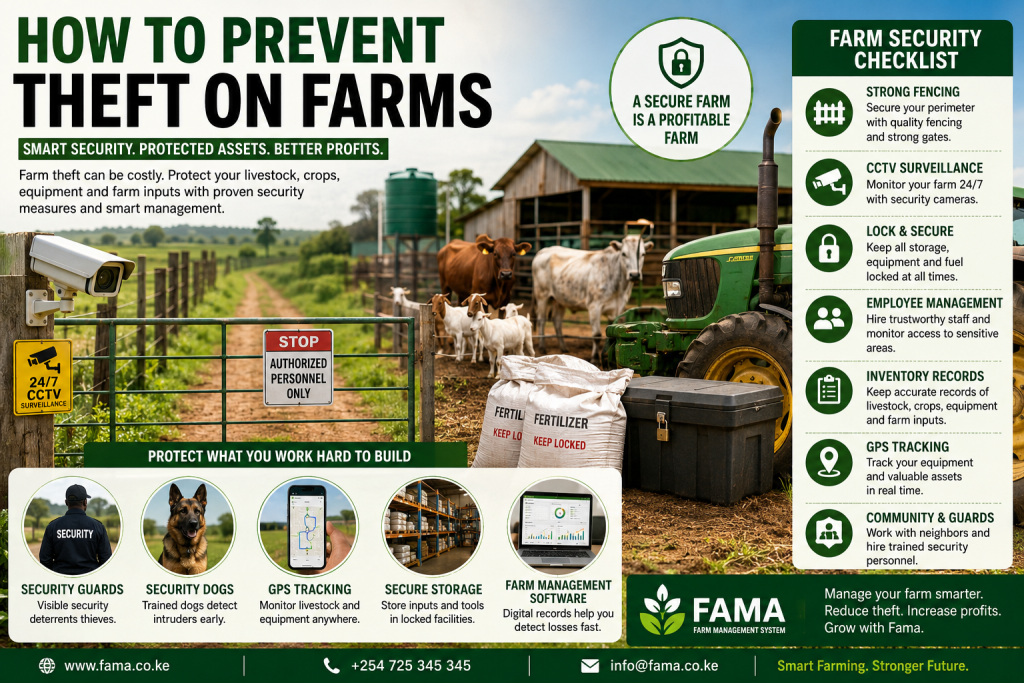
How to Prevent Theft on Farms: Protect Your Livestock, Crops, Equipment, and Profits
Farm theft is one of the biggest challenges affecting farmers across Kenya. Whether you own a small family farm or manage a large commercial agricultural enterprise, theft can significantly reduce your profits, disrupt operations, and discourage investment. Learning how to prevent theft on farms is no longer optional—it is essential for every farmer.
Modern farming involves valuable assets including livestock, harvested produce, irrigation equipment, farm machinery, fertilizers, pesticides, fuel, and expensive tools. Criminals target farms because they often have large areas with limited security and fewer people monitoring activities at night.
The good news is that with proper planning, technology, and good farm management practices, farmers can greatly reduce the risk of theft. This guide explains practical strategies that every farmer should implement.
At Fama Farm Management System, we help farmers not only manage daily operations but also improve accountability through proper farm records, inventory management, livestock tracking, and employee management.
If you need professional farm management software, contact us today:
📞 +254 725345345
Why Farm Theft is Increasing
Understanding why theft occurs helps farmers develop better security strategies.
Common reasons include:
- Rising prices of agricultural products
- High value of farm equipment
- Increasing demand for livestock
- Poor farm security
- Lack of inventory records
- Large unattended farms
- Seasonal harvesting periods
- Poor employee supervision
Knowing how to prevent theft on farms begins with identifying these vulnerabilities before criminals exploit them.
Common Types of Farm Theft
Farm theft takes many forms. Understanding what thieves commonly target helps farmers prepare better protection measures.
Livestock Theft
Livestock remains one of the most stolen farm assets in Kenya.
Animals commonly stolen include:
- Cattle
- Goats
- Sheep
- Pigs
- Poultry
- Rabbits
Livestock theft often happens during:
- Night hours
- Rainy weather
- Public holidays
- Market days
- Harvest seasons
Proper identification and tracking are essential components of how to prevent theft on farms.
Crop Theft
Harvest-ready crops attract thieves because they can easily be sold.
Frequently stolen crops include:
- Maize
- Beans
- Coffee
- Tea
- Avocados
- Bananas
- Tomatoes
- Potatoes
- Onions
- Fruits
Many farmers discover losses only after conducting harvest calculations, making proper farm record keeping extremely important.
Farm Equipment Theft
Modern farming depends on expensive machinery.
Commonly stolen equipment includes:
- Water pumps
- Generators
- Chainsaws
- Brush cutters
- Power tools
- Irrigation pipes
- Solar panels
- Sprayers
- Welding machines
Replacing stolen equipment can significantly increase operational costs.
Fertilizer and Chemical Theft
Agricultural inputs have become expensive.
Items commonly stolen include:
- Fertilizers
- Herbicides
- Fungicides
- Insecticides
- Seeds
- Animal feeds
- Veterinary medicines
Keeping proper inventory records is among the best methods of how to prevent theft on farms.
Fuel Theft
Fuel is frequently stolen from:
- Tractors
- Generators
- Water pumps
- Storage tanks
Small daily losses often accumulate into significant financial damage over time.
Why Farm Security Matters
Every theft affects the overall profitability of a farm.
Consequences include:
- Financial losses
- Delayed production
- Reduced yields
- Increased insurance costs
- Lower employee morale
- Reduced investor confidence
- Higher operating expenses
Farm security should therefore be viewed as an investment rather than an expense.
Conduct a Farm Security Assessment
Before investing in security, identify weak areas.
Walk around your farm and ask:
- Where can someone enter unnoticed?
- Which buildings remain unlocked?
- Are storage areas secure?
- Are valuable items visible?
- Are livestock properly fenced?
- Is there enough lighting?
- Are security cameras installed?
- Who has access to keys?
Performing regular security assessments forms the foundation of how to prevent theft on farms.
Install Proper Farm Fencing
A strong perimeter fence discourages unauthorized access.
Suitable fencing options include:
- Chain-link fencing
- Electric fencing
- Barbed wire
- Concrete perimeter walls
- Live fences
- Wooden fencing
Large commercial farms often combine several fencing methods.
Good fencing also helps manage livestock movement while improving overall farm security.
Secure Farm Gates
Many farms have strong fences but weak gates.
Install:
- Heavy-duty gates
- Strong hinges
- Quality padlocks
- Anti-cut locks
- Steel gate frames
Always keep gates locked whenever possible.
Limit the number of entry points into the farm.
Improve Farm Lighting
Darkness provides cover for thieves.
Install lighting around:
- Farm entrances
- Livestock sheds
- Machinery stores
- Chemical stores
- Fuel storage
- Farm offices
- Parking areas
Solar-powered security lights are becoming increasingly affordable and reliable.
Motion sensor lights are particularly effective because they activate automatically when movement is detected.
Advanced Strategies on How to Prevent Theft on Farms
Hire Professional Farm Security Guards
For medium-sized and large farms, employing trained security guards is one of the most reliable ways of implementing how to prevent theft on farms. Security personnel provide a visible deterrent that discourages criminals from targeting your property.
Security guards should:
- Patrol the farm during the day and night.
- Monitor entrances and exits.
- Check identification of visitors.
- Keep incident reports.
- Respond quickly to suspicious activity.
- Coordinate with local authorities when necessary.
Rotate patrol schedules so that thieves cannot predict guard movements. Combine physical security with technology such as CCTV cameras and alarm systems for even greater protection.
Use Security Dogs to Protect Your Farm
Security dogs are highly effective in how to prevent theft on farms because they can detect intruders long before people notice them.
Suitable breeds include:
- German Shepherd
- Belgian Malinois
- Boerboel
- Rottweiler
- Doberman
Properly trained dogs:
- Patrol farm compounds.
- Guard livestock.
- Alert owners to unusual activity.
- Protect equipment storage areas.
- Deter potential thieves.
Remember that dogs require proper training, feeding, healthcare, and supervision to remain effective.
Install GPS Trackers on Farm Equipment
Modern GPS technology has become an essential tool for how to prevent theft on farms. Expensive machinery can now be monitored in real time.
Install GPS trackers on:
- Tractors
- Harvesters
- Pickup trucks
- Motorbikes
- Water bowsers
- Generators
- Feed delivery vehicles
Benefits include:
- Real-time location tracking.
- Theft recovery.
- Movement history.
- Geofencing alerts.
- Improved fleet management.
GPS technology not only improves security but also increases operational efficiency.
Use GPS Ear Tags for Livestock
Livestock theft remains a serious problem across many farming regions. GPS-enabled livestock tags help farmers know where animals are located at all times.
These systems help:
- Track animal movement.
- Detect unusual movement patterns.
- Locate missing livestock.
- Improve grazing management.
- Reduce livestock losses.
Using livestock identification systems is among the most effective approaches to how to prevent theft on farms.
Implement Visitor Management
Many theft cases begin with unauthorized visitors gaining access to the farm.
A visitor management system should include:
- Visitor registration.
- Identification verification.
- Purpose of visit.
- Host approval.
- Entry and exit times.
- Vehicle registration details.
Never allow unknown visitors to move freely around the farm.
Secure Harvest Periods
Harvest season is when criminals are most active because crops are at their highest value.
To improve how to prevent theft on farms during harvesting:
- Harvest crops promptly.
- Avoid leaving harvested produce overnight.
- Use secure storage facilities.
- Increase security patrols.
- Schedule transport immediately after harvesting.
- Maintain accurate harvest records.
Good harvest planning reduces opportunities for theft.
Protect Farm Stores
Storage buildings often contain thousands of shillings worth of agricultural inputs.
Secure stores should include:
- Reinforced steel doors.
- High-quality locks.
- CCTV surveillance.
- Motion sensors.
- Fire alarms.
- Inventory records.
- Limited access.
Every movement of fertilizer, pesticides, seeds, feeds, and tools should be documented.
Store Fuel Safely
Fuel theft often occurs gradually and may go unnoticed for months.
Best practices include:
- Lock fuel tanks.
- Install fuel gauges.
- Monitor fuel usage.
- Record refueling activities.
- Restrict fuel access.
- Conduct weekly fuel audits.
Proper fuel management contributes significantly to how to prevent theft on farms.
Use Farm Management Software
One of the smartest investments a farmer can make is implementing digital record keeping.
Fama Farm Management Software helps farmers monitor:
- Livestock inventory.
- Crop production.
- Farm expenses.
- Employee attendance.
- Equipment usage.
- Input purchases.
- Harvest records.
- Sales records.
- Inventory movement.
When accurate records are available, missing items can be identified quickly before losses become substantial.
Digital farm management is transforming how to prevent theft on farms by improving accountability across every department.
Keep Detailed Equipment Logs
Maintain records for every piece of machinery.
Include:
- Purchase information.
- Serial numbers.
- Service history.
- Assigned operator.
- Current location.
- Maintenance schedule.
These records simplify insurance claims and improve recovery if equipment is stolen.
Label Every Valuable Asset
Asset identification discourages resale.
Mark:
- Machinery.
- Power tools.
- Water pumps.
- Irrigation equipment.
- Solar panels.
- Generators.
- Computers.
- Office equipment.
Visible identification makes stolen property easier to recognize.
Conduct Regular Stock Audits
Inventory should never remain unchecked.
Schedule:
- Daily inspections.
- Weekly stock counts.
- Monthly inventory reconciliation.
- Quarterly audits.
Frequent stock verification supports how to prevent theft on farms by detecting losses early.
Monitor Employee Activities
Internal theft can sometimes cause greater losses than external theft.
Managers should:
- Assign clear responsibilities.
- Record issued tools.
- Track equipment usage.
- Monitor attendance.
- Verify stock movement.
- Supervise loading activities.
Building a culture of accountability protects the entire farming operation.
Improve Communication
Farm workers should immediately report:
- Broken fences.
- Missing livestock.
- Suspicious vehicles.
- Unknown visitors.
- Damaged locks.
- Missing equipment.
Quick reporting often prevents small incidents from becoming major losses.
Secure Farm Records
Farm records contain valuable operational information.
Protect both physical and digital records through:
- Password protection.
- Cloud backups.
- Locked filing cabinets.
- Restricted access.
Accurate records support investigations whenever theft occurs.
Install Motion Detection Systems
Motion sensors automatically detect unauthorized movement.
They can activate:
- Floodlights.
- Alarms.
- CCTV recording.
- Mobile notifications.
Motion detection technology strengthens how to prevent theft on farms, especially during nighttime.
Use Drones for Farm Surveillance
Large farms are increasingly using drones to monitor operations.
Drones help:
- Patrol remote areas.
- Inspect fences.
- Monitor livestock.
- Detect unauthorized activities.
- Assess crop conditions.
Routine aerial surveillance discourages criminal activity.
Create Emergency Response Procedures
Every farm should have an emergency action plan.
Include:
- Emergency contacts.
- Police numbers.
- Veterinary contacts.
- Security company contacts.
- Staff responsibilities.
- Communication procedures.
Preparation reduces response time during theft incidents.
Work Closely with Local Authorities
Establish strong relationships with:
- Local police.
- Chiefs.
- Village elders.
- Community policing groups.
- Neighbouring farmers.
Sharing information improves the overall success of how to prevent theft on farms.
Purchase Farm Insurance
Although prevention remains the priority, insurance provides financial protection.
Consider insurance for:
- Livestock.
- Farm machinery.
- Buildings.
- Crops.
- Equipment.
- Greenhouses.
Always keep updated inventories and photographs of valuable assets to support claims.
Educate Your Farm Team
Security should become part of everyday farm culture.
Regular training should cover:
- Theft prevention.
- Inventory management.
- Visitor handling.
- Equipment accountability.
- Cybersecurity for digital records.
- Emergency reporting.
When every employee understands how to prevent theft on farms, the entire business becomes more secure.
Benefits of Preventing Farm Theft
Effective farm security offers many long-term advantages.
These include:
- Increased profitability.
- Lower replacement costs.
- Better employee accountability.
- Improved productivity.
- Greater investor confidence.
- Better livestock management.
- Improved inventory accuracy.
- Reduced operational risks.
- Stronger business growth.
Protecting farm assets is ultimately protecting the future of your farming business.
Why Choose Fama Farm Management Software?
While fences, locks, and guards play an important role, digital management provides another layer of protection. Fama Farm Management Software helps farmers detect irregularities before they become costly theft cases.
With Fama Farm Management Software, you can:
- Track livestock records.
- Manage crop production.
- Monitor inventory levels.
- Record purchases and sales.
- Manage employee attendance.
- Track farm expenses.
- Generate financial reports.
- Record equipment usage.
- Monitor farm activities from one centralized system.
Using Fama Farm Management Software is a smart investment for farmers looking to improve efficiency while strengthening how to prevent theft on farms.
Frequently Asked Questions (FAQs)
What is the best way to prevent theft on farms?
The best approach combines physical security, CCTV surveillance, farm management software, employee accountability, inventory management, and community cooperation. Using multiple layers of protection provides the strongest defense.
How does farm management software help prevent theft?
Farm management software creates detailed records of livestock, crops, equipment, inventory, employees, purchases, and sales. Accurate records make it easier to identify missing assets and investigate suspicious activities quickly.
Is CCTV necessary on farms?
Yes. CCTV cameras discourage criminals, provide evidence during investigations, and allow remote monitoring of farm operations, making them a valuable component of how to prevent theft on farms.
Can GPS tracking reduce livestock theft?
Yes. GPS-enabled ear tags and tracking devices allow farmers to monitor livestock locations in real time, making recovery much easier if animals are stolen.
Why are inventory records important?
Inventory records help farmers detect shortages early, identify unusual stock movements, improve accountability, and reduce opportunities for internal and external theft.
Conclusion
Farm theft is a growing challenge that can affect every aspect of agricultural production. Learning how to prevent theft on farms requires more than installing a fence—it involves adopting a comprehensive security strategy that combines technology, good management practices, employee accountability, community cooperation, and accurate record keeping.
By investing in CCTV systems, GPS tracking, secure storage, trained personnel, inventory management, visitor controls, and digital farm management software, farmers can significantly reduce theft and safeguard their investments. Every measure taken today helps protect future harvests, livestock, machinery, and profits.
If you are looking for a smarter way to manage your farm while improving security and accountability, Fama Farm Management Software provides the tools you need. From livestock tracking and inventory management to employee monitoring and financial reporting, Fama helps you build a more efficient, productive, and secure farming business.
Contact Fama today to learn how our farm management solutions can help protect your farm.
🌐 Website: fama.co.ke
📞 Call/WhatsApp: +254 725345345
Install CCTV Cameras
Security cameras help deter criminals while providing valuable evidence.
Monitor:
- Main entrances
- Animal sheds
- Equipment stores
- Fuel storage
- Packing houses
- Farm offices
- Parking yards
Modern CCTV systems allow farmers to monitor their farms remotely using smartphones.
Video surveillance plays an increasingly important role in how to prevent theft on farms.
Use Farm Management Software
One of the most effective tools for preventing theft is maintaining accurate records.
Without proper records, theft often goes unnoticed.
A modern farm management system helps monitor:
- Livestock inventory
- Equipment inventory
- Crop harvests
- Employee attendance
- Input usage
- Sales
- Purchases
- Farm expenses
Fama Farm Management Software helps farmers maintain complete operational visibility, making unauthorized losses easier to detect.
Keep Accurate Inventory Records
Every valuable asset should be documented.
Record:
- Quantity
- Purchase date
- Supplier
- Cost
- Storage location
- Current condition
- Person responsible
Regular stock reconciliation helps identify missing items before losses become severe.
Inventory management is a key principle of how to prevent theft on farms.
Mark Farm Equipment
Clearly mark machinery and tools.
Methods include:
- Engraving
- Permanent paint
- Serial numbers
- QR codes
- Asset labels
- RFID tags
Marked equipment becomes more difficult for thieves to sell.
Recovery also becomes easier if stolen items are found.
Restrict Employee Access
Not every employee requires access to every section of the farm.
Limit access to:
- Chemical stores
- Fuel storage
- Machinery sheds
- Financial records
- Livestock medicine
- Storage warehouses
Assign responsibilities clearly.
Maintain access logs whenever possible.
Conduct Employee Background Checks
Unfortunately, some theft cases involve insiders.
Before hiring workers:
- Verify identity
- Check references
- Confirm previous employment
- Request recommendations
- Verify contact information
Hiring trustworthy employees greatly reduces internal theft.
Train Employees on Farm Security
Employees should understand their role in protecting farm assets.
Training topics include:
- Reporting suspicious activity
- Locking storage rooms
- Visitor management
- Inventory handling
- Equipment accountability
- Emergency procedures
Security awareness should become part of everyday farm operations.
Lock Storage Facilities
Every storage building should have secure locks.
Storage areas include:
- Chemical stores
- Feed stores
- Tool rooms
- Equipment sheds
- Fuel stores
- Seed storage
- Harvest warehouses
High-value items should never be left unsecured overnight.
Install Alarm Systems
Alarm systems provide immediate alerts during unauthorized access.
Modern alarms can notify:
- Farm owners
- Security companies
- Farm managers
- Local police
Wireless alarm systems are becoming increasingly popular for farms.
Use Livestock Identification Systems
Each animal should have a unique identity.
Popular identification methods include:
- Ear tags
- RFID tags
- Branding
- Tattoos
- GPS collars
Proper livestock identification supports insurance claims and recovery efforts if animals are stolen.
Monitor Animal Movement
Keep detailed records of:
- Births
- Sales
- Purchases
- Deaths
- Transfers
- Veterinary treatments
Unexpected changes often indicate theft or management issues.
Good livestock records strengthen how to prevent theft on farms by ensuring accountability.
Build Good Relationships with Neighbours
Neighbouring farmers are valuable partners in farm security.
Encourage:
- Information sharing
- Joint patrols
- Emergency communication
- Reporting suspicious vehicles
- Community watch groups
Many successful theft prevention initiatives rely on strong community cooperation.
Strengthen Your Farm Security with Smart Technology and Better Farm Management
As farming continues to become more commercial and technology-driven, understanding how to prevent theft on farms is more important than ever. Every farmer should make how to prevent theft on farms a daily priority rather than reacting only after losses occur. Whether you manage livestock, crops, poultry, dairy farming, or mixed farming, investing in the right security measures will protect your income and ensure long-term success. Combining physical security with digital farm management creates one of the most effective strategies for how to prevent theft on farms.
A modern farm should use multiple layers of protection. Strong perimeter fencing, CCTV cameras, security lighting, GPS tracking, inventory management, employee accountability, and digital records all work together to improve how to prevent theft on farms. Farmers who regularly inspect their farms, monitor equipment, and maintain accurate records are far less likely to experience significant losses. Regular audits of livestock, harvested produce, fertilizers, chemicals, fuel, and machinery help identify missing items quickly, making how to prevent theft on farms much easier to implement.
Fama Farm Management Software is designed to support farmers who want better control over their operations while improving how to prevent theft on farms. The software enables you to monitor livestock, record crop harvests, manage farm inventory, supervise employees, track equipment, and generate accurate reports from one centralized platform. These features reduce opportunities for theft while improving overall farm productivity and accountability. Digital record keeping has become one of the smartest investments for farmers serious about how to prevent theft on farms.
If you are searching for reliable solutions on how to prevent theft on farms, now is the time to combine good management practices with modern technology. Protect your livestock, crops, machinery, tools, fuel, fertilizers, and valuable farm assets before theft occurs. By consistently applying proven methods of how to prevent theft on farms, you reduce financial losses, improve efficiency, increase profitability, and create a safer farming environment for your workers and your business. Choosing Fama Farm Management Software is another important step toward mastering how to prevent theft on farms and securing the future of your agricultural investment.
Contact us today:
📞 +254 725345345
Website: fama.co.ke