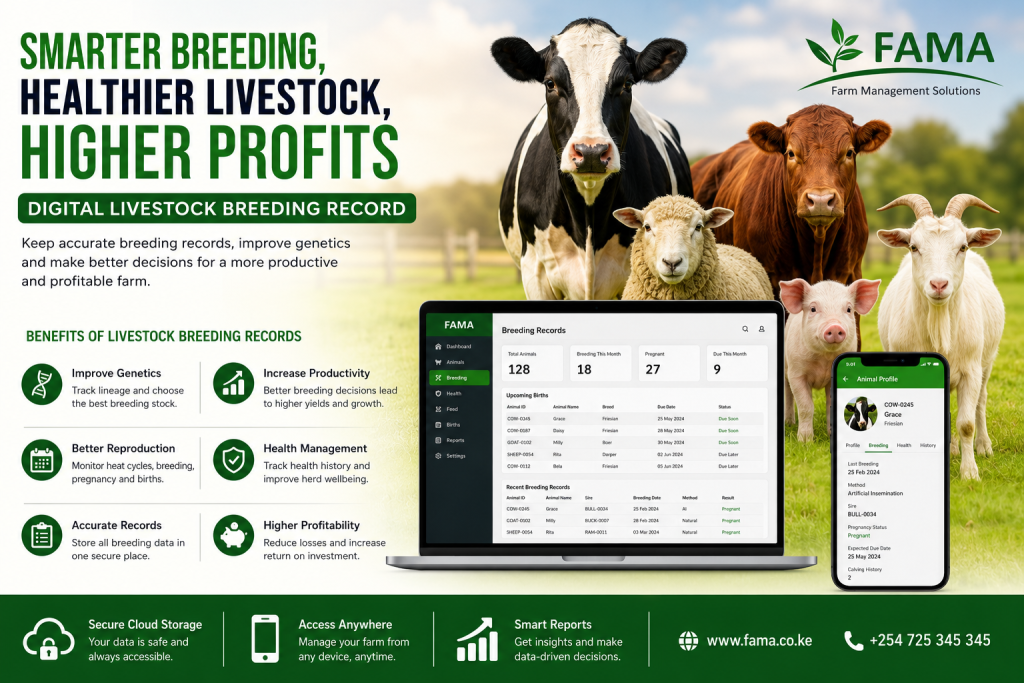
Managing a successful livestock farm requires more than feeding animals and providing shelter. Modern livestock farming depends on accurate data, informed decision-making, and continuous monitoring of every animal on the farm. This is where a livestock breeding record becomes one of the most valuable tools for farmers. Whether you keep cattle, dairy cows, goats, sheep, pigs, poultry, or rabbits, maintaining a detailed livestock breeding record helps improve productivity, profitability, and genetic quality.
At Fama (Fama.co.ke), we understand the importance of digitizing farm operations. Our smart farm management software enables farmers to create, store, and analyze every livestock breeding record with ease, helping eliminate paperwork while improving breeding decisions.
If you’re looking for the best way to manage breeding activities on your farm, this comprehensive guide explains everything you need to know about maintaining a livestock breeding record and why every livestock farmer should adopt a digital livestock management system.
What Is a Livestock Breeding Record?
A livestock breeding record is a detailed collection of information documenting the reproductive history of every breeding animal on a farm. These records include breeding dates, sire information, pregnancy checks, expected delivery dates, births, offspring performance, health history, and genetic lineage.
Without a proper livestock breeding record, farmers often struggle with:
- Missed breeding opportunities
- Poor fertility rates
- Inbreeding
- Low milk production
- Reduced meat quality
- Difficult genetic improvement
- Poor financial returns
A well-maintained livestock breeding record provides valuable insights that help farmers make informed breeding decisions.
Why Every Farmer Needs a Livestock Breeding Record
Many farmers still rely on memory or notebooks to monitor breeding activities. Unfortunately, handwritten records are easily misplaced, damaged, or forgotten.
Using a digital livestock breeding record offers several advantages.
Improved Breeding Decisions
Accurate breeding records allow farmers to select the best bulls, bucks, rams, boars, or cocks based on proven performance instead of guesswork.
Better Fertility Management
A livestock breeding record helps identify animals with poor fertility, repeat breeders, and reproductive disorders.
Genetic Improvement
One of the greatest benefits of maintaining a livestock breeding record is improving genetics over time by selecting high-performing breeding animals.
Increased Farm Productivity
Better breeding management leads to:
- More healthy offspring
- Higher milk yields
- Better meat production
- Improved growth rates
- Reduced infertility
Why Manual Livestock Breeding Records Are No Longer Enough
Traditional record books present several challenges:
- Lost notebooks
- Incomplete entries
- Human errors
- Difficult reporting
- Time-consuming searches
- Poor historical tracking
Digital livestock breeding record software solves these challenges by storing information securely in one centralized system.
Fama Livestock Breeding Record Software
Fama provides one of Kenya’s most reliable livestock management solutions.
Using Fama, farmers can record:
- Animal identification
- Breed information
- Birth history
- Parent information
- Artificial insemination records
- Natural mating records
- Pregnancy diagnosis
- Calving records
- Kidding records
- Lambing records
- Pig farrowing records
- Mortality records
Every livestock breeding record remains securely stored and easily accessible whenever needed.
Information Included in a Livestock Breeding Record
An effective livestock breeding record should capture detailed information about every breeding event.
Animal Identification
Each breeding animal should have:
- Ear tag number
- Registration number
- Breed
- Sex
- Date of birth
- Color
- Physical characteristics
Proper identification ensures every livestock breeding record belongs to the correct animal.
Parent Information
A complete livestock breeding record should include:
- Sire ID
- Dam ID
- Breed lineage
- Family history
Knowing the ancestry helps avoid inbreeding and improves genetic selection.
Breeding Dates
Recording breeding dates is critical.
Information includes:
- Date serviced
- Method used
- Natural mating
- Artificial insemination
- Heat detection date
Every livestock breeding record should accurately capture these breeding events.
Pregnancy Diagnosis
Pregnancy confirmation should include:
- Examination date
- Results
- Expected delivery date
- Veterinary observations
These details improve reproductive planning.
Birth Records
Each livestock breeding record should document:
- Birth date
- Number of offspring
- Birth weight
- Sex
- Birth complications
- Survival status
Birth records provide important performance indicators.
Weaning Information
After birth, farmers should continue updating the livestock breeding record with:
- Weaning date
- Weaning weight
- Growth performance
- Feeding program
Livestock Species That Require Breeding Records
A livestock breeding record is valuable across many livestock enterprises.
Dairy Cattle
Dairy farmers should record:
- AI services
- Calving dates
- Lactation performance
- Milk production
- Dry periods
Beef Cattle
A livestock breeding record helps beef farmers monitor:
- Weight gain
- Calving intervals
- Bull performance
- Growth rates
Goat Farming
Goat farmers should maintain records for:
- Kidding dates
- Bucks used
- Fertility
- Milk production
- Kid growth
Sheep Farming
Sheep breeding records help monitor:
- Lambing
- Twin births
- Breed performance
- Wool production
Pig Farming
Pig farmers should document:
- Heat cycles
- Service dates
- Farrowing dates
- Litter size
- Piglet survival
Poultry Farming
Even poultry operations benefit from breeding records.
Information includes:
- Parent stock
- Egg fertility
- Hatchability
- Chick survival
- Breed performance
Benefits of Digital Livestock Breeding Record Software
Digital systems transform livestock management.
Automatic Reminders
The software reminds farmers about:
- Heat detection
- AI schedules
- Pregnancy testing
- Vaccination
- Expected delivery
No important breeding event is forgotten.
Faster Reporting
Generate reports instantly for:
- Pregnancy rates
- Birth rates
- Fertility performance
- Animal history
- Genetic performance
Easy Animal Search
Instead of flipping through notebooks, simply search by:
- Animal tag
- Breed
- Owner
- Birth date
- Identification number
Cloud Storage
Cloud-based livestock breeding record systems ensure data is never lost.
Benefits include:
- Automatic backup
- Multi-user access
- Mobile accessibility
- Secure storage
Common Challenges Solved by Livestock Breeding Records
Many livestock farmers face recurring breeding challenges that reduce productivity. A proper livestock breeding record helps identify and solve these issues before they become costly.
Some common problems include:
- Missed heat detection
- Long calving intervals
- Low conception rates
- Repeat breeding
- Unknown parentage
- Poor offspring performance
- Inbreeding
- Loss of historical breeding data
By maintaining an accurate livestock breeding record, farmers can quickly identify trends and make timely management decisions that improve herd performance.
How Livestock Breeding Records Improve Farm Profitability
A detailed livestock breeding record is not just for keeping information—it directly contributes to increased profits. Better breeding management leads to healthier animals, higher production, and lower operational costs.
Financial benefits include:
- Higher conception success rates
- Increased milk production
- Better quality breeding stock
- Faster genetic improvement
- Reduced veterinary expenses
- Lower replacement costs
- Improved offspring survival rates
- Higher market value for breeding animals
When breeding decisions are based on accurate livestock breeding record data instead of assumptions, farmers reduce losses and maximize returns on investment.
Why Choose Fama for Livestock Breeding Record Management?
Fama has been developed to simplify livestock management for both small-scale and commercial farmers. Instead of relying on paper files or spreadsheets, farmers can manage every livestock breeding record from one secure digital platform.
Fama helps you:
- Record every breeding activity in real time.
- Monitor pregnancy and expected delivery dates.
- Track the complete history of every animal.
- Improve breeding efficiency and genetic selection.
- Generate reports for better farm planning.
- Access your records anytime from your computer or mobile device.
Whether you keep dairy cattle, beef cattle, goats, sheep, pigs, poultry, or mixed livestock, Fama makes livestock breeding record management simple, organized, and reliable.
Contact Fama Today
Ready to digitize your farm and manage every livestock breeding record with confidence? Fama provides an easy-to-use livestock management solution designed for modern farmers across Kenya.
Website: https://fama.co.ke
Phone: +254 725 345 345
Advanced Livestock Breeding Management, Best Practices, and Future Trends
Maintaining organized breeding information is only one part of successful livestock production. The real value comes from using the information collected to improve animal performance, reduce production costs, and make better long-term decisions. As a farm grows, data becomes increasingly important because every breeding cycle contributes to the overall quality and profitability of the herd or flock.
Modern livestock enterprises rely on accurate information to identify productive animals, remove poor performers, and plan future breeding programs. Instead of depending on memory or scattered paperwork, farmers can access complete animal histories whenever they need them. This saves time while supporting more informed management decisions.
How Data Improves Breeding Decisions
Every breeding season presents opportunities to improve the quality of future generations. Farmers who consistently review historical records can identify patterns that would otherwise go unnoticed.
For example, certain animals may consistently produce healthy offspring with excellent growth rates, while others repeatedly experience fertility challenges or difficult births. Recognizing these differences allows farmers to make objective decisions instead of relying on assumptions.
Over several years, these improvements accumulate and contribute to stronger genetics, healthier animals, and increased production.
Selecting Superior Breeding Animals
Choosing breeding animals should involve much more than appearance. Productive breeding stock should demonstrate desirable characteristics that can be passed to future generations.
Important selection factors include:
- Good fertility history
- Healthy body condition
- Strong immunity
- Excellent growth performance
- High milk production where applicable
- Good temperament
- Strong mothering ability
- Structural soundness
- Resistance to common diseases
Making careful selection decisions improves the overall quality of the herd over time.
Preventing Inbreeding
One of the biggest challenges on many farms is accidental inbreeding. This often occurs when farmers lose track of family relationships over several years.
Inbreeding may result in:
- Lower fertility
- Smaller offspring
- Birth defects
- Reduced disease resistance
- Slower growth
- Lower productivity
Maintaining organized family lineage information helps ensure unrelated animals are selected for future breeding programs, protecting the genetic strength of the herd.
Artificial Insemination Management
Artificial insemination has become increasingly popular because it allows farmers to access superior genetics without purchasing expensive breeding males.
Proper management involves recording:
- Service dates
- Semen batch information
- Technician details
- Pregnancy confirmation
- Expected delivery dates
- Calving outcomes
Keeping these details organized allows farmers to evaluate conception rates and identify which genetic lines perform best under local conditions.
Natural Mating Management
Many farms continue to rely on natural mating systems. Even when artificial insemination is not used, documenting breeding activity remains equally important.
Useful information includes:
- Male identification
- Female identification
- Date of mating
- Number of services
- Pregnancy outcome
- Birth results
Tracking this information helps evaluate the performance of each breeding male and determine whether replacements are necessary.
Managing Replacement Stock
Future productivity depends on selecting the right young animals for breeding.
Replacement animals should be evaluated using multiple performance indicators rather than age alone.
Factors to consider include:
- Growth rate
- Body weight
- Health history
- Structural development
- Parent performance
- Fertility potential
- Feed efficiency
Selecting quality replacements contributes to continuous improvement across the entire farm.
Health and Reproduction Work Together
Successful breeding depends heavily on animal health. Even genetically superior animals may experience poor reproductive performance if nutrition or disease management is inadequate.
Healthy breeding programs should include:
- Routine vaccinations
- Parasite control
- Mineral supplementation
- Balanced feeding
- Regular veterinary examinations
- Clean housing
- Stress reduction
Good health management supports higher conception rates and healthier offspring.
Nutrition Before and After Breeding
Nutrition plays a major role in reproductive success.
Animals should receive balanced diets containing adequate:
- Energy
- Protein
- Vitamins
- Minerals
- Clean drinking water
- Quality forage
Undernourished animals often experience delayed breeding, poor conception, and weak offspring, while overfeeding can also create reproductive challenges.
Providing the correct nutrition before breeding, during pregnancy, and after birth improves productivity throughout the reproductive cycle.
Managing Pregnant Animals
Pregnancy requires careful monitoring to ensure both the mother and offspring remain healthy.
Important management practices include:
- Providing adequate nutrition
- Avoiding unnecessary stress
- Maintaining clean housing
- Monitoring body condition
- Scheduling veterinary examinations
- Preparing suitable birthing areas
Proper care during pregnancy reduces complications and improves newborn survival.
Preparing for Birth
As expected delivery dates approach, farmers should prepare suitable facilities and necessary equipment.
Preparation may include:
- Clean bedding
- Disinfectants
- Calving or kidding supplies
- Veterinary contact information
- Adequate lighting
- Fresh water
- Feed supplies
Being prepared reduces emergency situations and supports successful deliveries.
Caring for Newborn Animals
The first few hours after birth are critical.
Newborn management should focus on:
- Ensuring breathing is normal
- Cleaning the umbilical cord
- Providing colostrum quickly
- Monitoring body temperature
- Recording birth weight
- Identifying the newborn
Early care has a significant impact on future growth and survival.
Performance Monitoring Throughout Life
Monitoring should continue well beyond birth.
Farmers benefit from recording:
- Growth rates
- Feed consumption
- Medical treatments
- Vaccinations
- Weight changes
- Production performance
- Reproductive development
Long-term monitoring creates a complete history that supports future breeding and culling decisions.
The Importance of Regular Data Reviews
Collecting information alone is not enough. Farmers should schedule regular reviews to identify trends and opportunities for improvement.
Monthly or quarterly reviews can reveal:
- Declining fertility
- Extended calving intervals
- Poor growth rates
- Increasing disease cases
- High mortality
- Improved genetic performance
These reviews allow problems to be addressed before they become costly.
Integrating Technology into Farm Management
Technology has transformed modern agriculture by simplifying daily farm operations.
Digital farm management systems allow farmers to:
- Access records from multiple devices
- Generate reports instantly
- Store information securely
- Monitor animal performance over time
- Reduce paperwork
- Improve planning
- Save valuable time
Cloud-based platforms also minimize the risk of losing years of valuable farm information.
Common Mistakes Farmers Should Avoid
Many breeding challenges arise from avoidable management mistakes.
Some common errors include:
- Delaying record updates
- Using unidentified breeding animals
- Ignoring fertility problems
- Breeding animals too early
- Poor nutrition before breeding
- Failing to monitor pregnancies
- Inadequate newborn care
- Not reviewing historical data
- Allowing uncontrolled mating
Avoiding these mistakes improves both productivity and profitability.
Benefits for Small-Scale and Commercial Farmers
Good breeding management practices benefit farms of every size.
Small-scale farmers gain:
- Better organization
- Improved planning
- Reduced production losses
- Increased income opportunities
Commercial farms benefit from:
- Faster decision-making
- Improved herd management
- Better production forecasting
- Higher operational efficiency
- Easier regulatory compliance
- Stronger genetic improvement programs
Regardless of farm size, organized information supports better management.
Future Trends in Livestock Management
Agriculture continues to evolve through innovation.
Emerging technologies include:
- Artificial intelligence for breeding recommendations
- Wearable animal monitoring devices
- Automated heat detection
- Remote health monitoring
- GPS livestock tracking
- Electronic identification tags
- Cloud-based analytics
- Mobile farm applications
These innovations allow farmers to make faster and more accurate management decisions while improving productivity.
Why Digital Farm Records Matter
Paper notebooks have served farmers for decades, but digital systems provide significant advantages in today’s farming environment.
Electronic records make it easier to retrieve historical information, compare animal performance across multiple years, generate management reports, and share information with veterinarians or farm managers. As farms expand, these efficiencies become increasingly valuable because they reduce administrative work while improving decision-making.
Digital systems also provide stronger data security through automated backups, helping protect years of valuable farm information from accidental loss or damage.
Supporting Sustainable Livestock Production
Sustainability has become an important goal for livestock producers around the world. Better management practices help farmers produce more while using resources efficiently.
Accurate information contributes to sustainability by helping farmers:
- Improve feed efficiency
- Reduce unnecessary medication
- Lower mortality rates
- Increase reproductive success
- Improve animal welfare
- Reduce production costs
- Make informed investment decisions
These improvements strengthen both environmental and economic sustainability.
Why Choose Fama?
Fama is designed to simplify livestock management by bringing all important farm information together in one secure platform. Farmers can organize animal profiles, monitor reproductive activities, track health treatments, record production data, and generate useful reports without relying on paper files.
The platform is suitable for dairy farms, beef operations, goat farms, sheep producers, pig farms, poultry enterprises, and mixed livestock businesses. Whether managing a few animals or a large commercial operation, Fama provides practical tools that support better planning and improved farm performance.
With an easy-to-use interface, secure data storage, and access from multiple devices, Fama helps farmers spend less time on paperwork and more time growing successful livestock enterprises.
Conclusion
Successful livestock farming is built on consistent management, informed decision-making, and continuous improvement. Well-organized breeding information enables farmers to evaluate performance, strengthen genetics, improve fertility, and increase overall productivity.
As livestock production becomes more competitive, adopting digital management solutions provides a significant advantage. Farmers who embrace technology are better equipped to monitor animal performance, respond quickly to challenges, and make evidence-based decisions that improve long-term profitability.
If you are looking for a reliable farm management solution, Fama provides an efficient way to organize livestock information, streamline farm operations, and support sustainable agricultural growth.
Visit Fama.co.ke to learn more about our farm management software and discover how digital record management can transform your livestock enterprise.
Contact Us
Fama.co.ke
Phone: +254 725 345 345