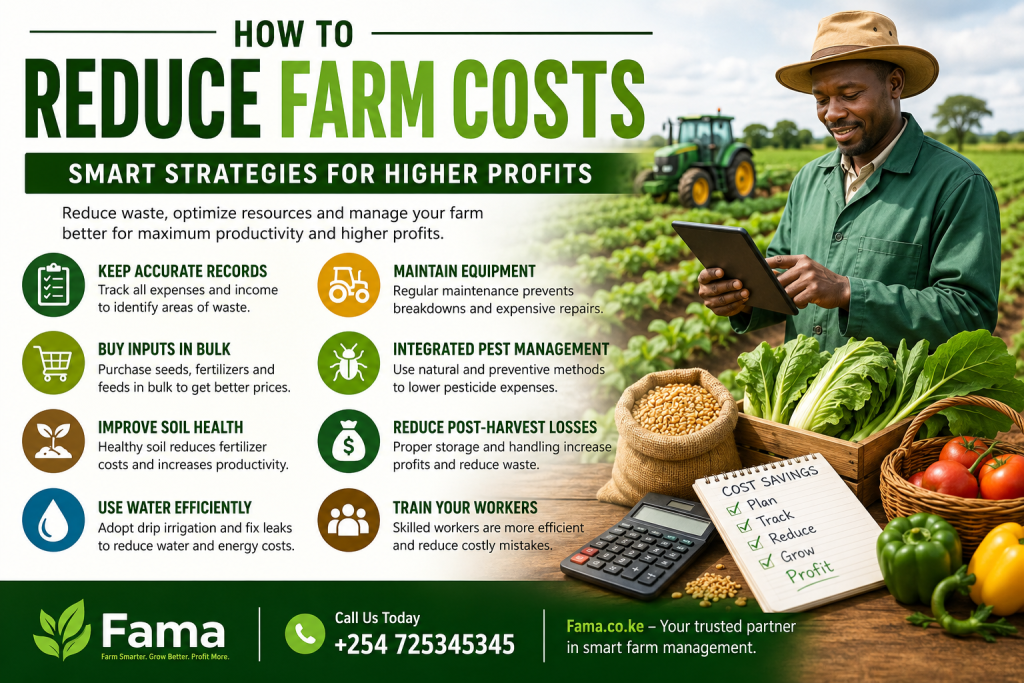
How to Reduce Farm Costs Without Reducing Productivity
Every farmer wants to increase profits, but many focus only on increasing production while ignoring one of the most important factors—how to reduce farm costs. Whether you own a small family farm or manage a large commercial agricultural enterprise, understanding how to reduce farm costs can significantly improve your income and long-term sustainability.
With rising fertilizer prices, expensive farm inputs, unpredictable weather, labor shortages, and fluctuating market prices, farmers across Kenya are searching for practical ways to reduce expenses while maintaining or even increasing productivity. The good news is that reducing farm costs does not necessarily mean cutting corners. Instead, it means improving efficiency, adopting smart technologies, planning better, and eliminating unnecessary expenses.
At Fama.co.ke, we help farmers embrace modern farm management practices that improve productivity while lowering operational costs. If you’re looking for professional farm management solutions, digital farm record systems, and expert guidance, contact us today on +254 725345345.
In this comprehensive guide, you’ll learn practical strategies that answer the important question:
How to reduce farm costs while maximizing profits?
Why Reducing Farm Costs Matters
Agriculture operates on thin profit margins. Every unnecessary expense reduces profitability. Farmers who actively work on reducing operational costs enjoy several advantages including:
- Higher profits
- Better cash flow
- Improved farm sustainability
- Greater resilience during poor seasons
- Ability to invest in expansion
- Better competitiveness in agricultural markets
Reducing costs is not about spending less at all times. Instead, it’s about spending wisely.
Understanding Where Farm Money Goes
Before learning how to reduce farm costs, farmers must first understand where their money is spent.
Typical farm expenses include:
- Seeds
- Fertilizers
- Pesticides
- Animal feeds
- Veterinary services
- Labor
- Fuel
- Machinery maintenance
- Irrigation
- Farm equipment
- Storage
- Transportation
- Packaging
- Marketing
- Loan interest
- Farm utilities
Many farmers never track these expenses accurately, making it difficult to identify areas where money is being wasted.
visit Fama.co.ke to see how to reduce farm costs
Keep Accurate Farm Records
One of the simplest answers to how to reduce farm costs is keeping proper farm records.
Without records, farmers often:
- Buy duplicate inputs
- Lose track of expenses
- Overuse fertilizers
- Waste pesticides
- Mismanage livestock feed
- Fail to monitor profits
Proper records should include:
- Daily expenses
- Sales
- Livestock records
- Crop records
- Input purchases
- Labor payments
- Equipment maintenance
- Harvest yields
Digital farm management software like the solutions available through Fama.co.ke helps farmers monitor every shilling spent.
visit Fama.co.ke to see how to reduce farm costs
Plan Before Every Planting Season
Poor planning leads to unnecessary spending.
Successful farmers prepare months before planting by:
- Budgeting
- Comparing supplier prices
- Ordering inputs early
- Scheduling labor
- Repairing machinery
- Preparing irrigation systems
- Testing soil
Planning prevents emergency purchases, which are often much more expensive.
Buy Farm Inputs in Bulk
Bulk purchasing is one of the easiest ways to reduce farm costs.
Buying fertilizer, seeds, feeds, and chemicals in larger quantities often results in:
- Lower prices
- Reduced transport costs
- Supplier discounts
- Better inventory planning
Farmers’ groups and cooperatives can negotiate even better prices.
Compare Suppliers Before Buying
Never purchase from the first supplier you find.
Compare:
- Prices
- Product quality
- Delivery charges
- Payment terms
- Warranty
- Customer support
A small price difference on fertilizers or feeds can save thousands of shillings over an entire season.
Avoid Overusing Fertilizers
Many farmers mistakenly believe that more fertilizer equals higher yields.
This is not always true.
Excess fertilizer:
- Wastes money
- Damages soil
- Pollutes water
- Reduces crop quality
Instead:
- Conduct soil testing.
- Apply only recommended amounts.
- Use split applications.
- Monitor crop nutrient requirements.
This approach lowers costs while improving production.
Conduct Soil Testing
Soil testing prevents unnecessary fertilizer purchases.
A professional soil test identifies:
- Nutrient deficiencies
- Soil pH
- Organic matter levels
- Micronutrient needs
Instead of applying expensive fertilizers blindly, farmers apply only what the soil actually requires.
Use Organic Fertilizers Where Possible
Organic fertilizers can significantly reduce long-term production costs.
Examples include:
- Compost
- Farmyard manure
- Poultry manure
- Green manure
- Vermicompost
Benefits include:
- Lower fertilizer expenses
- Improved soil health
- Better water retention
- Reduced chemical dependency
Improve Irrigation Efficiency
Water is expensive.
Poor irrigation wastes:
- Electricity
- Fuel
- Labor
- Water
Modern irrigation systems such as drip irrigation deliver water directly to plant roots, reducing both water usage and pumping costs.
Regular maintenance also prevents leaks that increase operating expenses.
Reduce Labor Costs Through Better Management
Labor is one of the largest expenses on many farms.
Rather than reducing workers, improve productivity by:
- Scheduling work efficiently
- Providing proper tools
- Training employees
- Eliminating idle time
- Mechanizing repetitive tasks
Well-managed workers accomplish more within fewer working hours.
Invest in Farm Mechanization
Although machinery requires an initial investment, it often reduces long-term operational costs.
Examples include:
- Tractor services
- Automatic planters
- Mechanical harvesters
- Milking machines
- Feed mixers
Mechanization reduces:
- Labor costs
- Harvest losses
- Production time
- Human error
Perform Preventive Equipment Maintenance
Equipment breakdowns are expensive.
Routine maintenance includes:
- Oil changes
- Lubrication
- Cleaning
- Replacing worn parts
- Tire inspections
- Belt adjustments
Preventive maintenance is much cheaper than emergency repairs.
Reduce Post-Harvest Losses
Many farmers lose up to 30% of their harvest after production.
Reducing these losses immediately lowers production costs.
Ways to minimize losses include:
- Proper harvesting techniques
- Good storage facilities
- Improved packaging
- Temperature control
- Pest management
- Fast transportation
Every kilogram saved increases profitability.
Practice Integrated Pest Management
Excessive pesticide use increases production costs.
Integrated Pest Management (IPM) combines:
- Biological controls
- Crop rotation
- Resistant crop varieties
- Monitoring pests
- Targeted spraying
IPM reduces chemical expenses while protecting crop health.
Rotate Crops
Crop rotation naturally improves soil fertility.
Benefits include:
- Reduced fertilizer use
- Lower pest populations
- Improved yields
- Better soil structure
- Reduced disease outbreaks
This reduces production costs over multiple seasons.
Select High-Quality Seeds
Cheap seeds often become expensive later due to:
- Poor germination
- Low yields
- Disease susceptibility
- High pesticide costs
Certified quality seeds improve productivity while lowering the cost per kilogram harvested.
Reduce Feed Wastage in Livestock Farming
Animal feed represents one of the largest livestock expenses.
Reduce feed losses by:
- Proper storage
- Balanced feeding
- Automatic feeders
- Preventing contamination
- Feeding according to production stage
Even small reductions in feed waste translate into significant annual savings.
Improve Animal Health Management
Healthy animals are more productive and less expensive to maintain.
Preventive measures include:
- Vaccination
- Deworming
- Clean housing
- Balanced nutrition
- Regular veterinary checkups
Preventing disease is far cheaper than treating outbreaks.
Use Renewable Energy
Energy costs continue to rise.
Many farms are now investing in:
- Solar pumps
- Solar lighting
- Solar electric fencing
- Solar-powered irrigation
Although installation requires investment, operating costs decrease substantially over time.
Minimize Fuel Consumption
Fuel expenses can quickly reduce profits.
Lower fuel costs by:
- Planning farm routes
- Servicing tractors
- Combining field operations
- Avoiding unnecessary transport
- Using fuel-efficient machinery
Proper machinery maintenance alone can significantly reduce diesel consumption.
Train Farm Workers
Skilled workers make fewer mistakes.
Training improves:
- Input application accuracy
- Equipment handling
- Animal care
- Harvest quality
- Workplace safety
Better-trained employees reduce waste and increase efficiency.
Monitor Farm Performance Regularly
Farmers should evaluate performance throughout the season instead of waiting until harvest.
Track key indicators such as:
- Production cost per acre
- Cost per kilogram harvested
- Labor efficiency
- Fertilizer use
- Feed conversion
- Livestock growth
- Water consumption
- Machinery utilization
Regular monitoring helps identify unnecessary expenses early, making it easier to reduce farm costs before they affect profitability.
How to Reduce Farm Costs: Advanced Strategies for Maximum Profitability
Reducing expenses is not a one-time activity. It is an ongoing process that requires planning, monitoring, and continuous improvement. Farmers who understand how to reduce farm costs consistently outperform those who simply increase production without controlling expenses. Whether you grow crops, rear livestock, or operate a mixed farm, implementing cost-saving strategies can dramatically improve your bottom line.
If you have been searching for practical ways on how to reduce farm costs, this section explores advanced methods that modern farmers use to maximize efficiency while maintaining excellent yields.
visit Fama.co.ke to see how to reduce farm costs
Adopt Precision Farming
One of the smartest ways to understand how to reduce farm costs is by embracing precision agriculture.
Precision farming uses technology to ensure every resource is applied only where and when it is needed.
Examples include:
- GPS-guided farming
- Soil mapping
- Variable-rate fertilizer application
- Drone crop monitoring
- Smart irrigation systems
- Yield mapping
Instead of treating every section of the farm equally, precision farming allows farmers to target specific areas, reducing waste and lowering production costs.
Invest in Farm Management Software
Farm management software has become one of the best tools for farmers wondering how to reduce farm costs.
Instead of relying on notebooks or memory, digital systems help farmers monitor every operation.
A modern farm management system allows you to:
- Record expenses
- Track income
- Monitor inventory
- Schedule farm activities
- Record livestock performance
- Track crop production
- Monitor machinery maintenance
- Generate financial reports
At Fama.co.ke, we provide smart farm management solutions that help farmers reduce unnecessary spending while improving productivity. Our digital platform gives farmers complete visibility into farm operations, making it much easier to identify areas where costs can be reduced.
For more information, call +254 725345345.
Budget Every Farming Season
A proper budget is one of the strongest answers to how to reduce farm costs.
Before planting or stocking livestock, prepare a detailed budget covering:
- Seeds
- Fertilizer
- Animal feed
- Chemicals
- Labor
- Fuel
- Equipment maintenance
- Irrigation
- Packaging
- Marketing
- Transportation
- Emergency expenses
Following a budget helps prevent overspending and allows farmers to identify unnecessary purchases before they happen.
Monitor Every Farm Expense
Many farmers know their sales but cannot explain where their profits disappear.
To understand how to reduce farm costs, record every expense no matter how small.
Examples include:
- Fuel receipts
- Worker wages
- Water bills
- Veterinary expenses
- Transport charges
- Packaging materials
- Machinery repairs
Small daily expenses accumulate into significant annual costs.
Reduce Transportation Costs
Transport is often overlooked when discussing how to reduce farm costs.
Ways to lower transport expenses include:
- Planning delivery routes
- Combining multiple deliveries
- Purchasing inputs from nearby suppliers
- Selling produce closer to markets
- Working with farmer cooperatives
- Maintaining transport vehicles
Reducing unnecessary trips can save thousands of shillings every season.
Reduce Storage Losses
Harvest losses continue long after crops leave the field.
Good storage helps reduce:
- Pest damage
- Mold
- Moisture loss
- Rodent attacks
- Spoilage
Proper storage facilities preserve produce quality while reducing financial losses.
Buy Quality Farm Equipment
Cheap equipment often results in:
- Frequent repairs
- High maintenance costs
- Downtime
- Low efficiency
Although quality machinery costs more initially, it lasts longer and significantly lowers long-term operating costs.
Share Machinery with Other Farmers
Not every farmer needs to own expensive equipment.
Machinery sharing allows neighboring farmers to share:
- Tractors
- Planters
- Harvesters
- Sprayers
- Feed mixers
This approach dramatically reduces capital investment while ensuring access to modern farming equipment.
Improve Harvest Timing
Harvesting too early or too late increases losses.
Good harvest timing:
- Reduces spoilage
- Improves quality
- Increases market prices
- Minimizes labor waste
- Lowers storage costs
Knowing the right harvesting period is another important aspect of how to reduce farm costs.
Practice Crop Diversification
Diversification spreads financial risk.
Instead of depending on one crop, farmers can grow:
- Maize
- Beans
- Vegetables
- Fruits
- Herbs
- Fodder crops
Multiple income streams protect farmers from market fluctuations while improving land utilization.
Improve Livestock Breeding
Poor breeding programs increase production costs.
Choose animals with:
- Fast growth rates
- Disease resistance
- High fertility
- Better milk production
- Better feed conversion
High-performing animals generate more income using fewer resources.
visit Fama.co.ke to see how to reduce farm costs
Reduce Water Waste
Water conservation directly affects profitability.
Methods include:
- Rainwater harvesting
- Drip irrigation
- Mulching
- Leak detection
- Water scheduling
Water saved is money saved.
Produce Your Own Animal Feed
Commercial feeds can be expensive.
Many farmers reduce expenses by producing:
- Silage
- Hay
- Napier grass
- Maize stover
- Homemade feed mixtures
Producing quality feeds on the farm significantly lowers livestock production costs.
Reduce Chemical Dependency
Excessive chemical use increases operational expenses.
Alternative practices include:
- Biological pest control
- Crop rotation
- Resistant crop varieties
- Organic farming practices
- Healthy soil management
Reducing chemical dependency helps farmers lower recurring production costs while protecting the environment.
Improve Farm Security
Farm theft causes major financial losses.
Good security measures include:
- Fencing
- Solar security lighting
- Farm surveillance
- Security guards
- Controlled access
- Proper inventory management
Protecting farm assets is another effective strategy for how to reduce farm costs.
Negotiate Better Prices
Never accept the first quotation.
Compare several suppliers before purchasing:
- Fertilizers
- Seeds
- Livestock feed
- Equipment
- Chemicals
- Irrigation materials
Negotiating can substantially reduce production costs over an entire farming season.
Join Farmer Cooperatives
Farmer groups enjoy several financial benefits.
These include:
- Bulk purchasing discounts
- Shared transportation
- Shared storage
- Better market access
- Training opportunities
- Affordable financing
Working together significantly lowers operational expenses.
Add Value to Farm Produce
Value addition increases income without greatly increasing production costs.
Examples include:
- Milk processing
- Fruit drying
- Vegetable packaging
- Flour milling
- Honey processing
Higher selling prices improve profitability and offset production expenses.
Train Yourself Continuously
Agriculture changes rapidly.
Successful farmers regularly learn about:
- New technologies
- Disease control
- Market trends
- Modern irrigation
- Improved crop varieties
- Digital farming
Continuous learning helps farmers discover better ways of how to reduce farm costs while increasing productivity.
visit Fama.co.ke to see how to reduce farm costs
Analyze Farm Profitability
At the end of every season, evaluate:
- Cost per acre
- Cost per animal
- Revenue generated
- Net profit
- Input efficiency
- Labor efficiency
- Machinery costs
These reports reveal where money is being lost and where improvements can be made.
How Fama.co.ke Helps Farmers Reduce Farm Costs
Managing farm expenses manually becomes increasingly difficult as farms grow.
At Fama.co.ke, we provide comprehensive farm management software designed to simplify agricultural operations while helping farmers understand exactly how to reduce farm costs.
Our solutions help you:
- Track daily farm expenses
- Manage crop records
- Monitor livestock performance
- Control inventory
- Record farm income
- Generate financial reports
- Schedule farm activities
- Improve decision-making
- Reduce waste
- Increase profitability
With real-time reports and accurate records, farmers can quickly identify unnecessary spending and make informed financial decisions.
For demonstrations, consultations, and support, contact +254 725345345.
visit Fama.co.ke to see how to reduce farm costs
Frequently Asked Questions
What is the easiest way to reduce farm costs?
The easiest way to reduce farm costs is to keep accurate records, prepare a seasonal budget, eliminate waste, purchase quality inputs, and use farm management software to monitor every expense.
Does reducing farm costs lower productivity?
No. Proper cost management focuses on eliminating waste rather than reducing production. Many farmers actually increase productivity while lowering expenses.
Can technology help reduce farm costs?
Yes. Digital farm management systems, precision farming, GPS technology, smart irrigation, and automated record keeping significantly improve efficiency while reducing operational expenses.
Why should farmers monitor expenses daily?
Daily expense tracking prevents overspending, identifies waste early, improves budgeting, and increases overall farm profitability.
Which farming system helps reduce costs the most?
The best system depends on your enterprise, but combining good planning, efficient resource management, quality inputs, preventive maintenance, and digital farm management offers the greatest long-term savings.
visit Fama.co.ke to see how to reduce farm costs
Conclusion
Learning how to reduce farm costs is one of the most valuable investments any farmer can make. Rising input prices, labor shortages, unpredictable weather, and changing market conditions mean that profitability now depends as much on cost control as it does on production. Farmers who understand how to reduce farm costs through proper budgeting, efficient resource utilization, modern technology, accurate record keeping, preventive maintenance, and smart planning consistently achieve better financial results than those who focus only on increasing output.
Whether you operate a smallholder farm or a large commercial agricultural enterprise, every shilling saved contributes directly to increased profitability. By applying the strategies discussed throughout this guide—from reducing input waste and improving irrigation efficiency to adopting precision agriculture and digital farm management—you can build a more productive, resilient, and profitable farming business.
If you are looking for professional solutions on how to reduce farm costs, improve farm efficiency, and manage your agricultural operations with confidence, Fama.co.ke is your trusted partner. Our innovative farm management software empowers farmers with accurate records, real-time reporting, inventory management, crop and livestock tracking, and actionable insights that simplify decision-making and reduce unnecessary expenses.
Start transforming your farm into a more efficient and profitable enterprise today. Contact Fama.co.ke on +254 725345345 to learn how our farm management solutions can help you reduce costs, increase productivity, and achieve sustainable agricultural success.