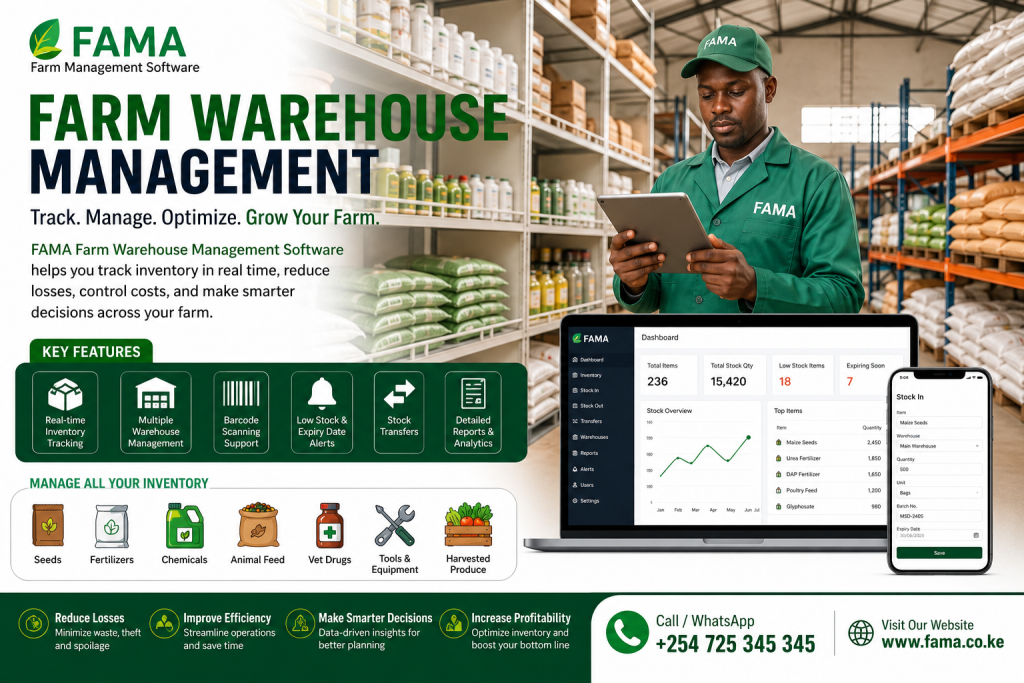
Farm warehouse management has become one of the most important aspects of modern agriculture. Whether you own a small family farm or manage thousands of acres of commercial farmland, proper warehouse management determines how efficiently you store, protect, track, and distribute agricultural products. Without an organized warehouse management system, farmers face inventory losses, product spoilage, inaccurate stock records, delayed deliveries, and reduced profitability.
At FAMA Farm Management Software, we understand the unique challenges that farmers face every day. Our intelligent farm warehouse management solution helps farmers monitor inventory, manage farm inputs, track harvested produce, reduce wastage, and make informed business decisions from one centralized platform.
If your farm is still using notebooks, spreadsheets, or manual warehouse records, this guide will show you why upgrading to a digital warehouse management solution is one of the smartest investments you can make.
What is Farm Warehouse Management?
Farm warehouse management refers to the systematic process of organizing, monitoring, storing, and controlling every item inside a farm warehouse. These items include:
- Fertilizers
- Seeds
- Agrochemicals
- Animal feeds
- Veterinary drugs
- Farm tools
- Machinery spare parts
- Harvested crops
- Fresh produce
- Packaging materials
- Livestock supplements
An effective farm warehouse management system ensures every item entering or leaving the warehouse is properly recorded, monitored, and accounted for.
Instead of guessing stock levels, farmers can instantly know:
- Current inventory
- Products running low
- Products nearing expiry
- Products recently purchased
- Harvest currently in storage
- Warehouse value
- Losses due to spoilage
Why Farm Warehouse Management Matters
Many farms lose significant amounts of money every season because warehouse operations are poorly managed.
Common problems include:
- Missing inventory
- Theft
- Duplicate purchases
- Overstocking
- Expired chemicals
- Rotten produce
- Poor storage conditions
- Manual record errors
Proper farm warehouse management eliminates these problems by creating complete visibility over every warehouse operation.
Benefits include:
- Better inventory accuracy
- Reduced waste
- Faster stock movement
- Lower operational costs
- Improved profitability
- Better purchasing decisions
- Improved harvest management
Challenges Farmers Face Without Farm Warehouse Management
Many agricultural businesses continue using manual inventory books that create more problems than solutions.
Common challenges include:
Poor Inventory Visibility
Farm managers often don’t know:
- Which products are available
- How much stock remains
- Which warehouse stores specific items
This leads to unnecessary purchases and confusion.
Product Expiry
Seeds, pesticides, fertilizers, and veterinary medicines have expiry dates.
Without digital farm warehouse management, expired products often remain unnoticed until they become unusable.
Harvest Losses
Improper storage causes:
- Moisture damage
- Pest infestation
- Mold growth
- Weight loss
- Reduced quality
A structured warehouse management process helps reduce post-harvest losses.
Theft
Inventory theft is surprisingly common on farms.
Without accurate warehouse records, it’s difficult to determine:
- What disappeared
- When it disappeared
- Who accessed the warehouse
Overstocking
Some farms purchase more inventory than needed.
This ties up cash that could have been invested elsewhere.
Farm warehouse management software helps farmers buy only what they actually need.
Understocking
Running out of:
- Fertilizer
- Animal feed
- Chemicals
- Packaging materials
can delay farm operations and reduce productivity.
Real-time inventory alerts prevent shortages.
Features of Modern Farm Warehouse Management Software
Modern warehouse systems go beyond simple inventory recording.
FAMA provides intelligent features including:
Real-Time Inventory Tracking
Every stock movement is recorded immediately.
Whether receiving fertilizer or issuing animal feed, inventory updates automatically.
This eliminates guesswork.
Multiple Warehouse Support
Large farms often have:
- Main warehouse
- Chemical store
- Feed store
- Cold room
- Produce warehouse
Farm warehouse management software allows tracking each warehouse separately while maintaining centralized reporting.
Batch Tracking
Every inventory batch can be monitored from purchase until use.
This is particularly useful for:
- Fertilizers
- Chemicals
- Seeds
- Animal medicine
Batch tracking improves accountability.
Barcode Support
Modern warehouses use barcode labels to simplify stock management.
Benefits include:
- Faster stock receiving
- Faster issuing
- Reduced human errors
- Accurate inventory updates
Stock Movement History
Every movement is recorded including:
- Date
- Product
- Quantity
- User
- Destination
- Source warehouse
This creates complete transparency.
Low Stock Alerts
Instead of discovering shortages during planting season, warehouse management software automatically alerts users when inventory reaches minimum levels.
This allows timely procurement.
Expiry Date Monitoring
Warehouse software tracks expiry dates for:
- Agrochemicals
- Veterinary medicine
- Seeds
- Fertilizers
Notifications help farmers use products before they expire.
Farm Warehouse Management for Crop Farmers
Crop farmers manage hundreds of inventory items throughout each season.
Warehouse management simplifies tracking:
Seeds
Know:
- Quantity received
- Quantity planted
- Remaining inventory
Fertilizer
Track:
- Purchase date
- Batch
- Application history
- Current stock
Chemicals
Monitor:
- Usage
- Expiry
- Warehouse location
- Remaining stock
Harvest
Warehouse software records:
- Harvest quantity
- Storage location
- Sales
- Remaining inventory
Farm Warehouse Management for Livestock Farms
Livestock farms handle inventory every single day.
Items include:
- Dairy feed
- Poultry feed
- Pig feed
- Veterinary medicine
- Supplements
- Vaccines
- Equipment
Warehouse management software ensures every item is tracked from purchase to usage.
Warehouse Management Improves Farm Profitability
Many farmers focus only on production while ignoring inventory efficiency.
However, warehouse losses directly reduce profits.
Proper farm warehouse management helps by:
- Reducing spoilage
- Reducing theft
- Eliminating duplicate purchases
- Improving purchasing decisions
- Increasing inventory accuracy
- Reducing operational costs
Over time, these savings become substantial.
Inventory Categories in Farm Warehouse Management
A good warehouse system organizes inventory into categories.
Examples include:
Crop Inputs
- Seeds
- Fertilizers
- Chemicals
Livestock Inputs
- Feed
- Supplements
- Medicine
Equipment
- Tools
- Spare parts
- Machinery components
Harvest
- Maize
- Beans
- Coffee
- Tea
- Fruits
- Vegetables
Categorization makes searching and reporting easier.
Receiving Inventory into the Warehouse
Every item entering the warehouse should be recorded.
Typical receiving information includes:
- Supplier
- Purchase order
- Delivery note
- Quantity received
- Warehouse location
- Batch number
- Expiry date
Digital farm warehouse management ensures these records remain accurate and accessible.
Issuing Inventory
Farm warehouse management also controls outgoing inventory.
Examples include:
- Fertilizer issued to Field A
- Feed issued to Dairy Unit
- Chemicals issued to Greenhouse
- Packaging materials issued to Processing Unit
Every issue transaction updates inventory automatically.
Warehouse Management Reports
Accurate reporting helps farmers make informed decisions.
Common reports include:
- Current inventory report
- Warehouse valuation report
- Low stock report
- Fast-moving inventory
- Slow-moving inventory
- Expired products report
- Inventory adjustment report
- Daily warehouse transactions
- Monthly inventory summary
These reports improve planning and budgeting.
Warehouse Locations and Bin Management
Large farms often divide warehouses into storage locations.
Examples include:
- Rack A
- Rack B
- Shelf C
- Cold Room
- Bulk Storage
- Chemical Cabinet
Warehouse management software records exactly where every item is stored, reducing search time and improving efficiency.
Seasonal Inventory Planning
Agriculture is seasonal.
Farm warehouse management helps prepare for:
- Planting season
- Harvest season
- Dry season
- Rainy season
Farmers can stock the right quantities at the right time while avoiding unnecessary inventory carrying costs.
Why Choose FAMA for Farm Warehouse Management?
FAMA Farm Management Software provides a complete digital solution designed specifically for agricultural businesses. Instead of relying on paper records or disconnected spreadsheets, FAMA centralizes warehouse operations alongside other farm management activities, giving you better visibility, accountability, and control.
With FAMA, you can:
- Manage warehouse inventory from one dashboard
- Track farm inputs and harvested produce in real time
- Monitor stock levels and receive low-stock alerts
- Record purchases, stock issues, and warehouse transfers
- Generate inventory and warehouse reports instantly
- Improve planning while reducing waste and unnecessary expenses
- Support both crop and livestock farming operations
Whether you operate a small farm, commercial estate, greenhouse, dairy farm, poultry farm, or mixed agricultural enterprise, FAMA helps streamline warehouse processes so you can focus on productivity and profitability.
Contact FAMA today to learn how our Farm Warehouse Management Software can transform your farm operations.
Website: https://fama.co.ke
Call/WhatsApp: +254 725 345 345
Part 2: Advanced Farm Warehouse Management Strategies, Best Practices, FAQs, and Conclusion
Integrating Farm Warehouse Management with Farm Operations
A modern farm warehouse management system should never operate in isolation. Instead, it should connect seamlessly with every department on the farm to ensure accurate information flows throughout the business.
For example:
- Procurement purchases fertilizers
- Warehouse receives the fertilizers
- Inventory updates automatically
- Farm managers allocate fertilizer to different fields
- Field supervisors record usage
- Remaining inventory updates in real time
This integrated workflow eliminates duplicate data entry and improves accountability across the entire farm.
Likewise, harvested produce entering the warehouse can be tracked from the field through storage, processing, and eventual sale, giving farm owners complete visibility into the production cycle.
Farm Warehouse Management for Harvest Storage
Harvest storage is one of the most critical functions of any agricultural warehouse. Without proper storage management, farmers risk losing a significant percentage of their produce before it reaches the market.
A reliable farm warehouse management system enables farmers to:
- Record harvest quantities immediately after collection
- Assign produce to specific warehouse locations
- Monitor stock balances
- Track outgoing sales
- Record quality inspections
- Monitor storage duration
- Reduce post-harvest losses
This organized approach ensures harvested crops remain marketable for longer periods.
Cold Storage Warehouse Management
Many agricultural products require controlled temperatures.
Examples include:
- Fruits
- Vegetables
- Dairy products
- Flowers
- Seed potatoes
- Vaccines
- Livestock medicines
Managing these products manually is extremely difficult.
Farm warehouse management software helps monitor:
- Cold room inventory
- Entry dates
- Exit dates
- Product movement
- Batch information
- Shelf life
This minimizes spoilage while improving inventory accuracy.
Warehouse Security and Loss Prevention
Warehouse security extends beyond locking doors. Inventory shrinkage can occur through theft, poor handling, or inaccurate record-keeping.
Good farm warehouse management practices include:
- Controlled user access
- Stock issue approvals
- Inventory movement logs
- Regular stock verification
- Digital audit trails
- Warehouse surveillance
- Restricted access to chemical stores
When every stock movement is recorded, unauthorized inventory losses become much easier to detect.
Inventory Auditing
Inventory audits help verify that physical stock matches recorded stock.
Warehouse management software simplifies auditing by providing:
- Current inventory reports
- Historical transactions
- Batch records
- Warehouse balances
- Adjustment history
Routine stock counts improve confidence in inventory records and help identify discrepancies early.
Warehouse Transfers
Large agricultural businesses often operate multiple warehouses across different locations.
Examples include:
- Main warehouse
- Regional warehouse
- Livestock warehouse
- Seed warehouse
- Chemical warehouse
- Machinery store
A digital farm warehouse management system records transfers between warehouses, ensuring stock remains visible regardless of its location.
Procurement Planning
Inventory data plays an important role in purchasing decisions.
Warehouse reports help procurement teams determine:
- Which items require replenishment
- Average monthly consumption
- Seasonal demand
- Supplier performance
- Purchasing trends
Instead of guessing what to buy, purchasing decisions become data-driven.
Warehouse Management for Agricultural Cooperatives
Agricultural cooperatives manage inventory for multiple farmers.
Warehouse software helps cooperatives track:
- Member deliveries
- Warehouse balances
- Grain storage
- Fertilizer distribution
- Input sales
- Produce sales
- Payment records
This improves transparency and strengthens trust among cooperative members.
Mobile Farm Warehouse Management
Modern farms are increasingly adopting mobile technology.
Using smartphones or tablets, warehouse staff can:
- Receive inventory
- Issue stock
- Perform stock counts
- Check inventory balances
- Scan barcodes
- Approve transfers
- Update warehouse transactions from anywhere
Mobile warehouse management reduces paperwork while improving efficiency.
Warehouse Performance Indicators
Measuring warehouse performance helps identify opportunities for improvement.
Useful indicators include:
- Inventory accuracy
- Stock turnover
- Storage utilization
- Order fulfillment time
- Inventory carrying costs
- Stock-out frequency
- Spoilage rate
- Inventory shrinkage
- Warehouse productivity
Monitoring these metrics enables farm managers to make informed operational decisions.
Best Practices for Effective Farm Warehouse Management
Successful farms follow consistent warehouse management practices.
Recommended best practices include:
- Keep inventory records up to date.
- Perform regular stock counts.
- Clearly label all storage locations.
- Rotate inventory using the First-In, First-Out (FIFO) method.
- Store chemicals separately from seeds and feeds.
- Monitor expiry dates regularly.
- Train warehouse personnel on inventory procedures.
- Restrict warehouse access to authorized staff.
- Maintain clean and organized storage facilities.
- Back up warehouse data frequently.
Following these practices reduces waste, improves safety, and enhances overall efficiency.
Why Digital Farm Warehouse Management Is Better Than Manual Records
Many farms still rely on notebooks and spreadsheets, but these methods often lead to errors and inefficiencies.
Digital farm warehouse management offers significant advantages:
- Instant inventory updates
- Improved accuracy
- Faster stock searches
- Better reporting
- Reduced paperwork
- Enhanced accountability
- Real-time visibility
- Easier audits
- Better decision-making
By moving to a digital system, farms can save time, reduce losses, and improve operational control.
Future Trends in Farm Warehouse Management
Agricultural warehouse management continues to evolve with technology.
Emerging trends include:
- Artificial Intelligence (AI) for demand forecasting
- Internet of Things (IoT) sensors for environmental monitoring
- RFID and advanced barcode systems
- Cloud-based inventory management
- Mobile-first warehouse operations
- Predictive inventory analytics
- Automated reporting
- Integration with accounting and financial systems
- Smart warehouse automation
- Drone-assisted inventory inspections
These innovations will help farms become more efficient, resilient, and profitable.
Frequently Asked Questions (FAQs)
What is farm warehouse management?
Farm warehouse management is the process of organizing, storing, tracking, and controlling all farm inventory, including inputs, harvested produce, equipment, and supplies.
Why is farm warehouse management important?
It reduces inventory losses, prevents stock shortages, improves accountability, minimizes waste, and supports better financial planning.
Can small farms benefit from warehouse management software?
Yes. Even small farms gain better inventory visibility, reduce unnecessary purchases, and improve operational efficiency.
Can warehouse software manage multiple storage locations?
Absolutely. Modern systems allow farmers to manage several warehouses, stores, cold rooms, and storage facilities from one centralized platform.
Does warehouse management help reduce post-harvest losses?
Yes. Accurate inventory tracking, proper storage management, and timely stock rotation significantly reduce spoilage and wastage.
Is farm warehouse management suitable for livestock farms?
Yes. Livestock farms can manage feed, veterinary medicines, supplements, vaccines, equipment, and other supplies more efficiently using warehouse management software.
Why Choose FAMA Farm Warehouse Management Software?
Managing inventory manually becomes increasingly difficult as your farm grows. FAMA Farm Management Software provides an all-in-one solution that simplifies warehouse operations while improving accuracy, transparency, and profitability.
With FAMA, you can:
- Track inventory in real time
- Monitor harvested produce and farm inputs
- Manage multiple warehouses and storage locations
- Receive low-stock and expiry alerts
- Record purchases, transfers, and stock issues
- Generate detailed inventory reports
- Improve warehouse accountability
- Reduce wastage and operational costs
- Support crop farms, livestock farms, agribusinesses, and agricultural cooperatives
Whether you’re managing a commercial farm, greenhouse, dairy operation, poultry farm, or mixed farming enterprise, FAMA provides the tools you need to keep your warehouse organized and your farm running efficiently.
Additional 200 Words to Insert Before the Conclusion
As agricultural businesses continue to grow, investing in a reliable farm warehouse management solution becomes increasingly important for maintaining efficiency and long-term sustainability. Every bag of fertilizer, packet of seed, litre of agrochemical, bale of animal feed, and kilogram of harvested produce represents valuable farm assets that should be carefully monitored. A well-organized warehouse not only protects these assets but also improves planning, budgeting, and day-to-day decision-making. By implementing effective farm warehouse management, farmers can reduce unnecessary expenses, improve inventory accuracy, and ensure that every
department has access to the supplies they need when they need them. Digital warehouse systems also make it easier to prepare inventory reports, monitor warehouse performance, and identify opportunities to reduce waste. As farms adopt modern technologies, warehouse operations become faster, more transparent, and easier to manage across multiple locations. Whether storing crops, livestock supplies, machinery parts, or packaging materials, a centralized farm warehouse management platform ensures that inventory remains accurate and accessible at all times. This level of visibility supports better purchasing decisions, prevents stock shortages during critical farming seasons, and helps maintain consistent production throughout the year.
Ultimately, adopting a professional farm warehouse management system is not just about organizing storage facilities—it is about creating a more productive, profitable, and resilient agricultural business that is prepared for future growth and changing market demands.
Conclusion
Effective farm warehouse management is no longer optional for modern agricultural businesses. As farms become larger and more complex, accurate inventory control is essential for reducing losses, improving productivity, and increasing profitability. From managing seeds and fertilizers to tracking harvested produce and livestock supplies, every warehouse activity has a direct impact on farm performance.
By implementing a digital farm warehouse management system, farmers gain complete visibility into inventory levels, warehouse movements, procurement planning, and storage efficiency. This leads to better decision-making, reduced waste, improved accountability, and stronger financial performance.
If you are looking for a reliable, user-friendly, and powerful farm warehouse management solution in Kenya, FAMA Farm Management Software is the ideal choice. Our platform is built specifically for the needs of modern farmers and agricultural businesses, helping you streamline warehouse operations and manage your farm with confidence.
Get Started Today
Visit https://fama.co.ke to learn more about our farm management solutions.
Call or WhatsApp: +254 725 345 345
Take control of your inventory, reduce losses, and grow your agricultural business with FAMA’s intelligent Farm Warehouse Management Software.