Farm Planning Software: The Complete Guide to Smarter Farm Planning and Higher Agricultural Productivity

farm planning software

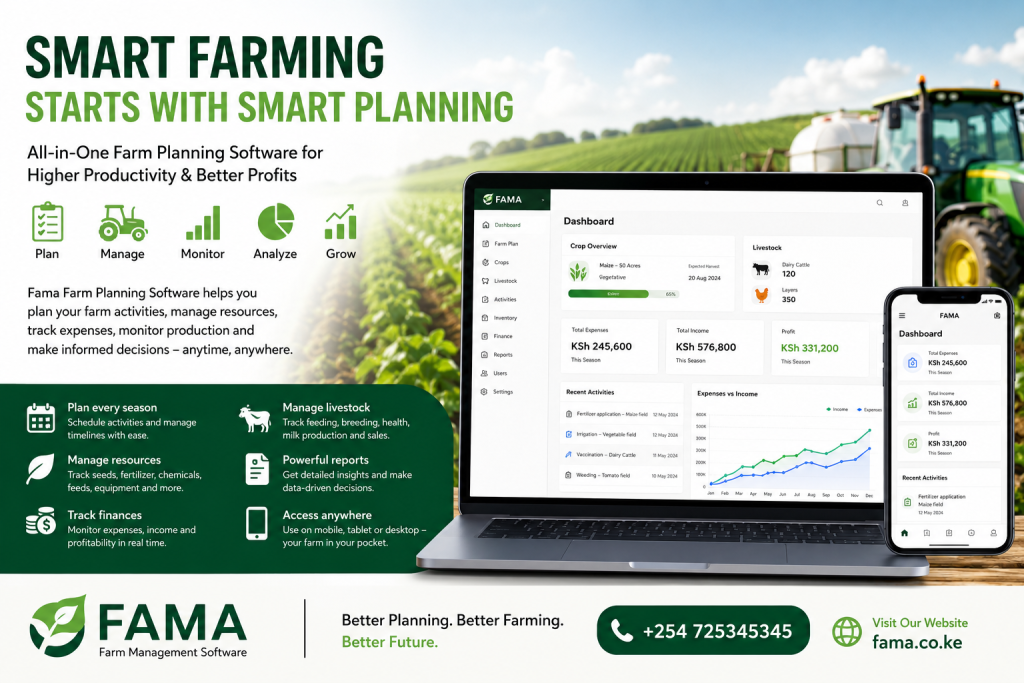
Farm planning software has become an essential digital tool for modern farmers who want to improve productivity, reduce operational costs, and maximize profits. Whether you manage a small family farm, a commercial plantation, a dairy farm, a poultry operation, or a mixed agricultural enterprise, the right farm planning software helps organize every farming activity from land preparation to harvesting and marketing.

At Fama Farm Management Software, we understand that farming is no longer about guesswork. Every successful agricultural business depends on proper planning, accurate record keeping, efficient resource allocation, and timely decision-making. Our advanced farm planning software enables farmers to plan every season with confidence while keeping all farm information in one centralized system.

If you’re looking for reliable farm planning software in Kenya or anywhere in Africa, Fama provides an all-in-one solution designed specifically for modern agriculture.

Contact us today:
📞 +254 725345345
🌐 www.fama.co.ke


Table of Contents

What is Farm Planning Software?

Farm planning software is a digital platform that assists farmers in planning, managing, monitoring, and analyzing every aspect of farming operations. Instead of relying on notebooks, spreadsheets, or memory, farmers use farm planning software to create structured production plans and monitor farm activities throughout the farming season.

A comprehensive farm planning software solution allows farmers to:

  • Plan crop production
  • Schedule farm activities
  • Allocate workers
  • Track farm expenses
  • Manage livestock
  • Monitor inventory
  • Record farm inputs
  • Forecast yields
  • Generate reports
  • Improve decision making

Modern agriculture depends heavily on information. Good information leads to better decisions, and better decisions increase profitability.


Why Farm Planning Software Matters Today

Agriculture has become increasingly competitive. Farmers must deal with:

  • Rising production costs
  • Climate change
  • Labour shortages
  • Market fluctuations
  • Pest outbreaks
  • Disease management
  • Water scarcity
  • Compliance requirements

Without proper planning, these challenges become difficult to manage.

This is why thousands of successful farmers are investing in farm planning software to simplify operations and improve efficiency.

Farm planning software transforms scattered information into actionable insights, helping farmers stay organized throughout the production cycle.


Common Problems Farmers Face Without Farm Planning Software

Many farms still rely on manual records.

Some common challenges include:

Poor Record Keeping

Paper records are easily lost or damaged.

Important information like fertilizer application dates, pesticide usage, worker attendance, and harvest quantities may disappear permanently.

Farm planning software securely stores all farm information digitally.


Poor Financial Tracking

Without proper planning:

  • Expenses go unnoticed
  • Input costs increase
  • Budget overruns occur
  • Profit becomes difficult to calculate

Farm planning software records every financial transaction for better accountability.


Missed Farm Activities

Farm operations depend on timing.

Missing one irrigation schedule or delaying fertilizer application can significantly reduce yields.

Farm planning software provides activity schedules and reminders.


Labour Mismanagement

Managing workers manually becomes difficult, especially on large farms.

Farm planning software allows farmers to:

  • Assign tasks
  • Track attendance
  • Monitor productivity
  • Calculate wages

Poor Inventory Control

Farm inputs often disappear because inventory isn’t monitored properly.

Farm planning software tracks:

  • Seeds
  • Fertilizers
  • Chemicals
  • Animal feeds
  • Equipment
  • Spare parts

This reduces theft and unnecessary purchases.


Key Features of Modern Farm Planning Software

A complete farm planning software should include multiple integrated modules.

Farm Activity Planning

Every farming season starts with planning.

Farm planning software enables users to schedule:

  • Land preparation
  • Planting
  • Fertilizer application
  • Irrigation
  • Weeding
  • Spraying
  • Harvesting
  • Transport

Every activity is assigned a timeline.


Crop Planning Module

Crop production requires careful organization.

The crop planning feature helps farmers determine:

  • Crops to plant
  • Acreage allocation
  • Planting dates
  • Expected harvest dates
  • Fertilizer requirements
  • Water needs
  • Labour requirements

This improves productivity significantly.


Livestock Planning

Livestock farmers also benefit from farm planning software.

The software helps manage:

  • Dairy cattle
  • Beef cattle
  • Poultry
  • Goats
  • Sheep
  • Pigs
  • Fish farming

Planning includes:

  • Feeding schedules
  • Vaccinations
  • Breeding
  • Medication
  • Milk production
  • Weight monitoring

Budget Planning

Every farm requires financial planning.

Farm planning software assists in preparing production budgets before the season begins.

Budgets may include:

  • Seed costs
  • Fertilizer costs
  • Labour
  • Machinery
  • Fuel
  • Irrigation
  • Veterinary expenses

Farmers compare planned costs with actual expenditures.


Input Management

Farm planning software tracks every agricultural input.

Examples include:

  • Seeds
  • Chemicals
  • Fertilizers
  • Animal feed
  • Veterinary drugs

The system records:

  • Quantity purchased
  • Quantity used
  • Remaining stock
  • Expiry dates
  • Purchase prices

Equipment Planning

Farm machinery requires maintenance planning.

Farm planning software monitors:

  • Tractors
  • Harvesters
  • Irrigation pumps
  • Generators
  • Sprayers

Maintenance schedules reduce breakdowns.


Benefits of Farm Planning Software

Better Decision Making

Farm planning software provides real-time information that supports informed decisions.

Instead of guessing, farmers rely on accurate reports.


Improved Productivity

Organized farm operations reduce delays.

Activities happen on schedule.

Resources are utilized efficiently.

Productivity improves naturally.


Reduced Operational Costs

Proper planning minimizes waste.

Farm planning software helps reduce:

  • Fuel wastage
  • Labour wastage
  • Chemical misuse
  • Seed losses
  • Fertilizer overuse

Every resource is optimized.


Better Yield Forecasting

Farm planning software estimates expected production.

Farmers can prepare for:

  • Storage
  • Transportation
  • Marketing
  • Labour requirements

Forecasting improves business planning.


Easier Compliance

Many agricultural buyers require production records.

Farm planning software automatically stores:

  • Spray records
  • Fertilizer applications
  • Harvest records
  • Worker activities

Compliance becomes easier.


Farm Planning Software for Crop Farmers

Crop farmers benefit enormously from digital planning.

Whether growing:

  • Maize
  • Wheat
  • Coffee
  • Tea
  • Rice
  • Tomatoes
  • Onions
  • Potatoes
  • Avocados
  • Bananas
  • Flowers

Farm planning software helps organize every production stage.

Planning begins before planting and continues until produce reaches the market.


Farm Planning Software for Dairy Farms

Dairy farming requires continuous monitoring.

Farm planning software records:

  • Milk production
  • Artificial insemination
  • Breeding
  • Feeding
  • Vaccinations
  • Disease management
  • Income
  • Expenses

Managers can quickly identify high-performing animals.


Farm Planning Software for Poultry Farms

Poultry farms generate large volumes of daily data.

Farm planning software records:

  • Chick placement
  • Feed consumption
  • Egg production
  • Mortality
  • Vaccination schedules
  • Medication
  • Sales

This information improves profitability.


Farm Planning Software for Mixed Farming

Many farms combine crops and livestock.

Farm planning software integrates all operations under one dashboard.

Managers no longer need separate systems.

Everything is connected.

This improves coordination across departments.


How Farm Planning Software Improves Time Management

Time is one of the most valuable resources in agriculture. Delayed planting, spraying, irrigation, or harvesting can significantly reduce yields and increase production costs. Farm planning software helps farmers create detailed schedules that ensure every activity happens at the right time.

With an organized digital calendar, farmers can plan daily, weekly, and seasonal activities. Managers can assign responsibilities to workers, monitor task completion, and receive reminders for critical operations. This reduces missed deadlines and improves accountability across the farm.

For example, instead of relying on memory to remember when to apply fertilizer or vaccinate livestock, the software automatically tracks important dates and notifies users when actions are due. This organized approach leads to healthier crops, healthier animals, and more efficient farm operations.


Data-Driven Farming with Farm Planning Software

Successful farming increasingly depends on accurate information rather than assumptions. Farm planning software collects valuable farm data and transforms it into useful reports that support better decision-making.

Farm managers can analyze:

  • Production trends
  • Seasonal performance
  • Input usage
  • Labour efficiency
  • Financial performance
  • Crop yields
  • Livestock productivity
  • Resource utilization

These reports help identify strengths, weaknesses, and opportunities for improvement. Instead of repeating mistakes every season, farmers learn from previous performance and continuously improve their operations.

Modern agriculture rewards farmers who use data effectively, making farm planning software an important investment for long-term success.


Why Choose Fama Farm Planning Software?

Fama is designed specifically for African farmers and agricultural businesses. Our farm planning software simplifies farm management by combining planning, record keeping, inventory management, financial tracking, labour management, crop management, livestock management, and reporting into one easy-to-use platform.

Whether you operate a small farm or a large commercial agricultural enterprise, Fama provides the tools needed to improve efficiency, increase productivity, and maximize profitability.

Our solution is suitable for:

  • Individual farmers
  • Commercial farms
  • Agribusiness companies
  • Cooperatives
  • Agricultural institutions
  • Farm consultants
  • Ranches
  • Mixed farming enterprises

With Fama, you gain complete visibility into your farming operations, allowing you to make smarter decisions every season.

Contact Fama today to learn more about our Farm Planning Software:

📞 +254 725345345

Farm Planning Software and Precision Agriculture

Modern farming is moving toward precision agriculture, where decisions are based on accurate data rather than assumptions. A well-designed farm planning solution becomes the foundation of this transformation by bringing together information from different parts of the farm into one easy-to-use platform.

Precision farming allows producers to understand what is happening in each field, greenhouse, orchard, or livestock unit. Instead of applying the same amount of fertilizer, water, or pesticides everywhere, farmers can identify specific areas that require attention. This targeted approach helps reduce waste while improving productivity.

When planning tools are combined with technologies such as GPS mapping, drones, weather monitoring stations, soil sensors, and satellite imagery, farm managers gain a clearer understanding of field conditions throughout the growing season. Even farmers who are not yet using advanced equipment can benefit from digital planning because organized records make it easier to adopt new technologies in the future.

For commercial farms, better planning leads to better forecasting. Managers can estimate labor requirements, predict harvesting periods, prepare storage facilities, arrange transportation, and negotiate with buyers well before produce is ready. This level of organization minimizes delays and helps maximize returns.


Mobile Accessibility for Farmers

Agricultural work rarely happens inside an office. Most decisions are made in the field, in livestock units, or while supervising workers. That is why mobile accessibility has become one of the most valuable features of modern farm management platforms.

With mobile access, farmers can:

  • Update farm records immediately after completing a task.
  • Record planting dates while working in the field.
  • Monitor livestock health during inspections.
  • Capture photos of crop diseases or pest infestations.
  • Check inventory before purchasing additional supplies.
  • View financial reports while away from the office.
  • Approve worker assignments remotely.
  • Access historical records from any location.

Having information available on smartphones or tablets eliminates delays caused by waiting to return to the office. Real-time updates also improve communication between farm owners, managers, supervisors, and workers.


Planning for Seasonal Farming Success

Agriculture is seasonal, and every season presents unique opportunities and challenges. Effective planning before the season begins often determines whether a farm achieves high profitability or struggles with unexpected expenses and poor yields.

Successful seasonal planning typically includes:

Land Preparation

Preparing fields early allows sufficient time for soil testing, land clearing, plowing, harrowing, and irrigation planning. Organized scheduling ensures machinery and labor are available when required.

Input Procurement

Purchasing seeds, fertilizers, pesticides, feeds, veterinary drugs, and other supplies before demand peaks often results in better prices and prevents shortages during critical production periods.

Labor Scheduling

Seasonal farms frequently require temporary workers. Planning labor requirements in advance makes recruitment easier and prevents shortages during planting and harvesting.

Equipment Readiness

Farm machinery should be inspected, serviced, and repaired before intensive operations begin. Preventive maintenance reduces costly breakdowns during peak production periods.

Financial Planning

Every production cycle should begin with a realistic budget that estimates expected costs and projected income. Comparing actual spending against planned expenditure helps maintain financial discipline throughout the season.


Improving Communication Across the Farm

Large farms often involve multiple teams working simultaneously in different locations. Poor communication can result in duplicated work, missed activities, delayed operations, and unnecessary expenses.

Centralized planning improves communication by ensuring everyone has access to the same information. Managers can assign tasks, monitor progress, update schedules, and receive status reports without relying on paper records or verbal instructions.

Departments such as crop production, livestock management, finance, procurement, maintenance, and administration can work together more efficiently because all operational information is available within a single system.

This coordinated approach improves accountability and reduces misunderstandings.


Inventory Planning and Stock Control

Inventory represents a significant investment for every agricultural business. Poor stock management often leads to unnecessary purchases, expired products, theft, and production delays.

An organized inventory management process allows farm managers to monitor:

  • Available stock quantities
  • Purchase history
  • Supplier information
  • Unit costs
  • Batch numbers
  • Expiry dates
  • Storage locations
  • Consumption rates

Having accurate inventory records ensures that important supplies remain available when needed while avoiding excessive stock accumulation.

Automatic alerts for low inventory levels further improve procurement planning and minimize interruptions during production.


Financial Planning for Sustainable Growth

Financial management is one of the most important aspects of running a successful agricultural enterprise. While increasing production is important, long-term sustainability depends on understanding costs, revenues, profitability, and cash flow.

Digital planning supports financial management by recording every transaction associated with farm operations.

These may include:

  • Land preparation expenses
  • Machinery operating costs
  • Fuel purchases
  • Worker wages
  • Fertilizer purchases
  • Livestock feed
  • Veterinary services
  • Utility bills
  • Equipment maintenance
  • Harvesting expenses
  • Transportation costs
  • Sales revenue

Accurate financial records help farm owners answer important questions such as:

  • Which crops generate the highest profits?
  • Which livestock enterprise performs best?
  • Where are unnecessary expenses occurring?
  • How much does it cost to produce one acre of maize?
  • What is the return on investment for each production season?

Reliable financial information supports better budgeting and strategic planning for future expansion.


Supporting Sustainable Agriculture

Sustainability has become an important priority for farms around the world. Consumers, regulators, and buyers increasingly expect agricultural businesses to adopt environmentally responsible practices.

Better planning contributes to sustainability by improving resource utilization and reducing waste.

Examples include:

  • Efficient irrigation scheduling that conserves water.
  • Optimized fertilizer application to reduce nutrient losses.
  • Accurate pesticide records that support responsible chemical use.
  • Improved livestock feeding programs that reduce waste.
  • Better crop rotation planning to maintain soil fertility.
  • Reduced fuel consumption through efficient equipment scheduling.

Sustainable farming practices not only protect the environment but can also improve profitability through lower operating costs.


Farm Planning for Different Agricultural Enterprises

Every farming business has unique planning requirements.

Horticulture

Fruit and vegetable producers need detailed schedules for nursery management, transplanting, irrigation, pruning, spraying, harvesting, grading, and packaging.

Dairy Farming

Milk production requires continuous monitoring of feeding, breeding, animal health, milk yields, and reproductive performance.

Poultry Production

Planning includes chick placement, feed programs, vaccination schedules, environmental monitoring, egg collection, and market preparation.

Beef Production

Managers monitor weight gains, pasture utilization, breeding schedules, veterinary treatments, and marketing plans.

Mixed Farming

Operations involving both crops and livestock benefit from centralized planning that coordinates labor, machinery, finances, and shared resources across multiple enterprises.


Managing Agricultural Risks

Every farming business faces uncertainty. Weather changes, pest outbreaks, diseases, market fluctuations, labor shortages, and equipment failures can affect productivity.

While risks cannot be eliminated completely, organized planning improves preparedness.

Managers can develop contingency plans for:

  • Delayed rainfall
  • Extended drought
  • Flooding
  • Pest infestations
  • Livestock disease outbreaks
  • Equipment breakdowns
  • Input price increases
  • Transportation disruptions

Historical records also help identify recurring risks and improve future decision-making.


The Importance of Reporting and Analytics

Raw data becomes valuable when converted into meaningful reports.

Comprehensive reporting helps managers evaluate farm performance using information such as:

  • Production summaries
  • Income statements
  • Expense analysis
  • Labor productivity
  • Inventory movement
  • Machinery utilization
  • Livestock performance
  • Crop performance
  • Profitability analysis

These reports support operational improvements and provide valuable information for investors, lenders, partners, and agricultural consultants.


Selecting the Right Farm Planning Solution

Choosing the right software requires careful evaluation of business needs rather than focusing only on price.

Important considerations include:

Ease of Use

The platform should be simple enough for farm owners, managers, and workers to learn quickly.

Scalability

As the business grows, the system should continue supporting larger operations without requiring replacement.

Security

Farm information represents valuable business data and should be protected through secure user access and regular backups.

Customization

Every farm operates differently. Flexible software can adapt to different production systems and management practices.

Reporting Capabilities

Decision-makers require accurate reports that summarize operational and financial performance.

Technical Support

Reliable customer support ensures users receive assistance whenever questions or technical issues arise.


Why Agricultural Businesses Are Going Digital

The agricultural sector is experiencing rapid digital transformation. Farms of every size are recognizing the value of replacing manual records with centralized digital management systems.

Digital planning offers several long-term advantages:

  • Better organization.
  • Faster decision-making.
  • Improved collaboration.
  • Increased operational efficiency.
  • Reduced paperwork.
  • Higher data accuracy.
  • Greater transparency.
  • Easier regulatory compliance.
  • Improved business continuity.

As farming becomes increasingly competitive, businesses that embrace digital tools are better positioned to improve productivity and respond quickly to changing market conditions.


Frequently Asked Questions

Is this software suitable for small farms?

Yes. Whether managing a few acres or a large commercial enterprise, organized planning improves efficiency and decision-making.

Can multiple users access the system?

Yes. Farm owners, managers, supervisors, accountants, and other authorized personnel can access information based on their assigned permissions.

Can records be generated for different production seasons?

Absolutely. Historical records remain available for comparison, making it easier to evaluate performance across multiple years.

Is financial reporting included?

Yes. Income, expenses, budgets, and profitability reports help managers understand the financial health of their operations.

Can the system support both crops and livestock?

Yes. Integrated management allows multiple agricultural enterprises to be managed from one centralized platform.


Why Choose Fama?

Fama has been developed with the realities of modern agriculture in mind. Rather than forcing farmers to use multiple disconnected applications, Fama brings planning, operations, finance, inventory, labor management, reporting, and enterprise management together in one comprehensive solution.

Whether your business focuses on crop production, dairy farming, poultry, horticulture, ranching, aquaculture, or mixed farming, Fama provides the tools needed to improve organization and support informed decision-making.

Our goal is to simplify farm administration while helping agricultural businesses improve productivity, increase profitability, and prepare for sustainable long-term growth.


Conclusion

The future of agriculture belongs to farmers who plan carefully, maintain accurate records, and make informed decisions using reliable information. As agricultural operations become more complex, relying solely on notebooks or spreadsheets is no longer enough to manage labor, finances, inventory, production schedules, and business performance effectively.

A modern planning platform provides greater visibility into every aspect of farm operations, allowing managers to allocate resources wisely, monitor progress throughout the production cycle, anticipate challenges before they become costly problems, and continually improve efficiency from one season to the next.

Whether you are operating a family farm, managing a commercial agricultural enterprise, supervising multiple production units, or expanding your agribusiness, investing in the right digital solution creates a stronger foundation for long-term success. Better planning leads to better decisions, and better decisions ultimately lead to healthier crops, more productive livestock, improved profitability, and sustainable business growth.

If you are ready to modernize your farm operations with a reliable and easy-to-use solution, Fama is here to help.

Contact Fama today

Website: https://fama.co.ke

Phone: +254 725345345

Take the next step toward smarter farm management with Fama and experience a more organized, productive, and profitable agricultural business.