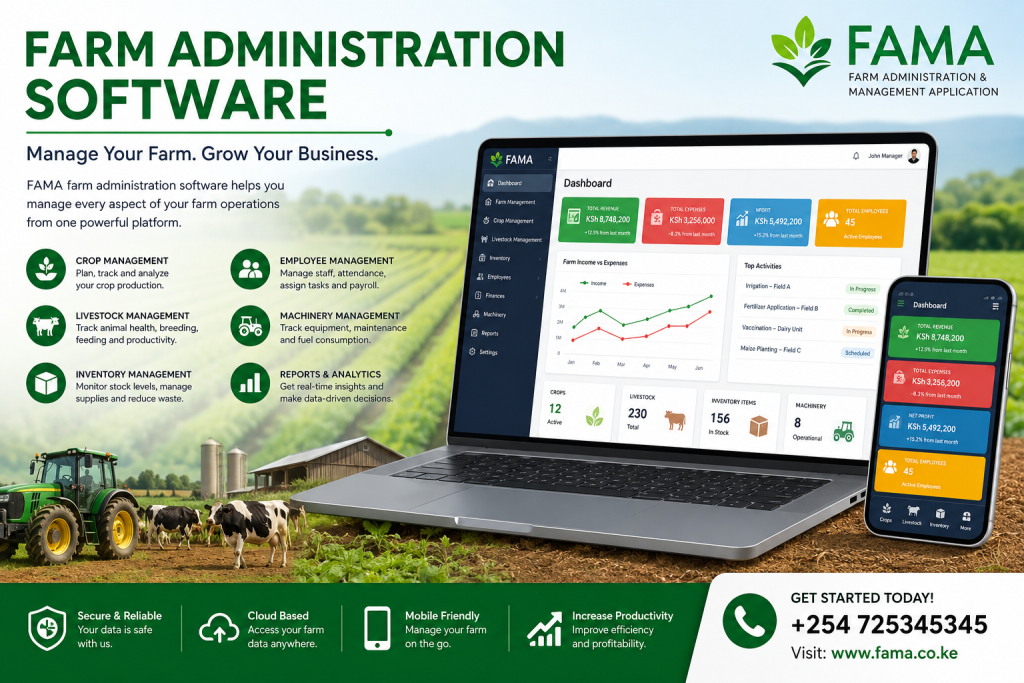
Farm Administration Software: The Complete Guide to Smarter Farm Operations

farm administration software

Running a successful farm today requires much more than planting crops or raising livestock. Modern agriculture has become increasingly data-driven, requiring farmers to manage finances, employees, inventory, machinery, compliance, production records, customer relationships, and market trends. This is where farm administration software becomes an essential tool for every modern agricultural business.

Whether you own a small family farm, a medium-sized commercial enterprise, or a large agribusiness, investing in reliable farm administration software helps improve efficiency, reduce operational costs, increase productivity, and make informed decisions. Instead of relying on spreadsheets, notebooks, and scattered paperwork, everything can be managed from one centralized digital platform.

At FAMA (Farm Administration & Management Application), we understand the unique challenges farmers face. Our goal is to simplify farm operations using intelligent software that keeps all farm information organized, accessible, and secure.

Visit FAMA at fama.co.ke or call +254 725345345 to learn how our farm administration software can transform your agricultural business.


Table of Contents

What is Farm Administration Software?

Farm administration software is a comprehensive digital system designed to help farmers manage every administrative aspect of their farming operations. It combines operational management, financial management, workforce coordination, inventory tracking, equipment monitoring, production planning, and reporting into one integrated solution.

Unlike traditional record-keeping methods, farm administration software automates repetitive tasks while providing real-time insights into farm performance.

The software acts as the central control system of your farm, enabling managers and owners to oversee every department from one dashboard.

Typical functions include:

  • Farm financial management
  • Crop management
  • Livestock administration
  • Employee management
  • Asset management
  • Inventory control
  • Farm scheduling
  • Machinery maintenance
  • Supplier management
  • Customer management
  • Reporting and analytics
  • Compliance management

Why Every Modern Farm Needs Farm Administration Software

Agriculture has evolved rapidly over the past decade. Rising production costs, climate uncertainty, labor shortages, and increasing market competition have forced farmers to become better managers.

Without farm administration software, farmers often struggle with:

  • Lost paperwork
  • Poor financial records
  • Delayed reporting
  • Inefficient employee supervision
  • Inventory shortages
  • Machinery breakdowns
  • Inaccurate production planning
  • Difficulty tracking farm expenses

Farm administration software eliminates these problems by creating one digital ecosystem where every farm activity is recorded automatically.


Benefits of Farm Administration Software

1. Centralized Farm Information

One of the biggest advantages of farm administration software is having every farm record stored in one place.

Instead of searching through files, notebooks, and spreadsheets, users can instantly retrieve:

  • Employee records
  • Livestock records
  • Crop records
  • Financial reports
  • Purchase history
  • Supplier information
  • Machinery maintenance logs
  • Production reports

This centralized system saves countless hours every week.


2. Better Decision Making

Successful farming depends on making timely decisions.

Farm administration software provides accurate data that helps managers answer questions like:

  • Which crops generate the highest profits?
  • Which livestock produce the best returns?
  • What are the monthly expenses?
  • Which machinery consumes the most fuel?
  • Which fields are most productive?
  • How much fertilizer has been used?

Instead of relying on assumptions, decisions become data-driven.


3. Improved Financial Management

Managing farm finances manually often leads to mistakes.

Farm administration software tracks:

  • Income
  • Expenses
  • Payroll
  • Profit margins
  • Budgets
  • Cash flow
  • Purchase orders
  • Sales

Financial transparency allows farm owners to understand where money is being spent and where savings can be made.


4. Increased Productivity

Automation reduces repetitive administrative work.

Tasks such as:

  • Employee attendance
  • Payroll calculations
  • Inventory updates
  • Report generation
  • Purchase tracking

can all be automated.

Employees spend less time doing paperwork and more time focusing on productive farming activities.


5. Accurate Farm Records

Good record keeping is essential for successful farming.

Farm administration software stores years of historical information including:

  • Crop yields
  • Livestock health
  • Vaccination schedules
  • Feeding programs
  • Fertilizer applications
  • Weather observations
  • Harvest quantities

These records become valuable resources for future planning.


Features of Farm Administration Software

An advanced farm administration software solution should provide numerous integrated modules.

Farm Dashboard

The dashboard provides an overview of:

  • Current farm activities
  • Financial summaries
  • Employee attendance
  • Inventory levels
  • Machinery status
  • Production statistics

Everything is visible in one place.


Employee Management

Managing agricultural workers becomes much easier.

Features include:

  • Staff registration
  • Attendance tracking
  • Leave management
  • Payroll
  • Performance evaluation
  • Task assignments

Managers always know who is working and what they are doing.


Farm Inventory Management

Inventory management is one of the most important components of farm administration software.

Track items like:

  • Fertilizers
  • Seeds
  • Chemicals
  • Animal feeds
  • Veterinary drugs
  • Fuel
  • Spare parts
  • Packaging materials

The software sends alerts when inventory reaches minimum stock levels.


Crop Management

Crop administration includes:

  • Field registration
  • Planting schedules
  • Irrigation schedules
  • Fertilizer applications
  • Pest control
  • Harvest records
  • Yield analysis

Every farming activity is documented.


Livestock Management

Livestock farms benefit from features such as:

  • Animal registration
  • Breed records
  • Vaccination schedules
  • Medical treatments
  • Feeding programs
  • Weight tracking
  • Milk production
  • Breeding records

Everything is stored digitally.


Machinery Management

Farm machinery is expensive.

Farm administration software helps monitor:

  • Maintenance schedules
  • Repairs
  • Fuel consumption
  • Operator assignments
  • Service history
  • Spare parts
  • Equipment utilization

Preventive maintenance reduces costly breakdowns.


Financial Module

The accounting section helps manage:

  • Revenue
  • Expenses
  • Assets
  • Liabilities
  • Payroll
  • Bank reconciliation
  • Budgets
  • Profit reports

Managers gain complete financial visibility.


How Farm Administration Software Improves Efficiency

Efficiency comes from eliminating unnecessary manual processes.

Instead of filling paper forms, managers simply use the software.

Examples include:

Before Software

Employee attendance:

  • Paper register

Inventory:

  • Notebook

Payroll:

  • Calculator

Reports:

  • Manual spreadsheets

Machinery maintenance:

  • Sticky notes

Farm expenses:

  • Receipts in folders

After Farm Administration Software

Employee attendance:

  • Digital

Inventory:

  • Real-time

Payroll:

  • Automated

Reports:

  • One click

Machinery maintenance:

  • Automatic reminders

Expenses:

  • Instantly categorized

This saves hours every day.


Farm Administration Software for Different Types of Farms

One advantage of modern farm administration software is flexibility.

It supports different agricultural sectors.

Crop Farms

Suitable for:

  • Maize farms
  • Wheat farms
  • Rice farms
  • Coffee farms
  • Tea farms
  • Vegetable farms
  • Fruit farms

Track every stage from planting to harvest.


Dairy Farms

Manage:

  • Milk production
  • Animal health
  • Feed inventory
  • Breeding
  • Veterinary treatments
  • Daily production reports

Poultry Farms

Monitor:

  • Bird populations
  • Egg production
  • Feed consumption
  • Vaccinations
  • Mortality rates
  • Sales

Pig Farms

Track:

  • Growth rates
  • Breeding
  • Feed usage
  • Medication
  • Sales

Mixed Farms

For farms with crops and livestock, farm administration software integrates all operations into one platform.


Challenges Solved by Farm Administration Software

Many farms struggle with operational inefficiencies.

Farm administration software addresses common problems.

Problem:

Poor communication.

Solution:
Centralized task management.


Problem:

Inventory losses.

Solution:
Real-time stock tracking.


Problem:

Delayed reports.

Solution:
Automatic report generation.


Problem:

Employee accountability.

Solution:
Attendance monitoring and task tracking.


Problem:

Financial confusion.

Solution:
Integrated accounting.


Problem:

Equipment downtime.

Solution:
Maintenance scheduling.


Why Manual Farm Administration No Longer Works

Paper records may seem inexpensive, but they come with significant hidden costs.

These include:

  • Missing information
  • Duplicate records
  • Human error
  • Time-consuming calculations
  • Lost receipts
  • Poor reporting
  • Limited data analysis

As farms grow, manual administration becomes increasingly difficult.

Farm administration software removes these limitations by digitizing every administrative process.


Who Should Use Farm Administration Software?

Almost every agricultural enterprise can benefit from farm administration software, including:

  • Smallholder farmers
  • Commercial farms
  • Agribusiness companies
  • Agricultural cooperatives
  • Dairy farms
  • Poultry farms
  • Horticulture farms
  • Livestock ranches
  • Agricultural training institutions
  • Farm consultants

Whether managing a few acres or thousands of hectares, digital administration improves efficiency and long-term sustainability.

Advanced Reporting with Farm Administration Software

One of the greatest advantages of implementing farm administration software is the ability to generate comprehensive reports instantly. Traditional reporting often requires hours or even days of compiling records from multiple notebooks, spreadsheets, and paper files. With modern farm administration software, these reports can be generated in seconds, providing accurate and actionable insights.

Reports help farm owners, managers, investors, and stakeholders evaluate performance, identify opportunities for improvement, and make informed decisions based on reliable data.

Common reports generated by farm administration software include:

  • Daily operational reports
  • Weekly production summaries
  • Monthly financial statements
  • Annual farm performance reports
  • Crop production reports
  • Livestock productivity reports
  • Employee attendance reports
  • Payroll reports
  • Equipment maintenance reports
  • Inventory movement reports
  • Sales reports
  • Purchase reports
  • Expense analysis
  • Profit and loss statements
  • Cash flow reports

These reports provide a complete picture of the farm’s operations and financial health.


Real-Time Farm Monitoring

Modern farm administration software allows farm managers to monitor operations in real time. Instead of waiting until the end of the week or month to review progress, managers can access live updates on farm activities from their computers, tablets, or smartphones.

Real-time monitoring allows management to:

  • View ongoing field activities
  • Monitor employee attendance
  • Check inventory availability
  • Review financial transactions
  • Track machinery utilization
  • Monitor livestock records
  • Follow crop development schedules

Having immediate access to this information helps managers respond quickly to challenges before they become costly problems.


Cloud-Based Farm Administration Software

Cloud technology has transformed how agricultural businesses manage their operations. Instead of storing information on a single computer, cloud-based farm administration software stores data securely online.

Benefits of cloud deployment include:

Access Anywhere

Farm owners can log into the system from:

  • Office computers
  • Home laptops
  • Smartphones
  • Tablets

This flexibility is especially valuable for managers who oversee multiple farms or frequently travel.


Automatic Data Backup

Paper records can be destroyed by:

  • Fire
  • Floods
  • Theft
  • Misplacement

Cloud-based systems automatically back up information, ensuring valuable farm records remain safe.


Multi-User Collaboration

Different departments can access the software simultaneously.

Examples include:

Finance department

Updating expenses.

Store manager

Recording inventory.

Farm supervisor

Assigning employee tasks.

Livestock officer

Recording animal treatments.

Management

Viewing reports.

Everyone works from one centralized database, eliminating duplicate work and improving communication.


Automatic Software Updates

Cloud-based farm administration software receives regular updates that introduce:

  • New features
  • Security improvements
  • Performance enhancements
  • Bug fixes

Farm owners do not need to purchase new software versions manually.


Data Security in Farm Administration Software

Agricultural businesses collect significant amounts of valuable information. Protecting this data is essential.

Reliable farm administration software includes multiple security measures such as:

  • Secure user authentication
  • Password protection
  • User role management
  • Data encryption
  • Automatic backups
  • Audit trails
  • Activity logs

Only authorized personnel can access sensitive financial or operational information.


User Access Levels

Different employees require different permissions.

For example:

Farm owner

  • Full system access

Farm manager

  • Operational management
  • Employee supervision
  • Reports

Accountant

  • Financial records
  • Payroll
  • Budgets

Storekeeper

  • Inventory
  • Purchase orders

Livestock officer

  • Animal records

Field supervisor

  • Crop activities

This prevents unauthorized changes while improving accountability.


Farm Budget Planning

Budgeting is critical for profitable farming.

Farm administration software helps prepare realistic budgets by analyzing historical data.

Budgets can include:

  • Seeds
  • Fertilizers
  • Chemicals
  • Animal feeds
  • Veterinary costs
  • Fuel
  • Salaries
  • Machinery maintenance
  • Utilities
  • Transportation

Managers can compare actual spending against planned budgets and make adjustments before costs escalate.


Expense Tracking

Every farming operation involves numerous expenses.

Farm administration software categorizes expenditures automatically.

Examples include:

Operational expenses

  • Fuel
  • Electricity
  • Water
  • Repairs

Agricultural inputs

  • Seeds
  • Fertilizers
  • Chemicals

Livestock costs

  • Feed
  • Medicine
  • Vaccinations

Labor costs

  • Salaries
  • Casual wages
  • Overtime

Administrative expenses

  • Office supplies
  • Communication
  • Insurance

Detailed expense tracking improves profitability by identifying unnecessary spending.


Revenue Management

Income can come from multiple farm activities.

Farm administration software records revenue from:

  • Crop sales
  • Livestock sales
  • Milk sales
  • Egg sales
  • Poultry sales
  • Fruit sales
  • Vegetable sales
  • Equipment rentals
  • Farm tourism
  • Value-added products

Managers gain a clear understanding of which enterprises generate the highest returns.


Payroll Management

Managing agricultural workers manually becomes increasingly difficult as farms grow.

Farm administration software automates payroll calculations.

Features include:

  • Salary calculations
  • Overtime
  • Leave deductions
  • Tax calculations
  • Allowances
  • Bonuses
  • Payment history

Payroll automation reduces errors while saving administrative time.


Supplier Management

Every successful farm depends on reliable suppliers.

Farm administration software maintains complete supplier profiles including:

  • Contact information
  • Purchase history
  • Payment records
  • Product categories
  • Delivery performance

Managers can easily compare suppliers and negotiate better purchasing agreements.


Customer Relationship Management

For commercial farms, customer relationships are just as important as production.

Farm administration software stores customer information including:

  • Contact details
  • Purchase history
  • Outstanding invoices
  • Delivery schedules
  • Payment records

This helps improve customer service while encouraging repeat business.


Purchase Order Management

Farm purchases should follow organized approval procedures.

Farm administration software simplifies procurement by managing:

  • Purchase requests
  • Quotations
  • Supplier selection
  • Purchase approvals
  • Delivery tracking
  • Invoice matching
  • Payment processing

This reduces procurement delays while maintaining financial control.


Inventory Optimization

Inventory shortages can delay farm operations.

Excess inventory ties up working capital.

Farm administration software helps maintain optimal inventory levels by:

  • Monitoring stock movements
  • Predicting consumption
  • Issuing reorder alerts
  • Tracking expiry dates
  • Identifying slow-moving items

Inventory optimization reduces waste and lowers operational costs.


Equipment Maintenance Scheduling

Farm equipment represents one of the largest investments in agriculture.

Regular maintenance protects this investment.

Farm administration software schedules maintenance based on:

  • Calendar dates
  • Operating hours
  • Distance travelled
  • Fuel consumption
  • Manufacturer recommendations

Preventive maintenance minimizes costly breakdowns during critical farming seasons.


Vehicle Management

Many farms operate several vehicles.

Farm administration software tracks:

  • Fuel usage
  • Driver assignments
  • Maintenance
  • Insurance
  • Licensing
  • Repairs
  • Mileage

Vehicle management improves accountability while reducing operating costs.


Compliance Management

Agricultural businesses must comply with numerous regulations.

Farm administration software assists with compliance by maintaining records related to:

  • Food safety
  • Chemical applications
  • Employee records
  • Environmental regulations
  • Animal welfare
  • Organic certification
  • Export standards

Having organized records simplifies audits and inspections.


Mobile Accessibility

Farm managers rarely spend all day in an office.

Mobile-friendly farm administration software allows users to:

  • Record field observations
  • Update livestock information
  • Approve purchases
  • Review reports
  • Check inventory
  • Assign tasks

Information is updated immediately, improving communication across the farm.


Business Intelligence and Analytics

Beyond record keeping, farm administration software provides advanced analytics that support strategic planning.

Analytics may include:

  • Production trends
  • Seasonal performance
  • Financial forecasts
  • Employee productivity
  • Machinery utilization
  • Cost analysis
  • Revenue comparisons

Managers gain valuable insights that support continuous improvement.


Integration with Smart Farming Technologies

Modern agriculture increasingly relies on digital technologies.

Farm administration software can integrate with:

  • GPS equipment
  • Weather stations
  • Soil sensors
  • Irrigation controllers
  • Drone imagery
  • Precision farming tools
  • IoT devices

These integrations improve operational efficiency while supporting data-driven agriculture.


Sustainability Through Farm Administration Software

Sustainable farming requires efficient use of resources.

Farm administration software helps reduce environmental impact by monitoring:

  • Water usage
  • Fertilizer application
  • Chemical usage
  • Fuel consumption
  • Waste generation
  • Carbon footprint indicators

Efficient resource management benefits both profitability and environmental conservation.


Scaling Agricultural Businesses

As farms expand, administration becomes increasingly complex.

Farm administration software grows with the business.

Whether managing:

  • One farm
  • Multiple farms
  • Regional operations
  • National agribusinesses

the software provides centralized management across all locations.

Expansion becomes significantly easier because standardized processes already exist.


Why Choose FAMA Farm Administration Software?

At FAMA, we understand the practical challenges faced by modern farmers. Our farm administration software has been designed to simplify day-to-day operations while providing powerful management tools for long-term success.

With FAMA, you can:

  • Digitize all farm records
  • Manage crops and livestock from one platform
  • Track expenses and revenue in real time
  • Automate payroll and employee management
  • Monitor inventory and farm assets
  • Generate detailed management reports
  • Improve accountability across departments
  • Make faster, data-driven decisions
  • Access your farm information securely from anywhere
  • Scale your operations as your business grows

Whether you operate a small family farm or a large commercial agricultural enterprise, FAMA provides the flexibility and reliability needed to manage your farm efficiently.


Best Practices for Successfully Implementing Farm Administration Software

Implementing farm administration software is not just about installing a system; it is about improving the way your farm operates. To maximize the benefits, it is important to follow best practices during implementation.

Start by digitizing existing records such as financial transactions, employee information, inventory lists, crop histories, and livestock records. Clean and accurate data ensures that reports generated by the software are meaningful and reliable.

Train employees who will be using the system regularly. Staff should understand how to record transactions, update inventory, manage production schedules, and generate reports. Proper training reduces errors and encourages adoption across the organization.

Assign user roles based on responsibilities. Limiting access to sensitive information improves security while ensuring that every employee has the tools they need to perform their duties effectively.

Review reports consistently rather than waiting until the end of the season. Regular monitoring allows managers to identify trends, address issues early, and make informed operational decisions.

Finally, treat your farm administration software as a strategic management tool rather than just a record-keeping system. The more consistently you use the software, the greater the return on your investment.


Frequently Asked Questions (FAQs)

Is farm administration software suitable for small farms?

Yes. Small farms benefit from improved organization, accurate record keeping, simplified financial management, and better planning. The software can scale as the farm grows.

Can the software manage both crops and livestock?

Absolutely. A comprehensive farm administration software solution like FAMA supports mixed farming by managing crop production, livestock records, inventory, finances, employees, and assets within one integrated platform.

Is my farm data secure?

Yes. FAMA prioritizes data security through secure authentication, role-based access controls, encrypted data storage, and regular backups to ensure your information remains protected.

Can multiple users access the system?

Yes. Farm owners, managers, accountants, storekeepers, field supervisors, and livestock officers can all use the system simultaneously, each with permissions tailored to their role.

Can I access the software remotely?

Yes. Because FAMA is cloud-based, you can securely access your farm information from any location using a computer, tablet, or smartphone with an internet connection.


Conclusion

Agriculture is becoming increasingly competitive, and efficient administration is just as important as productive farming practices. Investing in farm administration software allows farmers to streamline operations, improve financial management, optimize resource utilization, enhance employee productivity, and make smarter decisions backed by accurate data.

Instead of relying on manual paperwork and disconnected spreadsheets, modern farms need a centralized digital solution that brings every aspect of farm management together. From crop planning and livestock tracking to payroll, inventory, machinery maintenance, budgeting, reporting, and analytics, farm administration software provides the foundation for sustainable agricultural success.

If you are looking for a reliable, scalable, and user-friendly farm administration software, FAMA is ready to help you modernize your agricultural operations.

Visit fama.co.ke today to learn more about our solutions or contact us directly at +254 725345345. Our team is ready to demonstrate how FAMA can help you improve efficiency, increase profitability, and confidently manage every aspect of your farming business with powerful farm administration software.