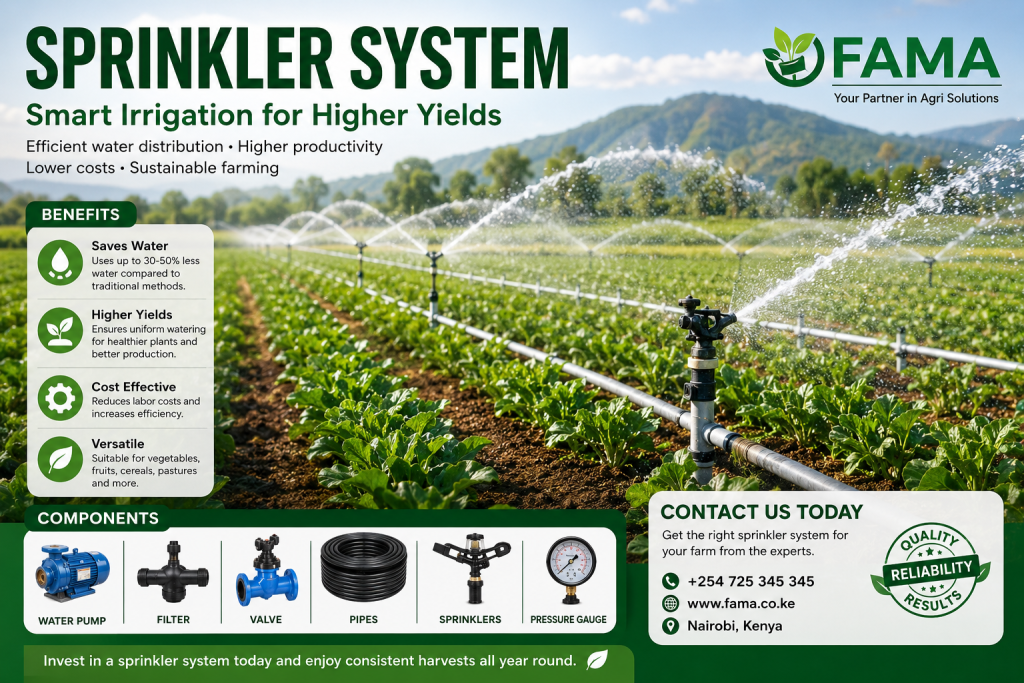
Agriculture continues to evolve as farmers embrace modern technologies that improve efficiency, reduce water wastage, and increase crop yields. Among the most effective irrigation methods available today is the sprinkler system. Whether you operate a small vegetable garden, a medium-sized horticultural farm, or a large commercial plantation, investing in a sprinkler system can significantly transform your farming operations.
A sprinkler system distributes water evenly across crops by simulating natural rainfall. Instead of relying solely on unpredictable weather patterns or labor-intensive manual watering, farmers can use sprinkler irrigation to provide crops with consistent moisture throughout their growing season.
At FAMA (fama.co.ke), we specialize in supplying quality sprinkler systems designed for Kenyan farmers. Our irrigation solutions help maximize crop production while conserving water, lowering labor costs, and promoting sustainable agriculture.
For inquiries, installation, and consultation, contact us today:
FAMA Kenya
📞 +254 725 345 345
🌐 www.fama.co.ke
What is a Sprinkler System?
A sprinkler system is an irrigation system that delivers water through pipes under pressure before spraying it through specially designed sprinkler heads. The water falls gently onto crops like natural rain, ensuring uniform watering over the entire field.
Unlike flood irrigation, where water flows across the soil surface, a sprinkler system applies water precisely, reducing wastage and improving irrigation efficiency.
Modern sprinkler systems can be customized depending on:
- Farm size
- Crop type
- Water availability
- Soil characteristics
- Water pressure
- Terrain
Farmers across Kenya increasingly prefer the sprinkler system because it works effectively in areas where rainfall is unreliable.
How Does a Sprinkler System Work?
Every sprinkler system follows a relatively simple process.
First, water is pumped from a reliable source such as:
- Boreholes
- Rivers
- Water tanks
- Dams
- Reservoirs
- Municipal water supply
The pump creates pressure that forces water through a network of pipes.
The water then reaches sprinkler heads positioned strategically throughout the farm. These sprinklers rotate or spray water over the crops in controlled patterns, ensuring even distribution.
The amount of water applied depends on:
- Sprinkler nozzle size
- Operating pressure
- Spacing between sprinklers
- Irrigation schedule
This controlled application makes the sprinkler system highly efficient.
Main Components of a Sprinkler System
Understanding the parts of a sprinkler system helps farmers make informed purchasing decisions.
1. Water Source
Every sprinkler irrigation project begins with a reliable water source.
Common options include:
- Boreholes
- Rivers
- Water pans
- Storage tanks
- Reservoirs
The available water determines the overall design of the sprinkler system.
2. Water Pump
The pump provides the pressure needed to move water throughout the irrigation network.
Popular pump types include:
- Electric pumps
- Diesel pumps
- Petrol pumps
- Solar-powered pumps
Selecting the correct pump ensures your sprinkler system performs efficiently.
3. Mainline Pipes
These transport water from the pump to different sections of the farm.
Most sprinkler systems use:
- HDPE pipes
- PVC pipes
- Aluminum pipes
High-quality piping minimizes leaks and pressure loss.
4. Lateral Pipes
Lateral pipes distribute water from the mainline to individual sprinklers.
Proper spacing improves water uniformity.
5. Sprinkler Heads
The sprinkler head is the heart of every sprinkler system.
Different sprinkler heads provide varying spray patterns.
Examples include:
- Rotary sprinklers
- Impact sprinklers
- Pop-up sprinklers
- Rain gun sprinklers
- Micro sprinklers
Each is suitable for different crops and farm sizes.
6. Control Valves
Valves regulate water flow throughout the sprinkler system.
They allow farmers to irrigate different sections independently.
7. Filters
Water filtration prevents clogging.
Clean water prolongs the lifespan of the sprinkler system.
Types of Sprinkler Systems
There are several kinds of sprinkler systems available depending on farming requirements.
Portable Sprinkler System
A portable sprinkler system uses movable pipes and sprinklers.
Advantages include:
- Affordable
- Easy installation
- Flexible use
- Suitable for small farms
Many vegetable farmers in Kenya use portable sprinkler irrigation.
Permanent Sprinkler System
Permanent systems remain installed underground or above ground.
Benefits include:
- Minimal labor
- Long lifespan
- Automated irrigation
- Excellent efficiency
Although initial investment is higher, permanent sprinkler systems offer long-term savings.
Semi-Permanent Sprinkler System
These combine permanent pipelines with portable sprinklers.
Farmers enjoy flexibility while reducing installation costs.
Center Pivot Sprinkler System
Large commercial farms often use center pivot irrigation.
The rotating structure irrigates circular fields efficiently.
This sprinkler system is ideal for:
- Wheat
- Maize
- Pasture
- Seed production
Rain Gun Sprinkler System
Rain gun irrigation delivers water over long distances.
Applications include:
- Sugarcane
- Maize
- Pasture
- Large farms
Rain guns are powerful sprinkler systems capable of covering several hectares.
Micro Sprinkler System
Micro sprinklers apply water gently around plants.
They are suitable for:
- Orchards
- Flowers
- Greenhouses
- Tree nurseries
Micro sprinkler systems reduce water wastage considerably.
Advantages of a Sprinkler System
The popularity of the sprinkler system continues growing because of its numerous advantages.
Uniform Water Distribution
One of the biggest benefits of a sprinkler system is uniform watering.
Every crop receives nearly equal moisture.
This improves plant growth consistency.
Water Conservation
Water is becoming increasingly scarce.
A properly designed sprinkler system minimizes losses caused by runoff and excessive application.
Farmers save substantial amounts of water annually.
Higher Crop Yields
Healthy crops require consistent moisture.
A sprinkler system maintains optimal soil moisture, encouraging:
- Better germination
- Strong root development
- Increased flowering
- Improved fruit formation
The result is higher yields.
Labor Savings
Manual irrigation requires significant labor.
Using a sprinkler system dramatically reduces labor requirements.
Farm workers can focus on other productive activities.
Reduced Soil Erosion
Flood irrigation often causes erosion.
A sprinkler system applies water gently, preserving valuable topsoil.
Suitable for Different Soil Types
The sprinkler system works effectively on:
- Sandy soils
- Loamy soils
- Clay soils
Proper design ensures suitable application rates.
Works on Uneven Terrain
Unlike surface irrigation, a sprinkler system performs well on sloping land.
Minimal land leveling is required.
Fertigation Compatibility
Many sprinkler systems allow fertilizers to be injected into irrigation water.
Benefits include:
- Better nutrient uptake
- Reduced fertilizer wastage
- Improved crop growth
Cooling Crops
During extremely hot weather, sprinkler irrigation lowers crop temperatures.
This reduces heat stress.
Frost Protection
Some farmers use sprinkler systems to protect crops against frost damage.
The water forms a protective layer around plants.
Crops Suitable for Sprinkler Systems
Nearly every crop benefits from sprinkler irrigation.
Examples include:
Vegetables
- Tomatoes
- Cabbage
- Spinach
- Kale
- Onions
- Carrots
- Capsicum
Cereals
- Maize
- Wheat
- Barley
- Sorghum
Fruits
- Mangoes
- Oranges
- Avocados
- Apples
- Passion fruits
Cash Crops
- Coffee
- Tea
- Sugarcane
- Pyrethrum
Pasture
Livestock farmers use sprinkler systems to maintain healthy grazing fields.
Flower Farming
Commercial flower farms rely heavily on modern sprinkler systems.
Factors to Consider Before Installing a Sprinkler System
Selecting the right sprinkler system requires proper planning.
Consider the following.
Water Availability
Always determine whether your water source provides sufficient flow.
Water Quality
Dirty water clogs sprinkler heads.
Proper filtration is essential.
Farm Size
Small farms require different sprinkler layouts compared to large commercial farms.
Crop Type
Different crops require varying irrigation schedules.
Your sprinkler system should match crop water requirements.
Soil Type
Heavy clay retains water longer than sandy soil.
System design should consider infiltration rates.
Wind Conditions
Strong winds affect sprinkler performance.
Professional installation minimizes wind-related water losses.
Budget
Choose a sprinkler system that balances cost with long-term efficiency.
Cheaper systems often require more maintenance.
Why Farmers in Kenya are Choosing Sprinkler Systems
Kenyan agriculture increasingly depends on irrigation because rainfall patterns continue changing.
Farmers are investing in sprinkler systems because they offer:
- Reliable irrigation
- Better crop quality
- Increased profitability
- Reduced labor costs
- Water efficiency
- Higher production throughout the year
Whether farming in Nakuru, Uasin Gishu, Meru, Nyeri, Kirinyaga, Embu, Kajiado, Machakos, Kiambu, or other counties, a professionally installed sprinkler system helps farmers achieve consistent harvests regardless of seasonal rainfall.
Why Buy Your Sprinkler System from FAMA?
At FAMA (fama.co.ke), we provide high-quality irrigation solutions tailored to the needs of Kenyan farmers. We offer durable sprinkler equipment, expert consultation, professional installation, and reliable after-sales support to help you maximize your farm’s productivity.
Our team assists with selecting the right sprinkler system based on your farm size, crops, water source, and budget.
Contact FAMA Today
📞 +254 725 345 345
🌐 www.fama.co.ke
Sprinkler System Installation Process
Installing an irrigation system is not simply about connecting pipes and sprinklers. A successful installation begins with proper planning and a clear understanding of the farm’s characteristics. Every farm has unique requirements depending on the crops being grown, the size of the land, soil conditions, water availability, and future expansion plans. Careful preparation before installation helps avoid unnecessary costs and ensures that the irrigation setup performs efficiently for many years.
Site Assessment
The first stage involves carrying out a detailed assessment of the farm. During this process, several factors are evaluated, including the shape of the land, elevation differences, water source location, and existing infrastructure. Understanding these conditions helps determine the most suitable layout and equipment for the project.
A thorough assessment also identifies any obstacles such as buildings, trees, roads, or power lines that could interfere with irrigation coverage. Proper planning at this stage reduces future modifications and improves the efficiency of the entire system.
Designing the Irrigation Layout
After collecting all the necessary information, a detailed irrigation layout is developed. The design determines the placement of pipelines, valves, sprinkler heads, pumps, filters, and control units.
The objective is to ensure every section of the farm receives adequate water while minimizing pressure loss and water wastage. A well-designed layout also allows future expansion without requiring complete replacement of the infrastructure.
Proper design ensures:
- Even water distribution
- Reduced operating costs
- Lower maintenance expenses
- Efficient water usage
- Long-term reliability
Selecting Quality Equipment
Quality materials directly influence the lifespan of any irrigation project. Pipes, fittings, pumps, valves, and sprinklers should be selected based on durability, pressure ratings, and compatibility with local conditions.
Choosing cheaper materials may reduce initial investment but often results in frequent repairs, water leakage, and higher operational costs over time.
Professional suppliers help farmers select equipment that matches both their farming requirements and budget.
Preparing the Farm
Before installation begins, the farm should be prepared by clearing areas where pipelines will be laid. Trenches may be dug where underground pipes are required, while above-ground installations should have stable support structures.
Proper preparation simplifies installation and reduces delays during construction.
Installing the Water Pump
The pump is installed close to the water source to reduce suction losses. It should be placed on a firm, level foundation to minimize vibration and extend its operational life.
Electrical or solar connections should be installed by qualified technicians to ensure safety and reliable performance.
Pipe Installation
Once the pump is in place, the pipeline network is installed according to the approved design. Every connection should be secured properly to prevent future leakage.
Pressure testing is normally performed before covering underground pipes. This ensures that all joints are watertight and capable of handling the required operating pressure.
Installing Sprinklers
Sprinkler heads are positioned according to the recommended spacing to provide overlapping coverage. Correct spacing prevents dry patches while avoiding excessive watering in overlapping areas.
Each sprinkler should be adjusted to achieve the intended spray pattern and operating angle.
Testing and Commissioning
Before the system is handed over, a complete performance test is carried out. During testing, technicians verify:
- Water pressure
- Spray uniformity
- Rotation of sprinklers
- Valve operation
- Pump performance
- Water flow rate
Any issues discovered during testing are corrected before the system becomes operational.
Routine Maintenance
Regular maintenance helps irrigation equipment remain efficient throughout its service life. A maintenance schedule prevents unexpected breakdowns and reduces repair costs.
Inspect Pipes Regularly
Pipelines should be inspected for cracks, loose fittings, or leaks. Small leaks often become major problems if ignored for extended periods.
Routine inspection helps conserve water and maintain proper operating pressure.
Clean Filters Frequently
Filters remove sand, debris, and other particles from the water supply. Dirty filters restrict water flow and increase pressure loss.
Cleaning intervals depend on water quality and the amount of suspended material entering the system.
Check Sprinkler Heads
Sprinkler heads should be inspected for blockage, wear, or physical damage.
Common issues include:
- Blocked nozzles
- Broken rotating mechanisms
- Uneven spray patterns
- Damaged seals
Cleaning or replacing damaged components restores proper water distribution.
Lubricate Moving Parts
Moving components such as bearings, pivots, and rotating sprinkler mechanisms benefit from periodic lubrication.
Proper lubrication reduces friction and prolongs equipment life.
Monitor Pump Performance
The pump should operate smoothly without excessive vibration or unusual noises.
Indicators requiring attention include:
- Reduced water pressure
- Overheating
- Excessive vibration
- Water leakage around seals
- Unusual operating sounds
Routine servicing prevents costly pump failures.
Flush the Pipeline Network
Over time, sediment may accumulate inside pipelines.
Flushing removes accumulated particles and maintains unrestricted water flow throughout the irrigation network.
Common Problems and Their Solutions
Even properly installed irrigation systems occasionally develop operational problems. Fortunately, most issues can be identified and corrected quickly.
Uneven Water Distribution
Possible causes include:
- Incorrect pressure
- Blocked nozzles
- Improper spacing
- Wind interference
Regular inspections and pressure adjustments usually solve these issues.
Low Water Pressure
Pressure loss may result from:
- Pipe leaks
- Worn pumps
- Blocked filters
- Excessive pipe length
Replacing damaged components restores performance.
Leaking Pipes
Leaks often occur due to:
- Aging pipes
- Loose fittings
- Physical damage
- Poor installation
Prompt repair prevents unnecessary water loss.
Blocked Nozzles
Dirty water sometimes blocks sprinkler openings.
Cleaning affected nozzles restores normal spray patterns.
Installing effective filtration greatly reduces clogging.
Pump Failure
Pump failures may result from:
- Electrical faults
- Dry running
- Poor maintenance
- Excessive wear
Regular servicing significantly reduces the likelihood of pump breakdowns.
Water Management Best Practices
Efficient irrigation involves much more than turning water on and off. Good water management improves crop performance while reducing operating expenses.
Irrigate Early Morning
Morning irrigation minimizes evaporation losses while allowing plants to dry before evening.
This reduces disease development associated with prolonged leaf wetness.
Avoid Overwatering
Applying excessive water wastes resources and may damage crops.
Overwatering can lead to:
- Root diseases
- Nutrient leaching
- Poor root development
- Increased weed growth
Monitoring soil moisture helps determine the correct irrigation schedule.
Adjust According to Weather
Cool weather generally requires less irrigation than hot, windy conditions.
Rainfall should also be considered when planning irrigation schedules.
Monitor Soil Moisture
Rather than following fixed schedules throughout the season, irrigation should respond to actual soil moisture conditions.
Simple moisture monitoring methods help improve irrigation efficiency.
Environmental Benefits
Modern irrigation contributes significantly to sustainable farming practices.
Some environmental benefits include:
- Reduced soil erosion
- Better water conservation
- Improved groundwater protection
- Reduced nutrient runoff
- Lower energy consumption through efficient operation
- Healthier plant growth
Responsible water management supports long-term agricultural sustainability.
Financial Benefits for Farmers
Although irrigation requires initial investment, many farmers recover their costs through improved productivity and better crop quality.
Financial advantages may include:
- Higher yields
- Improved produce quality
- Extended growing seasons
- Increased market opportunities
- Lower labor expenses
- Better income stability
Many commercial farms view irrigation as a long-term investment rather than a short-term expense.
Choosing the Right Supplier
Selecting the right supplier is just as important as selecting the equipment itself.
A reputable supplier should provide:
- Professional consultation
- Site assessment
- Quality equipment
- Installation services
- Technical support
- Spare parts availability
- Warranty coverage
- Maintenance services
Working with experienced professionals reduces installation mistakes and ensures reliable long-term performance.
Frequently Asked Questions
How long does installation take?
Installation time depends on the farm size, terrain, and project complexity. Small farms may be completed within a few days, while larger commercial projects may require several weeks.
Can irrigation be powered using solar energy?
Yes. Solar-powered pumping systems have become increasingly popular, particularly in remote areas where grid electricity is unavailable or unreliable.
Does every farm require the same design?
No. Every farm has unique characteristics. Soil type, crop selection, water source, elevation, and available budget all influence the final design.
How often should maintenance be performed?
Basic inspections should be carried out regularly throughout the growing season. More comprehensive servicing is generally recommended at least once or twice each year depending on usage.
Can an existing farm be upgraded?
Yes. Many older irrigation installations can be expanded or modernized without replacing every component. Upgrades often improve efficiency while reducing long-term operating costs.
Why Professional Installation Matters
Professional installation provides several long-term advantages beyond simply assembling equipment. Experienced technicians understand hydraulic design, pressure management, equipment compatibility, and field layout optimization.
A professionally installed system typically offers:
- Better reliability
- Uniform irrigation coverage
- Lower maintenance costs
- Longer equipment lifespan
- Improved water efficiency
- Easier future expansion
Attempting to install complex irrigation infrastructure without proper planning often leads to uneven watering, pressure problems, and expensive repairs later.
Conclusion
Reliable irrigation has become an essential investment for modern agriculture. As climate patterns continue to change and water resources become increasingly valuable, efficient irrigation methods provide farmers with greater control over crop production throughout the year.
Beyond increasing productivity, a well-designed irrigation project contributes to healthier crops, more consistent harvests, improved resource management, and stronger long-term profitability. By combining quality equipment with professional planning, routine maintenance, and responsible water management practices, farmers can maximize the return on their investment while protecting valuable natural resources.
Whether operating a small family farm or managing a large commercial enterprise, investing in dependable irrigation infrastructure supports sustainable agricultural growth and creates opportunities for higher production in every season.
Contact FAMA Kenya
If you are planning a new irrigation project or upgrading an existing one, the team at FAMA is ready to assist with expert consultation, equipment selection, professional installation, and ongoing technical support.
FAMA Kenya
🌐 www.fama.co.ke
📞 +254 725 345 345
Our experienced team is committed to helping farmers implement practical irrigation solutions that improve productivity, conserve water, and support successful farming operations across Kenya.