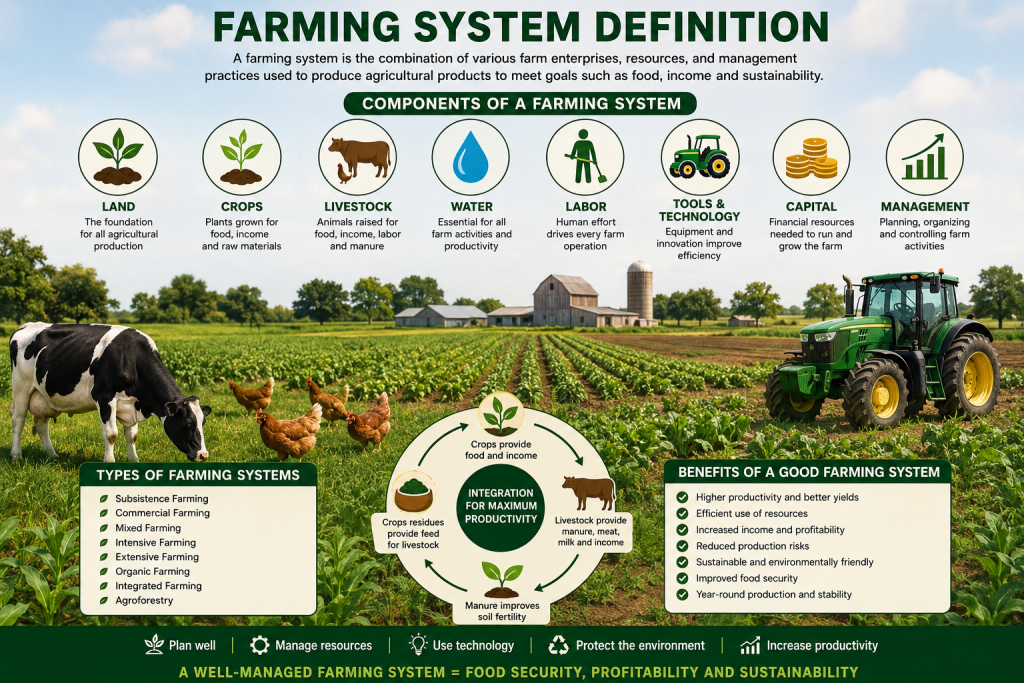
Farming System Definition: A Complete Guide to Farming Systems and Their Importance in Modern Agriculture

farming system definition

Table of Contents

Farming System Definition

Understanding the farming system definition is one of the first steps toward becoming a successful farmer. Whether you are a beginner, a commercial farmer, or an agricultural investor, knowing the correct farming system definition helps you make informed decisions that increase productivity, improve profitability, and ensure sustainable farming.

A farming system is much more than planting crops or raising livestock. It is an organized combination of resources, farming activities, management practices, labor, technology, capital, and environmental factors working together to achieve agricultural production goals.

At FAMA Kenya (fama.co.ke), we understand that selecting the right farming system determines whether a farm succeeds or struggles. Farmers who understand different farming systems are able to maximize land utilization, reduce production costs, and increase income throughout the year.

If you would like professional advice on implementing the best farming system for your farm, contact us today on +254 725345345.


What is the Farming System Definition?

The farming system definition refers to the way different agricultural enterprises, including crops, livestock, fish farming, poultry, machinery, labor, land, water, and financial resources, are combined and managed within a farm to produce food and generate income.

Simply put, the farming system definition explains how all farm activities interact to achieve maximum productivity while maintaining sustainability.

A farming system includes:

  • Land management
  • Crop production
  • Livestock management
  • Water utilization
  • Farm machinery
  • Labor allocation
  • Marketing
  • Financial planning
  • Farm technology
  • Environmental conservation

Every successful farm follows a particular farming system whether the owner realizes it or not.


Why Understanding the Farming System Definition Matters

Many farmers fail because they only focus on production without understanding the complete farming system.

Learning the farming system definition helps farmers:

  • Increase farm profits
  • Improve planning
  • Reduce wastage
  • Enhance food security
  • Improve soil fertility
  • Diversify income
  • Reduce production risks
  • Manage farm resources efficiently
  • Improve sustainability
  • Adapt to climate change

The better you understand the farming system definition, the easier it becomes to make strategic farming decisions.


Components of a Farming System

A farming system consists of several interconnected components.

1. Land

Land forms the foundation of every farming system.

The quality of soil determines:

  • Crop performance
  • Water retention
  • Fertility
  • Productivity
  • Profitability

Good farming systems always prioritize proper land management.


2. Crops

Crop production is one of the most important components under the farming system definition.

Examples include:

  • Maize
  • Beans
  • Coffee
  • Tea
  • Wheat
  • Rice
  • Potatoes
  • Tomatoes
  • Onions
  • Vegetables
  • Fruits

The choice of crops depends on climate, soil type, rainfall, and market demand.


3. Livestock

Many farming systems integrate livestock production.

Examples include:

  • Dairy cattle
  • Beef cattle
  • Poultry
  • Goats
  • Sheep
  • Rabbits
  • Fish
  • Pigs

Livestock provide:

  • Income
  • Organic manure
  • Food
  • Employment
  • Farm power in some regions

4. Farm Labor

A farming system cannot function without labor.

Labor may include:

  • Family labor
  • Permanent employees
  • Casual workers
  • Seasonal workers

Proper labor management improves farm efficiency.


5. Farm Inputs

Inputs include:

  • Seeds
  • Fertilizers
  • Pesticides
  • Herbicides
  • Animal feeds
  • Machinery
  • Irrigation equipment

Efficient use of farm inputs determines productivity.


6. Capital

Capital finances every farming operation.

Examples include:

  • Loans
  • Savings
  • Farm equipment
  • Irrigation investments
  • Machinery purchases

Without adequate capital, farming operations become difficult.


7. Technology

Modern farming systems rely heavily on technology.

Examples include:

  • Farm management software
  • GPS mapping
  • Drones
  • Smart irrigation
  • Greenhouses
  • Digital record keeping

Technology improves efficiency while reducing costs.


Characteristics of a Farming System

Every farming system has unique characteristics.

These include:

Integration

All farm enterprises support one another.

For example:

Livestock produce manure.

Manure fertilizes crops.

Crop residues feed livestock.

This creates an efficient cycle.


Resource Utilization

A good farming system ensures maximum utilization of available resources.

Resources include:

  • Land
  • Water
  • Labor
  • Capital
  • Technology

Sustainability

Modern farming systems prioritize long-term production rather than short-term profits.

Sustainability involves:

  • Soil conservation
  • Water conservation
  • Biodiversity
  • Climate resilience

Productivity

An effective farming system increases output while minimizing production costs.

Higher productivity leads to higher profits.


Profitability

Ultimately, every farming system should improve farm income.

Farmers invest in farming to generate returns while feeding communities.


Types of Farming Systems

There are several farming systems practiced worldwide.


1. Subsistence Farming System

This farming system focuses on producing food mainly for family consumption.

Characteristics include:

  • Small land sizes
  • Traditional tools
  • Family labor
  • Low technology
  • Limited commercialization

Advantages:

  • Food security
  • Low investment
  • Family employment

Disadvantages:

  • Low income
  • Low productivity
  • Poor market access

2. Commercial Farming System

Commercial farming aims at producing agricultural products for sale.

Characteristics include:

  • Large farms
  • Modern machinery
  • Improved seeds
  • Irrigation
  • Mechanization

Examples include:

  • Commercial dairy farming
  • Flower farming
  • Tea plantations
  • Coffee plantations
  • Large-scale maize farming

Advantages:

  • High profits
  • High productivity
  • Job creation

3. Mixed Farming System

Mixed farming combines crop production with livestock farming.

This is among the most common farming systems in Kenya.

Benefits include:

  • Diversified income
  • Better manure utilization
  • Reduced risks
  • Improved resource use

4. Intensive Farming System

This farming system maximizes production from a small area.

Characteristics include:

  • High fertilizer use
  • High labor
  • Irrigation
  • Modern technology
  • Greenhouses

Examples:

  • Greenhouse tomato farming
  • Poultry farming
  • Dairy zero grazing

5. Extensive Farming System

Extensive farming uses large land areas with relatively low labor and capital inputs.

Examples include:

  • Ranching
  • Beef production
  • Sheep farming

Advantages include:

  • Lower labor costs
  • Lower input costs
  • Less pressure on land

6. Organic Farming System

Organic farming avoids synthetic chemicals.

Instead, farmers use:

  • Compost
  • Organic manure
  • Biological pest control
  • Crop rotation

Benefits include:

  • Healthy food
  • Better soil
  • Environmental conservation
  • Higher market prices

7. Integrated Farming System

Integrated farming combines multiple enterprises.

Examples include:

  • Fish farming
  • Poultry
  • Dairy
  • Vegetables
  • Fruit farming

Waste from one enterprise becomes input for another.

Integrated farming improves efficiency and sustainability.


Factors Affecting Farming Systems

Several factors influence the choice of farming systems.

These include:

Climate

Rainfall patterns determine suitable farming activities.

Soil Type

Different soils support different crops.

Water Availability

Reliable water supports irrigation farming.

Capital

Investment determines the farming technologies adopted.

Labor

Availability of skilled workers affects productivity.

Market Access

Farmers near markets often choose commercial farming systems.

Government Policies

Agricultural policies influence farming decisions through subsidies, extension services, and financing.


Importance of Choosing the Right Farming System

Selecting the right farming system helps farmers:

  • Increase yields
  • Reduce production costs
  • Improve soil fertility
  • Diversify income
  • Minimize farming risks
  • Improve environmental conservation
  • Enhance food security
  • Increase profitability
  • Utilize farm resources efficiently
  • Build sustainable agricultural businesses

A well-planned farming system is the foundation of successful farming, regardless of the farm’s size.

Farming Systems in Kenya

Kenya has one of the most diverse agricultural sectors in Africa, and understanding the farming system definition helps explain why different regions practice different methods of farming. Climate, soil type, rainfall, market access, and available technology all influence the farming system adopted by farmers.

The highlands are well known for dairy farming, tea, coffee, potatoes, and horticulture, while the arid and semi-arid regions mainly practice livestock farming due to limited rainfall. Areas with access to irrigation support rice farming, vegetable production, and fruit farming throughout the year.

The farming system definition in Kenya is therefore not limited to one method. It includes a wide range of agricultural practices that are adapted to local environmental conditions and economic opportunities.

Common farming systems practiced in Kenya include:

  • Mixed farming
  • Dairy farming
  • Commercial crop farming
  • Subsistence farming
  • Irrigated farming
  • Greenhouse farming
  • Poultry farming
  • Fish farming
  • Agroforestry
  • Organic farming

Each farming system contributes significantly to national food production, employment, and economic growth.


Benefits of Understanding the Farming System Definition

Every farmer should understand the farming system definition before investing in agriculture. Knowledge enables farmers to maximize available resources while minimizing risks.

Some of the major benefits include:

Better Planning

Farmers can plan land use, labor requirements, irrigation schedules, crop rotation, and livestock management more effectively.

Increased Productivity

A well-designed farming system ensures every resource contributes toward improving farm output.

Improved Profitability

Farmers are able to identify the most profitable enterprises while reducing unnecessary expenses.

Efficient Resource Utilization

Land, water, labor, machinery, and capital are used more efficiently.

Reduced Risks

Diversification helps farmers overcome challenges such as drought, pests, diseases, and market price fluctuations.

Environmental Protection

Modern farming systems encourage soil conservation, water harvesting, and sustainable production practices.

Improved Food Security

Well-managed farming systems ensure continuous production of food throughout the year.


Advantages of Different Farming Systems

Different farming systems offer different advantages depending on the farmer’s objectives.

Mixed Farming

Advantages include:

  • Multiple income sources
  • Better utilization of manure
  • Reduced dependence on one enterprise
  • Improved soil fertility
  • Lower production risks

Commercial Farming

Advantages include:

  • High productivity
  • Better access to markets
  • Mechanization
  • Large-scale production
  • Higher profitability

Organic Farming

Advantages include:

  • Premium market prices
  • Reduced chemical exposure
  • Healthy food production
  • Environmental sustainability
  • Improved soil health

Intensive Farming

Advantages include:

  • High yields
  • Efficient land use
  • Year-round production
  • Greater return on investment

Integrated Farming

Advantages include:

  • Efficient recycling of farm waste
  • Multiple income streams
  • Lower production costs
  • Improved environmental sustainability
  • Better farm resilience

Challenges Facing Farming Systems

Although farming systems provide many benefits, farmers also face several challenges.

Climate Change

Unpredictable rainfall, prolonged droughts, floods, and rising temperatures affect agricultural productivity.

High Cost of Inputs

Prices of fertilizers, pesticides, animal feeds, machinery, and fuel continue to increase.

Limited Access to Finance

Many small-scale farmers struggle to obtain affordable loans for expansion.

Poor Market Access

Some farmers experience low prices because they lack access to reliable markets.

Pest and Disease Outbreaks

Crop pests and livestock diseases reduce productivity and increase production costs.

Inadequate Technology

Limited access to modern equipment slows agricultural development.

Land Fragmentation

Population growth has reduced average farm sizes, making large-scale farming difficult.

Understanding the farming system definition helps farmers anticipate these challenges and adopt suitable solutions.


Modern Farming Systems

Agriculture has changed significantly over the past decade. Modern farming systems combine traditional farming knowledge with technology to increase efficiency.

Examples include:

  • Precision farming
  • Smart irrigation
  • Greenhouse farming
  • Hydroponics
  • Aquaponics
  • Climate-smart agriculture
  • Automated dairy farming
  • Digital farm management
  • Drone-assisted farming
  • GPS-guided machinery

These innovations improve productivity while reducing labor and operational costs.


Digital Farming Systems

Digital agriculture is transforming how farms are managed.

Farmers now use technology to monitor crops, livestock, finances, and farm operations from computers and smartphones.

Digital farming systems help farmers:

  • Record farm activities
  • Monitor expenses
  • Track harvests
  • Manage livestock
  • Schedule farm operations
  • Forecast production
  • Improve decision-making
  • Analyze farm performance

Digital record keeping also makes it easier to access loans, insurance, and government support programs.


Sustainable Farming Systems

Sustainability is an essential aspect of modern agriculture. A sustainable farming system produces food while protecting natural resources for future generations.

Sustainable farming practices include:

  • Crop rotation
  • Conservation tillage
  • Organic manure application
  • Rainwater harvesting
  • Agroforestry
  • Soil testing
  • Mulching
  • Efficient irrigation
  • Renewable energy
  • Integrated pest management

These practices reduce environmental degradation while improving long-term productivity.


How to Choose the Right Farming System

Selecting the most appropriate farming system depends on several factors.

Farm Size

Small farms often benefit from intensive or mixed farming, while larger farms may support commercial or extensive farming.

Climate

Rainfall and temperature determine the crops and livestock suitable for a region.

Soil Fertility

Conducting soil tests helps farmers identify the most suitable farming enterprises.

Water Availability

Reliable water sources make irrigation farming possible throughout the year.

Available Capital

The amount of investment influences machinery, irrigation systems, and farm infrastructure.

Market Demand

Farmers should produce commodities that have strong and consistent market demand.

Labor Availability

Some farming systems require more labor than others.

Personal Experience

Farmers should choose enterprises that match their skills, knowledge, and management capacity.


The Role of Farm Management in Farming Systems

Even the best farming system will underperform without proper management.

Good farm management involves:

  • Financial planning
  • Budget preparation
  • Farm record keeping
  • Inventory management
  • Labor supervision
  • Equipment maintenance
  • Marketing strategies
  • Risk management

Proper management ensures the farming system operates efficiently and remains profitable.


Common Mistakes Farmers Make

Many farmers experience losses because they overlook key principles of a successful farming system.

Common mistakes include:

  • Choosing unsuitable crops
  • Ignoring soil testing
  • Poor record keeping
  • Lack of budgeting
  • Overdependence on one enterprise
  • Poor pest management
  • Delayed planting
  • Inadequate irrigation planning
  • Poor marketing
  • Failure to adopt modern technology

Avoiding these mistakes significantly improves farm performance and profitability.


Why Farm Records Matter

Farm records are an essential component of every farming system.

Accurate records help farmers monitor:

  • Income
  • Expenses
  • Production costs
  • Harvest quantities
  • Livestock performance
  • Input usage
  • Labor costs
  • Profit margins

Good record keeping supports better planning and informed decision-making.


Future Trends in Farming Systems

Agriculture continues to evolve with new technologies and changing consumer preferences.

Future farming systems are expected to emphasize:

  • Artificial intelligence in agriculture
  • Smart sensors
  • Automated irrigation
  • Robotics
  • Drone monitoring
  • Climate-resilient farming
  • Digital marketplaces
  • Sustainable production
  • Renewable energy on farms
  • Data-driven farm management

Farmers who embrace these innovations will be better positioned to remain competitive.


Frequently Asked Questions (FAQs)

What is the farming system definition?

The farming system definition refers to the organized combination of crops, livestock, labor, land, capital, technology, and management practices that work together to achieve agricultural production goals.

Why is understanding the farming system definition important?

It helps farmers improve productivity, manage resources efficiently, reduce risks, and increase profitability.

What are the main types of farming systems?

The main farming systems include subsistence farming, commercial farming, mixed farming, intensive farming, extensive farming, integrated farming, and organic farming.

Which farming system is best?

There is no single best farming system. The ideal choice depends on climate, land size, soil fertility, water availability, market access, and financial resources.

Can technology improve farming systems?

Yes. Modern technology improves efficiency through digital record keeping, precision farming, irrigation automation, farm monitoring, and better decision-making.

Why is sustainability important in farming systems?

Sustainable farming protects soil, conserves water, improves biodiversity, and ensures farms remain productive for future generations.


Final Thoughts

Understanding the farming system definition is essential for every farmer, agribusiness owner, and agricultural investor. A well-designed farming system enables efficient use of land, labor, water, capital, and technology while improving productivity and profitability.

Whether you are practicing mixed farming, commercial farming, dairy farming, greenhouse production, poultry farming, or organic agriculture, choosing the right farming system lays the foundation for long-term success. As agriculture continues to evolve, integrating modern technology, sustainable practices, and effective farm management will help farmers remain competitive and resilient.

By applying the principles discussed in this guide, farmers can increase yields, reduce costs, diversify income, and contribute to food security while building profitable agricultural enterprises.


The Future of Agriculture Depends on Understanding the Farming System Definition

As agriculture continues to evolve, understanding the farming system definition has become more important than ever before. Farmers who understand the farming system definition are better equipped to adapt to changing weather patterns, fluctuating market prices, technological advancements, and increasing food demand. The farming system definition is no longer just an academic concept—it is a practical guide that helps farmers organize every aspect of agricultural production for maximum efficiency and profitability.

A successful farming system definition emphasizes the proper integration of crops, livestock, labor, machinery, irrigation, capital, and technology. By applying the principles behind the farming system definition, farmers can improve productivity while reducing unnecessary costs. Whether practicing mixed farming, commercial farming, intensive farming, or organic farming, the farming system definition provides a framework for making better farming decisions.

Modern agriculture requires more than planting crops and raising animals. Farmers must understand how every enterprise supports another. This is the essence of the farming system definition. Crop residues can feed livestock, livestock manure can improve soil fertility, and efficient water management can increase crop yields. These interconnected activities demonstrate why the farming system definition is central to sustainable agriculture.

In addition, digital technologies continue to transform farming. Farm management software, precision agriculture, smart irrigation, GPS mapping, drones, and automated record keeping all strengthen the implementation of the farming system definition. Farmers who embrace innovation while applying the correct farming system definition are more likely to increase yields, reduce production risks, and improve profitability.

The farming system definition also plays a vital role in environmental conservation. Sustainable farming systems promote responsible use of natural resources through crop rotation, soil conservation, efficient irrigation, agroforestry, integrated pest management, and organic manure application. These practices help preserve soil fertility while ensuring long-term agricultural productivity.

Ultimately, understanding the farming system definition enables farmers to build resilient, profitable, and sustainable agricultural enterprises. Whether you are a small-scale farmer or a large commercial producer, mastering the farming system definition will help you improve farm planning, optimize resource utilization, increase income, and secure long-term success in the ever-changing agricultural industry.

Why Choose FAMA Kenya?

At FAMA Kenya, we are committed to helping farmers embrace modern agricultural practices through innovative farm management solutions and expert support. Whether you are starting a new farm or improving an existing one, our team can help you implement efficient farming systems, improve record keeping, streamline operations, and make informed management decisions.

Visit fama.co.ke to learn more about our agricultural solutions and discover how technology can transform your farming business.

📞 Call us today: +254 725345345

Take the next step toward a more productive, profitable, and sustainable farming future with FAMA Kenya.