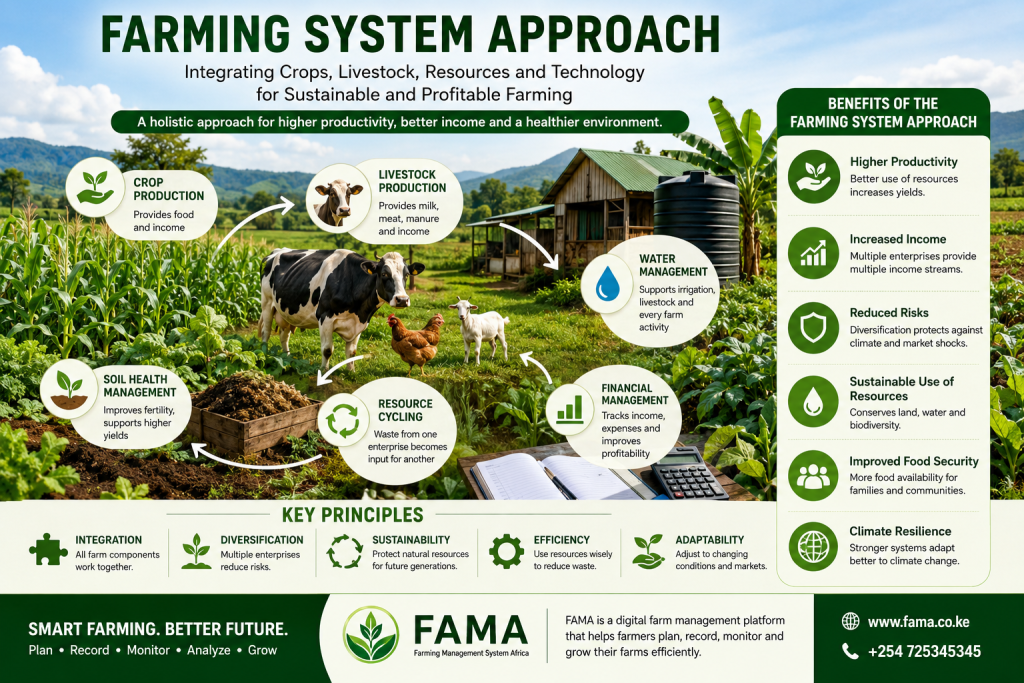
Farming System Approach: A Complete Guide for Modern Farmers
Agriculture remains one of the most important sectors in Kenya and across Africa. As populations continue to grow and climate conditions become more unpredictable, farmers are searching for better ways to increase productivity while protecting natural resources. One proven solution is the farming system approach, a comprehensive method of managing agricultural activities by considering the farm as a complete, interconnected system.
The farming system approach focuses on integrating crops, livestock, natural resources, technology, labour, and financial management into one coordinated production system. Instead of treating farming enterprises separately, this approach ensures that every activity supports another, leading to higher productivity, lower costs, and improved sustainability.
Whether you are a small-scale farmer, commercial producer, agricultural consultant, cooperative society, NGO, or government institution, understanding the farming system approach can transform agricultural productivity and profitability.
At FAMA (Farming Management System Africa), we help farmers embrace digital farming through smart farm management solutions that simplify planning, monitoring, reporting, and decision-making.
For inquiries or demonstrations, contact us today:
Phone: +254 725345345
Website: https://fama.co.ke
What Is a Farming System Approach?
A farming system approach is a holistic way of managing agricultural production where all farm enterprises work together as one integrated system. Rather than focusing on a single crop or livestock enterprise, farmers evaluate how different farm activities interact and complement each other.
A farming system may include:
- Crop production
- Livestock keeping
- Poultry farming
- Dairy farming
- Fish farming
- Beekeeping
- Irrigation
- Farm machinery
- Labour management
- Soil conservation
- Financial planning
- Marketing
- Farm record management
Every component contributes to the overall performance of the farm.
For example:
Maize residues feed dairy cows.
Cow manure fertilizes crop fields.
Crop income purchases improved livestock breeds.
Livestock sales finance irrigation projects.
Water harvesting supports vegetable production during dry seasons.
This interconnected relationship is the foundation of the farming system approach.
Why the Farming System Approach Is Important
Traditional farming often treats each enterprise independently. Unfortunately, this leads to inefficiencies such as:
- Resource wastage
- High production costs
- Poor planning
- Environmental degradation
- Low profitability
- Increased production risks
The farming system approach solves these challenges by encouraging efficient resource utilization.
Major benefits include:
- Better use of land
- Reduced production costs
- Higher farm income
- Improved soil fertility
- Better risk management
- Sustainable farming
- Increased food security
- Climate resilience
Objectives of the Farming System Approach
The primary goal is maximizing farm productivity while maintaining environmental sustainability.
Specific objectives include:
Increase Agricultural Productivity
Farmers produce more using the same available resources through proper planning and integration.
Improve Farm Income
Diversified enterprises provide multiple income streams throughout the year.
Enhance Resource Utilization
Resources such as water, labour, land, machinery, and manure are efficiently utilized.
Reduce Production Risks
Diversification protects farmers against:
- Drought
- Market fluctuations
- Pest outbreaks
- Disease epidemics
- Price instability
Promote Sustainable Agriculture
The farming system approach protects natural resources for future generations.
Core Principles of the Farming System Approach
Successful implementation depends on several important principles.
Integration
Different enterprises support one another.
Examples include:
- Dairy manure fertilizes crops.
- Crop residues feed livestock.
- Fish pond water irrigates vegetables.
Diversification
Growing multiple crops and raising different livestock minimizes financial risks.
Sustainability
Natural resources should be conserved through:
- Soil conservation
- Water harvesting
- Agroforestry
- Organic farming
Efficiency
Farm resources should never be wasted.
Examples include:
- Efficient irrigation
- Proper machinery utilization
- Timely planting
- Controlled fertilizer application
Adaptability
Farm systems should adjust to:
- Weather changes
- Market demand
- Government policies
- Technological innovations
Components of a Farming System Approach
Understanding the various components helps farmers design productive systems.
Crop Production
Crop production remains the backbone of many farming systems.
Common crops include:
- Maize
- Wheat
- Rice
- Beans
- Potatoes
- Tomatoes
- Coffee
- Tea
- Vegetables
- Fruits
Proper crop management improves overall farm performance.
Livestock Production
Livestock provides:
- Milk
- Meat
- Eggs
- Manure
- Draft power
- Income
Common livestock includes:
- Dairy cattle
- Beef cattle
- Goats
- Sheep
- Poultry
- Rabbits
- Pigs
Livestock complements crop production effectively.
Soil Management
Healthy soil determines agricultural success.
Good practices include:
- Organic manure application
- Composting
- Mulching
- Crop rotation
- Minimum tillage
- Cover cropping
Healthy soils improve yields and reduce fertilizer costs.
Water Management
Water is becoming increasingly scarce.
The farming system approach promotes:
- Drip irrigation
- Rainwater harvesting
- Water storage
- Efficient irrigation scheduling
- Soil moisture conservation
Proper water management ensures year-round production.
Farm Labour Management
Labour should be carefully planned.
Activities include:
- Planting schedules
- Harvest planning
- Livestock feeding
- Machinery operation
- Irrigation management
Good labour planning increases efficiency.
Farm Financial Management
Farmers should maintain proper financial records.
Essential records include:
- Income
- Expenses
- Budgets
- Cash flow
- Asset registers
- Loan repayment schedules
Digital farm management systems simplify financial management considerably.
Types of Farming Systems
There are several farming systems depending on location and objectives.
Mixed Farming
Mixed farming combines crops and livestock.
Benefits include:
- Improved soil fertility
- Reduced waste
- Additional income
- Better resource utilization
This is among the most popular farming systems in Kenya.
Integrated Farming
Integrated farming combines several enterprises that support one another.
Examples include:
- Fish farming with vegetables
- Poultry with horticulture
- Dairy with fodder production
- Biogas production
Integrated farming improves profitability.
Commercial Farming
Commercial farming focuses on producing for markets.
Characteristics include:
- Large farms
- Mechanization
- High investment
- Modern technology
- Export orientation
Subsistence Farming
Subsistence farming mainly produces food for family consumption.
Smallholder farmers often combine crops with livestock.
Organic Farming
Organic farming avoids synthetic chemicals.
Instead, it emphasizes:
- Compost
- Organic manure
- Biological pest control
- Crop rotation
- Soil health
Organic products often fetch premium market prices.
Farming System Approach and Climate Change
Climate change has become one of the biggest challenges facing agriculture.
Farmers experience:
- Drought
- Floods
- Heat stress
- Pest outbreaks
- Unpredictable rainfall
The farming system approach helps farmers become more resilient.
Strategies include:
- Crop diversification
- Water harvesting
- Agroforestry
- Livestock integration
- Soil conservation
- Improved farm planning
These practices reduce climate-related risks.
Technology in the Farming System Approach
Modern agriculture depends heavily on technology.
Farmers now use:
- GPS farming
- Farm management software
- Mobile applications
- Satellite imagery
- Weather forecasting
- Precision agriculture
- Digital record keeping
- Smart irrigation
Technology improves decision-making and profitability.
How FAMA Supports the Farming System Approach
Managing an integrated farm manually becomes increasingly difficult as operations grow. FAMA provides farmers with an easy-to-use digital platform designed to simplify modern farm management.
With FAMA, farmers can:
- Keep detailed farm records
- Track crop and livestock activities
- Monitor farm expenses and income
- Plan seasonal operations
- Manage inventory and farm inputs
- Generate insightful reports
- Improve productivity through data-driven decisions
Using a digital farming management solution enables farmers to organize every aspect of their farming system approach from a single platform, making operations more efficient and profitable.
Whether you manage a small family farm or a large commercial agricultural enterprise, FAMA helps you stay in control of your farm every day.
Contact FAMA Today
Website: https://fama.co.ke
Phone: +254 725345345
Advantages of the Farming System Approach
Farmers who implement the farming system approach enjoy numerous benefits, including:
- Higher crop yields
- Improved livestock productivity
- Better use of farm resources
- Increased profitability
- Reduced environmental impact
- Improved soil fertility
- Efficient water management
- Better farm planning
- Enhanced food security
- Long-term sustainability
These advantages make the farming system approach one of the most effective strategies for modern agriculture.
Challenges of Implementing the Farming System Approach
Although the farming system approach offers numerous benefits, implementing it successfully requires commitment, planning, and continuous learning. Many farmers face obstacles during the transition from traditional farming methods to a fully integrated farming system. Understanding these challenges allows farmers to prepare better solutions and achieve long-term success.
Limited Access to Agricultural Knowledge
One of the greatest barriers is limited knowledge about integrated farming practices. Many farmers still rely on traditional production methods that may not maximize available resources. Without proper training, it becomes difficult to understand how crops, livestock, water resources, labour, and technology can work together efficiently.
Agricultural extension services, farmer field schools, online learning platforms, and digital farm management systems can bridge this knowledge gap by providing practical guidance and timely information.
Inadequate Farm Records
Many farms still operate without maintaining proper records. Without accurate records, farmers cannot determine:
- Which crops are most profitable
- Input costs per season
- Labour efficiency
- Livestock performance
- Fertilizer usage
- Revenue generated
- Profit margins
A farming system approach relies heavily on data-driven decision-making. Proper record keeping enables farmers to identify strengths, weaknesses, and opportunities for improvement.
Climate Variability
Changing weather patterns continue to affect agricultural production. Irregular rainfall, prolonged droughts, floods, and extreme temperatures disrupt farming operations and reduce yields.
The farming system approach encourages climate-smart farming practices such as:
- Rainwater harvesting
- Drip irrigation
- Agroforestry
- Crop diversification
- Conservation agriculture
- Drought-resistant crop varieties
These practices increase resilience while protecting farm productivity.
High Initial Investment
Some integrated farming enterprises require significant startup capital. Farmers may need to invest in:
- Irrigation systems
- Farm machinery
- Livestock housing
- Water storage facilities
- Farm software
- Improved livestock breeds
- Greenhouses
- Solar-powered pumping systems
Although these investments may appear costly, they often provide substantial returns through increased efficiency and higher productivity over time.
Limited Market Access
Producing quality agricultural products is only one part of successful farming. Farmers must also access profitable markets.
Challenges include:
- Poor road infrastructure
- Price fluctuations
- Middlemen exploitation
- Lack of market information
- Limited storage facilities
- Post-harvest losses
An effective farming system approach includes market planning before production begins, helping farmers align output with customer demand.
Steps for Implementing a Successful Farming System Approach
Transitioning to an integrated farming model requires careful planning. The following steps provide a practical roadmap.
Assess Farm Resources
Begin by evaluating all available resources.
These include:
- Land size
- Soil type
- Water availability
- Existing crops
- Livestock numbers
- Farm equipment
- Labour availability
- Financial resources
- Farm infrastructure
A thorough assessment helps determine which enterprises can complement each other.
Identify Suitable Enterprises
Choose agricultural activities that naturally support one another.
Examples include:
- Dairy farming and fodder production
- Poultry farming and vegetable production
- Fish farming and irrigation
- Fruit farming and beekeeping
- Goat farming and pasture development
- Greenhouse farming and drip irrigation
Selecting compatible enterprises maximizes resource efficiency.
Develop a Farm Plan
Every successful farm begins with a detailed plan.
A comprehensive farm plan should include:
- Production calendar
- Planting schedules
- Livestock breeding calendar
- Feeding plans
- Irrigation schedules
- Pest control measures
- Harvest dates
- Marketing strategy
- Budget projections
Planning reduces uncertainty and improves coordination throughout the farming season.
Manage Soil Health
Healthy soil supports every farming enterprise.
Recommended soil management practices include:
- Regular soil testing
- Organic manure application
- Compost production
- Crop rotation
- Mulching
- Green manure crops
- Reduced tillage
- Cover crops
Improving soil health increases yields while reducing dependence on chemical fertilizers.
Adopt Modern Technology
Technology plays a critical role in modern agriculture.
Farmers should consider adopting:
- Digital farm management software
- GPS-guided farming
- Precision fertilizer application
- Mobile farm applications
- Weather monitoring systems
- Smart irrigation
- Livestock monitoring systems
- Electronic farm records
Technology improves efficiency, minimizes waste, and enhances profitability.
Monitor Farm Performance
Regular monitoring helps identify problems before they become costly.
Important indicators include:
- Crop growth
- Animal health
- Feed consumption
- Water usage
- Labour productivity
- Fertilizer application
- Pest infestations
- Farm expenses
- Sales performance
Monitoring enables continuous improvement throughout the production cycle.
Best Farming Practices within the Farming System Approach
The farming system approach promotes several best practices that improve sustainability and profitability.
Crop Rotation
Growing different crops in sequence helps:
- Reduce pests
- Improve soil fertility
- Increase yields
- Break disease cycles
- Reduce fertilizer requirements
Common rotations include:
- Maize and beans
- Wheat and legumes
- Potatoes and vegetables
- Sorghum and groundnuts
Intercropping
Intercropping involves growing two or more crops together.
Advantages include:
- Better land utilization
- Reduced weeds
- Improved soil fertility
- Lower pest pressure
- Increased overall production
Examples include maize with beans, cassava with legumes, or bananas with coffee.
Agroforestry
Trees contribute significantly to sustainable farming systems.
Benefits include:
- Soil conservation
- Wind protection
- Shade
- Carbon sequestration
- Additional income
- Firewood production
- Fruit production
Agroforestry improves biodiversity while protecting agricultural land.
Integrated Pest Management
Rather than relying solely on pesticides, integrated pest management combines several control methods.
These include:
- Biological control
- Crop rotation
- Resistant crop varieties
- Proper sanitation
- Mechanical control
- Targeted pesticide application
This reduces environmental pollution while protecting beneficial insects.
Water Conservation
Efficient water management is essential for sustainable farming.
Recommended methods include:
- Rainwater harvesting
- Drip irrigation
- Mulching
- Water storage tanks
- Farm ponds
- Efficient irrigation scheduling
These practices reduce water wastage while improving crop performance.
Role of Farm Management Software in the Farming System Approach
Managing multiple farming enterprises manually becomes increasingly difficult as farms expand.
Farm management software simplifies every aspect of agricultural operations.
Key features include:
Farm Record Management
Store detailed records for:
- Crop production
- Livestock
- Expenses
- Income
- Assets
- Labour
- Inputs
- Harvests
Financial Management
Monitor:
- Cash flow
- Budgets
- Profitability
- Loan repayments
- Operational costs
- Sales
Financial visibility supports informed business decisions.
Inventory Management
Track:
- Seeds
- Fertilizers
- Chemicals
- Animal feeds
- Veterinary medicines
- Farm equipment
- Fuel
- Packaging materials
Inventory management reduces waste and prevents shortages.
Activity Scheduling
Plan important farm activities including:
- Planting
- Fertilizer application
- Irrigation
- Vaccination
- Harvesting
- Machinery maintenance
Scheduling ensures timely farm operations.
Reporting
Generate reports for:
- Production
- Financial performance
- Livestock growth
- Input utilization
- Labour efficiency
Reports support better planning and easier compliance with stakeholders, investors, and lenders.
Why Kenyan Farmers Should Adopt the Farming System Approach
Kenyan agriculture continues to face several challenges, including:
- Small land sizes
- Climate change
- High production costs
- Declining soil fertility
- Water shortages
- Pest outbreaks
- Market volatility
The farming system approach provides practical solutions by improving resource utilization and increasing resilience.
Farmers who integrate crops, livestock, technology, and proper planning are better positioned to generate stable incomes throughout the year.
Common Mistakes Farmers Should Avoid
Even with the right strategy, avoid these common pitfalls:
Ignoring Farm Records
Without records, measuring performance and profitability is difficult.
Overusing Chemical Fertilizers
Excessive fertilizer use can damage soil health and increase production costs.
Depending on One Enterprise
Relying solely on one crop or livestock enterprise increases financial risk.
Poor Water Management
Inefficient irrigation wastes valuable water resources.
Delayed Farm Operations
Late planting, fertilization, or harvesting often reduces productivity.
Ignoring Market Research
Producing crops without understanding market demand may lead to unsold harvests and financial losses.
Future Trends in the Farming System Approach
Agriculture continues to evolve rapidly.
Emerging trends include:
- Artificial Intelligence in farming
- Precision agriculture
- Drone technology
- Internet of Things (IoT)
- Satellite crop monitoring
- Smart irrigation systems
- Climate-smart agriculture
- Digital marketplaces
- Automated farm equipment
- Data-driven farm management
Farmers who embrace innovation will remain competitive and more profitable.
Frequently Asked Questions (FAQs)
What is a farming system approach?
A farming system approach is a method of managing agriculture by integrating crops, livestock, natural resources, labour, technology, and finances into one coordinated production system.
Why is the farming system approach important?
It improves productivity, reduces production costs, increases profitability, conserves natural resources, and strengthens resilience against climate change.
Which farmers benefit from the farming system approach?
Smallholder farmers, commercial farms, cooperatives, agribusinesses, educational institutions, NGOs, and government agricultural projects can all benefit.
Can small farms implement a farming system approach?
Yes. Even farms with limited land can integrate vegetables, poultry, dairy goats, composting, water harvesting, and digital record keeping to improve efficiency.
How does technology support the farming system approach?
Technology simplifies planning, monitoring, record management, financial tracking, inventory management, and decision-making while reducing operational errors.
Is the farming system approach profitable?
Yes. By reducing waste, improving resource use, diversifying income sources, and supporting better management, it significantly increases long-term profitability.
Why Choose FAMA for Farm Management?
Implementing a farming system approach becomes easier with the right digital tools. FAMA is designed to help farmers organize every aspect of farm operations from one centralized platform.
FAMA provides solutions for:
- Farm record management
- Crop management
- Livestock management
- Inventory tracking
- Financial management
- Labour management
- Farm activity scheduling
- Production reports
- Asset management
- Decision support
Whether you manage a small family farm or a large commercial agricultural enterprise, FAMA helps you improve efficiency, increase productivity, reduce operational costs, and make informed decisions based on accurate farm data.
By adopting FAMA, farmers can fully embrace the farming system approach while keeping every farming activity organized, transparent, and profitable.
Visit https://fama.co.ke to learn more about our modern farm management solutions.
Conclusion
The farming system approach is transforming agriculture by encouraging farmers to manage their farms as interconnected enterprises rather than isolated activities. By integrating crops, livestock, soil management, water conservation, financial planning, labour, and modern technology, farmers create resilient production systems capable of delivering higher yields, improved profitability, and sustainable growth.
As agriculture continues to face the pressures of climate change, rising input costs, and increasing food demand, adopting a farming system approach is no longer optional—it is a strategic investment in the future of farming. Farmers who embrace diversification, efficient resource utilization, continuous learning, and digital management are better prepared to overcome challenges and seize new market opportunities.
FAMA is committed to supporting this transformation by providing an intelligent farm management platform that simplifies record keeping, planning, monitoring, reporting, and decision-making. With the right farming practices and digital tools, every farm can become more productive, profitable, and sustainable.
Contact FAMA Today
Website: https://fama.co.ke
Phone: +254 725345345
Take the next step toward smarter agriculture with FAMA and experience how the farming system approach can revolutionize your farming operations for lasting success.