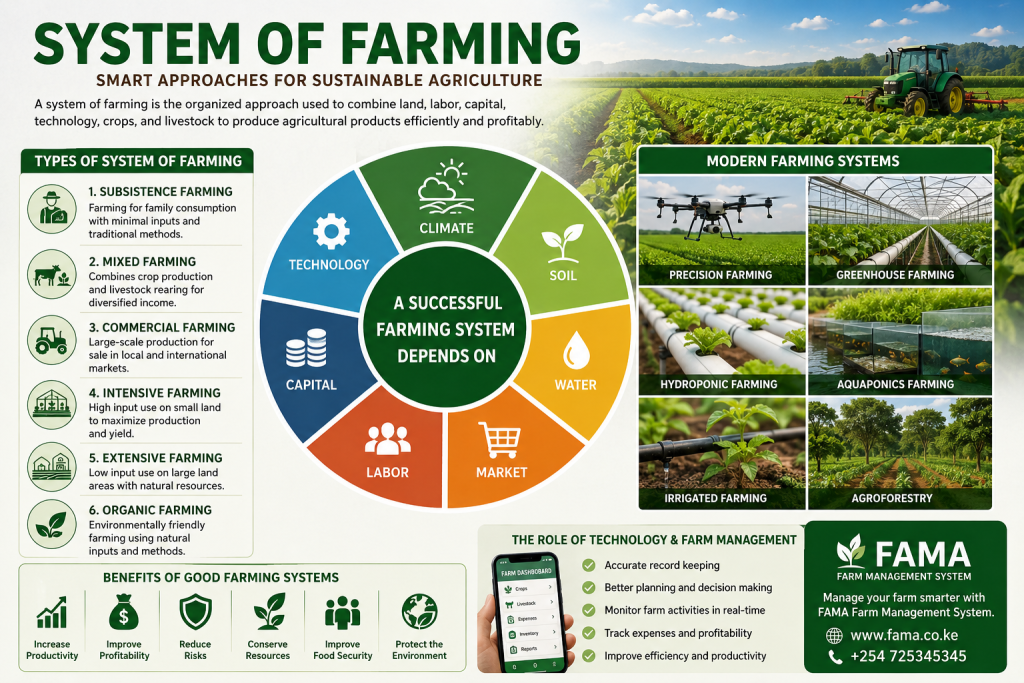
Agriculture remains the backbone of Kenya’s economy, employing millions of people and contributing significantly to food security and national development. However, achieving consistent productivity requires more than fertile land and favorable weather. Farmers must adopt the right system of farming that matches their resources, climate, market demands, and production goals.
Whether you are a small-scale farmer, commercial producer, agricultural investor, or agribusiness owner, understanding the different types of farming systems can greatly improve profitability and sustainability. Choosing the appropriate system of farming enables farmers to maximize land use, improve resource management, reduce production costs, and increase yields.
At FAMA (Farm Management System Africa), we empower farmers with digital tools that simplify farm operations, improve record keeping, and support better decision-making. Through technology-driven farm management, farmers can efficiently manage crops, livestock, finances, workers, and inventories from one centralized platform.
In this comprehensive guide, we explore everything you need to know about the system of farming, including its meaning, classifications, advantages, challenges, and how digital technology is transforming modern agriculture.
What is a System of Farming?
A system of farming refers to the overall method or approach used to organize agricultural production on a farm. It involves the combination of land, labor, capital, machinery, crops, livestock, management practices, and technology to produce agricultural products efficiently.
Rather than simply growing crops or keeping animals, a farming system determines how all farm resources interact to achieve maximum productivity and profitability.
A successful system of farming considers:
- Available land
- Soil fertility
- Climate conditions
- Water availability
- Farm capital
- Labor supply
- Market demand
- Technology adoption
- Government policies
Every farm is unique. Therefore, selecting the appropriate system of farming is one of the most important decisions every farmer makes.
Why Choosing the Right System of Farming Matters
Many farms struggle not because of poor weather but because they operate under an unsuitable farming system.
The right farming system helps farmers:
- Increase production
- Improve land utilization
- Reduce unnecessary expenses
- Manage labor efficiently
- Diversify income
- Improve food security
- Reduce production risks
- Enhance environmental sustainability
- Increase farm profitability
A poor farming system often results in low yields, poor soil health, inefficient resource use, and reduced income.
Objectives of a Good System of Farming
Every successful system of farming aims to achieve several important objectives.
1. Maximum Productivity
The primary goal is producing the highest possible output using available resources efficiently.
2. Sustainable Resource Use
Land, water, and natural resources should remain productive for future generations.
3. Higher Farm Income
Farmers seek stable and profitable returns from agricultural activities.
4. Risk Reduction
Diversification helps reduce losses caused by drought, pests, diseases, or market fluctuations.
5. Food Security
A good farming system ensures continuous food production throughout the year.
6. Environmental Conservation
Modern farming systems emphasize soil conservation, biodiversity, and efficient water use.
Major Components of a Farming System
Understanding a system of farming requires knowing the different components that work together.
Land
Land is the foundation of agriculture. Its size, fertility, slope, and drainage influence farming decisions.
Labor
Labor includes family workers, hired employees, and seasonal workers.
Efficient labor management increases productivity while reducing operational costs.
Capital
Capital consists of machinery, irrigation systems, buildings, livestock, seeds, fertilizers, and equipment.
Investment in quality farm inputs often leads to better production outcomes.
Farm Management
Good planning, budgeting, scheduling, and monitoring determine the success of any farming enterprise.
Technology
Modern agriculture increasingly depends on digital technologies such as farm management software, GPS mapping, sensors, drones, and mobile applications.
Factors Affecting the Choice of a System of Farming
Several factors influence which farming system works best.
Climate
Rainfall patterns, temperatures, humidity, and seasons determine suitable farming activities.
Soil Type
Different soils support different crops and livestock.
Farm Size
Large commercial farms often adopt mechanized systems while smallholders may practice mixed farming.
Capital Availability
Investment capacity affects machinery, irrigation, and technology adoption.
Market Access
Farmers closer to urban markets often specialize in high-value crops.
Government Policies
Agricultural subsidies, extension services, and regulations influence farming practices.
Farmer Experience
Knowledge and technical skills determine how effectively different systems are managed.
Types of System of Farming
Agricultural experts classify farming systems into several categories.
Each system has unique advantages depending on farm objectives.
1. Subsistence Farming
Subsistence farming involves producing food mainly for family consumption rather than commercial sale.
Characteristics include:
- Small land holdings
- Family labor
- Minimal machinery
- Traditional farming methods
- Low capital investment
Advantages include food security for households and lower financial risks.
However, limited surplus production often results in lower household income.
2. Commercial Farming
Commercial farming focuses on producing agricultural products for sale in local and international markets.
Characteristics include:
- Large-scale production
- Mechanization
- Improved seeds
- Irrigation
- Modern equipment
- Professional farm management
Commercial farming contributes significantly to national food supply and export earnings.
3. Mixed Farming
Mixed farming combines crop production with livestock keeping on the same farm.
This is among the most common farming systems in Kenya.
Benefits include:
- Diversified income
- Better manure utilization
- Reduced production risks
- Improved soil fertility
- Efficient land use
Examples include dairy farming combined with maize production or poultry farming integrated with vegetable cultivation.
4. Intensive Farming
Intensive farming maximizes production from relatively small areas through heavy use of inputs.
Farmers invest heavily in:
- Fertilizers
- Improved seeds
- Irrigation
- Greenhouses
- Mechanization
- Pest control
This system produces high yields but requires significant investment.
5. Extensive Farming
Extensive farming involves cultivating large areas with relatively low labor and capital inputs.
It is common in regions with abundant land.
Examples include:
- Ranching
- Large wheat farms
- Pastoral livestock production
While production per hectare may be lower, total output can still be substantial.
6. Organic Farming
Organic farming avoids synthetic fertilizers and chemical pesticides.
Instead, farmers rely on:
- Compost manure
- Crop rotation
- Biological pest control
- Green manure
- Organic fertilizers
Organic products often attract premium market prices while protecting the environment.
Advantages of Understanding Your Farming System
Farmers who understand their system of farming make better decisions regarding:
- Resource allocation
- Crop selection
- Livestock management
- Financial planning
- Labor scheduling
- Investment priorities
- Technology adoption
Knowledge allows farmers to improve efficiency while reducing unnecessary costs.
The Role of Technology in Modern Farming Systems
Agriculture has entered a digital era.
Modern farmers increasingly rely on farm management software to simplify daily operations.
Instead of relying on notebooks and memory, digital systems help organize farm information accurately.
Technology enables farmers to:
- Record farm activities
- Monitor crop performance
- Track livestock health
- Manage inventories
- Monitor expenses
- Forecast production
- Generate financial reports
- Improve decision-making
Digital transformation is no longer optional for competitive agriculture.
Why Farmers Need a Farm Management System
Managing today’s farms manually becomes increasingly difficult as operations grow.
A modern farm management system provides a centralized platform for managing every aspect of farm operations.
Benefits include:
- Better record keeping
- Accurate financial tracking
- Easier inventory management
- Improved employee supervision
- Production monitoring
- Data-driven decisions
- Reduced paperwork
- Increased profitability
FAMA Farm Management System helps Kenyan farmers simplify operations while improving productivity through smart agricultural technology.
In the next section, we will explore advanced farming systems, sustainable agriculture, precision farming, climate-smart farming, common challenges, practical implementation strategies, frequently asked questions, and why adopting digital farm management is becoming essential for successful farming businesses.
Advanced Systems of Farming and the Future of Agriculture
As agriculture continues to evolve, farmers are increasingly adopting modern production methods that combine technology, sustainability, and data-driven decision-making. Traditional farming practices still have their place, but modern farming systems offer greater efficiency, resilience, and profitability. Understanding these advanced systems helps farmers remain competitive while meeting the growing demand for food.
Precision Farming: Making Every Input Count
Precision farming is one of the fastest-growing agricultural systems worldwide. It uses technology to ensure that every part of the farm receives the exact amount of inputs it needs. Instead of applying the same quantity of fertilizer, water, or pesticides across an entire field, precision farming allows farmers to tailor applications based on the specific conditions of different sections of the farm.
This system relies on technologies such as:
- GPS-guided machinery
- Soil sensors
- Weather stations
- Satellite imagery
- Drones
- Mobile applications
- Farm management software
By collecting and analyzing data, farmers can make informed decisions that reduce waste while increasing productivity. Precision farming also helps conserve natural resources, making agriculture more environmentally friendly.
Climate-Smart Farming Systems
Climate change has become one of the greatest challenges facing agriculture. Unpredictable rainfall, prolonged droughts, floods, and increasing temperatures require farmers to adopt systems that improve resilience.
Climate-smart farming focuses on three major objectives:
- Increasing agricultural productivity
- Building resilience against climate change
- Reducing greenhouse gas emissions where possible
Common climate-smart practices include:
- Rainwater harvesting
- Drip irrigation
- Conservation tillage
- Agroforestry
- Crop rotation
- Cover cropping
- Mulching
- Use of drought-tolerant crop varieties
Farmers who adopt climate-smart systems are better prepared to withstand changing weather patterns while maintaining stable production.
Integrated Farming Systems
Integrated farming combines several agricultural enterprises so that each supports the others. Instead of treating crop farming and livestock production as separate businesses, integrated systems create beneficial relationships between them.
For example:
- Livestock produce manure that fertilizes crops.
- Crop residues feed livestock.
- Fish ponds provide irrigation water rich in nutrients.
- Poultry manure fertilizes vegetable gardens.
- Biogas systems convert animal waste into renewable energy.
This interconnected approach improves resource efficiency, minimizes waste, and diversifies income sources.
Conservation Agriculture
Conservation agriculture is designed to protect soil health while maintaining productivity. It emphasizes minimal disturbance of the soil and maintaining permanent soil cover.
Its three key principles include:
- Minimum soil tillage
- Continuous soil cover
- Crop rotation
Benefits include:
- Improved soil fertility
- Better water retention
- Reduced erosion
- Lower labor costs
- Increased biodiversity
- Improved long-term productivity
Agroforestry Farming Systems
Agroforestry integrates trees with crops or livestock. Rather than clearing all trees, farmers intentionally plant useful species alongside agricultural activities.
Benefits include:
- Improved soil fertility
- Reduced wind erosion
- Increased biodiversity
- Additional income from timber
- Firewood production
- Fruit production
- Carbon sequestration
Examples include planting grevillea trees around crop fields or combining fruit orchards with vegetable farming.
Irrigated Farming Systems
Water availability often determines agricultural success. Irrigated farming systems reduce dependence on rainfall by supplying water directly to crops.
Popular irrigation methods include:
- Drip irrigation
- Sprinkler irrigation
- Surface irrigation
- Center pivot irrigation
- Micro-irrigation
Advantages include:
- Higher crop yields
- Multiple growing seasons
- Better crop quality
- Reduced production risks
- Improved water efficiency
Greenhouse Farming Systems
Greenhouse farming provides controlled growing environments that protect crops from adverse weather conditions.
Farmers can regulate:
- Temperature
- Humidity
- Light
- Water
- Fertilizer application
Greenhouse farming is widely used for:
- Tomatoes
- Capsicum
- Cucumbers
- Herbs
- Flowers
- Strawberries
Although initial investment costs may be high, greenhouse systems often generate significantly higher returns.
Livestock Farming Systems
Livestock farming is another important component of agricultural systems.
Different livestock systems include:
Dairy Farming
Focused on milk production using improved breeds, proper feeding programs, and efficient herd management.
Beef Production
Concentrates on raising animals for meat while maximizing weight gain.
Poultry Farming
Includes broilers for meat and layers for egg production.
Goat Farming
Suitable for both milk and meat production, especially in semi-arid regions.
Sheep Farming
Common in pastoral communities and suitable for meat and wool production.
Each livestock enterprise requires proper feeding, breeding, healthcare, and record management.
Crop Rotation as a Farming System
Crop rotation involves planting different crops on the same land in successive seasons.
Benefits include:
- Improved soil fertility
- Reduced pest infestations
- Better weed management
- Increased yields
- Reduced fertilizer requirements
A farmer may rotate maize with beans, followed by vegetables or fodder crops.
Monoculture Farming
Monoculture involves growing one crop continuously over a large area.
Advantages include:
- Easy mechanization
- Simplified management
- Uniform harvesting
- Efficient marketing
However, monoculture may increase vulnerability to pests, diseases, and declining soil fertility if not properly managed.
Diversified Farming Systems
Diversified farming spreads production across multiple enterprises.
Examples include:
- Dairy farming
- Poultry
- Fish farming
- Horticulture
- Fruit orchards
- Beekeeping
Diversification reduces financial risks because poor performance in one enterprise can be offset by success in another.
Urban Farming Systems
Urban agriculture continues to grow as cities expand.
Urban farming includes:
- Rooftop gardens
- Kitchen gardens
- Vertical farming
- Hydroponics
- Aquaponics
- Container gardening
These systems improve food security while utilizing limited urban space.
Hydroponic Farming
Hydroponics grows plants without soil by using nutrient-rich water solutions.
Advantages include:
- Faster plant growth
- Reduced water usage
- Higher yields
- Less disease pressure
- Year-round production
Hydroponics is ideal for leafy vegetables, herbs, and specialty crops.
Aquaponics Farming
Aquaponics combines fish farming with hydroponics.
Fish waste provides nutrients for plants, while plants filter the water before it returns to the fish tanks.
This creates a sustainable closed-loop production system with minimal waste.
Challenges Facing Different Farming Systems
Despite the benefits, farmers face numerous challenges regardless of the farming system they adopt.
These challenges include:
- Climate variability
- High input costs
- Limited financing
- Poor market access
- Pest outbreaks
- Livestock diseases
- Inadequate extension services
- Limited mechanization
- Land fragmentation
- Water scarcity
Addressing these challenges requires proper planning, improved technologies, and better farm management practices.
Importance of Farm Records in Every System of Farming
Regardless of the farming system, maintaining accurate records is essential.
Farm records help farmers monitor:
- Crop performance
- Livestock productivity
- Expenses
- Sales
- Inventory
- Employee attendance
- Equipment maintenance
- Farm profitability
Without reliable records, it becomes difficult to identify profitable enterprises or make informed management decisions.
Digital Farm Management is Transforming Agriculture
Modern agriculture increasingly depends on information.
Successful farmers no longer rely solely on experience or memory. They use digital tools to collect, analyze, and utilize farm data.
A digital farm management system enables farmers to:
- Record daily farm activities
- Monitor field operations
- Schedule farm tasks
- Manage workers
- Track machinery usage
- Monitor inventory levels
- Record veterinary treatments
- Generate financial reports
- Analyze production trends
- Forecast future production
This improves planning and overall farm efficiency.
Why FAMA Farm Management System is the Right Choice
Managing multiple enterprises manually often leads to errors, misplaced records, and poor decision-making.
FAMA Farm Management System simplifies farm management by bringing every aspect of the farm into one centralized platform.
With FAMA, farmers can:
- Manage crop production
- Track livestock records
- Monitor employee activities
- Record farm expenses
- Generate financial reports
- Manage farm inventory
- Schedule farming activities
- Improve operational efficiency
- Make data-driven decisions
- Increase profitability
Whether you operate a small family farm or a large commercial enterprise, FAMA provides the tools needed to manage agricultural operations professionally.
Best Practices for Choosing the Right System of Farming
When selecting the most appropriate farming system, farmers should consider the following:
- Evaluate available land resources.
- Understand local climate conditions.
- Conduct soil testing.
- Identify market opportunities.
- Assess available capital.
- Consider labor availability.
- Adopt suitable technologies.
- Diversify income sources where possible.
- Maintain accurate farm records.
- Continuously improve farming knowledge.
Choosing the right system is not about following trends but about matching available resources with achievable goals.
Frequently Asked Questions
What is a system of farming?
A system of farming is the organized method used to combine land, labor, capital, technology, crops, and livestock to produce agricultural products efficiently.
Why is choosing the right farming system important?
The right farming system improves productivity, increases profitability, reduces risks, conserves resources, and supports sustainable agriculture.
Which farming system is most profitable?
Profitability depends on factors such as market demand, farm management, climate, available resources, and production efficiency. Commercial farming, greenhouse farming, dairy farming, and integrated farming can all be highly profitable when managed effectively.
Can small-scale farmers benefit from digital farm management?
Yes. Digital farm management systems help farmers organize records, reduce costs, improve planning, and make better decisions regardless of farm size.
How does technology improve farming systems?
Technology improves efficiency through better record keeping, precision agriculture, financial management, inventory control, weather monitoring, and production planning.
Final Thoughts
Agriculture continues to evolve rapidly, and farmers who embrace modern management practices position themselves for long-term success. A well-planned system of farming is more than a method of production—it is the foundation of a profitable, sustainable, and resilient agricultural enterprise.
Whether you specialize in crops, livestock, horticulture, mixed farming, greenhouse production, or integrated agriculture, success depends on selecting the right farming system and managing it effectively. Careful planning, continuous learning, responsible resource use, and timely decision-making are essential ingredients for higher productivity and better financial performance.
As farms grow in size and complexity, manual record keeping and guesswork become increasingly inefficient. Digital solutions now play a central role in helping farmers monitor operations, control costs, track production, and make informed decisions backed by real-time data.
Transform Your Farm with FAMA Farm Management System
If you are looking for a smarter way to manage your farm, FAMA Farm Management System is built to help you streamline every aspect of your agricultural operation. From crop production and livestock management to inventory control, employee management, financial reporting, and farm analytics, FAMA provides everything you need in one easy-to-use platform.
Whether you are a smallholder farmer, cooperative, agribusiness, NGO, or large commercial farm, FAMA is designed to improve efficiency, increase profitability, and support sustainable agricultural growth.
Visit: https://fama.co.ke
Call or WhatsApp: +254 725345345
Take the next step toward modern agriculture by adopting a professional farm management solution that helps you make smarter decisions, improve productivity, and grow your farming business with confidence.