Introduction
Agriculture remains one of the most important sectors in Kenya and across Africa. As farming operations continue to grow in complexity, farmers need innovative solutions to manage crops, livestock, finances, labor, inventory, and production efficiently. This is where Agricultural Management SaaS comes in.
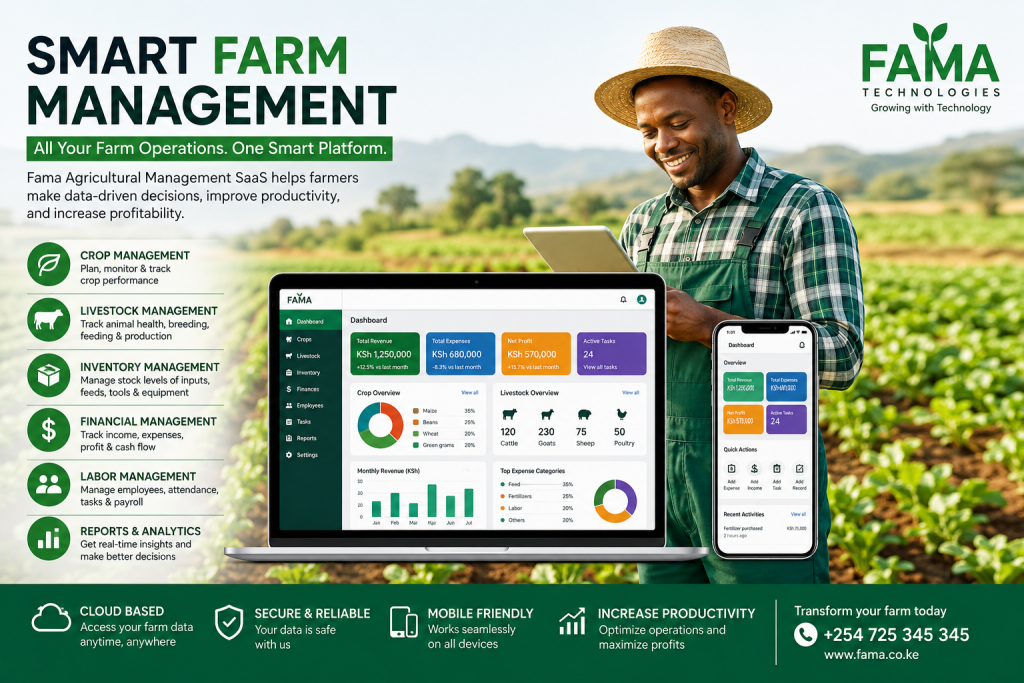
An Agricultural Management SaaS (Software as a Service) platform provides farmers, agribusinesses, cooperatives, and farm managers with cloud-based tools to streamline operations, improve productivity, and increase profitability. Instead of relying on paperwork, spreadsheets, and manual records, farmers can manage everything from a centralized digital platform.
At Fama Technologies, we provide a powerful Agricultural Management SaaS solution through Fama.co.ke, helping farms embrace digital transformation and achieve sustainable growth.
For inquiries and demonstrations, contact us at +254 725345345.
What is Agricultural Management SaaS?
Agricultural Management SaaS is cloud-based software designed to help farmers manage every aspect of farm operations through an internet-connected platform.
Unlike traditional farm management methods, Agricultural Management SaaS enables users to:
- Manage crop production
- Monitor livestock performance
- Track farm expenses
- Record farm income
- Manage workers and payroll
- Monitor inventory levels
- Generate reports
- Analyze farm productivity
- Access farm data remotely
A modern Agricultural Management SaaS solution eliminates inefficiencies while providing real-time insights for better decision-making.
Why Agricultural Management SaaS is Becoming Essential
Agriculture is increasingly data-driven. Farmers who leverage technology gain a significant competitive advantage.
An Agricultural Management SaaS platform helps farmers:
Improve Farm Efficiency
Tasks that previously required hours of paperwork can now be completed within minutes.
Reduce Operational Costs
By monitoring expenses and resource utilization, farmers can reduce waste and improve profitability.
Increase Productivity
Agricultural Management SaaS provides visibility into all farming activities, helping managers optimize operations.
Enhance Decision Making
Data-driven insights allow farmers to make informed decisions regarding planting schedules, fertilization, harvesting, and resource allocation.
Improve Accountability
Every transaction, activity, and inventory movement is recorded within the system, promoting transparency.
Key Features of Agricultural Management SaaS
Crop Management
Crop management is one of the most important modules in any Agricultural Management SaaS platform.
Farmers can record:
- Crop types
- Planting dates
- Field locations
- Fertilizer applications
- Irrigation schedules
- Pesticide usage
- Harvest dates
This information allows farm managers to monitor crop performance and improve yields.
Benefits of Crop Management
- Better planning
- Improved productivity
- Reduced crop losses
- Enhanced record keeping
- Easier compliance reporting
Livestock Management
Livestock farmers benefit significantly from Agricultural Management SaaS solutions.
The software can track:
- Animal identification
- Breeding records
- Vaccination schedules
- Medical history
- Milk production
- Feed consumption
- Weight monitoring
With comprehensive livestock records, farmers can improve herd health and maximize productivity.
Advantages
- Improved breeding programs
- Better disease management
- Accurate production tracking
- Enhanced profitability
Farm Financial Management
Financial management is critical for agricultural success.
Agricultural Management SaaS enables farmers to monitor:
- Revenue
- Expenses
- Cash flow
- Asset value
- Operational costs
- Profitability
The software provides financial reports that help farm owners understand business performance.
Financial Reports Include
- Income statements
- Expense summaries
- Cash flow reports
- Profit and loss reports
- Budget comparisons
Inventory Management
Managing inventory manually often leads to losses and inefficiencies.
Agricultural Management SaaS helps track:
- Seeds
- Fertilizers
- Chemicals
- Animal feeds
- Farm tools
- Equipment spare parts
Farm managers can monitor stock levels in real time and avoid shortages.
Inventory Benefits
- Reduced wastage
- Better procurement planning
- Improved stock control
- Enhanced accountability
Farm Labor Management
Labor is one of the largest operational costs in agriculture.
Agricultural Management SaaS enables farms to manage:
- Employee records
- Attendance
- Task assignments
- Payroll
- Performance tracking
This ensures accountability while improving workforce productivity.
Labor Management Advantages
- Accurate payroll processing
- Better task allocation
- Increased productivity
- Improved employee accountability
How Agricultural Management SaaS Improves Farm Productivity
Productivity depends on effective planning and resource utilization.
Agricultural Management SaaS helps by:
Centralizing Information
All farm data is stored in one secure platform.
Reducing Human Error
Automated processes eliminate common record-keeping mistakes.
Enhancing Communication
Farm managers and workers can collaborate more effectively.
Tracking Performance
Managers can monitor progress and identify bottlenecks quickly.
Supporting Strategic Planning
Historical data helps predict future outcomes and improve planning.
Cloud-Based Agricultural Management SaaS Advantages
One major advantage of Agricultural Management SaaS is cloud accessibility.
Access Anywhere
Users can access farm data from:
- Smartphones
- Tablets
- Laptops
- Desktop computers
Real-Time Updates
Changes made by one user are instantly visible to authorized users.
Secure Data Storage
Cloud systems provide better security compared to paper records.
Automatic Backups
Data remains protected even if devices are lost or damaged.
Scalability
Agricultural Management SaaS grows with your farming operation.
Agricultural Management SaaS for Small-Scale Farmers
Many smallholder farmers believe digital solutions are only suitable for large farms.
However, Agricultural Management SaaS provides tremendous benefits for small farms.
Better Financial Control
Small farmers can track expenses and revenue accurately.
Improved Planning
The software helps organize farming activities efficiently.
Enhanced Productivity
Farmers can identify profitable practices and eliminate inefficiencies.
Easier Record Keeping
Digital records replace notebooks and paper files.
Increased Profitability
Better management ultimately leads to improved earnings.
Agricultural Management SaaS for Commercial Farms
Commercial farms often manage multiple fields, departments, and workers.
Agricultural Management SaaS provides centralized control over large-scale operations.
Commercial Farm Benefits
- Multi-farm management
- Resource optimization
- Large workforce management
- Financial oversight
- Production monitoring
- Comprehensive reporting
Large farms can significantly improve operational efficiency through Agricultural Management SaaS.
Agricultural Management SaaS for Agribusinesses
Agribusinesses require accurate data to manage operations effectively.
Agricultural Management SaaS supports:
- Agricultural cooperatives
- Exporters
- Processors
- Contract farming organizations
- Input suppliers
The platform provides visibility across the entire agricultural value chain.
Agribusiness Advantages
- Better supplier management
- Improved traceability
- Enhanced reporting
- Stronger operational control
Data Analytics in Agricultural Management SaaS
Modern farming requires actionable insights.
Agricultural Management SaaS generates analytics that help farmers understand:
- Yield performance
- Production trends
- Resource utilization
- Profitability
- Labor efficiency
These insights support better decision-making and continuous improvement.
Examples of Analytics
- Best-performing crops
- Most profitable fields
- Labor productivity trends
- Seasonal performance comparisons
- Cost-per-acre analysis
Mobile Accessibility in Agricultural Management SaaS
Mobile technology has revolutionized agriculture.
Agricultural Management SaaS platforms can be accessed via smartphones, enabling users to:
- Enter field data
- Record expenses
- Monitor livestock
- Check inventory
- View reports
This flexibility improves responsiveness and operational efficiency.
Mobile Benefits
- Faster data entry
- Real-time updates
- Remote management
- Improved communication
- Better decision making
Why Choose Fama Agricultural Management SaaS?
At Fama Technologies, we understand the challenges faced by modern farmers.
Our Agricultural Management SaaS platform is designed to help farms digitize operations and achieve sustainable growth.
Features Include
- Crop management
- Livestock management
- Inventory management
- Financial tracking
- Labor management
- Reporting and analytics
- Cloud accessibility
- Mobile support
Why Farmers Choose Fama
- Easy to use
- Affordable pricing
- Reliable support
- Secure cloud infrastructure
- Scalable architecture
- Customizable features
Whether you manage a small family farm or a large commercial agricultural enterprise, Fama Agricultural Management SaaS provides the tools needed to succeed in today’s competitive farming environment.
For demonstrations and consultations, contact +254 725345345 or visit Fama.co.ke.
Building a Data-Driven Agricultural Enterprise
Agriculture is no longer just about planting and harvesting. Today’s successful farms operate as sophisticated businesses that rely on accurate information, efficient resource allocation, and strategic planning. Digital transformation has become an important factor in helping agricultural enterprises remain competitive and profitable in an increasingly demanding market environment.
One of the greatest challenges faced by farm owners is maintaining visibility across all operational activities. As farms grow larger, it becomes difficult to manually monitor production schedules, labor activities, inventory movements, machinery utilization, and financial performance. Without reliable information, decision-making becomes reactive rather than proactive.
A modern digital platform provides farm managers with a centralized environment where all operational data can be collected, organized, and analyzed. This enables leadership teams to identify opportunities, address inefficiencies, and optimize performance across every department.
The ability to access accurate information in real time can significantly improve planning processes. Instead of relying on assumptions, managers can use historical records and current operational data to make informed decisions that support long-term growth.
Improving Resource Utilization
Resource management remains one of the most critical aspects of successful farming operations. Every farm depends on land, labor, equipment, water, fertilizers, feed, and other valuable inputs. Inefficient use of these resources often leads to unnecessary expenses and reduced profitability.
Digital management solutions allow organizations to monitor resource consumption more accurately. By tracking usage patterns and identifying areas of waste, managers can implement corrective measures that improve efficiency without compromising productivity.
For example, better visibility into equipment utilization can help reduce idle time while ensuring machinery receives timely maintenance. Monitoring labor allocation can reveal productivity gaps and support more effective workforce planning. Tracking input consumption can help minimize wastage and improve procurement decisions.
These improvements may seem small individually, but collectively they can have a substantial impact on operational performance and financial outcomes.
Enhancing Operational Transparency
Transparency plays a vital role in building accountability throughout an organization. When operational records are incomplete or scattered across multiple systems, it becomes difficult to verify activities, track responsibilities, and evaluate performance.
Centralized record management creates a clear audit trail for every transaction and activity. Managers can review operational history, monitor progress, and ensure compliance with established procedures.
Improved transparency also supports stronger communication among departments. Everyone involved in production, logistics, procurement, and administration can access the information they need without unnecessary delays.
As a result, teams become more aligned, coordination improves, and operational bottlenecks can be identified more quickly.
Supporting Sustainable Farming Practices
Sustainability has become a major priority across the agricultural sector. Consumers, regulators, and investors increasingly expect farming organizations to adopt environmentally responsible practices while maintaining economic viability.
Technology can support sustainability initiatives by providing accurate information regarding resource usage, production activities, and environmental impacts.
Managers can monitor water consumption, fertilizer application schedules, fuel usage, and waste generation more effectively. This visibility enables organizations to identify opportunities for conservation and implement practices that reduce environmental impact.
Sustainable farming not only benefits the environment but can also improve efficiency, reduce costs, and strengthen long-term business resilience.
Strengthening Financial Oversight
Financial performance ultimately determines the long-term success of any agricultural enterprise. However, maintaining accurate financial records can be challenging when multiple operations are occurring simultaneously across different locations.
Comprehensive financial oversight enables business owners to understand where money is being spent and where revenue is being generated. Accurate reporting provides visibility into profitability, operational costs, and investment performance.
This level of insight helps management teams make better budgeting decisions and allocate resources more effectively. It also simplifies tax preparation, financial audits, and compliance reporting.
Organizations that maintain strong financial discipline are generally better positioned to secure funding, attract investors, and pursue expansion opportunities.
Better Planning Through Historical Data
One of the most valuable assets any organization can possess is reliable historical information. Past performance data provides important insights that can guide future decision-making.
By maintaining detailed operational records over multiple seasons, farms can analyze trends, compare outcomes, and identify recurring challenges. This information can be used to improve planning accuracy and reduce uncertainty.
Historical analysis can reveal:
- Seasonal performance patterns
- Resource consumption trends
- Labor requirements
- Equipment utilization rates
- Cost fluctuations
- Production outcomes
The ability to learn from past experiences allows organizations to continuously improve their operations and achieve better results over time.
Managing Growth Effectively
As agricultural enterprises expand, operational complexity increases significantly. Additional acreage, employees, equipment, suppliers, and customers create new management challenges.
Growth often exposes weaknesses in manual processes that may have worked adequately when operations were smaller. Without scalable systems, organizations can struggle to maintain efficiency and control.
A structured digital approach helps ensure that growth remains manageable. Standardized processes, centralized information, and automated workflows support consistency across expanding operations.
This enables leadership teams to focus on strategic initiatives rather than becoming overwhelmed by administrative tasks.
Enhancing Collaboration Across Teams
Agricultural operations often involve multiple stakeholders working together toward common goals. These may include farm managers, field supervisors, agronomists, veterinarians, accountants, procurement officers, and business owners.
Effective collaboration requires access to accurate and timely information. When communication breaks down, mistakes occur, productivity suffers, and opportunities are missed.
Modern management platforms facilitate collaboration by ensuring all stakeholders have access to relevant information when needed. Updates can be shared instantly, reducing delays and improving coordination.
Improved collaboration contributes to stronger teamwork, faster problem resolution, and more consistent operational performance.
Preparing for the Future of Agriculture
The agricultural sector continues to evolve rapidly. Emerging technologies such as artificial intelligence, automation, remote sensing, predictive analytics, and connected devices are reshaping how farms operate.
Organizations that embrace innovation today will be better positioned to capitalize on future opportunities. Digital transformation provides the foundation required to integrate advanced technologies as they become more accessible and affordable.
Future-ready farms will rely heavily on data-driven decision-making, automated processes, and real-time operational visibility. Establishing strong digital systems now can create a competitive advantage that delivers benefits for years to come.
Risk Management and Business Resilience
Every agricultural enterprise faces risks. Weather variability, market fluctuations, disease outbreaks, supply chain disruptions, and changing regulations can all impact business performance.
While risks cannot be eliminated entirely, they can be managed more effectively through better information and planning.
Comprehensive operational records allow organizations to assess vulnerabilities, evaluate potential impacts, and develop mitigation strategies. Managers can respond more quickly to emerging challenges and make informed decisions during periods of uncertainty.
Strong information management also supports business continuity by ensuring critical records remain accessible and secure.
The Importance of Continuous Improvement
Successful organizations recognize that improvement is an ongoing process rather than a one-time initiative. Regular evaluation of operations helps identify opportunities for enhanced efficiency, productivity, and profitability.
Access to accurate performance metrics allows management teams to establish benchmarks, monitor progress, and measure results objectively.
Continuous improvement encourages innovation, promotes accountability, and creates a culture focused on excellence. Over time, incremental improvements can generate significant competitive advantages and contribute to sustained business success.
Creating a Culture of Accountability and Excellence
Beyond technology and processes, long-term success in any agricultural enterprise depends on people. Even the most advanced systems deliver the greatest value when employees, managers, and stakeholders embrace a culture of accountability and continuous improvement. Clear responsibilities, measurable objectives, and transparent reporting help create an environment where every team member understands their role in achieving organizational goals.
When information is readily available, managers can evaluate performance fairly and identify areas where additional training or support may be needed. Employees also gain a better understanding of how their daily activities contribute to broader operational outcomes. This alignment encourages greater ownership, motivation, and commitment to quality work.
Regular review meetings supported by accurate operational data can foster productive discussions and informed decision-making. Instead of relying on assumptions or incomplete information, teams can focus on facts, identify opportunities, and develop practical solutions to challenges. Over time, this approach strengthens organizational learning and helps establish best practices that can be replicated across different departments or locations.
Another important benefit of structured information management is improved succession planning. Agricultural businesses often span multiple generations, and maintaining comprehensive records ensures valuable knowledge is preserved rather than lost when key personnel retire or transition into new roles. Historical records, documented procedures, and operational insights provide continuity that supports long-term stability and growth.
Strong organizational practices also enhance relationships with external stakeholders. Financial institutions, investors, suppliers, regulatory agencies, and business partners often require accurate documentation and performance records. Businesses that can provide reliable information demonstrate professionalism, build trust, and improve their ability to secure opportunities for expansion and collaboration.
Ultimately, sustainable growth is achieved through a combination of effective leadership, informed decision-making, and a commitment to operational excellence. By investing in better management practices and embracing modern approaches to information management, agricultural enterprises can strengthen resilience, improve competitiveness, and create a solid foundation for future success in an increasingly dynamic and technology-driven industry.
Conclusion
The future of farming belongs to organizations that embrace innovation, efficiency, and data-driven decision-making. As agricultural operations become increasingly complex, digital tools provide the visibility and control necessary to manage resources effectively, improve productivity, and strengthen profitability.
Whether managing crops, livestock, finances, inventory, labor, or overall business performance, technology provides the foundation for smarter and more sustainable operations. By adopting modern management solutions, farms can position themselves for long-term growth while remaining agile in an ever-changing agricultural landscape.
To learn more about advanced agricultural technology solutions and how they can support your farming operations, visit Fama.co.ke or contact us at +254 725345345 for a personalized consultation and demonstration.