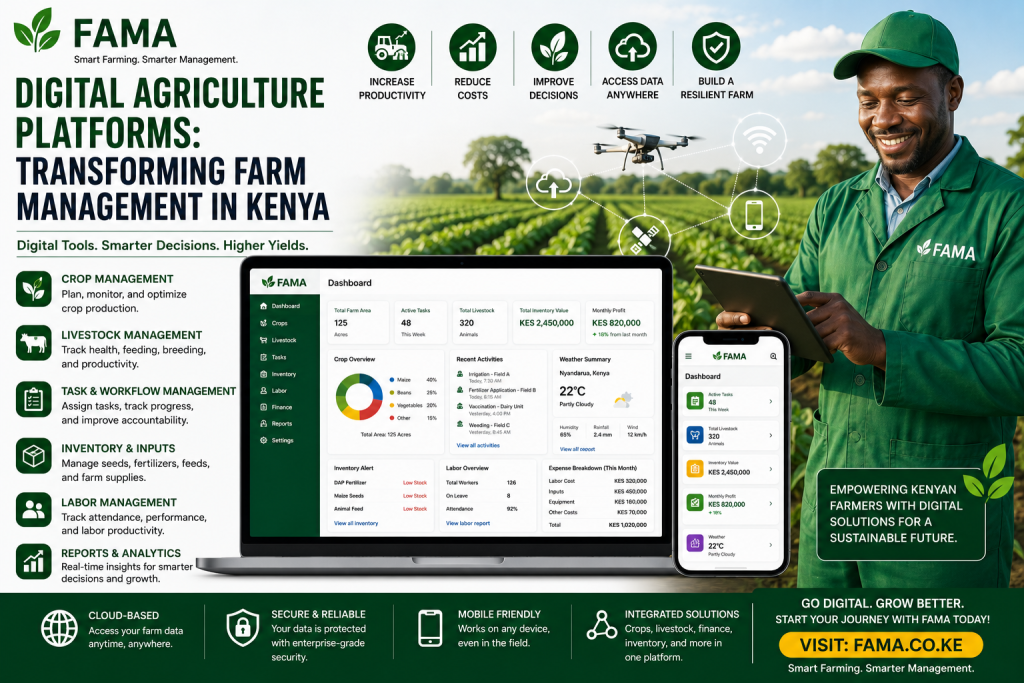
Agriculture is changing rapidly, and farmers are embracing technology to improve efficiency, reduce losses, and increase profitability. A modern farm management system helps farmers monitor operations, track production, manage finances, and make informed decisions. Whether you own a dairy farm, poultry farm, crop farm, or mixed farming enterprise, using a reliable farm management system is becoming essential for sustainable growth.
At Fama.co.ke, we provide a powerful and easy-to-use farm management system designed to simplify daily farm activities and help farmers maximize productivity. Our software enables farmers to manage livestock, crop production, expenses, revenues, inventory, workers, and reports from one centralized platform.
What is a Farm Management System?
A farm management system is software that helps farmers organize and control all farming operations efficiently. Instead of relying on notebooks, spreadsheets, or manual records, farmers can use a digital platform to track every activity taking place on the farm.
A modern farm management system allows farmers to:
- Monitor farm production.
- Record livestock information.
- Manage crop planting schedules.
- Track expenses and revenues.
- Manage inventory and supplies.
- Generate farm reports.
- Monitor farm workers and tasks.
- Analyze profitability.
- Improve decision-making.
Using a professional farm management system reduces errors and saves time while improving productivity and profitability.
Why Farmers Need a Farm Management System
Many farmers face challenges due to poor record keeping and lack of proper farm planning. Without accurate records, it becomes difficult to know whether the farm is making profits or losses.
A reliable farm management system solves these problems by providing accurate information about farm activities. Farmers can monitor production trends, control expenses, and make better decisions based on real data.
Benefits of using a farm management system include:
- Improved record keeping.
- Better financial management.
- Increased productivity.
- Reduced wastage.
- Efficient inventory control.
- Better employee management.
- Easier reporting and analysis.
- Improved profitability.
Features of a Modern Farm Management System
Livestock Management
Livestock farmers need accurate records to ensure proper management of animals. A quality farm management system helps farmers track animal information including:
- Breed information.
- Birth records.
- Vaccination schedules.
- Feeding records.
- Milk production.
- Weight records.
- Health history.
- Sales and purchases.
Using a livestock module in a farm management system improves productivity and helps maintain healthy animals.
Crop Management
Crop farmers can use a farm management system to manage every stage of production. The system allows farmers to monitor:
- Land preparation.
- Planting dates.
- Fertilizer application.
- Pesticide application.
- Irrigation schedules.
- Harvesting activities.
- Crop yields.
With a crop management module, farmers can optimize production and reduce losses.
Farm Financial Management
One of the biggest advantages of using a farm management system is improved financial management. Farmers can record:
- Expenses.
- Sales.
- Income.
- Purchases.
- Labor costs.
- Equipment costs.
- Operating costs.
Financial reports generated by the system help farmers understand their profitability and cash flow.
Inventory Management
Inventory control is essential for successful farming. A farm management system helps farmers track:
- Animal feeds.
- Seeds.
- Fertilizers.
- Chemicals.
- Medicines.
- Tools and equipment.
Inventory management prevents shortages and helps reduce wastage.
Employee Management
Managing workers manually can be difficult, especially for large farms. A modern farm management system enables farmers to:
- Assign tasks.
- Monitor performance.
- Record attendance.
- Track wages.
- Manage departments.
This improves accountability and increases efficiency.
Benefits of Using Farm Management Software
Better Record Keeping
Manual records are often lost or damaged. A digital farm management system securely stores all information and allows quick retrieval whenever needed.
Increased Productivity
Farmers can easily monitor farm activities and identify areas that require improvement. This leads to increased productivity and higher yields.
Improved Decision Making
A farm management system provides reports and analytics that help farmers make informed decisions. Farmers can determine which enterprises are profitable and where improvements are needed.
Reduced Costs
Efficient monitoring of resources helps farmers avoid wastage and unnecessary expenses. This lowers production costs and improves profits.
Time Saving
Automation eliminates repetitive tasks and reduces paperwork. Farmers spend less time on record keeping and more time on productive activities.
Farm Management System for Dairy Farmers
Dairy farming requires accurate monitoring of milk production and animal health. Fama’s farm management system helps dairy farmers record:
- Daily milk production.
- Animal health records.
- Vaccination schedules.
- Feeding programs.
- Breeding information.
- Expenses and revenues.
These records help improve dairy farm productivity and profitability.
Farm Management System for Poultry Farmers
Poultry farmers can benefit greatly from a professional farm management system. The software helps monitor:
- Egg production.
- Feed consumption.
- Bird mortality.
- Vaccination schedules.
- Sales and purchases.
- Inventory levels.
With accurate data, poultry farmers can optimize production and increase profits.
Farm Management System for Crop Farmers
Crop farming involves numerous activities that require proper planning. A farm management system helps crop farmers manage:
- Planting schedules.
- Fertilizer application.
- Pest control activities.
- Irrigation.
- Harvesting.
- Storage management.
This improves efficiency and ensures better yields.
Farm Management System for Mixed Farming
Mixed farming involves managing both livestock and crops. A powerful farm management system integrates all activities into one platform, making it easier to monitor operations and generate reports.
Farmers can track:
- Livestock records.
- Crop production.
- Inventory.
- Expenses and revenues.
- Employee performance.
- Sales and purchases.
Having all information in one place improves decision-making and enhances profitability.
Common Challenges Farmers Face and How Technology Helps
Running a successful farm involves much more than planting crops or raising animals. Farmers face numerous challenges every day, from unpredictable weather patterns to rising production costs and labor shortages. Managing all these activities manually can become overwhelming, especially as the farm grows.
One of the biggest challenges many farmers encounter is maintaining accurate records. Important information such as production figures, expenses, sales, and inventory is often written in notebooks or scattered across different files. Over time, records may be misplaced, damaged, or forgotten, making it difficult to evaluate the overall performance of the business.
Another challenge is planning. Farming activities are interconnected, and delays in one area can affect the entire production cycle. Missing vaccination schedules, forgetting planting dates, or failing to monitor feed usage can result in losses that are difficult to recover from. Having a structured approach to planning allows farmers to anticipate needs and avoid unnecessary setbacks.
Weather changes also continue to affect agricultural productivity. Unexpected droughts, excessive rainfall, and changing seasons require farmers to make quick decisions. Monitoring operations and keeping historical records allows farm owners to understand trends and prepare better for future seasons.
Labor management presents another obstacle, particularly for medium-sized and large farms. Supervising workers, assigning tasks, and ensuring accountability becomes difficult without proper systems in place. Clear organization improves productivity and helps ensure that daily activities are completed efficiently.
Access to information is equally important. Many farmers rely on experience and memory when making decisions, yet data-driven decisions are often more reliable. Historical production records and financial information provide insights that help determine what works best and where improvements are needed.
Technology is helping address these challenges by making farm operations more organized and efficient. Digital tools enable farmers to store information securely, monitor activities more effectively, and generate reports that support better planning. Rather than spending hours searching through paperwork, information becomes available whenever it is needed.
Another important aspect of modern farming is sustainability. As populations continue to grow, farmers are expected to produce more food while using resources responsibly. Efficient use of water, feed, fertilizers, and labor contributes to both profitability and environmental conservation. Better planning reduces waste and ensures resources are utilized effectively.
Young people are also becoming increasingly interested in agriculture, especially when technology is involved. Digital transformation is changing the image of farming from a traditional occupation into a modern business enterprise. Entrepreneurs entering the agricultural sector are adopting innovative approaches that allow them to scale operations and compete effectively.
Collaboration is becoming easier as well. Farm owners, managers, and workers can coordinate activities more effectively when information is centralized. This improves communication and ensures that everyone involved understands their responsibilities and objectives.
Looking ahead, agriculture will continue to evolve with advancements in technology. Automation, smart devices, and data analysis are expected to play a greater role in improving efficiency and supporting food production. Farmers who embrace innovation today position themselves for long-term growth and success.
Regardless of the size of the operation, maintaining organized records, planning effectively, and making informed decisions remain essential components of successful farming. By combining practical experience with modern tools, farmers can overcome challenges, increase efficiency, and build sustainable agricultural enterprises that thrive in a changing world.
Why Choose Fama Farm Management System?
Fama provides a reliable and user-friendly farm management system designed for modern farmers. Our software helps farmers streamline operations, improve productivity, and increase profitability.
Key advantages include:
- Easy to use interface.
- Secure cloud-based access.
- Comprehensive reports.
- Financial management tools.
- Livestock management features.
- Crop management capabilities.
- Inventory management.
- Employee management.
- Data backup and security.
- Scalability for small and large farms.
Whether you operate a dairy farm, poultry farm, crop farm, or mixed farming enterprise, Fama provides the right farm management system to help you succeed.
For more information about our farm management software, contact us today.
Phone: +254 725345345
Website: https://fama.co.ke
Cloud-Based Farm Management System
Technology has transformed farming, and cloud computing has made farm operations easier than ever. A cloud-based farm management system enables farmers to access information from anywhere using a computer, tablet, or smartphone.
Unlike traditional record books, cloud-based farm management software stores data securely and allows users to access information in real time. This means farm owners can monitor activities even when they are away from the farm.
Benefits of a cloud-based farm management system include:
- Access farm data from anywhere.
- Automatic data backup.
- Better collaboration between farm managers and workers.
- Reduced risk of losing records.
- Improved security.
- Real-time reporting and monitoring.
Fama offers a cloud-based farm management system that allows farmers to manage operations efficiently while enjoying the flexibility of remote access.
Farm Management Software in Kenya
Agriculture is one of the largest sectors in Kenya, contributing significantly to the economy. Farmers across the country are increasingly adopting technology to improve production and profitability.
A reliable farm management system in Kenya helps farmers manage daily activities while maintaining proper records. Whether you are involved in dairy farming, poultry farming, crop farming, fish farming, or greenhouse farming, a digital solution can simplify operations.
Farm management software in Kenya helps farmers:
- Reduce paperwork.
- Improve financial management.
- Increase efficiency.
- Monitor production.
- Manage inventory.
- Generate reports.
- Make informed decisions.
Fama provides a modern farm management system designed specifically for farmers in Kenya and beyond.
Farm Financial Management
Financial management is one of the most important aspects of successful farming. Without proper records, farmers may not know whether they are making profits or losses.
A professional farm management system helps farmers manage:
- Sales records.
- Purchase records.
- Income and expenses.
- Worker wages.
- Operational costs.
- Equipment expenses.
- Farm investments.
By generating financial reports, farmers can understand where money is being spent and identify opportunities for improvement.
Budgeting and Planning
Budgeting helps farmers prepare for future expenses and maximize profits. A farm management system allows farmers to estimate:
- Feed costs.
- Seed costs.
- Fertilizer expenses.
- Labor expenses.
- Equipment maintenance.
- Production targets.
With proper budgeting, farmers can avoid unexpected financial challenges and plan effectively.
Farm Production Tracking
Production tracking is critical for measuring farm performance. A farm management system enables farmers to monitor output and evaluate productivity.
Livestock Production Tracking
Farmers can track:
- Milk production.
- Egg production.
- Weight gain.
- Feed consumption.
- Breeding cycles.
- Animal health records.
These records help improve efficiency and increase yields.
Crop Production Tracking
Crop farmers can monitor:
- Planting dates.
- Fertilizer applications.
- Irrigation schedules.
- Harvest periods.
- Crop yields.
This information helps farmers improve planning and maximize productivity.
Inventory and Stock Management
Inventory management is essential for preventing shortages and controlling expenses. A farm management system allows farmers to track:
- Animal feeds.
- Seeds.
- Fertilizers.
- Chemicals.
- Veterinary medicines.
- Farm tools and equipment.
With accurate inventory records, farmers can avoid overstocking and reduce wastage.
Employee and Task Management
Large farms often have multiple workers performing different tasks. A farm management system simplifies workforce management by allowing farm owners to:
- Assign duties.
- Track employee attendance.
- Monitor performance.
- Manage salaries and wages.
- Improve accountability.
This ensures farm activities are completed efficiently and on time.
Reporting and Analytics
One of the major advantages of a modern farm management system is access to reports and analytics. Reports provide valuable insights that help farmers make informed decisions.
Common reports include:
- Income reports.
- Expense reports.
- Profit and loss reports.
- Production reports.
- Inventory reports.
- Employee reports.
- Sales reports.
These reports allow farmers to identify strengths and areas that need improvement.
How Farm Management Software Improves Profitability
Profitability depends on effective management. A farm management system helps increase profits by:
- Reducing operational costs.
- Minimizing wastage.
- Improving resource utilization.
- Enhancing productivity.
- Providing accurate financial reports.
- Supporting better decision-making.
By understanding the performance of different farm activities, farmers can focus on the most profitable enterprises.
Farm Management System for Different Types of Farming
Dairy Farming
Dairy farmers can use a farm management system to manage:
- Milk production.
- Animal breeding.
- Vaccinations.
- Feeding schedules.
- Sales records.
- Expenses and revenues.
Poultry Farming
Poultry farmers can track:
- Egg production.
- Feed consumption.
- Mortality rates.
- Vaccination schedules.
- Sales and purchases.
Fish Farming
Fish farmers can manage:
- Pond information.
- Feeding schedules.
- Stock levels.
- Growth rates.
- Harvest records.
Greenhouse Farming
Greenhouse farmers can monitor:
- Temperature.
- Irrigation schedules.
- Fertilizer applications.
- Crop growth.
- Harvest records.
Mixed Farming
Mixed farmers can combine livestock and crop records in one centralized platform, making management easier and more efficient.
Why Digital Farming is the Future
Modern farming relies heavily on technology. Farmers who adopt digital solutions gain a competitive advantage through better planning and increased efficiency.
A farm management system helps farmers:
- Increase productivity.
- Reduce risks.
- Improve profitability.
- Manage resources effectively.
- Make data-driven decisions.
As agriculture continues to evolve, digital tools will become increasingly important in ensuring food security and sustainable farming.
Why Choose Fama Farm Management System?
Fama provides a comprehensive farm management system designed to meet the needs of modern farmers.
Our system offers:
- Livestock management.
- Crop management.
- Financial management.
- Inventory management.
- Worker management.
- Reporting and analytics.
- Cloud access.
- Secure data storage.
- Easy-to-use interface.
- Scalability for small and large farms.
Whether you operate a dairy farm, poultry farm, crop farm, greenhouse farm, or mixed farming enterprise, Fama provides the tools needed to improve efficiency and profitability.
Frequently Asked Questions
What is a farm management system?
A farm management system is software designed to help farmers manage production, finances, inventory, workers, and reporting from a centralized platform.
Why is a farm management system important?
A farm management system improves record keeping, reduces costs, increases productivity, and supports better decision-making.
Can small-scale farmers use a farm management system?
Yes. Farm management software is suitable for both small-scale and large-scale farmers.
Can I access the system remotely?
Yes. Fama offers a cloud-based farm management system that allows users to access information from anywhere.
Does the system support livestock and crop farming?
Yes. The system supports dairy farming, poultry farming, crop farming, fish farming, greenhouse farming, and mixed farming.
Is farm management software worth it?
Yes. Farm management software helps farmers save time, reduce losses, improve efficiency, and increase profitability.
Transform Your Farm with Fama Farm Management System
Managing a farm should not be stressful. With the right farm management system, farmers can organize operations, track production, monitor finances, and make informed decisions that lead to growth.
Fama Farm Management System provides an all-in-one solution for modern agriculture. Whether you are a small-scale farmer or a commercial farming enterprise, our software helps you streamline operations and maximize profits.
Start your journey towards smart farming today with Fama.
Website: https://fama.co.ke
Phone: +254 725345345
Experience the power of a modern farm management system and take your farming business to the next level with Fama.