Table of Contents
ToggleIntorduction to Animal Record Keeping Software
Livestock farming has become increasingly data-driven. Whether a farmer manages dairy cows, beef cattle, goats, sheep, pigs, poultry, or mixed livestock operations, maintaining accurate records is one of the most important activities on the farm. Unfortunately, many farmers still depend on notebooks, memory, spreadsheets, and paper files that are easily lost, damaged, or forgotten. This often leads to poor breeding decisions, missed vaccinations, inaccurate financial records, and reduced profitability.
This is where Animal record keeping software becomes a valuable investment. Modern livestock businesses generate significant amounts of information every day. Farmers must track animal identification, births, breeding schedules, milk production, feed consumption, treatments, vaccinations, expenses, and sales. Managing all this information manually becomes difficult as herd sizes grow.
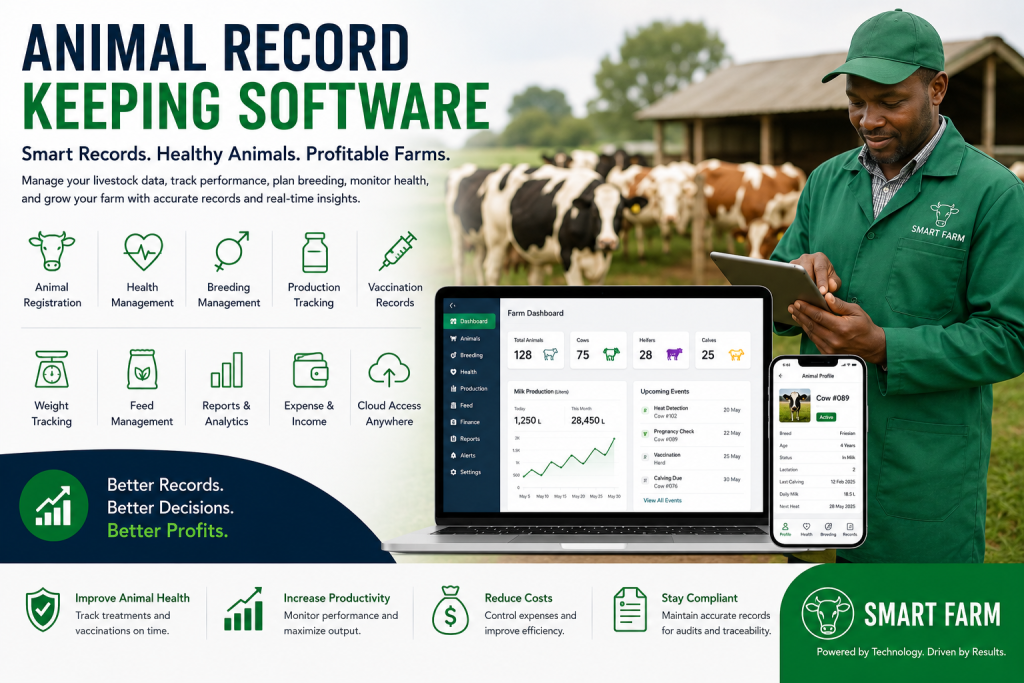
A reliable Animal record keeping software solution centralizes farm records into a single digital platform. Instead of searching through multiple notebooks, farmers can access critical information instantly. This improves decision-making and allows farm managers to focus more on productivity and less on paperwork.
Across Kenya, livestock farmers are increasingly adopting digital technologies to improve efficiency and competitiveness. As farming costs rise and profit margins become tighter, better record management has become essential. A modern Animal record keeping software platform helps farmers understand their operations in greater detail and identify opportunities to increase productivity.
What Is Animal Record Keeping Software?
Animal record keeping software is a digital system designed to help farmers store, manage, analyze, and access livestock information. It replaces paper records with a centralized database that captures every important event in an animal’s lifecycle.
The software allows farmers to maintain complete animal profiles. These profiles may include identification numbers, breed information, birth records, health treatments, breeding history, production performance, and ownership details.
Unlike traditional record books, Animal record keeping software provides real-time access to information. Farm managers can generate reports instantly, track trends, and make informed decisions based on accurate data.
Whether managing twenty dairy cows or several thousand poultry birds, the software creates structure and consistency across farm operations.
Why Record Keeping Matters in Livestock Farming
Many farmers underestimate the financial impact of poor record management. Without accurate records, important decisions are often based on assumptions rather than facts.
A dairy farmer may not know which cows produce the highest milk yields. A beef farmer may struggle to track weight gain performance. A goat farmer may miss breeding opportunities because mating records are incomplete.
Animal record keeping software helps eliminate these challenges by ensuring information is captured consistently and stored securely.
Good records enable farmers to identify productive animals, remove underperforming stock, optimize breeding programs, and improve overall farm profitability.
Organizations such as Food and Agriculture Organization (FAO) consistently emphasize the importance of accurate farm record management for sustainable agricultural development.
Core Features of Animal Record Keeping Software
A quality Animal record keeping software platform includes animal registration tools that allow farmers to create detailed records for every animal.
Health management features track vaccinations, treatments, disease history, and veterinary interventions.
Breeding management capabilities monitor heat cycles, insemination dates, pregnancy checks, and calving schedules.
Production monitoring tools record milk yields, egg production, weight gains, and other performance indicators.
Financial management functionality helps track farm expenses, livestock sales, feed purchases, and profitability.
Many modern systems also include mobile access, enabling farmers to manage records directly from the field.
Animal Identification and Tracking
One of the most important benefits of Animal record keeping software is accurate animal identification.
Each animal can be assigned a unique profile linked to ear tags, electronic tags, or identification numbers. Farmers can quickly retrieve complete records whenever needed.
This becomes particularly valuable for farms with large herds where individual animals may be difficult to track manually.
With digital identification, managers can view health history, breeding records, production performance, and ownership information within seconds.
Breeding Management and Reproductive Performance
Breeding management significantly influences livestock profitability.
Missing a breeding cycle can delay production and reduce annual revenue. Manual record systems often make it difficult to monitor reproductive events accurately.
Animal record keeping software helps farmers schedule breeding activities and receive reminders for important reproductive milestones.
Managers can track insemination dates, expected calving periods, pregnancy confirmations, and fertility performance.
By improving breeding accuracy, farms can achieve more predictable production cycles and better herd management outcomes.
Health Monitoring and Disease Control
Animal health directly affects productivity and profitability.
A single disease outbreak can cause substantial losses if not detected and managed quickly.
Animal record keeping software helps farmers maintain comprehensive health records for every animal. Vaccinations, treatments, laboratory tests, and veterinary visits can all be recorded digitally.
The software also makes it easier to identify recurring health issues and evaluate treatment effectiveness.
Better health monitoring contributes to lower mortality rates and improved production performance.
Resources from World Organisation for Animal Health provide additional guidance on livestock health management best practices.
Milk Production Management
For dairy farmers, milk production is one of the most important performance indicators.
Animal record keeping software enables farmers to monitor milk yields at both individual animal and herd levels.
Managers can identify top-performing cows and detect production declines early. This information supports better feeding, breeding, and health management decisions.
Historical production records also help evaluate long-term farm performance and identify seasonal trends.
Feed Management and Cost Control
Feed expenses often represent the largest operating cost in livestock farming.
Without proper monitoring, feed wastage can significantly reduce profitability.
Animal record keeping software allows farmers to track feed purchases, feeding schedules, and consumption patterns.
The system provides visibility into feed-related costs and helps managers evaluate feed efficiency across different animal groups.
Improved feed management supports better budgeting and resource allocation.
Financial Record Management
Many livestock farmers focus heavily on production while neglecting financial tracking.
A farm may appear busy and productive yet generate disappointing profits.
Animal record keeping software integrates operational records with financial information, providing a clearer picture of business performance.
Farmers can monitor income from milk sales, livestock sales, breeding services, and other revenue sources.
Expenses such as feed, veterinary services, labor, fuel, and equipment maintenance can also be tracked systematically.
This financial visibility supports better decision-making and long-term planning.
Multi-Farm and Multi-Location Management
Large livestock operations often manage animals across multiple locations.
Maintaining consistent records becomes increasingly difficult when information is scattered across farms.
Animal record keeping software centralizes data and allows managers to monitor operations from a single platform.
This improves coordination, reporting accuracy, and operational oversight.
Cloud-based systems are particularly useful because they provide access from virtually anywhere with internet connectivity.
Data Analysis and Reporting
One of the greatest advantages of Animal record keeping software is reporting.
Farmers no longer need to spend hours compiling information manually.
The software can generate reports on:
- Animal performance
- Breeding success rates
- Health trends
- Mortality rates
- Milk production
- Financial performance
- Feed consumption
These insights help managers make data-driven decisions that improve productivity and profitability.
Modern reporting technologies promoted by Microsoft Power BI demonstrate how analytics can improve operational management across industries.
Mobile Accessibility for Modern Farmers
Today’s farmers spend significant time away from office environments.
Mobile-friendly Animal record keeping software allows data entry directly from livestock pens, grazing fields, and milking areas.
This reduces paperwork duplication and improves record accuracy.
Farm managers can update records immediately after treatments, births, sales, or breeding activities occur.
Real-time updates ensure information remains accurate and accessible.
Regulatory Compliance and Traceability
Livestock traceability requirements continue to increase globally.
Accurate records support compliance with industry regulations, certification programs, and export requirements.
Animal record keeping software provides organized documentation that simplifies inspections and audits.
Farmers can quickly produce records when required by regulators, buyers, or certification bodies.
This improves professionalism and strengthens market opportunities.
Integration With Modern Agricultural Technology
Agriculture is becoming increasingly connected.
Many livestock operations now use digital weighing systems, milk meters, sensors, and monitoring devices.
Advanced Animal record keeping software can integrate with these technologies to automate data collection and improve accuracy.
This reduces manual data entry and provides richer insights into farm performance.
Technology adoption trends are frequently discussed by IBM Agriculture Solutions and Google Cloud Agriculture Solutions.
Internal Links and Business Technology Resources
Farmers seeking broader business management solutions may also benefit from exploring:
These platforms demonstrate how digital systems are transforming business operations across multiple industries.
Risks and How to Mitigate Them
Although Animal record keeping software offers substantial benefits, implementation is not without challenges.
One common risk is inconsistent data entry. If farm workers fail to record events accurately, reports become unreliable. Proper training and clear procedures help address this issue.
Another challenge involves resistance to technology adoption. Some employees may prefer traditional record books. Gradual implementation and ongoing support can improve acceptance.
Data loss concerns may arise when using digital systems. Choosing reputable providers with backup and security measures reduces this risk.
Connectivity limitations can also affect cloud-based systems in remote areas. Offline functionality and reliable internet planning help mitigate operational disruptions.
How Animal Record Keeping Software Improves Farm Profitability
Many farmers think profitability depends only on increasing production. While production is important, profitability is often determined by how well a farm manages information. Poor records can hide costly problems such as underperforming animals, excessive veterinary expenses, low conception rates, and feed wastage. This is why Animal record keeping software has become an essential management tool for modern livestock operations.
When farm records are digitized, managers can quickly identify trends that affect profits. For example, if certain cows consistently produce less milk than the herd average, management can investigate whether the issue is related to nutrition, genetics, health, or age. Without proper records, these performance gaps may go unnoticed for years.
A good Animal record keeping software platform also helps farmers identify the most productive animals for breeding programs. Instead of selecting breeding stock based on visual appearance alone, farmers can use historical production and health data to make better decisions. Over time, this improves herd quality and contributes to increased productivity.
Financial planning also becomes easier when records are organized digitally. Farmers can compare production costs across different seasons, evaluate profitability per animal, and determine which livestock categories generate the highest returns. This level of insight supports smarter investment decisions and long-term growth.
Animal Record Keeping Software for Dairy Farms
Dairy farming is one of the sectors that benefits most from Animal record keeping software. Dairy operations generate large volumes of information daily, including milk production records, breeding schedules, treatment records, feed consumption data, and calf management information.
With digital record keeping, dairy farmers can monitor milk production trends across the herd. If milk output drops unexpectedly, managers can investigate quickly and identify potential causes. This proactive approach helps reduce losses and maintain consistent production levels.
The software also supports calf management by tracking birth records, growth rates, vaccination schedules, and weaning dates. Maintaining accurate records from birth creates a complete animal history that remains valuable throughout the animal’s productive life.
For dairy cooperatives and commercial dairy farms, accurate record keeping can improve operational efficiency and strengthen decision-making processes. As dairy farming becomes more competitive, access to reliable data increasingly separates successful farms from struggling ones.
Animal Record Keeping Software for Beef Production
Beef farmers also benefit significantly from Animal record keeping software. Weight gain monitoring is particularly important because profitability often depends on achieving target market weights efficiently.
The software allows farmers to track weight measurements over time and compare growth performance across different animal groups. Managers can identify animals that are growing slowly and investigate possible causes such as disease, poor nutrition, or management issues.
Breeding records are equally important in beef operations. Tracking parentage, calving history, and fertility performance helps farmers improve herd genetics and maintain productive breeding programs.
Accurate records also support marketing efforts. Buyers increasingly value traceability and documented animal histories. Farms that maintain detailed digital records often present a more professional image and may gain access to premium markets.
Future Trends in Livestock Record Management
The future of livestock farming is becoming increasingly digital. New technologies are expanding the capabilities of Animal record keeping software beyond basic record storage.
Mobile applications now allow farmers to update records directly from the field. Cloud technology enables real-time access to information from virtually anywhere. Artificial intelligence is beginning to help farmers identify health issues and production trends before they become major problems.
Wearable livestock sensors are also becoming more common. These devices can monitor animal activity, temperature, feeding behavior, and reproductive status. When integrated with Animal record keeping software, the data provides even deeper insights into herd performance.
As technology continues to evolve, farms that already use digital record systems will be better positioned to adopt future innovations. Building a strong digital foundation today makes it easier to integrate advanced technologies tomorrow.
Why Digital Records Are Replacing Traditional Farm Books
For generations, livestock records were maintained using notebooks and paper files. While these methods served farmers for many years, they have limitations that become increasingly apparent as operations grow.
Paper records can be lost, damaged, or difficult to organize. Retrieving historical information often requires searching through multiple books and files. Calculating trends manually takes time and increases the likelihood of errors.
In contrast, Animal record keeping software stores information securely and makes retrieval almost instantaneous. Historical records remain available for years and can be analyzed using automated reports. This saves time while improving accuracy.
The transition from paper to digital systems is similar to the shift that occurred in accounting, inventory management, and customer relationship management across many industries. Livestock farming is following the same path as producers seek better visibility, improved efficiency, and stronger profitability.
For farmers who want to remain competitive in the coming years, adopting Animal record keeping software is becoming less of an option and more of a business necessity. The farms that embrace digital management tools today will be better prepared to meet future challenges, improve productivity, and build sustainable livestock enterprises for long-term success.
Is This Worth It? Honest Verdict
For most commercial livestock farms, the answer is yes.
The value of Animal record keeping software extends far beyond replacing paper records. The software improves visibility, supports better decisions, enhances productivity, and strengthens financial management.
Small farms may initially feel that manual records are sufficient. However, as herd sizes grow and operations become more complex, manual systems often become difficult to manage effectively.
Farmers who want to improve breeding performance, monitor animal health, control costs, and make data-driven decisions typically benefit significantly from digital record management.
The key is selecting software that matches the farm’s needs and ensuring consistent usage across the operation.
Frequently Asked Questions
1. What is Animal record keeping software used for?
It helps farmers track livestock information including breeding, health, production, expenses, sales, and performance records.
2. Can small-scale farmers use Animal record keeping software?
Yes. Many solutions are suitable for small, medium, and large livestock operations.
3. Does Animal record keeping software work for dairy farms?
Absolutely. Dairy farmers commonly use it to track milk production, breeding schedules, and animal health records.
4. Is cloud-based Animal record keeping software secure?
Reputable providers use encryption, backups, and security controls to protect farm data.
5. How quickly can farmers benefit from the software?
Many farmers begin seeing improvements in record accuracy and operational visibility within the first few months of consistent use.
Start Your Livestock Digital Transformation Today
Modern farming requires modern tools. If you want better livestock records, improved breeding management, stronger financial visibility, and more informed decision-making, investing in Animal record keeping software is a practical step forward.
Whether you manage dairy cattle, beef herds, goats, sheep, poultry, or mixed livestock operations, digital record management can help improve efficiency and profitability.
Get started today with Zama Technologies and explore how modern farm management solutions can help your livestock business operate smarter, grow faster, and compete successfully in Kenya’s evolving agricultural sector.