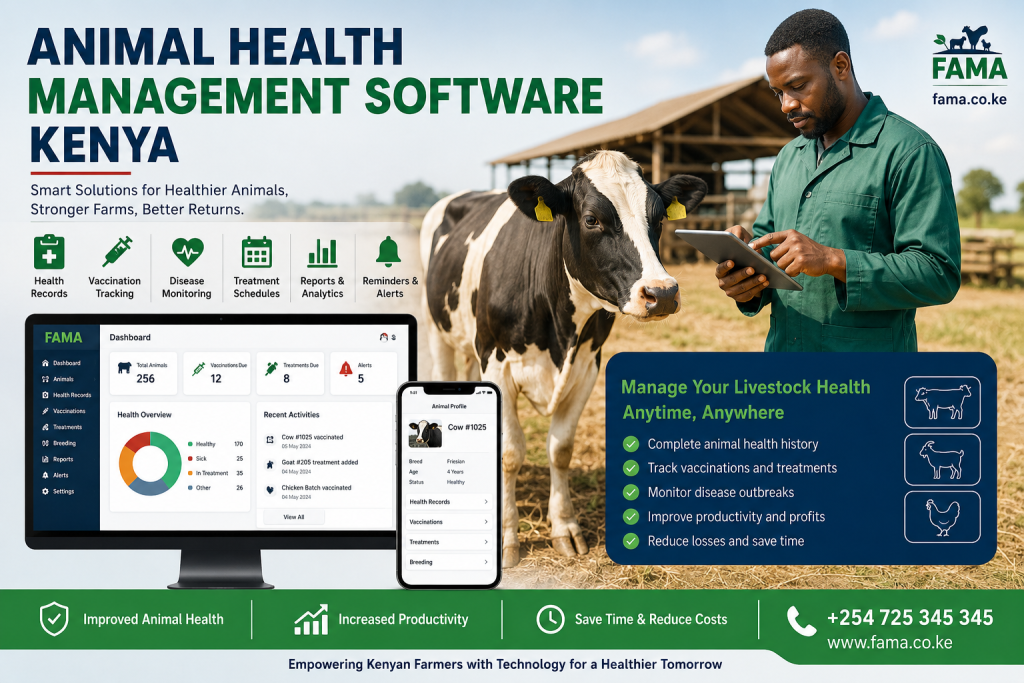
Episode 1: Introduction, Importance, Challenges, and Core Features
The livestock sector in Kenya continues to grow rapidly, supporting millions of farmers and contributing significantly to food security, employment, and the national economy. However, as farms expand and animal populations increase, traditional methods of managing animal health are no longer effective.
This is where animal health management software Kenya comes in. At Fama.co.ke, we provide modern digital solutions designed to help farmers, veterinarians, and agribusinesses efficiently monitor, track, and manage animal health records in real time.
In this first episode, we explore what animal health management software Kenya is, why it is important, the challenges it solves, and its core features in detail.
What is Animal Health Management Software Kenya?
Animal health management software Kenya is a specialized digital system designed to help farmers and veterinary professionals manage all aspects of livestock health in one centralized platform.
Instead of relying on handwritten records, notebooks, or scattered spreadsheets, the software allows users to digitally track every animal’s health journey from birth to maturity.
With animal health management software Kenya, users can manage:
- Vaccination schedules
- Disease history
- Treatment records
- Breeding cycles
- Growth performance
- Veterinary visits
- Mortality tracking
This system is especially useful in Kenya where livestock farming includes cattle, goats, sheep, poultry, camels, and pigs, each requiring detailed and consistent health monitoring.
Why Animal Health Management Software Kenya is Becoming Essential
The farming environment in Kenya has changed significantly over the past decade. Climate change, disease outbreaks, and increased demand for animal products have forced farmers to adopt smarter farming methods.
Animal health management software Kenya plays a central role in this transformation.
1. Increasing Livestock Population
As farmers scale up operations, it becomes difficult to manually track each animal. Large dairy farms, poultry farms, and ranches require automated systems to avoid errors and losses.
2. Rising Disease Outbreaks
Kenya has experienced recurring livestock diseases such as:
- Foot and Mouth Disease
- East Coast Fever
- Mastitis in dairy cows
- Newcastle disease in poultry
With animal health management software Kenya, farmers can monitor symptoms, track vaccination coverage, and respond quickly to outbreaks.
3. Demand for Food Safety and Quality
Consumers and export markets demand high-quality, disease-free animal products. Proper health tracking ensures compliance with veterinary standards.
Key Problems Solved by Animal Health Management Software Kenya
Before digital systems were introduced, livestock farmers faced several operational challenges that led to losses and inefficiencies.
1. Poor Record Keeping
Many farmers relied on handwritten notes or memory. This often led to:
- Missing vaccination dates
- Repeated treatments
- Loss of animal history
- Confusion during veterinary visits
Animal health management software Kenya solves this by centralizing all data in one system.
2. Delayed Disease Detection
Without proper monitoring tools, diseases often spread before farmers notice symptoms. This leads to:
- High mortality rates
- Increased treatment costs
- Reduced productivity
With automated alerts, the software helps detect abnormalities early.
3. Inefficient Veterinary Coordination
Veterinarians often lack complete animal history, making diagnosis slower and less accurate. The software provides full access to:
- Previous illnesses
- Medications used
- Response to treatment
4. Lack of Data-Driven Decision Making
Farmers previously made decisions based on guesswork rather than data. This affected:
- Breeding cycles
- Feeding strategies
- Herd management
With animal health management software Kenya, farmers now rely on accurate reports and analytics.
Core Features of Animal Health Management Software Kenya
At Fama.co.ke, our system is designed to support both small-scale farmers and large commercial livestock operations. Below are the detailed features.
1. Complete Livestock Profile Management
Each animal is assigned a unique digital profile that includes:
- Identification number or tag
- Breed and age
- Weight records
- Health history
- Ownership details
This ensures every animal is traceable and properly managed throughout its lifecycle.
2. Vaccination Scheduling and Tracking
Vaccination is one of the most critical aspects of livestock health.
The animal health management software Kenya automatically:
- Schedules vaccination dates
- Sends reminders before due dates
- Tracks completed vaccinations
- Flags missed vaccinations
This reduces the risk of disease outbreaks significantly.
3. Disease Monitoring System
The software allows farmers to log symptoms and track disease patterns across their herd or flock.
It helps identify:
- Common disease trends
- High-risk animals
- Possible outbreak zones
Early detection leads to faster response and reduced losses.
4. Treatment and Medication Records
Every treatment administered to an animal is recorded, including:
- Medication type
- Dosage
- Date of treatment
- Veterinarian notes
This ensures transparency and helps avoid repeated or incorrect treatments.
5. Breeding and Reproduction Management
Reproduction is key to livestock profitability.
The system tracks:
- Heat cycles
- Mating history
- Pregnancy status
- Calving or hatching dates
This improves breeding efficiency and ensures better herd planning.
6. Weight and Growth Tracking
Farmers can monitor animal growth over time by recording weight at different stages.
This helps in:
- Feeding optimization
- Market readiness decisions
- Performance evaluation
7. Alerts and Notifications System
One of the most powerful features of animal health management software Kenya is automated alerts.
Farmers receive notifications for:
- Upcoming vaccinations
- Disease risks
- Vet appointments
- Breeding schedules
8. Reporting and Data Analytics
The system generates detailed reports such as:
- Herd performance summaries
- Mortality rates
- Vaccination coverage reports
- Disease history analysis
These insights help farmers make better business decisions.
9. Multi-Device Access (Mobile & Desktop)
Since many farmers in Kenya operate in rural areas, the system is designed to work on:
- Smartphones
- Tablets
- Computers
This ensures accessibility anytime, anywhere.
The Role of Animal Health Management Software Kenya in Modern Farming
Modern agriculture depends heavily on data and technology. Animal health management software Kenya is part of a larger shift toward smart farming.
It supports:
- Precision livestock farming
- Digital veterinary services
- Smart disease tracking systems
- Automated farm management
This transformation improves efficiency and reduces losses across the livestock sector.
Challenges Faced Before Digital Animal Health Systems
Before adopting animal health management software Kenya, farmers struggled with:
- Lack of structured data systems
- High dependency on manual records
- Difficulty tracking large herds
- Limited veterinary support in remote areas
- High operational inefficiencies
These challenges often led to reduced productivity and financial losses.
Why Fama.co.ke is Leading in Animal Health Management Software Kenya
At Fama.co.ke, we focus on delivering practical, affordable, and easy-to-use digital tools tailored specifically for Kenyan farmers.
Our system stands out because:
- It is designed for local farming conditions
- It supports all major livestock types
- It is user-friendly even for beginners
- It provides real-time updates and alerts
- It integrates easily into farm operations
For inquiries, demos, or partnerships:
📞 +254 725345345
Advanced Benefits of Animal Health Management Software Kenya
While Episode 1 covered the core features, animal health management software Kenya also delivers deeper, long-term advantages that directly impact farm profitability and sustainability.
1. Reduced Livestock Losses
One of the biggest hidden costs in farming is animal death due to preventable diseases or mismanagement. With proper tracking and alerts, farmers can:
- Detect illness early
- Respond quickly to outbreaks
- Prevent treatment delays
- Reduce mortality rates significantly
This alone makes animal health management software Kenya a valuable investment for both small and large farms.
2. Improved Farm Profitability
Healthy animals grow faster, produce more milk, and reproduce efficiently. This directly increases income through:
- Higher milk production in dairy farms
- Better meat quality and weight gain
- Increased egg production in poultry farms
- Improved breeding success rates
By optimizing animal health, the software indirectly improves farm revenue.
3. Better Compliance with Veterinary Regulations
In Kenya, livestock farming is regulated to ensure food safety and disease control. The system helps farmers stay compliant by:
- Keeping accurate vaccination records
- Tracking disease treatment history
- Providing audit-ready reports
- Supporting veterinary inspection requirements
This is especially important for commercial farms and exporters.
4. Data-Driven Decision Making
Instead of guessing, farmers can now make decisions based on real data generated by animal health management software Kenya, such as:
- Which animals are underperforming
- When to sell or breed livestock
- Which treatments are most effective
- Seasonal disease patterns
This leads to smarter, more profitable farming strategies.
5. Improved Farm Efficiency
The software reduces manual work and streamlines operations. Farmers save time by:
- Automating record keeping
- Receiving automatic reminders
- Reducing paperwork
- Centralizing all animal data
This allows farmers to focus more on actual animal care rather than administration.
Real-World Use Cases of Animal Health Management Software Kenya
The impact of animal health management software Kenya can be seen across different farming environments in Kenya.
1. Dairy Farming in Rift Valley
Large dairy farms in Nakuru, Eldoret, and Nyandarua use digital systems to:
- Track milk-producing cows
- Monitor mastitis cases
- Schedule regular vaccinations
- Improve breeding cycles
This results in higher milk output and reduced disease-related losses.
2. Poultry Farming in Nairobi and Kiambu
Poultry farmers use animal health management software Kenya to manage:
- Vaccination schedules for Newcastle disease
- Feed optimization tracking
- Egg production records
- Mortality rate monitoring
This ensures consistent egg and meat supply to urban markets.
3. Goat and Sheep Farming in ASAL Regions
Farmers in arid and semi-arid areas use the system to:
- Track herd movement and health
- Monitor drought-related stress
- Manage breeding cycles efficiently
- Reduce losses during harsh seasons
4. Veterinary Clinics Across Kenya
Veterinarians rely on the software to:
- Manage multiple farm clients
- Track treatment history
- Diagnose diseases faster
- Provide accurate prescriptions
This improves service delivery and professionalism in veterinary practice.
5. Large Ranches and Commercial Farms
Large-scale livestock operations benefit by:
- Managing thousands of animals efficiently
- Monitoring multiple herds in different locations
- Generating automated performance reports
- Ensuring consistent animal welfare standards
How to Implement Animal Health Management Software Kenya
Adopting animal health management software Kenya is simple when done step by step.
Step 1: Farm Assessment
The first step involves analyzing your farm size, livestock type, and current record-keeping system. This helps customize the software to your needs.
Step 2: System Setup
At Fama.co.ke, we configure the system to include:
- Animal categories (cattle, poultry, goats, etc.)
- User accounts for staff or veterinarians
- Farm-specific health tracking rules
- Notification settings
Step 3: Data Migration
Existing records (if available) are transferred into the system, ensuring continuity of animal history.
Step 4: Training and Onboarding
Farm owners and workers are trained on how to use the system, including:
- Adding animals
- Recording treatments
- Checking reports
- Using mobile features
Step 5: Daily Use and Monitoring
Once active, the system becomes part of daily farm operations. Farmers continuously update:
- Health records
- Vaccination schedules
- Breeding logs
- Weight data
Step 6: Continuous Support and Updates
Fama.co.ke provides ongoing support, ensuring the system remains effective and up to date with farming needs in Kenya.
Why Animal Health Management Software Kenya is the Future of Farming
The future of livestock farming in Kenya is digital. Traditional methods are no longer enough to handle:
- Large herd sizes
- Disease complexity
- Market demands
- Climate variability
Animal health management software Kenya ensures farming becomes:
- More efficient
- More profitable
- More sustainable
- More data-driven
This shift is already happening across progressive farms in Kenya.
Integration of Animal Health Management Software Kenya with Smart Farming Systems
One of the most powerful advancements in modern agriculture is the integration of animal health management software Kenya with other smart farming technologies. Farming today is no longer an isolated activity; it is a connected ecosystem that includes IoT devices, mobile applications, cloud systems, and data analytics platforms.
When animal health management software Kenya is integrated into this ecosystem, farmers gain a complete digital view of their livestock operations. For example, sensors placed in barns or animal collars can monitor temperature, movement, feeding patterns, and overall behavior. This data is then synchronized with the software to provide real-time insights into animal health conditions.
This level of integration helps farmers detect early warning signs of disease before visible symptoms appear. If an animal shows reduced movement or abnormal feeding behavior, the system can immediately alert the farmer or veterinarian. This proactive approach reduces livestock losses and improves treatment success rates.
Role of Mobile Technology in Animal Health Management Software Kenya
Mobile technology is one of the biggest drivers of adoption for animal health management software Kenya, especially among small-scale farmers. In rural areas where access to computers may be limited, mobile phones become the primary tool for managing farm operations.
The mobile version of animal health management software Kenya allows farmers to:
- Register new animals directly from their phones
- Receive vaccination and treatment reminders
- Record veterinary visits on the go
- Access animal health history anytime
- Get instant alerts on disease outbreaks
This flexibility ensures that even farmers in remote parts of Kenya can benefit from modern livestock management tools. The system works on both smartphones and tablets, making it accessible to a wide range of users regardless of technical background.
Economic Impact of Animal Health Management Software Kenya
The adoption of animal health management software Kenya has a significant economic impact on both individual farmers and the national economy. Livestock farming contributes a large percentage to Kenya’s agricultural GDP, and improving efficiency in this sector leads to broader economic growth.
At the farm level, farmers experience:
- Reduced veterinary costs due to early disease detection
- Lower mortality rates among livestock
- Increased productivity per animal
- Better market pricing due to improved animal quality
At a national level, improved livestock health leads to:
- Increased meat and milk production
- Better export opportunities for animal products
- Reduced dependency on imports
- Stronger food security across the country
By improving efficiency and reducing losses, animal health management software Kenya plays a direct role in strengthening Kenya’s agricultural economy.
Customization and Scalability of Animal Health Management Software Kenya
One of the key advantages of modern animal health management software Kenya is its ability to scale and adapt to different farm sizes and types. Whether a farmer has 10 cows or 10,000 chickens, the system can be customized to meet specific needs.
For small-scale farmers, the software focuses on simplicity. It includes basic features such as animal registration, vaccination reminders, and treatment tracking. This ensures that users are not overwhelmed by complex tools.
For large commercial farms, the system becomes more advanced. It includes features such as:
- Multi-farm management dashboards
- Staff role assignments and permissions
- Advanced analytics and reporting tools
- Integration with supply chain systems
- Bulk data processing for large herds
This scalability makes animal health management software Kenya suitable for every level of livestock production.
Security and Data Protection in Animal Health Management Software Kenya
Data security is a major concern in modern digital systems. Farmers need to ensure that their livestock records, financial data, and operational details are safe from unauthorized access.
Animal health management software Kenya uses secure cloud-based systems to protect sensitive information. Key security features include:
- Encrypted data storage
- User authentication and password protection
- Role-based access control
- Regular system backups
- Secure cloud hosting infrastructure
This ensures that farmers’ data is always protected and accessible only to authorized users. In case of device loss or damage, all records remain safely stored in the cloud and can be recovered instantly.
Training and Support for Farmers Using Animal Health Management Software Kenya
Adopting new technology can be challenging, especially for farmers who are not familiar with digital systems. That is why training and support are essential components of animal health management software Kenya.
At Fama.co.ke, farmers receive full onboarding support, including:
- Step-by-step system tutorials
- Hands-on training sessions
- Video guides and documentation
- Customer support via phone and messaging
- Continuous system updates and improvements
This ensures that every user, regardless of technical skill level, can successfully use the software to manage their livestock.
Future Developments in Animal Health Management Software Kenya
The future of animal health management software Kenya is highly promising as technology continues to evolve. In the coming years, we expect to see more advanced features such as:
- Artificial intelligence for disease prediction
- Drone-based livestock monitoring
- Blockchain-based livestock traceability
- Automated feeding and health systems
- Advanced genetic tracking for breeding optimization
These innovations will further improve productivity, reduce costs, and make livestock farming even more efficient.
Why Choose Fama.co.ke
Fama.co.ke is not just a software provider — it is a partner in agricultural transformation.
Our animal health management software Kenya stands out because:
- It is built specifically for Kenyan farmers
- It supports all livestock types
- It is mobile-friendly for rural access
- It is simple, fast, and reliable
- It improves both productivity and profitability
Whether you run a small farm or a large commercial operation, we provide the right tools to help you succeed.
📞 For demos, setup, or inquiries: +254 725345345
Conclusion
Animal health management software Kenya is transforming livestock farming from a traditional, manual system into a modern, data-driven industry. Farmers who adopt this technology gain a significant advantage in productivity, disease control, and profitability.
From improving vaccination tracking and reducing livestock losses to enabling smarter breeding and better farm planning, the benefits are clear and measurable.
Fama.co.ke is committed to supporting farmers across Kenya with reliable and easy-to-use digital solutions that make livestock management simpler, smarter, and more profitable.
The future of farming is not just physical—it is digital, and animal health management software Kenya is at the center of this transformation.