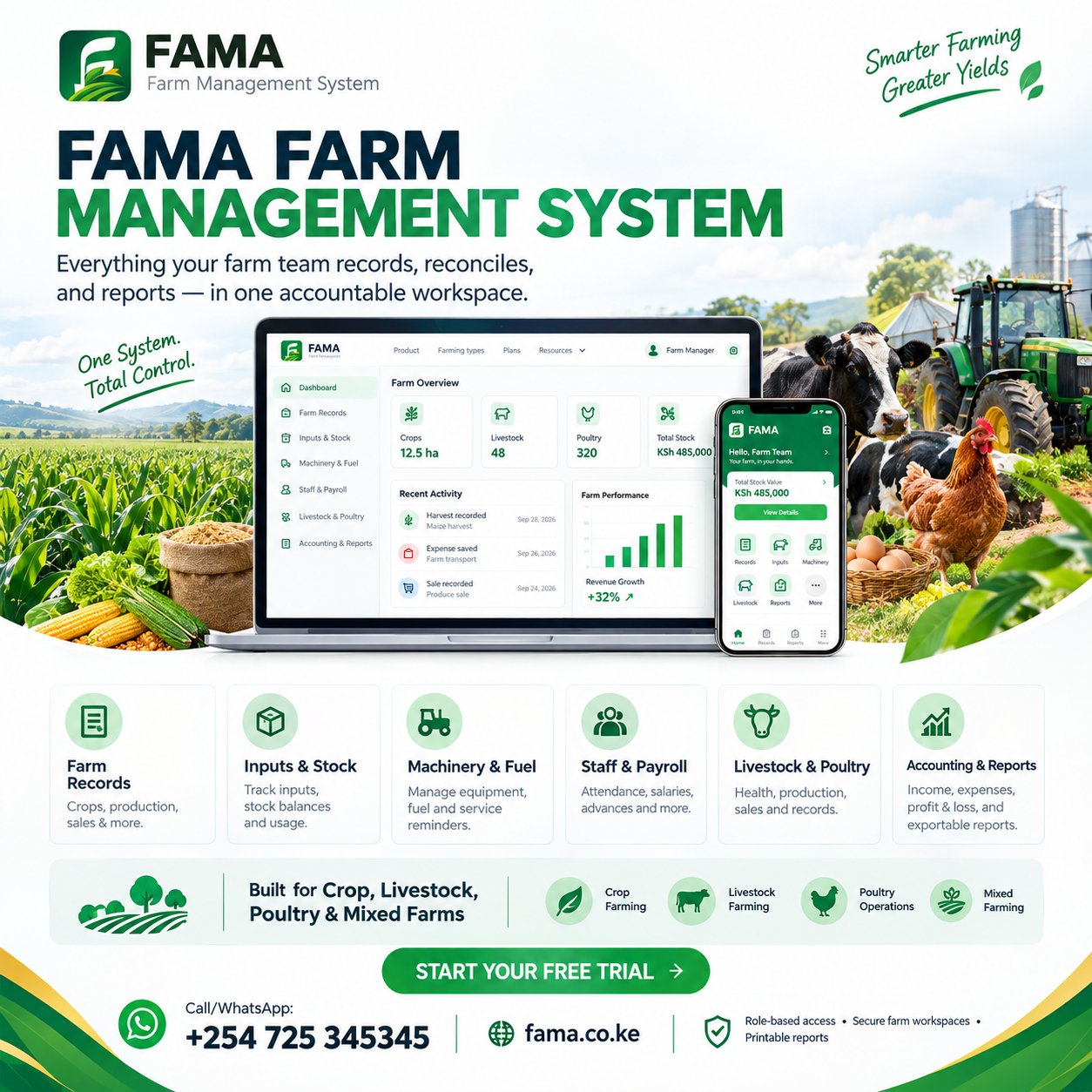
Farm cashbook management is the most fundamental financial discipline on any Kenyan farm, because a farm can be productive, well-managed, and hard-working and still fail if nobody knows where the cash is going. Fama.co.ke provides an innovative platform that makes farm cashbook management simple and practical, helping farmers move from scattered receipts and mental accounting to organised, verifiable cash records. With studies showing that farmers who keep records increase their incomes by 26 per cent, yet seven out of ten commercial farmers in Kenya report having kept no records for their farm, mastering farm cashbook management has become essential for anyone serious about agricultural profitability.
The consequences of poor farm cashbook management are severe and quietly expensive. Most Kenyan farmers who do keep records note down only one or two items, usually the price of seed and how much they sold their crop. This means they do not truly know whether their produce, after deducting labour, fertiliser, and transport, made a profit or a loss and by how much. A disciplined approach to farm cashbook management changes this by ensuring that every shilling in and out is recorded, categorised, and reconciled.
Fama.co.ke‘s platform helps farmers master farm cashbook management by providing digital cash books that record income and expenses as they happen, calculate running balances automatically, and reconcile M-Pesa and bank transactions. Research shows that the two biggest challenges reported by 68 per cent of farmers are the lack of the right tools to keep farm records and a lack of knowledge in record keeping. With farm cashbook management, both challenges are addressed by a structured system that tells the farmer exactly what to record and does the arithmetic automatically.
The financial case for adopting farm cashbook management is compelling. A farm turning over Sh2 million a year with a 15 per cent net margin earns Sh300,000. If unrecorded expenses and unnoticed cash leakage erode even 20 per cent of that margin, the farmer loses Sh60,000. A farm cashbook management system that captures every transaction prevents this erosion and pays for itself within the first season.
The legal context has made farm cashbook management a necessity rather than a good habit. From 1 January 2026, the Kenya Revenue Authority began validating all income and expenses declared in tax returns against official data sources, including eTIMS invoices, withholding tax records, and import records. If a declared expense does not have a valid eTIMS invoice, KRA treats that expense as profit and adds it back to taxable income. This is why every farmer must understand farm cashbook management in the context of digital invoicing, not just traditional ledgers.
The eTIMS requirement directly shapes farm cashbook management. Every farmer must onboard on the iTax system and use eTIMS to generate invoices for the purchase and payment of farm inputs. At the end of the year, those invoices must be provided when filing the return. A farm cashbook management system that stores every eTIMS invoice alongside the related transaction ensures that no legitimate deduction is lost and no penalty is incurred.
Reconciliation is the heart of effective farm cashbook management. A cash book that is not reconciled against bank and M-Pesa statements is merely a record of what someone remembered to write down. Reconciliation reveals errors, omissions, and theft. A farm cashbook management system that automates reconciliation against M-Pesa and bank records ensures that the cash book reflects reality rather than intention.
The petty cash dimension of farm cashbook management is where many farms fail. Casual labour, minor repairs, fuel for a motorbike, and sundries are paid in cash and often not recorded. Over a season, these small amounts accumulate into substantial sums that vanish from the accounts. A structured approach to farm cashbook management includes a petty cash book with receipts, ensuring that small expenses are captured alongside large ones.
For farmers managing multiple enterprises, farm cashbook management becomes a question of attribution. A mixed farm with dairy, maize, and horticulture must know which enterprise is profitable and which is being subsidised by the others. A farm cashbook management system that records income and costs by enterprise enables this analysis, revealing the truth that aggregate accounts hide.
Cash versus accrual is another decision that shapes farm cashbook management. Most small farms use cash accounting, recording income when received and expenses when paid. Larger operations use accrual accounting, recording income when earned and expenses when incurred. For a farm carrying significant receivables from buyers or payables to suppliers, accrual accounting gives a truer picture, and a farm cashbook management system should support the method that matches the operation’s complexity.
Why Kenyan Farmers Struggle with Farm Cashbook Management
The reasons farmers fail at farm cashbook management are well understood. Farming is physical work, and bookkeeping feels like office work. Receipts are lost, purchases are made in cash, and transactions are reconstructed from memory weeks later. The result is a set of records that exists in name but not in substance.
The structure of Kenyan farm transactions makes cashbook management harder. Inputs are bought from multiple agro-dealers, often informally. Labour is paid daily in cash. Produce is sold to brokers, cooperatives, and processors on varying terms. Each transaction type requires different documentation, and without a system, nothing is captured consistently.
The consequences extend beyond tax. Without farm cashbook management, farmers cannot demonstrate creditworthiness to lenders, cannot prove their costs to buyers, cannot identify loss-making enterprises, and cannot plan cash flow through the season. A structured cashbook system addresses all these gaps simultaneously.
The Core Components of Farm Cashbook Management
Effective farm cashbook management rests on a small number of core components that must all be present.
The Main Cash Book
The main cash book records every transaction involving cash, whether physical cash, bank transfers, or mobile money. Each entry should record the date, description, amount, category, and reference. Running balances should be calculated automatically.
The Petty Cash Book
The petty cash book records small cash expenses that are impractical to process through the main cash book. Casual labour payments, minor repairs, fuel for small equipment, and sundries belong here. Receipts should be attached to every entry.
The Bank Account Register
The bank account register records all transactions passing through the farm’s bank account, including deposits, withdrawals, transfers, and charges. It should be reconciled monthly against the bank statement.
The M-Pesa Register
The M-Pesa register records all transactions passing through the farm’s M-Pesa business account, including payments received from buyers, payments made to suppliers and workers, and charges. It should be reconciled monthly against the M-Pesa statement.
The Imprest System
For larger farms, the imprest system provides a fixed float to a supervisor, records expenses against it, and replenishes the float when receipts are presented. This creates a control on casual spending and ensures that petty cash does not disappear unaccounted.
Setting Up a Farm Cashbook: A Step-by-Step Guide
Setting up a cashbook is straightforward and pays immediate dividends.
Step 1: Separate Farm and Personal Accounts
Open a dedicated farm bank account and a dedicated M-Pesa business account. Pay all farm expenses from the farm accounts and all personal expenses from the personal accounts. This separation is essential for accurate cashbook management.
Step 2: Choose Your Format
Decide whether to use a paper cashbook, a spreadsheet, or a digital platform. Paper is cheapest but least reliable. Digital platforms offer automatic calculations, reconciliation, and reporting.
Step 3: Define Your Categories
Establish income and expense categories that match your farm enterprises. Typical income categories include crop sales, livestock sales, milk sales, and egg sales. Typical expense categories include seed, fertiliser, crop protection, labour, transport, fuel, repairs, and utilities.
Step 4: Record the Opening Balance
Record the opening balance of cash on hand, cash at bank, and cash in M-Pesa. This establishes the starting point for all subsequent entries.
Step 5: Begin Recording Daily
Record every transaction on the day it occurs, with documentation attached. Never rely on memory or reconstruct entries later.
Step 6: Reconcile Weekly
Reconcile the cashbook against bank and M-Pesa statements weekly. Investigate any discrepancy immediately.
Step 7: Review Monthly
At the end of each month, close the cashbook, generate a summary, and compare against budget.
The Farm Cashbook Format: What Columns to Include
A well-designed cashbook format makes recording fast and analysis easy.
| Column | Purpose |
|---|---|
| Date | Records the transaction date |
| Description | Describes the transaction clearly |
| Receipt or Voucher Number | Links the entry to supporting documentation |
| Income Category | Categorises income by type |
| Expense Category | Categorises expenses by type |
| Field or Enterprise | Attributes the transaction to a specific enterprise |
| Cash In | Records money received |
| Cash Out | Records money paid |
| Balance | Running balance after the transaction |
| Payment Method | Cash, M-Pesa, bank transfer, or cheque |
| Reference Number | M-Pesa code, cheque number, or bank reference |
| eTIMS Invoice Number | Links the entry to a compliant invoice |
| Notes | Records context and observations |
Recording Income in the Farm Cashbook
Accurate income recording is the foundation of knowing whether the farm is profitable.
Record Every Sale
Every sale should be recorded, whether to a cooperative, a broker, a processor, a supermarket, or a neighbour. Cash sales are the most commonly omitted and must be captured.
Record the Actual Price Received
Income should reflect the actual price received, not the market price quoted. Deductions for transport, levies, and quality downgrades reduce effective income and must be reflected.
Record the Buyer
Recording the buyer allows analysis of which buyers pay best and most reliably. This is valuable information when negotiating future sales.
Record Payment Terms
Where a sale is made on credit, the cashbook should note that payment is pending and should track the receivable until it is settled.
Separate Subsidies and Grants
Where farmers receive subsidies or grants, these should be recorded separately so that the farm understands its reliance on external support.
Recording Expenses in the Farm Cashbook
Expenses are where cashbooks most often go wrong, because costs are numerous and easily forgotten.
Direct Costs
Direct costs include seed and planting material, fertiliser, crop protection chemicals, casual labour, machinery hire, fuel, and transport. These typically represent the largest share of total costs and must be captured completely.
Overheads
Overheads include land rent, insurance, administration, utilities, repairs and maintenance, and depreciation. These support the whole farm rather than a single enterprise.
Labour Costs
Labour costs include casual wages, permanent salaries, statutory contributions, and overtime. Recording labour against specific fields and tasks enables labour cost per acre calculation.
Livestock Costs
Livestock costs include feed, veterinary services, vaccinations, breeding and AI, and livestock labour. These should be recorded against the livestock enterprise.
Machinery Costs
Machinery costs include fuel, repairs, maintenance, insurance, and depreciation. Recording these against specific machines enables cost per hour calculation.
Capital Expenditure
Capital expenditure such as land improvements, irrigation equipment, buildings, and heavy machinery should be recorded separately and depreciated over their useful life.
Reconciling a Farm Cashbook
Reconciliation is what separates a reliable cashbook from a list of remembered transactions.
Bank Reconciliation
Compare the cashbook bank balance against the bank statement balance. Identify items in transit, unpresented cheques, bank charges, and errors. Adjust the cashbook to reflect reality.
M-Pesa Reconciliation
Compare the cashbook M-Pesa balance against the M-Pesa statement. Identify transactions recorded in one but not the other, and reconcile charges and reversals.
Cash Reconciliation
Count physical cash on hand and compare against the cashbook balance. Any discrepancy reveals unrecorded transactions, errors, or theft.
Petty Cash Reconciliation
Count petty cash on hand, add receipts for expenses incurred, and compare against the imprest amount. The total should equal the float if all transactions are properly recorded.
Frequency
Reconciliation should happen weekly. Monthly reconciliation allows problems to compound, and annual reconciliation is effectively useless for management purposes.
Common Mistakes in Farm Cashbook Management
Recording Only Major Transactions
Small expenses accumulate into significant sums. Every expense, however minor, belongs in the cashbook.
Mixing Personal and Farm Money
When farm and household money share an account, accurate recording becomes impossible.
Recording in Arrears
Reconstructing records weeks later produces inaccuracies and missed transactions.
No Receipts or Invoices
Without documentation, expenses cannot be claimed and disputes cannot be resolved.
Not Reconciling
Unreconciled cashbooks hide errors, omissions, and theft.
Ignoring Depreciation
Excluding depreciation overstates profit and leaves the farm unable to fund replacement.
Recording Drawings as Expenses
Owner withdrawals are drawings, not expenses. Recording them as expenses understates profit.
Using Estimates Instead of Records
The cashbook must be built from records, not recollections.
Failing to Attribute Costs
Recording transactions without attributing them to enterprises prevents profitability analysis.
Not Comparing Across Periods
A single period’s figures are a data point. Trends across periods reveal whether performance is improving.
Farm Cashbook Management and KRA Compliance
The 2026 validation regime has made digital invoicing central to cashbook management.
Register on iTax
Every farmer operating commercially should be registered on iTax with the correct KRA PIN for the farm or agribusiness entity.
Issue Compliant Invoices on Sales
Sales to processors, exporters, supermarkets, and other business buyers require compliant invoices carrying the buyer’s PIN. Many unprocessed agricultural products are zero-rated for VAT, so the invoice carries no VAT but is still a compliant invoice.
Capture Purchase Invoices
Every purchase of farm inputs should be supported by an eTIMS-compliant invoice. Where a supplier’s turnover is at or below Sh5 million, buyer-initiated invoicing allows the buying farm to generate the invoice on the supplier’s behalf.
Reconcile eTIMS With the Cashbook
Monthly reconciliation between eTIMS records and the cashbook ensures that every declared transaction is supported. Mismatches trigger audits.
Handle Zero-Rated Produce Correctly
Because zero-rated produce allows a VAT-registered agribusiness to reclaim input VAT on standard-rated inputs such as packaging and fuel, correct treatment is valuable. Treating zero-rated produce as exempt by mistake forfeits that refund.
Cash Flow Management Through the Farm Cashbook
A cashbook is not only a record of the past; it is a tool for managing the future.
Identify Seasonal Patterns
Reviewing monthly cashbook summaries reveals seasonal patterns in income and expenses. This knowledge allows the farm to plan for lean periods and invest during surplus periods.
Forecast Future Cash Position
By understanding typical inflows and outflows, the farm can forecast its cash position and anticipate shortfalls before they occur.
Time Expenditure
Knowing the cash position allows the farm to time major expenditures—fertiliser purchases, equipment repairs, labour hiring—for periods when cash is available.
Reduce Borrowing
Farms with clear cash flow visibility borrow less because they anticipate shortfalls and plan for them rather than discovering them.
Improve Creditworthiness
Lenders require documented cash flow histories. A well-maintained cashbook provides the evidence needed for credit applications.
How Fama.co.ke Supports Farm Cashbook Management
Fama.co.ke provides the digital infrastructure to make farm cashbook management simple, compliant, and useful.
Digital Cashbook
The platform records every transaction with date, description, category, amount, payment method, and reference. It works offline and syncs automatically when connectivity returns.
Automatic Running Balances
The platform calculates running balances for cash, bank, and M-Pesa automatically, eliminating manual arithmetic and errors.
M-Pesa and Bank Reconciliation
The platform links M-Pesa and bank transactions to the cashbook, eliminating manual entry and reducing reconciliation errors.
eTIMS Invoice Storage
The platform stores eTIMS invoices alongside transactions, ensuring that every claimed expense is supported.
Petty Cash Management
The platform manages petty cash through the imprest system, recording expenses and replenishing floats when receipts are presented.
Field and Enterprise Attribution
Every transaction can be linked to a specific field or enterprise, enabling gross margin and net margin calculations.
Automated Financial Statements
The platform generates profit and loss statements, cash flow reports, and balance sheets without manual compilation.
Reports for Lenders and KRA
Reports are formatted for KRA filing and for lender requirements, supporting both tax compliance and access to finance.
Works Offline
The platform works offline and syncs automatically when connectivity returns, making it practical for farms in remote areas.
Frequently Asked Questions About Farm Cashbook Management
What is farm cashbook management?
Farm cashbook management is the systematic recording, categorisation, and reconciliation of all cash transactions on a farm, including cash, bank, and M-Pesa. Fama.co.ke‘s platform digitises the process.
What should a farm cashbook include?
Date, description, receipt or voucher number, income and expense categories, field or enterprise, cash in, cash out, running balance, payment method, reference number, eTIMS invoice number, and notes.
Why do most Kenyan farmers not keep cashbooks?
Research shows the two biggest challenges reported by 68 per cent of farmers are the lack of the right tools to keep farm records and a lack of knowledge in record keeping. Seven out of ten commercial farmers report having kept no records.
How often should I reconcile my farm cashbook?
Reconcile weekly against bank and M-Pesa statements. Monthly reconciliation allows problems to compound, and annual reconciliation is useless for management purposes.
How does eTIMS affect farm cashbook management in Kenya?
From January 2026, KRA validates declared income and expenses against eTIMS invoices. Expenses without valid eTIMS invoices are treated as profit and taxed, so the cashbook must capture and store eTIMS invoices.
Should owner drawings be recorded in the cashbook?
Yes, but as drawings rather than expenses. Recording drawings as expenses understates profit and distorts the financial picture.
How do I manage petty cash on a farm?
Use the imprest system: issue a fixed float, record expenses with receipts, and replenish the float when receipts are presented. Reconcile the float regularly.
Can I manage a farm cashbook without software?
Yes, using a paper cashbook and ledger, provided every transaction is recorded with documentation and reconciled regularly. Software makes the process faster and more reliable.
How does Fama.co.ke help with farm cashbook management?
Fama.co.ke records transactions, calculates running balances, reconciles M-Pesa and bank payments, stores eTIMS invoices, manages petty cash, and generates financial statements automatically—all offline-capable.