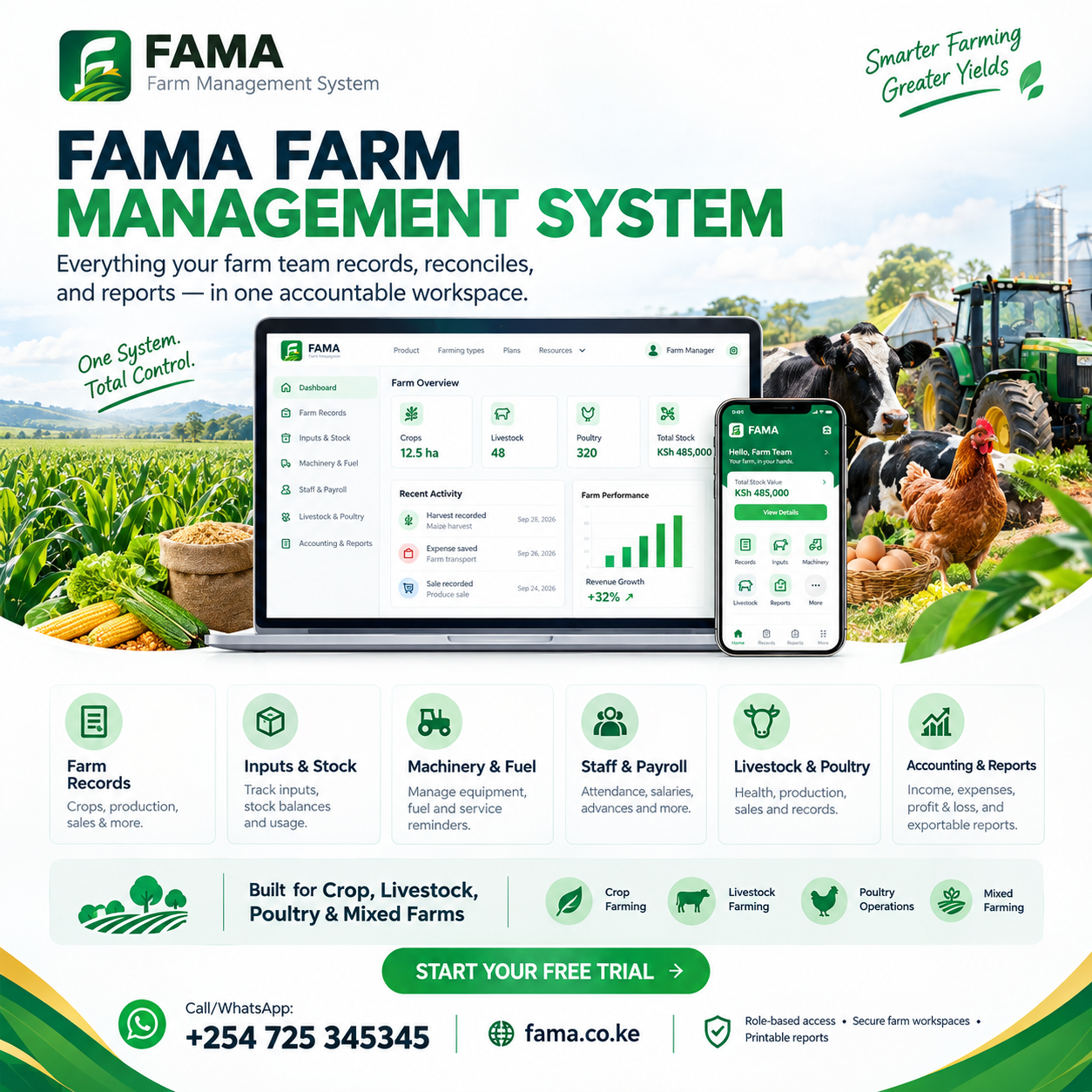
Owned vs leased land farming profit in Kenya is the fundamental economic question every farmer and agricultural investor must answer, because the choice between buying land and renting it determines your capital structure, your cash flow, your risk exposure, and ultimately your return on investment. Fama.co.ke provides an innovative platform that helps farmers track owned vs leased land farming profit in Kenya by recording land costs, rent payments, and production returns across both models. With land prices having grown much faster than operating profits over the past decade, making additional purchases of farm land less affordable relative to the income that land is capable of generating, understanding owned vs leased land farming profit in Kenya has never been more important for anyone committing capital to agriculture.
The financial case for each model rests on fundamentally different logic, and comparing owned vs leased land farming profit in Kenya requires separating the farming business from the real estate business. Rural land is a combination of two businesses: farming and a real estate business, and these must be analysed separately to be sure that each activity contributes to your overall financial position in its own right. This is why serious analysis of owned vs leased land farming profit in Kenya begins by recognising that owning land generates returns through both operating profit and capital appreciation, while leasing generates returns purely through operating profit on someone else’s asset.
Leasing land allows you to lever the potentially high returns from an operating business without tying up capital in land purchase. A commercial agribusiness managing nearly 5,000 acres across Africa without owning the land demonstrates the power of this model—leasing land made more sense than owning it because it preserved capital for operations and scale. When comparing owned vs leased land farming profit in Kenya, the leasing model often produces higher returns on capital deployed because the farmer’s equity goes into production, machinery, and working capital rather than into a static asset.
The cost structure of leasing varies enormously across Kenya, and this variation directly determines owned vs leased land farming profit in Kenya. An acre can rent for a few thousand shillings a year in the dry margins of Makueni or Kitui, and for twenty to forty thousand shillings or more in the irrigated, high-demand horticulture zones of Kiambu, Kirinyaga, or Nakuru. In the Rift Valley grain belt—Trans Nzoia, Uasin Gishu, Nakuru—annual rents commonly run from eight thousand to fifteen thousand shillings per acre. These rent levels sit at the heart of any comparison of owned vs leased land farming profit in Kenya.
Leasing introduces a crucial cash-flow dimension that ownership does not. Landowners benefit when yields improve, while operators avoid the cash-flow pressure of paying rent during periods of low production under share-based arrangements. On the other hand, fixed-rent leases create a rigid cash outflow regardless of harvest outcomes, which can be devastating in a bad season. Understanding owned vs leased land farming profit in Kenya therefore requires modelling not just average returns but the variability of returns under each model.
Land quality differs systematically between owned and rented plots in Kenya, and this affects owned vs leased land farming profit in Kenya in ways that pure financial models miss. Research has found that inherited and purchased plots were relatively more fertile than rented plots in Kenya, suggesting that plots traded on short-term markets tend to be of inferior quality due to market imperfections. A farmer comparing owned vs leased land farming profit in Kenya must account for the possibility that rented land may require more inputs to achieve the same yields.
The time horizon of investment behaviour differs sharply between the two models, with direct consequences for long-term owned vs leased land farming profit in Kenya. Practices with longer-term benefits such as trees, manuring, mulching, and composting are preferred on more tenure-secure plots, while those with immediate or season-to-season benefits such as drainage structures or chemical fertilizers are preferred on rented plots. The short-term nature of leasing arrangements in Kenya has meant the focus is on short-term profits, which often come at the expense of medium to longer-term returns. This is a critical consideration in owned vs leased land farming profit in Kenya because land degradation under short leases eventually reduces returns.
Long-term agricultural leases have emerged as the most bankable option for investors making significant capital commitments. Where a farmer or investor intends to install irrigation, plant perennial crops, or build permanent infrastructure, a lease term long enough to recover the investment is essential. A owned vs leased land farming profit in Kenya comparison that assumes a one-season lease cannot capture the returns available from a fifteen-year lease on which the tenant has invested in land improvement.
For farmers with limited capital, leasing is often the only viable entry point. Renting requires less money upfront than buying, making it attractive to someone who needs land for farming but does not have enough capital to purchase property. A four-acre leased farm in Kisumu generating an average of KSh 150,000 from vegetable sales, split equally among group members after deducting costs including leasing fees, illustrates how leasing enables production without land ownership. This accessibility is a major factor in owned vs leased land farming profit in Kenya for smallholders and new entrants.
The scale advantage of leasing is equally significant. Leasing land allows you to expand acreage rapidly without the capital outlay of purchase, capturing economies of scale that Kenyan cereal farmers identify as a key competitive advantage. A farmer who owns 50 acres but could profitably farm 500 acres can lease the additional 450 acres and multiply operating profit without multiplying land capital. When evaluating owned vs leased land farming profit in Kenya, this scalability is often the decisive advantage of the leasing model.
The Two Businesses Inside Every Farm: Farming and Real Estate
Understanding owned vs leased land farming profit in Kenya requires separating the operating business from the asset.
The Farming Business
The farming business generates profit from production—crops, livestock, and value addition. It requires working capital, machinery, labour, and management. Its return is measured by operating profit relative to capital employed in operations.
The Real Estate Business
The real estate business generates returns from land ownership—capital appreciation and, where land is leased out, rental income. Land prices in Kenya have grown at a much faster rate than operating profits, which has made additional purchases less affordable relative to the income that land is capable of generating.
Why the Separation Matters
A farmer who owns land and farms it is running both businesses simultaneously. The operating return may be modest while the real estate return is strong, or vice versa. Conflating the two obscures which is actually creating value. Separating them clarifies whether you should own land but not operate it, or operate land but not own it.
Cost Comparison: Owned vs Leased Land Farming Profit in Kenya
The cost structures of the two models differ in timing, magnitude, and flexibility.
Upfront Capital
Buying land requires substantial upfront capital. Agricultural land in Kenya varies widely in price, with some listings at KSh 150,000 per acre and riverfront investment land at KES 550,000 per acre. Leasing requires only the first period’s rent, preserving capital for operations.
Recurring Costs
Leasing creates a recurring rent obligation. In the Rift Valley grain belt, annual rents commonly run from eight thousand to fifteen thousand shillings per acre. In the Nairobi metropolitan area, agricultural leases range from Ksh 5,000 to Ksh 12,000 per acre per month, depending on location and amenities.
Financing Costs
Buying land typically involves a mortgage or loan, with interest costs that must be serviced from operating profit. Leasing avoids financing costs on land but may involve higher annual cash outflows than the interest on a mortgage.
Transaction Costs
Land purchase involves legal fees, stamp duty, and Land Control Board consent processes. Leasing also involves legal documentation, but at lower cost and complexity.
Opportunity Cost
Capital committed to land purchase cannot be deployed into operations, machinery, or working capital. Leasing preserves that capital for higher-return uses within the farming business.
Cash Flow: The Hidden Differentiator in Owned vs Leased Land Farming Profit in Kenya
Cash flow timing often matters more than total profit, particularly for capital-constrained farmers.
Owned Land Cash Flow
Owned land eliminates rent payments, leaving more cash available during the season. However, the initial purchase depletes capital reserves, and mortgage servicing creates a fixed monthly outflow that persists regardless of harvest outcomes.
Leased Land Cash Flow
Leased land creates a fixed rent obligation that must be met whether the season is good or bad. Share-based lease arrangements mitigate this by linking payments to production, giving both parties the confidence to agree to longer-term deals. Fixed-rent leases are simpler but riskier in volatile seasons.
Scheduling Rent Against Harvest
Farmers who understand lease rates in Kenya negotiate payment schedules that align with farming cash flow, timing payments against their harvests. A lease that requires payment before harvest can force distress sales; one that allows payment after harvest captures better prices.
The Lease Balance
The running record of what has been paid and what is still owed is where the relationship’s honesty lives or dies. Farmers who keep a documented history protect themselves in every disagreement and avoid discovering arrears at the worst possible moment.
Return on Investment: Owned vs Leased Land Farming Profit in Kenya
ROI calculations differ fundamentally between the two models.
Return on Assets for Owners
For a landowning operation, return on assets incorporates both operating profit and land appreciation. Published comparisons of dairy business models show return on assets figures around 6.4 per cent for certain structures, though these vary widely by enterprise and management.
Return on Capital for Lessees
For a lessee, return on capital employed is calculated on operating assets only, excluding land. Because lessees deploy less capital, the same operating profit produces a higher percentage return. This is why leasing land allows you to lever the potentially high returns from an operating business.
The Capital Efficiency Argument
A farmer with Sh5 million could buy 10 to 30 acres depending on location, or lease 100 to 300 acres. If operating profit per acre is positive and management capacity exists, the leased model produces far higher absolute profit on the same capital.
The Wealth Accumulation Argument
Ownership builds equity and captures land appreciation. Over decades, land ownership has been a primary source of wealth accumulation for Kenyan farming families. A pure ROI comparison that ignores capital appreciation understates the owned model’s long-term returns.
Land Quality and Productivity Differences
The productivity of land under each model affects the profitability comparison.
Fertility Differences
Inherited and purchased plots have been found to be relatively more fertile than rented plots in Kenya, suggesting that plots traded on short-term markets tend to be of inferior quality. A farmer comparing the two models should expect rented land to require more inputs or deliver lower yields unless carefully selected.
Investment Behaviour
Tenure security shapes investment. Longer-term practices are preferred on more tenure-secure plots, while immediate or season-to-season inputs are preferred on rented plots. This means owned land tends to improve over time while rented land may degrade under short leases.
Selection Bias
Cheap blocks in dry, wildlife-prone areas can lose far more than the lease saving. Prioritising rainfall reliability and distance from wildlife corridors matters more than headline rent when selecting leased land.
Risk Comparison: Owned vs Leased Land Farming Profit in Kenya
Risk profiles differ sharply between owning and leasing.
Market and Price Risk
Both models are exposed to output price risk. Leasing adds a fixed cost obligation that magnifies losses in bad years. Ownership spreads the impact over capital value, which may appreciate even in poor operating years.
Production Risk
Drought, pests, and disease affect both models. A lessee facing a failed harvest still owes rent; an owner facing a failed harvest still owns an appreciating asset.
Tenure Risk
Lessees face the risk of non-renewal, disputed boundaries, or lease termination. Owners face no tenure risk but bear the full burden of land-related disputes and regulatory compliance.
Liquidity Risk
Land is illiquid. An owner needing cash cannot quickly convert a portion of land into money. A lessee has no capital tied up in land and retains liquidity.
Diversification
Owning land but not operating it opens the door to diversifying into different geographical locations and different types of real estate investments. Leasing allows operational diversification without geographic capital lock-in.
When Owning Land Makes More Sense
Ownership is the better model under specific conditions.
Long-Term Perennial Crops
Coffee, tea, macadamia, and fruit trees require years to reach production. Tenure security justifies the investment in perennials that a short lease cannot.
Infrastructure Investment
Irrigation systems, boreholes, greenhouses, and permanent structures require long payback periods. Ownership or a long lease is essential.
Capital Appreciation Priority
Where the investor’s goal is wealth preservation and appreciation rather than operating returns, land ownership has historically delivered strong appreciation.
Scale Already Achieved
A farm that has reached optimum operating scale and generates surplus capital may deploy that capital into land purchase as a store of value.
Access to Subsidies and Programmes
Some government programmes and subsidies are tied to land ownership, making ownership advantageous for accessing support.
When Leasing Land Makes More Sense
Leasing is the better model under different conditions.
Limited Capital
Renting requires less money upfront, allowing entry into farming without the capital outlay of purchase. This is decisive for new entrants and smallholders.
Rapid Scaling
Leasing allows acreage to expand quickly without land purchase. Commercial agribusinesses managing thousands of acres across Africa have built scale entirely on leased land.
Higher Return on Capital
Because lessees deploy less capital, the same operating profit produces a higher percentage return. Leasing levers the high returns from the operating business.
Flexibility and Risk Management
Leasing allows a farmer to adjust acreage to market conditions, reduce exposure in poor seasons, and relocate to better land without selling and buying.
Avoiding Real Estate Risk
A farmer who wants exposure to farming but not to land price cycles can lease and keep capital in operations.
Hybrid Models: The Middle Path
Many successful Kenyan operations combine both models.
Own the Core, Lease the Rest
Owning a manageable core area for infrastructure and perennials while leasing additional land for seasonal crops combines security with flexibility.
Own Land but Don’t Operate It
Being prepared to own land but not operate it allows farmers to benefit from land ownership while leasing the land to more efficient operators.
Joint Ventures
Learning to work with other people through joint ventures offers an opportunity to grow operating businesses without tying up capital in additional farm land. This also overcomes the current lack of land available for lease in Kenya.
Share-Based Leases
Basing lease arrangements on a share of profit gives both parties the confidence to agree to longer-term deals, which in turn leads to a focus on longer-term returns and better management of the land asset.
How Fama.co.ke Helps You Compare Owned vs Leased Land Farming Profit in Kenya
Fama.co.ke provides the digital infrastructure to make the comparison evidence-based.
Land and Lease Records
The platform records owned land details, lease agreements, rent schedules, and payment histories in one system, separating the real estate business from the farming business.
Cost Attribution
Every cost is attributed to the specific land parcel, whether owned or leased, enabling true per-acre profitability comparisons across the two models.
Rent Tracking and Reconciliation
For leased land, the platform tracks rent due, rent paid, arrears, and escalation. For owned land, it tracks mortgage costs, land rates, and land rent.
Production and Revenue Attribution
Revenue is linked to the land parcel that generated it, enabling calculation of operating profit per acre under each model.
ROI Reporting
The platform combines operating profit with land-related costs to produce return on capital figures for owned and leased land separately.
Works Offline
The platform works offline and syncs automatically when connectivity returns, making it practical for farms across multiple locations.
Frequently Asked Questions About Owned vs Leased Land Farming Profit in Kenya
Is it more profitable to own or lease farm land in Kenya?
Neither is universally more profitable. Leasing often produces higher returns on capital because less capital is tied up in land. Ownership captures land appreciation and supports long-term investment. The better choice depends on capital availability, crop type, and investment horizon.
How much does it cost to lease farm land in Kenya?
Lease rates vary from a few thousand shillings per acre per year in dry areas like Makueni and Kitui to twenty to forty thousand shillings or more in irrigated horticulture zones. In the Rift Valley grain belt, annual rents commonly run from eight thousand to fifteen thousand shillings per acre.
Why does leasing land often give a higher return on capital?
Because lessees deploy less capital on land, the same operating profit produces a higher percentage return. Leasing levers the high returns from the operating business without tying up capital in a static asset.
What are the risks of leasing farm land in Kenya?
Risks include fixed rent obligations in bad seasons, non-renewal, disputed boundaries, and lower land quality on rented plots. Tenure insecurity also discourages long-term investment in land improvement.
Is rented land less fertile than owned land in Kenya?
Research suggests that inherited and purchased plots are relatively more fertile than rented plots in Kenya, indicating that plots traded on short-term markets tend to be of inferior quality due to market imperfections.
Can I lease land for perennial crops in Kenya?
Long-term agricultural leases have emerged as the most bankable option for investors making significant capital commitments. Perennials such as coffee, tea, and macadamia require lease terms long enough to recover the investment.
What is the short-term focus problem with leased land?
The short-term nature of leasing arrangements in Kenya has meant the focus is on short-term profits, often at the expense of medium to longer-term returns. Share-based lease arrangements can encourage longer-term thinking.
How does Fama.co.ke help compare owned and leased land profitability?
Fama.co.ke records land and lease details, attributes costs and revenue to specific parcels, tracks rent and mortgage obligations, and generates ROI reports for owned and leased land separately.