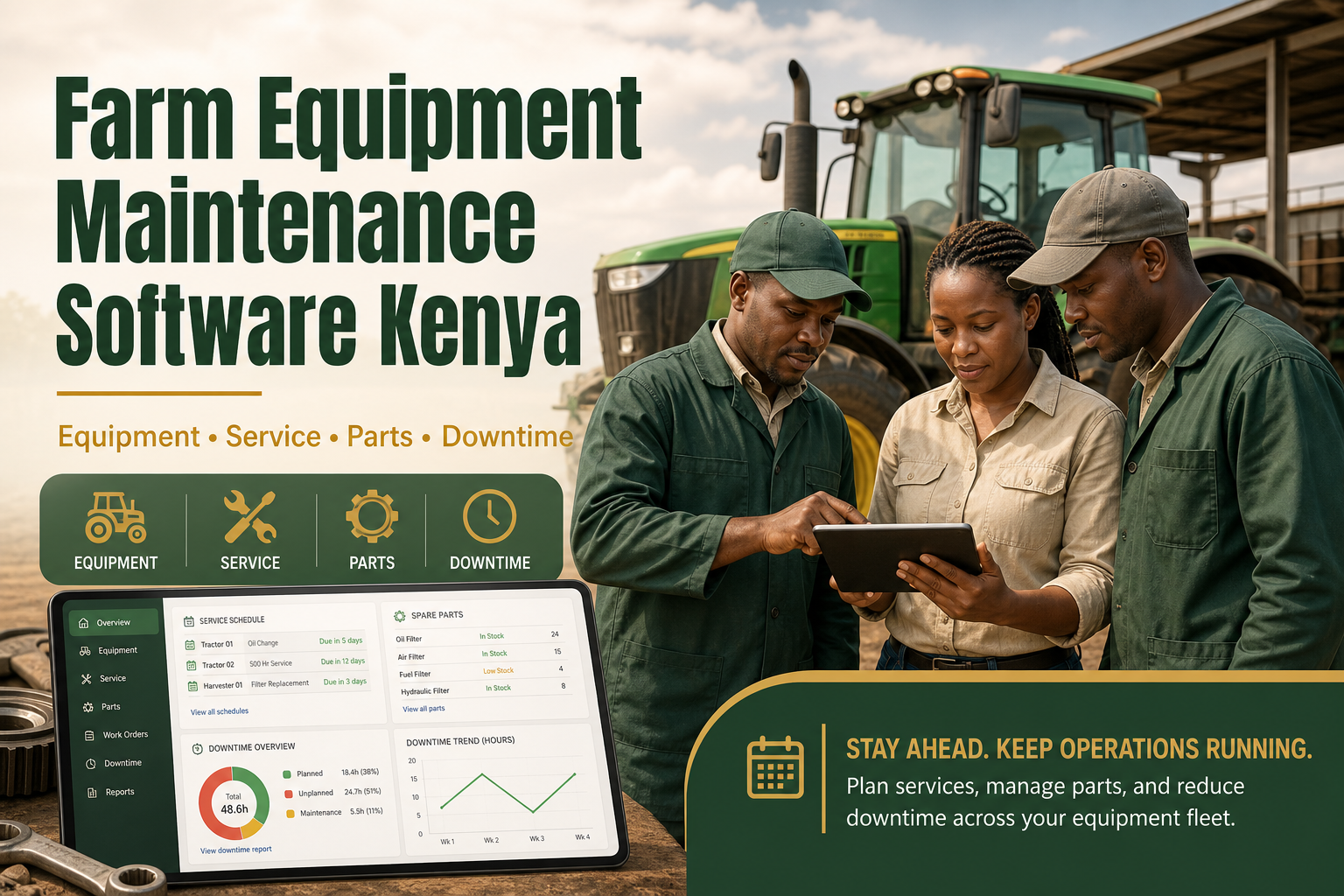
Farm equipment maintenance is the difference between a season that flows and a season that stalls. Every machine on your farm, from the water pump to the tractor, decides whether work happens on schedule or not. This guide shows you how to keep every piece of equipment ready, reliable and worth its cost.
A steady routine of farm equipment maintenance costs far less than its alternative. One failed pump during transplanting, or a dead tractor at the height of harvest, can undo a whole season’s work in days. Farmers who service small and early consistently outlast farmers who repair big and late.
Why Equipment Care Matters on Kenyan Farms
Machines are the muscle of the modern farm, and downtime at critical moments costs more than the repair itself. A broken pump in the planting window or a tractor that will not start on harvest morning turns good planning into loss. Disciplined farm equipment maintenance is how good seasons are protected from bad days.
Breakdowns are rarely sudden. They are the slow accumulation of dust, moisture, loose belts and skipped oil changes, each one small enough to ignore. A working farm equipment maintenance routine catches these faults while they are still cheap, because a tightened bolt today prevents a replaced engine next season.
Safety belongs in the same conversation. Machines in poor condition injure people, through missing guards, worn brakes or frayed hoses. Every entry in your farm equipment maintenance records is also a safety record, and safe machines keep experienced operators working without interruption.
Finally, documented care shows up in value. A machine with a complete service history sells faster and higher than one without, because buyers trust what they can read. When upgrading time comes, the file becomes money.
Know Your Machines: The Equipment Register
Begin with a register of every machine and major tool: make, model, serial number, purchase date, cost, condition and current location. This list is the opening page of your farm equipment maintenance system, and every later service entry refers back to it.
Photograph each machine and mark it with a simple ID number, painted or engraved. The ID ties together the physical machine, the register entry and the service history in your farm equipment maintenance records, so nothing ever floats unidentified.
Keep the service history of each machine in one place, whether a folder page, a notebook spread or a phone entry. Fragmented records are the reason repeated faults never get noticed. One continuous timeline per machine is what makes your farm equipment maintenance data useful.
The register also serves the rest of the farm. Insurance schedules, budgets, loan applications and resale negotiations all draw on the same list. Build it once, and it pays in four directions.
Daily Routines That Prevent Breakdowns
Adopt a five-minute pre-start check for every machine: oil level, coolant, tyres or tracks, hydraulic hoses, belts and guards. It feels slow on a busy morning and is exactly what prevents a lost day later. Log every check into your farm equipment maintenance records with a tick and initials.
Clean machines after use, not before the next use. Dust, mud, chaff and crop residue hold moisture, hide leaks and choke filters. A washdown habit, recorded in your farm equipment maintenance routine, extends machine life by years at almost no cost.
Report faults the day they appear, however small. A new noise, a slow leak, a switch that needs a wiggle — these are early warnings, not nuisances. Same-day fault notes in your farm equipment maintenance records turn operator observations into early repairs.
Empower operators to refuse faulty machines. An operator who knows a report will be acted upon reports early, and an operator who expects blame hides problems. The tone you set around fault reporting decides what your maintenance system ever gets to see.
Weekly and Monthly Service Schedules
Set a weekly round: greasing points, belt tension, battery terminals, air filter inspection and a walk-around for leaks. Thirty minutes per machine, done steadily, is the backbone of farm equipment maintenance and the cheapest hours your machines will ever receive.
Add a monthly round driven by engine hours rather than dates where possible: oil and filter changes, coolant checks and hydraulic inspection. Machine meters exist precisely for this, and hour-based servicing is the standard at the heart of farm equipment maintenance for tractors and pumps alike.
Put the schedule on a calendar with names attached, not wishes. A task with a name and a date happens; a task in general intention rarely does. Named scheduling is what lifts farm equipment maintenance from good ideas into completed work.
Consistency beats intensity. A modest schedule honoured every week protects machines better than an ambitious overhaul twice a year. Build the routine small enough that even your busiest weeks do not break it.
Service Records and What to Log
Record every service entry the day it happens: date, machine ID, hours on the meter, tasks done, parts used, cost and who performed the work. This discipline is the core of farm equipment maintenance, because memory cannot hold a year of small interventions.
File invoices and parts receipts against the machine entry, in date order. Paper trails are what turn a service history into evidence, for warranty claims, resale and insurance alike. Every document stored strengthens the authority of your farm equipment maintenance records.
Review the fault and repair history per machine each quarter. A pump that has been repaired three times in one season is telling you something, and patterns only become visible in a timeline. This reading of your farm equipment maintenance history is where spending decisions get smart.
Keep the records with the machine. When the day comes to sell or trade, a complete file travels with it and converts directly into price. Buyers pay for certainty, and the file is the certainty.
Tractors: The Heart of the Farm
Give the tractor the strictest routine on the farm. Check fluids daily, respect hour-based service intervals, and treat filters as scheduled items rather than emergencies. This level of farm equipment maintenance keeps the machine that drives every other operation alive.
Listen to the tractor. Hydraulic whines, PTO vibrations and gearbox changes are all early language, and operators who report what they hear give your farm equipment maintenance system its most valuable intelligence. investigate whispers before they become roars.
Mind tyres, ballast and implement matching. Wrong ballast, low pressure and mismatched implements wear out transmissions and axles quietly. A short monthly inspection focused on these, filed in your farm equipment maintenance records, protects the most expensive components you own.
Operator habits matter as much as service intervals. Overloading, riding the clutch and excessive idling all shorten machine life. Train for correct use, and the maintenance burden drops before a single tool is opened.
Irrigation Systems and Water Equipment
Service pumps on a fixed rhythm: clean intake filters, check seals, verify pressure and listen for cavitation. Water equipment fails suddenly and completely, which is why farm equipment maintenance for pumps is scheduled, never reactive.
Walk the lines. Drip and sprinkler systems need weekly flushing, emitter checks and leak patrols along every lateral. Small leaks waste water, starve far sections and signal blockages. Log each walk in your farm equipment maintenance records so patterns across weeks become visible.
Care for the power side too. Solar panels need cleaning to hold output, batteries need terminal checks, and controllers need ventilation. A fifteen-minute routine for the power components belongs inside your farm equipment maintenance calendar.
Plan redundancy for the critical window. A backup pump, a spare impeller and a known standby generator turn a failure from a crisis into an inconvenience. Water systems deserve the most conservative maintenance approach on the farm.
Hand Tools and Small Equipment
Hand tools last for years under the simplest care: clean after use, sharpen edges, oil metal and repair handles promptly. A tool board with painted outlines makes missing tools obvious at a glance and anchors the small end of your farm equipment maintenance system.
Give knapsack sprayers special attention. Rinse after every use, inspect seals and nozzles weekly, and retire worn nozzles before they distort spray patterns. Sprayer care is both farm equipment maintenance and crop protection, because a faulty sprayer wastes chemical and harms plants.
Run an issue-and-return register for shared tools. Whoever takes a tool signs, and whoever returns it countersigns. This light system feeds your farm equipment maintenance records and ends the quiet disappearance of spanners and secateurs.
Inspect small engines monthly: air filters, spark plugs, fuel lines and pull cords. Wheelbarrows, trailers and carts need axle and tyre checks too. Small equipment rewards small attention with disproportionately long life.
Spare Parts Management
Stock the fast movers: filters, belts, seals, blades, hoses and common fasteners for every machine you run. A shelf of the right parts is what turns a two-hour repair into a two-week wait avoided. This shelf is a physical extension of your farm equipment maintenance system.
Record part numbers per machine, from manuals or from the parts themselves. Ordering by guesswork produces wrong parts and wasted trips. A parts reference page per machine inside your farm equipment maintenance records makes every order accurate the first time.
Set minimum and maximum levels for each stocked item. When stock touches the minimum, reorder; when a good price appears, buy to the maximum. Simple level logic, applied through your farm equipment maintenance routine, prevents both dead stock and emergency shopping.
Beware counterfeit parts. Buy from authorised dealers where you can, check packaging quality, and prefer traceable receipts over market bargains for critical components. A failed counterfeit part does double damage, because it often breaks something else on the way out.
Fuel, Oils and Lubrication Discipline
Protect the fuel supply. Store fuel in clean, sealed tanks away from water and dust, and drain water separators regularly, because water in fuel destroys injectors and engines silently. Fuel discipline is invisible farm equipment maintenance that decides engine life.
Use the correct oils and grades for each machine, and record every change against the machine ID. Guessing grades saves nothing and costs plenty. A simple oil reference page per machine within your farm equipment maintenance records removes all doubt.
Schedule greasing by machine, listing every point and its interval. Bearings die from neglect more often than from work. A grease chart per machine, ticked weekly as part of your farm equipment maintenance routine, is one of the highest-return habits in this entire guide.
Keep containers labelled and dedicated. Oil decanting jugs, fuel funnels and grease guns should each serve one purpose, because cross-contamination grinds components from the inside. Order in the store becomes order inside the machine.
Operator Training and Handling
Trained operators extend machine life more than any single service. Run short internal training sessions on correct starting, loading, speeds and shutdown, and log each one in your farm equipment maintenance records with attendees and topics.
Keep manuals with the machines, in a plastic sleeve or a shared digital folder. Correct settings, load limits and service intervals live in those pages. An operator working from the manual strengthens your farm equipment maintenance system automatically.
Record misuse incidents and their corrections without drama. A stuck clutch from overloading, a bent tine from hidden stones, a burned pump from dry running — each is a training moment. Handled calmly, these notes make your farm equipment maintenance records a curriculum.
Rotate machine use among capable operators. Rotation spreads wear awareness, builds backup skills and prevents the single-person dependency that stalls farms when one person leaves. Skilled redundancy is maintenance by another name.
Seasonal Maintenance Calendar
Anchor major servicing to the farming calendar. The quiet weeks before planting are the window for overhauls, because a breakdown discovered then is an inconvenience and one discovered mid-planting is a disaster. Book pre-season work into your farm equipment maintenance calendar early.
Schedule mid-season spot checks for the machines carrying the peak load: the tractor, the main pump and the trailer. Twenty focused minutes at mid-season keeps the whole second half safe. Note every check in your farm equipment maintenance records.
Prepare machines for storage properly at season end: clean, dry, covered, fuel systems treated, batteries removed and tyres off the ground where possible. Storage discipline is farm equipment maintenance in its most concentrated form, because months of idle time either preserve or destroy.
Review the calendar at the start of every season and adjust intervals to what the records show. Machines, workloads and climates change, and a calendar that learns from evidence keeps earning its place.
Storage and Shed Organisation
Store equipment dry, covered and off the ground. Concrete floors, roofing sheets and simple pallets defeat the damp that destroys bearings, blades and handles. The shed itself is part of your farm equipment maintenance system, not just a building.
Separate fuel, chemicals and tools within the storage space, with ventilation for anything volatile. Fire risk and fume damage both begin with careless mixing of stores. A tidy, zoned shed is farm equipment maintenance applied to the environment around the machines.
Control access to the store. One keyholder, a sign-out sheet and a closing check each evening keep tools where they belong. The sign-out sheet feeds your farm equipment maintenance records and doubles as theft deterrence.
Seal the small holes and secure the doors. Rodents chew wiring, insulation and seat foam, and a single night of nesting can disable a machine. Physical security is maintenance of the conditions that machines depend on.
Repair vs Replace Decisions
Decide with arithmetic, not attachment. Compare the repair quote against the machine’s remaining useful life and its current value, and let the numbers speak. Your farm equipment maintenance history is what makes that arithmetic honest.
Weigh downtime into the decision. A cheap repair that fails mid-harvest is expensive, while a pricier reliable fix may be the bargain. Critical-window costs belong in every calculation your farm equipment maintenance records support.
Check parts availability before committing to keep an old machine. Some models are orphans, and keeping them means gambling on finding components. The parts market is as relevant as the machine’s condition when reading your farm equipment maintenance history.
Sell before terminal failure when the decision points that way. A machine that still runs sells as an asset, while one that died in the field sells as scrap. Timing, informed by records, captures value that breakdown destroys.
Maintenance Budgets and Depreciation
Set money aside monthly for service and repairs, commonly five to ten percent of machine value per year, so the bill never ambushes you. A funded farm equipment maintenance plan gets executed, while an unfunded one waits for crisis.
Track cost per hour of use for each major machine. Rising cost per hour is the clearest early signal that a machine is approaching its end. This single figure, drawn from your farm equipment maintenance records, drives most replace decisions well.
Keep depreciation records alongside the maintenance data. Together they show the true running cost of every machine and inform both pricing and purchase timing. When the day comes to seek finance, this combined farm equipment maintenance history is exactly what lenders want to see.
Treat maintenance spending as investment, not expense. Every shilling of service returns multiple shillings of avoided breakdown, extended life and preserved resale value. The budget line pays for itself quietly, season after season.
Working with Mechanics and Service Providers
Find a reliable mechanic before you need one urgently. Test them on small jobs, watch their diagnosis discipline, and keep their contact in your farm equipment maintenance records beside the machines they know best.
Get written quotes and job scopes for major repairs: what will be done, with which parts, at what price and by when. Written agreements prevent the classic story of a repair that grows. File every quote and invoice in your farm equipment maintenance records.
Ask about workmanship warranty on repairs and note it against the machine entry. A repair that fails in two weeks should return to the mechanic, but only if the arrangement was recorded. Warranty notes are part of professional farm equipment maintenance practice.
Develop a farm-based person for the basics. Someone who can service filters, tension belts, diagnose simple faults and handle small engines saves calls, money and days. Internal capability is the cheapest maintenance capacity you will ever build.
Warranties and Service Contracts
Register new equipment warranties immediately and store the documents where they can be found. Many claims are lost simply because the paperwork could not be produced. Registration details belong in your farm equipment maintenance records on the day of purchase.
Respect warranty conditions: authorised service points, genuine parts and service intervals. A warranty is a contract, and the conditions are its terms. Track each condition as part of your farm equipment maintenance routine so the cover survives to the day you need it.
Consider service contracts for complex equipment such as solar pumping systems or large generators. Fixed-cost servicing, priority response and documented visits all come with the contract. Renewal dates belong on your farm equipment maintenance calendar with reminders.
Remember that warranty claims rest on proof of service history. This is the quiet reason meticulous records matter: they are the price of admission when the manufacturer must decide whether to pay.
How Farm Management Software Helps
A good platform turns schedules into automatic reminders, whether driven by calendar dates or engine hours. No service slips because someone forgot a Tuesday. That reliability is the everyday advantage of running farm equipment maintenance inside the system that already runs the farm.
Costs accumulate by machine automatically. Parts, labour, fuel and repairs roll into a running total per asset, so cost per hour and replace decisions arrive without weekend arithmetic. This is farm equipment maintenance data doing its own bookkeeping.
Histories export cleanly for warranty claims, insurance schedules and resale negotiations. A complete, dated, signed record carries authority that a reconstructed notebook never will. Sharing that farm equipment maintenance history takes minutes instead of days.
Choose tools the operators will actually use in the field. Entries made beside the machine, with a photo attached, are the most valuable entries any maintenance system can hold. The best software is the one whose reminders get answered.
Building the Maintenance Habit
Fix a weekly maintenance session: check the fault log, confirm the schedule, order parts and update the records. Twenty minutes at a set hour keeps the whole system breathing. This session is the heartbeat of farm equipment maintenance.
Keep the checklist short: fluids, leaks, tyres, belts, guards and the log itself. A five-item round performed every week protects machines better than a long list performed occasionally, and it leaves time for the records that give the round its memory.
Put names on machines. When each operator owns the daily condition of one machine, problems surface earlier and care improves visibly. Named ownership is what turns farm equipment maintenance schedules into lived routines.
Audit the records quarterly. Walk the shed with the file, test whether entries match reality and correct the process where they drift. One honest hour each quarter keeps the farm equipment maintenance system truthful.
Action Steps for the Coming Season
Start this week: build the equipment register, photograph every machine, note serials and open a service page for each. That single afternoon creates the foundation, and from that day your farm equipment maintenance system has a date of birth.
Set the weekly and monthly calendar with names and dates, and stock the five most critical spare parts for your key machines. Small, complete beginnings outperform ambitious plans that stall.
Protect the routine, involve the operators and let one season of records guide the next season’s service and spending. Machines that are maintained quietly make money, and machines that are neglected loudly take it.
Frequently Asked Questions
How often should I service a tractor?
Follow hours-based intervals from the manual, commonly oil and filter changes every two hundred to two hundred and fifty engine hours, with hydraulic and air systems on their own schedules. Where hours accumulate slowly, apply calendar minimums such as oil twice a year, because oil degrades even when parked. The exact rhythm should live in your records, adjusted to your machine’s manual and your workload.
What daily checks should machine operators perform?
A five-minute round before starting: engine oil, coolant, tyres or tracks, hydraulic hoses, belts, guards and a visual sweep for leaks. Finish with a listen — new noises are early warnings worth reporting the same day. These checks, ticked and initialled daily, prevent the majority of serious failures and take less time than a single breakdown.
How do I store equipment between seasons?
Clean thoroughly, dry fully, cover and keep off the ground on pallets or stands. Treat the fuel system against degradation, remove batteries to a cool dry place and grease external points to exclude moisture. Rodent-proof the storage area and close every opening. Machines stored this way start the next season ready, while machines left in the field start it with problems.
How much should I budget for equipment maintenance?
A practical starting point is five to ten percent of each machine’s value per year, adjusted upward for older machines and heavy workloads. Better still, track actual cost per hour from your records and let the evidence set the budget. A funded schedule executed steadily always beats a larger amount spent in emergency bursts.
How do I avoid counterfeit spare parts?
Buy from authorised dealers where possible, examine packaging quality, verify part numbers against the manual and insist on traceable receipts for critical components. For high-wear items, price differences between genuine and suspicious parts are smaller than the damage a failure can cause. Building a relationship with one reputable supplier is itself a maintenance strategy.