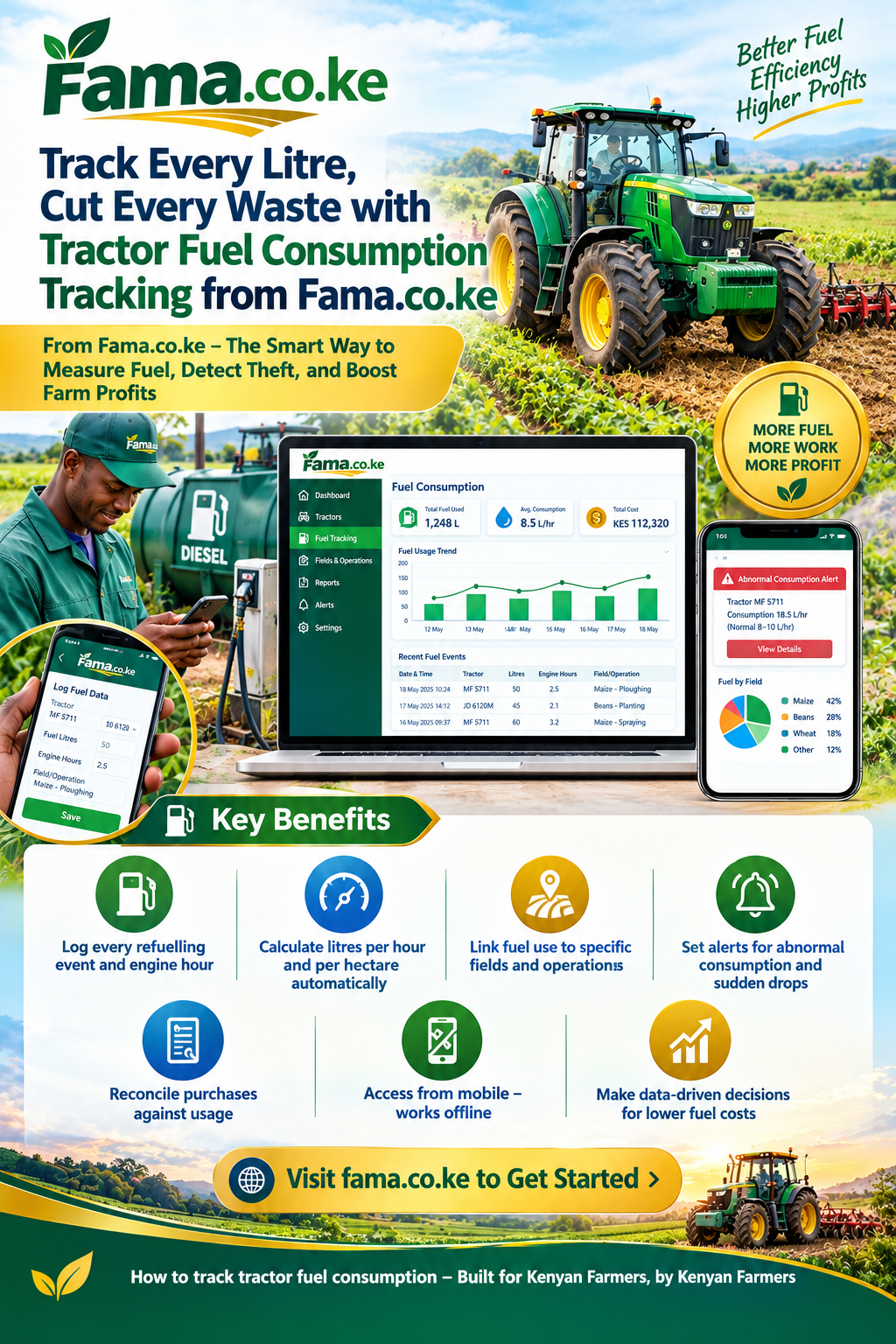
How to track tractor fuel consumption is one of the most financially consequential questions a Kenyan farmer can answer, because fuel is among the largest variable costs in mechanised agriculture and one of the easiest to lose through waste, inefficiency, and theft. Fama.co.ke provides an innovative platform that makes how to track tractor fuel consumption simple and practical, helping farmers move from estimated fuel budgets and handwritten logbooks to organised, verifiable consumption records. With diesel prices volatile and tractor hire rates rising, the difference between a profitable season and a marginal one often comes down to whether you know exactly how many litres your machines are burning—and why.
The consequences of not knowing how to track tractor fuel consumption are severe and quietly expensive. Fuel disappears from tanks overnight. A tractor that should burn 8 litres per hectare quietly consumes 12. Idling during loading and transport burns diesel without producing any field work. Without records, none of these losses are visible until the season’s accounts are reconciled—by which point the money is gone. This is precisely the leakage that how to track tractor fuel consumption eliminates.
Fama.co.ke‘s platform helps farmers master how to track tractor fuel consumption by providing tools to log refuelling events, record engine hours, calculate litres per hectare, and compare consumption across machines, operators, and fields. Research on Kenyan farms shows that digitising fuel and input records can trim millions of shillings from annual budgets by exposing double-counted and unaccounted expenses. With how to track tractor fuel consumption, farmers can finally see where every litre goes.
The financial case for adopting a disciplined approach to how to track tractor fuel consumption is compelling. Fuel monitoring deployments in East Africa report average fuel cost reductions of 25 per cent and theft reductions of up to 90 per cent after installation. For a farm spending Sh500,000 per year on diesel, a 25 per cent reduction represents Sh125,000 in savings—often more than the cost of the tracking system itself. A how to track tractor fuel consumption system that delivers this visibility pays for itself within a single season.
Manual tracking methods remain useful and cost nothing to start. The fill-to-fill method requires filling the tank completely before a field operation and again afterwards, noting the litres added and the area covered. Dividing litres used by hectares worked gives consumption in litres per hectare, while dividing by hours worked gives litres per hour. A how to track tractor fuel consumption routine built on fill-to-fill measurements establishes the baseline against which every future improvement is measured.
Engine-hour tracking is the second manual pillar of how to track tractor fuel consumption. Tractors are serviced and assessed by hours of operation, not distance travelled, so recording start and end hours for every task is essential. Combining hour data with fuel data reveals litres per hour for each operation, exposing machines or operators that consume more than they should. With how to track tractor fuel consumption, hour-based records transform fuel from a bulk monthly expense into a per-task metric that can be managed.
Digital telematics takes how to track tractor fuel consumption to a level that manual records cannot reach. GPS and fuel sensors stream real-time data to a dashboard, showing fuel level, consumption rate, location, and idle time continuously. Research prototypes using ultrasonic fuel sensors and GSM/GPS modules have achieved measurement accuracy within plus or minus five per cent and send automatic alerts during rapid fuel drops, enabling early detection of theft or leakage. A how to track tractor fuel consumption platform that integrates these signals gives managers visibility without relying on driver-reported figures.
Benchmarking is where how to track tractor fuel consumption becomes a management tool rather than a record-keeping chore. Published data from instrumented tractors shows fuel consumption ranging from approximately 3.73 litres per hectare for fertilisation to 11.69 litres per hectare for harvesting, with litres per hour ranging from about 4.95 to 14.70 depending on the operation. A farmer who knows how to track tractor fuel consumption can compare actual figures against these benchmarks and investigate any machine running significantly above them.
Fuel theft prevention is inseparable from how to track tractor fuel consumption. Fuel theft from tractors, generators, and tanks is a recognised risk on Kenyan farms, and GPS trackers combined with fuel-level sensors allow managers to see both location and whether a tank was drained. Electronic fuel cap locks add another layer, releasing only at authorised locations and logging every refuelling event by time, place, and volume. Together, these tools turn [how to track tractor fuel consumption] from an accounting exercise into an active security system.
Why Kenyan Farmers Struggle to Track Tractor Fuel Consumption
The reasons farmers fail at [how to track tractor fuel consumption] are well understood. Fuel is bought in bulk, stored in a tank, and issued to machines without measurement. Drivers report consumption from memory. Receipts are lost. Nobody compares litres purchased against litres burned. The result is a system in which losses are structurally invisible.
The complexity of mechanised operations makes tracking harder. A single tractor performs multiple tasks—ploughing, harrowing, planting, spraying, transport—each with a different consumption profile. Without task-level records, averages hide inefficiencies. A tractor that is efficient at ploughing may be wasteful at transport, and only granular tracking reveals the difference.
The consequences extend beyond fuel cost. Excessive idling accelerates engine wear. Poor consumption often signals mechanical problems—clogged filters, incorrect tyre pressure, or injector faults—that become expensive failures if ignored. And without consumption records, farmers cannot demonstrate fuel costs for contract pricing, tax documentation, or insurance claims.
Manual Methods for How to Track Tractor Fuel Consumption
Manual methods require no technology and can begin immediately.
The Fill-to-Fill Method
Fill the tank to the brim before the operation, record the hour meter, complete the work, then refill to the brim and record both the litres added and the area or hours covered. This gives litres per hectare and litres per hour for that specific task. Repeat across operations to build a consumption profile for each machine.
Engine-Hour Logging
Record start and end engine hours for every task, alongside fuel issued. Over time, this reveals the litres-per-hour figure for each operation and highlights anomalies. A tractor that suddenly consumes more per hour may need servicing or may be suffering from an operator habit that wastes fuel.
The Fuel Register
Maintain a register of every refuelling event: date, machine, litres, hour meter reading, and who authorised the fuelling. Reconciling the register against bulk purchases exposes losses between the tank and the machine. This simple discipline is the foundation of [how to track tractor fuel consumption] on farms without digital tools.
Task and Field Records
Link fuel issued to the specific task and field. Ploughing 10 hectares and harrowing 10 hectares should not be recorded as a single fuel event. Separating them reveals which operations are most fuel-intensive and where savings are possible.
Digital Methods for How to Track Tractor Fuel Consumption
Digital tools automate measurement and provide visibility that manual records cannot match.
GPS and Telematics
GPS trackers record location, movement, idle time, and route. Combined with fuel-level sensors, they show exactly where and when fuel was consumed—and where it disappeared. TrackAlways Africa supports Kenyan farm operators with geofences, fuel variance alerts, and utilisation dashboards, tracking machine-hours per field and fuel burn per route.
Fuel-Level Sensors
Ultrasonic, capacitive, and pressure sensors measure fuel level continuously. Capacitive sensors in East African deployments achieve 99.5 per cent accuracy with detection sensitivity of 0.5 litres, catching even small theft events. Sudden drops away from a fuel station trigger SMS or app alerts so supervisors can respond while the event is in progress.
CAN-Bus and Engine Data
Modern tractors broadcast engine data over CAN-bus, including fuel rate, engine speed, torque, and temperature. Farming management information systems capture this data and calculate consumption per hour and per hectare automatically. This is the most accurate form of [how to track tractor fuel consumption] available on equipped machines.
Electronic Fuel Cap Locks
Fuel cap locks prevent unauthorised fuelling and draining. GPS-based unlocking means the cap only releases at an authorised fuel station, and every refuelling event is logged with location, time, and volume. Tamper alerts are sent instantly if forced opening is attempted.
Integrated Farm Management Platforms
Platforms that combine fuel data with crop, labour, and financial records provide the fullest picture. Fama.co.ke links fuel consumption to specific fields, crops, and operations, enabling cost per hectare and cost per kilogram calculations. A tractor sensor streaming fuel consumption lands in the same system as fertiliser use and labour records, giving one source of truth.
Fuel Consumption Benchmarks for Kenyan Conditions
Benchmarks give context to the numbers your tracking produces.
Litres Per Hectare
Published measurements from instrumented tractors show fertilisation operations consuming approximately 3.73 litres per hectare, while harvesting operations consume approximately 11.69 litres per hectare. Tillage operations typically fall between these extremes depending on implement width, depth, and soil conditions.
Litres Per Hour
Hourly consumption ranges from approximately 4.95 litres per hour for light operations to 14.70 litres per hour for heavy harvesting work. A tractor consistently exceeding these figures for similar work warrants investigation.
Idle Consumption
Idling typically consumes 1 to 2 litres per hour depending on engine size. A tractor idling two hours per day across a 100-day season burns 200 to 400 litres without performing any work. Tracking idle time is therefore as important as tracking field consumption.
Transport Consumption
Transport on roads consumes fuel per kilometre rather than per hectare. Separating transport from field work in your records prevents transport costs from distorting field efficiency figures.
Preventing Fuel Theft Through Better Tracking
Fuel theft is a persistent risk on Kenyan farms, and tracking is the most effective deterrent.
Sudden Drop Alerts
Fuel sensors detect level changes as small as 0.5 litres. A sudden drop away from a fuel station triggers an immediate alert, allowing supervisors to intervene. Even the knowledge that such alerts exist deters casual theft.
Geofencing and After-Hours Monitoring
Geofences around the farm and store trigger movement alerts after rostered hours. Combined with fuel-level sensors, managers see both location and whether a tank was drained. This is particularly valuable during harvest season when equipment is most valuable and most vulnerable.
Refuelling Logs
Every authorised refuelling event should be logged with location, time, volume, and the person who authorised it. Electronic fuel cap locks automate this logging, creating a tamper-evident record that reconciles against bulk purchases.
Reconciliation Against Purchases
Compare litres purchased against litres issued and litres consumed. Any gap represents loss—whether theft, spillage, or measurement error. Regular reconciliation is the simplest and most powerful form of [how to track tractor fuel consumption] for theft prevention.
How Fama.co.ke Helps You Track Tractor Fuel Consumption
Fama.co.ke provides the digital infrastructure to make [how to track tractor fuel consumption] simple, practical, and profitable.
Fuel and Hour Logging
The platform records every refuelling event and engine-hour reading, linking fuel issued to specific machines and tasks. It works offline, allowing records to be captured in the field without internet access.
Consumption Calculations
The platform calculates litres per hour, litres per hectare, and cost per hectare automatically. It compares actual consumption against benchmarks and flags machines running above expected levels.
Task and Field Attribution
Every fuel record is linked to the field, crop, and operation where it was used. This enables precise cost per hectare and cost per kilogram calculations, and reveals which operations are most fuel-intensive.
Alert and Reconciliation Tools
The platform supports threshold alerts for unusual consumption and reconciliation reports comparing purchases against usage. Discrepancies are highlighted for investigation.
Reports for Management and Compliance
The platform generates reports showing fuel costs by machine, field, and season. These support budgeting, contract pricing, and documentation for lenders and tax authorities.
Step-by-Step: How to Get Started Tracking Tractor Fuel Consumption
Step 1: Establish a Baseline
Use the fill-to-fill method for one full season to measure current consumption per machine, per task, and per hectare. Record engine hours and area covered for every operation.
Step 2: Install Basic Controls
Introduce a fuel register with authorisation signatures, lock fuel stores, and record every issue. Even without digital tools, these controls reduce casual losses.
Step 3: Add Digital Tracking
Deploy GPS trackers and fuel-level sensors on the highest-value machines first. Integrate data into a farm management platform so fuel records sit alongside crop, labour, and financial data.
Step 4: Set Benchmarks and Alerts
Configure alerts for abnormal consumption and sudden fuel drops. Compare actual figures against published benchmarks for similar operations.
Step 5: Review and Act
Review consumption reports weekly. Investigate anomalies immediately. Adjust maintenance schedules, operator training, and implement choices based on what the data reveals.
Step 6: Reconcile Monthly
Compare bulk purchases against issued fuel and recorded consumption. Any unexplained gap should be investigated and documented.
Real-World Applications in the Kenyan Context
Large-Scale Grain Farms
Grain farms in Eldoret, Kitale, and Narok use fuel tracking to control diesel costs across ploughing, planting, spraying, and harvesting operations. Comparing consumption per hectare across fields reveals which operations and operators deliver the best efficiency.
Horticulture and Flower Farms
Horticulture operations rely on tractors and pumps for irrigation, spraying, and transport. Fuel tracking identifies pumps running inefficiently and tractors idling during loading, both of which waste diesel without producing output.
Tractor Hire and Contractor Businesses
Contractors use fuel tracking to price jobs accurately and to demonstrate fuel costs to clients. Consumption records also protect against disputes over fuel provided by the client.
Cooperatives and Machinery Sharing Groups
Cooperatives use fuel tracking to allocate fuel costs fairly among members and to identify machines that require servicing or replacement.
Common Mistakes in How to Track Tractor Fuel Consumption
Relying on Driver Estimates
Driver-reported consumption is consistently unreliable, whether through error or intent. Objective measurement through sensors or fill-to-fill methods is essential.
Ignoring Idle Time
Idling can account for 10 to 20 per cent of total fuel use on some farms. Tracking only field operations misses this entirely.
Averaging Across Operations
A single average consumption figure for a tractor hides the difference between efficient ploughing and wasteful transport. Task-level tracking is necessary for meaningful management.
Failing to Reconcile Purchases
Fuel can disappear between the bulk tank and the machine. Without reconciliation of purchases against issues and consumption, losses remain invisible.
Not Acting on the Data
Tracking without action is merely administration. Consumption data must trigger maintenance, training, or disciplinary decisions to deliver value.
Frequently Asked Questions About How to Track Tractor Fuel Consumption
What is the simplest way to track tractor fuel consumption?
The fill-to-fill method is the simplest: fill the tank before a task, record the hours and area covered, then refill and record the litres added. Dividing litres by hectares gives litres per hectare, and dividing by hours gives litres per hour.
How many litres per hectare does a tractor use?
Published measurements show consumption ranging from approximately 3.73 litres per hectare for fertilisation to 11.69 litres per hectare for harvesting. Tillage typically falls between these figures depending on implement and soil conditions.
How can I detect fuel theft on my farm?
Fuel-level sensors detect drops as small as 0.5 litres and trigger alerts when fuel disappears away from a fuel station. Geofences around stores and tanks, combined with GPS trackers on tractors, provide location and consumption data that expose theft.
Do I need expensive technology to track fuel?
No. Fill-to-fill measurements, engine-hour logs, and a fuel register cost nothing and deliver immediate visibility. Digital sensors and telematics add accuracy and real-time alerts but are not prerequisites for starting.
How does Fama.co.ke help with fuel tracking?
Fama.co.ke records refuelling events, engine hours, and fuel issued per machine and task. It calculates litres per hour and per hectare, links fuel to fields and crops, and generates reports for management and compliance—all offline-capable.