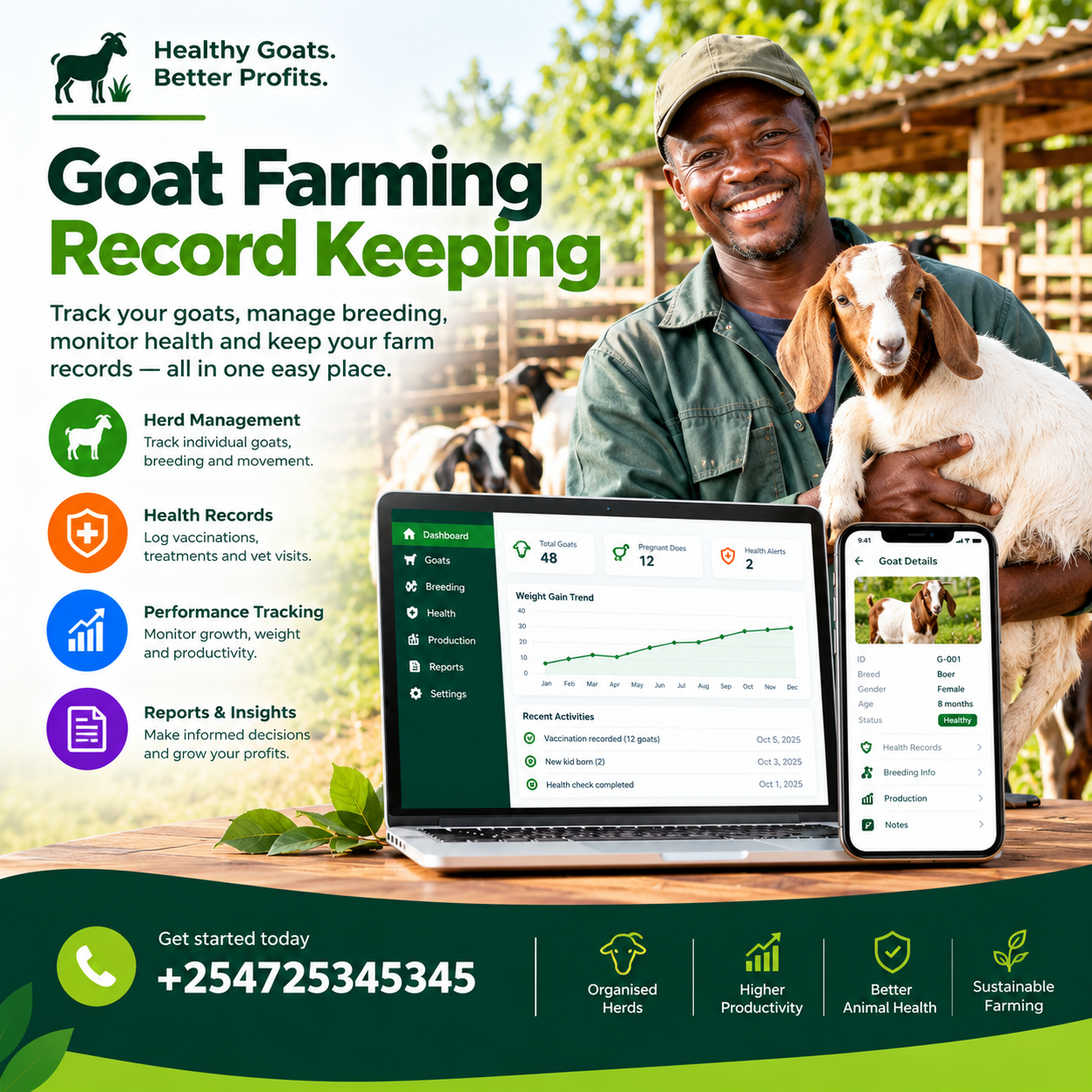
Goat farming record keeping is the habit of writing down every kid born, every litre milked, every treatment given and every shilling earned in your goat enterprise. Many Kenyan farmers keep goats for years without knowing their kidding rates, their mortality or their true cost per kilogram of meat. Without numbers, the herd runs on memory, and memory cannot tell a profitable goat from an expensive pet.
This is why goat farming record keeping separates serious goat businesses from casual herds. It shows which does conceive quickly, which bucks sire fast-growing kids, which animals milk well, and which goats are quietly eating your profit. Goats multiply fast and die fast too: a herd that doubles in two years can lose a third of its kids in one bad worm season, and records are what let you see those swings early enough to act.
This guide explains goat farming record keeping from the ground up: the records that matter, the templates to use, the mistakes that waste effort, and how digital tools simplify the work. Whether you run Galla meat goats in Marsabit or Toggenburg dairy goats in Nyandarua, the same principles apply.
The goat enterprises that grow in Kenya are rarely the ones with the most animals. They are the ones that know their numbers, act on them monthly, and never repeat an expensive mistake twice.
1. What Should You Record When You Keep Goats?
Goat farming record keeping covers every animal, event and shilling in the enterprise: herd inventory, breeding, kidding, milk, feeding, health, weights, sales and expenses. Together, these records form the biography of your herd and the evidence base for every decision.
A complete system answers four questions at any time: how many goats do I have, how are they performing, what have I spent, and what have I earned. When goat farming record keeping answers all four, you can manage the herd instead of just feeding it.
Depth depends on scale. A farmer with five goats needs an exercise book with a page per animal. A commercial unit, however, needs structured goat farming record keeping so that every worker records to the same standard without asking.
Start with identity, because no goat should be nameless. Then attach everything else to that identity: matings, medicines, weights and sales. One animal, one file, for life.
Think of the register as the herd’s curriculum vitae. The animals produce the kids and the milk, but the records decide which animals stay, which go, and which have quietly earned their keep.
2. Why Written Records Matter in Goat Farming
Goats hide illness until it is advanced, which is the strongest argument for goat farming record keeping. A doe that eats less today may be fighting worms or pneumonia, and only dated notes reveal the change before it becomes a death.
Records also expose the truth about profit. When you know kidding rates, mortality and feed costs, you know your real cost per kid. Farmers who commit to goat farming record keeping often discover that a handful of animals generates most of the income.
Documentation also unlocks markets. Buyers of breeding stock, dairy processors and microfinance lenders all want evidence, and goat farming record keeping supplies it in a form they trust. A paper trail turns conversations into contracts.
Two neighbouring farms can run the same breed under the same rains and get different results. The difference is rarely luck; it is who noticed the slipping kidding rate two seasons ago instead of this month.
3. Herd Inventory and Goat Identification Records
Start with a master herd register. For every goat record an ID (ear tag or tattoo number), sex, breed, date of birth or purchase, sire, dam and current status. Goat farming record keeping begins with knowing exactly who is in the herd.
Identify every kid within its first week using ear tags, tattoos or ear notches, and never mix coding systems. A register that links kids to their mothers makes goat farming record keeping traceable across generations, which is where selection power comes from.
Update the register the same day anything changes: purchases, deaths, sales, castrations or transfers between groups. An inventory updated when there is time defeats goat farming record keeping, because the forgotten events are always the costly ones.
Include photos of breeding bucks and does in the register. Pictures settle disputes about parentage and condition, and they make sales negotiations faster and more honest.
Do a monthly head count against the register as well. Goats are escape artists, and a register that says thirty when the pen holds twenty-seven is already telling you something important.
Buy ear tags in bulk before kidding season, and keep spares in the kidding kit. A kid left untagged for convenience this week becomes the untraceable animal that ruins a pedigree claim next year, and untraceable animals always sell at ordinary goat prices.
4. Breeding and Kidding Records
For every mating, record the doe, the buck, the date served or exposed, and the expected kidding date. At kidding, record the date, number of kids born, live or stillborn, sex and birth weights. This is the productive core of goat farming record keeping.
Doe performance builds into history over time: kidding interval, litter size, kids weaned per year and mothering ability. Structured goat farming record keeping turns does into ranked performers you can select on evidence rather than reputation.
Track the buck’s side too. Kids sired by one buck may grow visibly faster than others, and only records prove it. Buck performance data makes goat farming record keeping a selection tool rather than a diary.
Plan ahead with the dates you now control. Knowing expected kidding dates lets you prepare kidding pens, watch high-risk does at night, and schedule labour before the rush instead of after the losses.
Note difficult kiddings in detail: assistance given, kids lost, and does that rejected offspring. Repeat problems in the same bloodline are exactly what selection is meant to remove.
5. Milk Records for Dairy Goats
If you milk goats, record daily or weekly yields per doe, the lactation length and the stage of lactation. Detailed goat farming record keeping at doe level shows peak yield, persistence and the natural decline you should expect.
Weigh milk at every milking, even with a simple kitchen scale. Estimates hide the early drops that signal mastitis. Regular weights turn goat farming record keeping into an early warning system for udder health.
Record butterfat or solids where buyers test milk, plus anything that affects the tank: feed changes, treatments and withholding periods. Buyers of goat milk for cheese pay on quality, and goat farming record keeping is how you prove yours.
Cull on data, not sentiment. A doe that fails to milk through two lactations is consuming feed that a productive doe would turn into income.
Record the milking routine too: times, hand or machine, and who milks. Changes in routine produce changes in yield, and without routine notes you will blame the doe for what the schedule did.
In dual-purpose herds, record how much milk the kids take versus what you sell. Kids raised on free milk grow faster, and the register shows whether that sacrifice at the bucket pays back at weaning.
6. Feeding and Fodder Records
Record what the herd eats: concentrates, hay, silage, mineral licks and grazing hours, with quantities and costs. Feeding entries make goat farming record keeping honest, because feed is usually the largest controllable cost in goat production.
Link feed changes to performance. When you raise concentrate levels for the milking herd, milk and weight records will show whether the money came back. Comparing groups is one of the clearest insights goat farming record keeping can offer.
Record fodder planting and conservation as well: napier plots cut, hay baled, silage filled. Seasonal fodder notes turn goat farming record keeping into a planning tool for the next dry season instead of a scramble.
Cost every kilogram of concentrate. Feed prices rise quietly, and a ration that paid last year may be eating your margin this year without any visible change in the goats.
Pair feed records with body condition scores on a one-to-five scale. Feed that never appears in condition or output is being wasted, and the scorecard makes that visible within weeks.
7. Health, Disease and Vaccination Records
Kenyan goats face PPR, CCPP, pneumonia, footrot, mastitis, worms and external parasites. Record every illness: date, animal, symptoms, diagnosis, treatment, dosage, cost and outcome. Treatment logs are the compliance heart of goat farming record keeping.
Keep vaccination and deworming dates for the whole herd on one calendar. Withdrawal periods after treatment matter for milk and meat safety, and only goat farming record keeping with dated entries can guarantee clean produce reaches a buyer.
Track patterns across seasons. If worm burdens spike after every long rain, or pneumonia follows cold nights in July, you can act before the losses. Pattern reading is the advantage goat farming record keeping gives you over memory.
Record deaths with a suspected cause. Mortality data is painful to write and valuable to read: it tells you which month, which age group and which management gap to close first.
Keep an inventory of drugs on hand with expiry dates. Expired vaccines and antibiotics fail quietly, and the failure shows up months later as losses nobody can explain.
Photograph wounds, rashes and unusual droppings with the date visible. Pictures in the treatment file make veterinary consultations faster and give you a baseline when the same symptom returns in another animal.
8. Weight Gain and Growth Records
Weigh kids at birth, at weaning and monthly afterwards where possible. Growth rates separate genetics, feeding and management faster than any other measure. Weight data is the scoreboard of goat farming record keeping.
Calculate average daily gain between weighings and compare it against your targets. A herd gaining below expectation is telling you to check feed or worms. That feedback loop is exactly what goat farming record keeping exists to create.
Use weights to time sales as well. Selling at the weight where the market pays best, rather than when cash runs out, becomes a routine decision once goat farming record keeping holds the numbers.
A simple hanging scale and a notebook are enough to start. Within one season you will know which kids grow fast, which mothers wean heavy offspring, and which animals are only consuming feed.
Weigh on the same day of the week and at the same time, ideally before the morning feed. Small consistencies like this turn rough numbers into trends you can actually compare.
9. Sales and Customer Records
Record every sale: date, animal ID, buyer, weight or age, price and payment method. Note the channel too: farm gate, market day, butchery, hotel or breeding stock buyer. Sales entries tie goat farming record keeping to the market and show which channels actually pay.
Track demand patterns across the year. Eid seasons, December festivities and Easter push goat prices up sharply in Kenya, and goat farming record keeping across two years shows you exactly when to have finished animals ready.
Keep buyer contacts and preferences: weights wanted, breeds preferred, repeat order cycles. Many farmers find that goat farming record keeping of customer details sells the next batch before it is even finished.
Record rejected animals and the reasons given. A buyer who says your goats are too thin or too small is giving you free market research, and the pattern across rejections points to the fix.
Record home consumption, gifts and slaughter for ceremonies too. These animals left the herd without income, and hiding them from the books makes productivity look worse than it really is.
10. Housing, Equipment and Asset Records
List every asset: housing units, feed stores, scales, sprayers, taggers, water equipment and vehicles. Record purchase date, cost and maintenance. Asset registers give goat farming record keeping a depreciation view, so replacements are planned instead of emergencies.
Track housing changes and their effects. New floors, better ventilation or added shade usually show up in the health records soon after, and linking the two makes goat farming record keeping justify every shilling spent on the pen.
Record losses and repairs against each asset. A wooden shed needing repair every season may be costing more than a permanent structure, and that arithmetic only appears when goat farming record keeping includes assets.
Photograph buildings and equipment, and file receipts together with the register. Insurance assessors, lenders and even the police will ask for exactly this file after theft or fire.
Walk the farm with the asset list twice a year and mark what is broken, missing or idle. Assets that exist only on paper attract insurance premiums without protecting anything, and idle equipment is capital doing nothing for the herd.
11. Financial Records: Income, Expenses and Profit
Separate goat money from household money. Record every expense: stock, feed, drugs, vaccination, labour, transport and equipment. Clean books are the business core of goat farming record keeping, because profit only becomes visible when income and costs sit side by side.
Assign costs where they belong: feed for the milking herd, medicine for specific animals, marketing for specific sales. A true cost per kid or per litre only emerges when goat farming record keeping allocates spending properly.
Reconcile cash, mobile money and bank accounts every month. A monthly habit keeps goat farming record keeping accurate and catches leakage while it is still small.
Use the numbers to test prices against reality. If your cost per kilogram of meat or per litre of milk sits close to your selling price, either costs must fall or prices must rise, and records turn that uncomfortable truth into an early decision.
Budget for seasonal spikes as well: vaccination months, school fees weeks and feed shortages all land together. Records from previous years show the pattern and let you keep a reserve ready.
12. Labour and Task Records
If workers or family labour serve the herd, record who did what and when: herding, milking, treatments, kiddings attended and sales handled. Labour entries complete goat farming record keeping for farms where the owner is not the only pair of hands.
Task records protect quality and animal welfare. Knowing who attended which kidding or handled which treatment traces both mistakes and excellence. Accountability is a quiet benefit of goat farming record keeping that raises standards without constant supervision.
Record hours and costs for casual labour at kidding peaks, spraying weeks and market days. These bursts of spending are forgotten by season’s end, yet goat farming record keeping shows them inside the true cost of production.
Use the notes to plan training too. Repeated errors in the same task show exactly where a demonstration or a simple checklist would pay for itself.
13. Certification, Traceability and Market Compliance
Buyers beyond the village gate ask for evidence: animal movement permits, treatment histories, vaccination certificates and identification records. Traceability is where goat farming record keeping stops being optional and becomes your licence to trade.
For breeding stock sales, pedigree records raise prices on their own. A buyer pays more for an animal with a documented dam, sire and birth date. Premium genetics are only premium when goat farming record keeping can prove the family tree.
For milk or meat entering formal markets, keep batch, treatment and withdrawal records aligned with county veterinary and KEBS requirements. Processor and exporter audits move quickly when goat farming record keeping is already organised.
Keep copies of permits, certificates and buyer contracts with the herd file. Audits and inspections cost less time and money when every document has a known place.
14. Common Mistakes Farmers Make With Goat Records
The first mistake is recording only sales. Income without breeding, health and feed context explains nothing. Partial goat farming record keeping gives false confidence, because the missing fields hold the real answers.
The second mistake is nameless animals. “The brown doe” exists in every herd, and there are three of her. Without unique IDs, goat farming record keeping collapses into guesswork at the first disagreement.
The third mistake is complicated templates nobody fills in. The best goat farming record keeping system is the simplest one your team completes every single time, even if it captures fewer fields.
A fourth mistake is scattered storage: one book at home, notes on a phone, papers at the shed. Consolidate into one dated system so that totals, trends and audits are possible at all.
A fifth mistake is writing records nobody reads. A notebook that is only filled and never reviewed is storage, not management, so schedule the reading as firmly as the writing.
15. Paper Notebooks vs Digital Farm Apps
Paper is cheap, works offline and needs no training. A page-per-animal register plus a herd calendar is a genuine start for a smallholder. Many serious herds began their goat farming record keeping with a pencil and an exercise book.
Digital tools win at scale: search, reminders for expected kiddings and vaccinations, automatic totals, photo storage and multi-user access. Once the herd passes a few dozen animals, goat farming record keeping on paper collapses under its own weight.
A hybrid phase works well: capture in the field on a card or phone form, then sync everything to a central system weekly. Whatever you choose, consistency beats sophistication in goat farming record keeping.
Data loss is the hidden cost of paper. Rain, termites and lost books erase years of observation, and a phone-based system with backup removes that risk for less than the price of one kid.
16. How to Start Keeping Records Step by Step
Step one: tag every goat and open a page per animal. Step two: design a one-page kidding card and a health card with ten fields or fewer. Step three: set a fixed weekly review. Starting simple is the only reliable way to launch goat farming record keeping without overwhelming yourself.
Step four: add milk or weight logs and a sales book, then expense receipts. Step five: review monthly for trends in kidding rates, mortality, growth and costs. That review is what turns goat farming record keeping into decisions instead of filing.
Step six: adjust templates as the herd grows, deleting fields nobody uses and adding the ones you keep asking for. Living templates are the mark of mature goat farming record keeping.
Do not try to reconstruct three years of history in one weekend. Record from today and back-fill only what you can verify, because accurate current data beats an uncertain archive.
Involve everyone who touches the herd from day one. A record culture survives when workers see the notes used in real decisions, and dies when the book lives only in the owner’s head.
17. Records for Different Goat Enterprises
Meat herds live and die by growth rates and kidding percentages, so weights and breeding records lead. Dairy herds add daily milk per doe and udder health. Whatever the product, goat farming record keeping adapts by shifting weight to the records that drive that revenue.
Breeding stock sellers need the deepest pedigree files: dams, sires, birth dates and the performance of relatives. In that market, goat farming record keeping is the product as much as the animal itself.
Mixed farms that also run cattle, poultry or crops should keep goat records inside the whole-farm system. Shared labour, feed and equipment must be charged correctly, and whole-farm goat farming record keeping makes that allocation honest.
Choose the five numbers that matter most for your enterprise and track them without fail. Everything else can wait; those five cannot.
18. How Fama Supports Goat Farmers
Fama is built for Kenyan farm enterprises, including goats. Register every animal, log breedings, kiddings, treatments and weights from a phone, attach photos, and track sales and expenses in one place. For farmers who want goat farming record keeping without building spreadsheets, Fama mirrors the practices in this guide.
Because Fama also handles livestock, crops, payroll and inventory, your goat enterprise sits inside the whole farm rather than in a separate notebook. Integrated goat farming record keeping puts goat income in the same reports as every other enterprise, giving you one honest profit figure.
Reports can be shared with buyers, veterinary officers and lenders directly from the system. When a buyer asks for an animal’s full history, goat farming record keeping in Fama answers in seconds instead of days.
Start by mapping your current notebook into the app one section at a time: animals first, then health, then sales. Moving in small steps keeps the field work running while the records migrate.
Reminders for expected kiddings and vaccination dates mean the calendar works for you at night, while you work the herd by day.
19. Turning Records Into Better Decisions
Records earn their keep only when they change behaviour. Cull the doe that never weans a kid, replace the buck behind slow-growing offspring, and cut feed that shows no return. Decision-driven goat farming record keeping pays for its own effort within the first season.
Set yearly targets from your data: kids weaned, a mortality ceiling, kilograms sold and revenue to reach. Forward-looking goat farming record keeping turns last season’s numbers into next season’s plan.
Start where you are with what you have, and improve the system every month. The goat farmers who win in Kenya are not those with the biggest herds, but those whose goat farming record keeping tells them the truth about every animal they own.
Share a short monthly summary with partners, lenders, buyers and serious workers. Records that stay private protect nobody, while shared numbers build the trust that brings contracts and capital.
Benchmark annually against other goat farmers or county averages where such data exists. It separates weak results caused by your management from those caused by drought, and each calls for a different response.
Frequently Asked Questions
1. I keep fewer than ten goats. Do I still need formal records? Yes, and it takes minutes a week. One page per animal plus a health calendar is enough to start. Habits formed on a small herd carry you when you scale to fifty, and early records build the pedigree history that later commands premium prices.
2. What is the cheapest identification method for a small herd? Ear tags are the fastest and most readable, while tattooing is permanent and suits breeding stock. For very small herds, even numbered collars or ear notches beat nothing. The method matters less than the rule that every animal carries one unique code for life.
3. Which single record gives the fastest return? Weights. Birth, weaning and monthly weights expose genetics, feeding and worm problems within one season, and they show the exact week to sell. A basic hanging scale pays for itself in the first market decision it improves.
4. How long should I keep goat records? Keep individual animal histories for the animal’s life plus three years, and financial records for at least five years to satisfy tax and audit requirements. Pedigree and breeding records should be permanent, because their value grows with every generation.
5. Can I manage goat records together with my other farm enterprises? Yes, and you should. Platforms like Fama let you run goats, cattle, poultry and crops in one account, so shared labour, feed and equipment are charged correctly between enterprises. That single view shows which part of the farm truly funds the household.