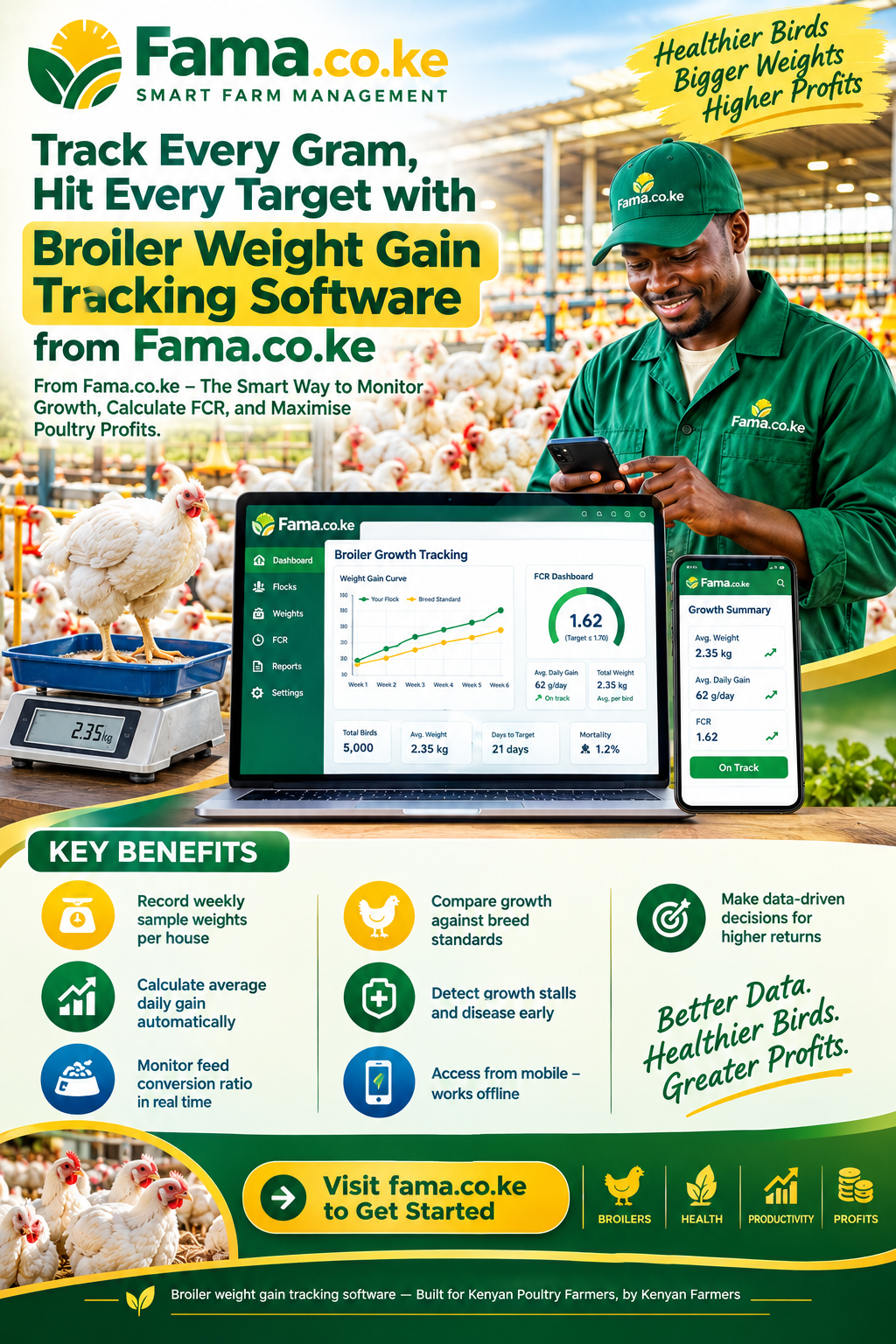
A broiler farm management software exists to solve the problem that decides everything in meat poultry: the batch whose real economics nobody actually knows. Broiler farming is Kenya’s most arithmetic-intensive livestock enterprise — birds arrive by the hundred, mature in six short weeks, and live or die by margins measured in decimals — yet most broiler farmers still run their batches on memory, a feed receipt, and the mood of the market day.
Every broiler farmer knows the strange arithmetic of the enterprise. The batch that “felt like” a success until the final feed bill arrived. The mortality that was counted in feelings until the closing count delivered its shock. The birds sold at five weeks because cash demanded it, when the data said the real money came at day forty-two.
The feed that cost more than the weight it delivered. Each of these failures was decided in week one — in the stocking record nobody kept, the feed log nobody tracked, and the daily weight nobody sampled — and each one is exactly what a broiler farm management software prevents.
The traditional toolkit was the exercise book, the feed supplier’s statement, and the market’s mood. It served when feed was cheap and margins were wide.
Neither condition holds anymore. Feed prices have multiplied, contracts demand consistent weights and volumes, and the difference between a profitable batch and a losing one is now measured in feed conversion — a number that cannot even be computed without records.
A broiler farm management software is the modern answer: one system where every stocking, feeding, weight, death, and sale is recorded the moment it happens — and the batch’s whole story builds itself into a final verdict the farm can actually use.
Anyone searching for broiler farm management software is really searching for control over the two numbers that decide everything: feed conversion ratio, and cost per kilogram of bird produced.
This guide examines broiler farm management software in full: why the timing is no accident, why batch discipline decides everything, what the software actually is, the features that separate genuine systems from digital notebooks, the benefits farmers report, who needs it most, and what each production model demands.
By the end, running meat poultry becomes a system rather than a gamble. The proven broiler farm management software principle is simple: the batch speaks daily, and only records can translate what it is saying.
Broiler farming also has a quality no other enterprise shares: it is the shortest complete business cycle in agriculture. Six weeks from chick to cheque means a farm runs eight or more full experiments every year — and a broiler farm management software is what turns those experiments into learning instead of repeated luck.
Everything a good broiler farm management software does flows from that one conversion: batch activity into batch data, and batch data into a farm that improves with every cycle. What follows is the complete map.
Why the Timing Is No Accident
The urgency behind adopting broiler farm management software is no accident. Feed prices have climbed relentlessly, and feed consumes sixty to seventy percent of broiler production cost — which means every wasted ration, every poor conversion, and every unrecorded kilogram now costs multiples of what it once did.
A batch that once survived sloppy tracking now punishes it visibly within six weeks. The margin no longer has room to absorb what the feed bill hides.
Markets have professionalised at the same time. Hotels, butcheries, institutions, and live-bird traders increasingly demand consistent weights, reliable volumes, and documented health histories before signing standing orders.
Growers whose records show weights, treatments, and batch histories enter those negotiations with evidence. Growers without them negotiate from mood — and the market notices within one delivery.
Financing has joined the pressure. Lenders and input credit programmes now finance batches against documented performance, and the grower with a history of recorded cycles borrows what the memory-based grower cannot. A broiler farm management software record base is the qualification those conversations require.
The tools completed the shift. Smartphones reached every production zone, offline-capable apps handle the houses where signal fails, and platforms priced for Kenyan farmers put systems within reach of a two-hundred-bird unit. A broiler farm management software deployment now costs less than one bag of starter feed — against losses it routinely prevents that dwarf the price.
Why Batch Discipline Decides Everything
The broiler batch is the enterprise’s entire unit of account: everything — stocking, feed, weights, mortality, and sale — belongs to a defined population with a defined start and finish. This makes broiler farming the most recordable livestock enterprise in existence, and the most punishing when records are absent.
The first reason is the feed economy. Feed delivered to a broiler batch either becomes saleable weight or becomes loss, and only records can say which. Growers who track feed against growth through broiler farm management software records know their conversion within days of drift — while the untracked grower discovers it at the final weigh-in, when correction is no longer possible.
The second reason is mortality. Broiler mortality is never silent in reality — only in unrecorded flocks. Deaths logged daily through broiler farm management software records form patterns within the first week: clustering after a feed change, spiking after a vaccination gap, concentrating in one house or one corner. Patterns point at causes, and causes are fixable.
The third reason is the growth curve itself. Broilers follow a known trajectory from day-old to market, and every batch either rides the curve or falls behind it. Sample weights recorded through broiler farm management software show the farm exactly where it stands against expectation — while there is still time to adjust feeding, heating, or the market plan.
The fourth reason is market timing. The decision to sell is the batch’s most valuable decision: too early sacrifices weight the feed has already paid for, and too late converts feed into days the bird cannot repay. Growers who plan sales from recorded growth curves through broiler farm management software sell at the batch’s actual peak — the timing edge that repeat buyers reward.
The fifth reason is cost honesty. Every batch carries its own complete economics — chicks, feed, vaccines, litter, labour, and heating — and closing the batch with a full cost picture is how the farm learns what a kilogram truly costs. Growers who compute this through broiler farm management software records price their birds from evidence instead of hope.
The sixth compounds across the year. A broiler farm runs eight to ten batches annually, and each one is a complete experiment the farm has already paid for. Farms that record through broiler farm management software learn from every batch; farms that do not repeat the same cycle eight times a year and call it experience.
What Broiler Farm Management Software Actually Is
At its core, broiler farm management software is a digital system — mobile-first, increasingly paired with a web dashboard — that manages the entire life of every batch: placement, feeding, environment, health, growth, and sale, connected in one record per batch.
The architecture follows one principle: one batch, one record, every event attached. The placement attaches to the batch, the feedings attach to the same batch, the weights build its curve, and the sale closes the cycle that began at the hatchery gate. A serious broiler farm management software is engineered so nothing is recorded twice and nothing is ever forgotten once.
The daily workflow shows the design. Morning: mortalities counted and logged, water and litter checked — under a minute at the house. Feeding: rations recorded as they are issued. Weekly: sample weights entered, and the batch’s curve updates itself.
By evening, the owner opens the broiler farm management software and sees the whole farm: every house’s standing batch, feed issued against plan, weights against curve, and the projected sale date the data is building — one picture, no notebook, nothing depending on memory.
The intelligence layer separates management systems from digital notebooks. Quality broiler farm management software computes continuously: feed conversion per batch, projected cost per kilogram, days to market weight, and the trends that reveal which houses, feeds, and practices actually earn.
Alerts finish the system. A vaccination due, a sample weighing overdue, feed approaching reorder, a batch drifting below its curve — a capable broiler farm management software reports each morning what needs attention, ranked and dated, before anything becomes urgent.
Core Features That Matter
Not every system deserves the batch’s data. These are the capabilities that genuinely separate management tools from digital notebooks — each tested against the realities of Kenyan broiler farming.
Placement and Stocking Records
Every batch begins with the placement record: hatchery source, breed, number received, day-old weight, and date. A broiler farm management software with stocking depth knows the batch’s true starting population — the denominator every survival, conversion, and cost figure depends on.
Daily Mortality Logs
Every death recorded with date, house, and suspected cause — the quietest and most valuable record in the enterprise. A broiler farm management software with mortality depth turns losses into patterns within days, and patterns into fixes within the same batch.
Feed Records by Stage
Starter, grower, and finisher issued and recorded per batch, benchmarked against the birds’ real capacity at each age. This is the highest-value discipline in the whole system — broiler farm management software feed records expose waste, spoilage, and siphoning that the sack economy hides completely.
Growth Sampling and Curves
Sample weights recorded weekly, building the batch’s curve against the breed’s expected trajectory. A broiler farm management software with curve tracking predicts the sale date from data — and shows the drift while the birds can still be corrected.
Vaccination and Medication Calendars
The batch’s health programme — Marek’s, Gumboro, Newcastle, and the coccidiosis strategy — carried with due dates alerted in advance. A broiler farm management software with the prevention calendar protects the batch from the outbreak that erases six weeks in a fortnight, and records every withdrawal period before sale.
Environment and House Records
Temperature, litter condition, and ventilation observations logged daily — because broiler performance responds to environment as strongly as to feed. A broiler farm management software with environment depth connects every production change to its likely cause, which makes records diagnostic instead of merely descriptive.
Sales, Weights and Buyer Records
Every sale recorded with birds sold, average weight, price, buyer, and payment — the batch’s earning side documented as carefully as its cost side. A broiler farm management software with sales depth shows which buyers pay best, which weights earn most, and which market days reward the farm.
Batch Costing and Closure
Every shilling the batch consumes — chicks, feed, vaccines, litter, fuel, labour — recorded as it occurs, and closed at sale into one verdict. A broiler farm management software with batch closure produces profit per batch and cost per kilogram automatically — the two numbers that decide whether the enterprise continues as designed.
Multi-House and Multi-Batch Views
Farms running staggered batches need the system to hold several at once — each with its own age, curve, and countdown. A broiler farm management software with multi-batch depth keeps every house’s story separate while the whole farm’s position stays visible in one view.
Reports That Steer the Cycle
The reporting layer must answer the grower’s actual questions: where is this batch against plan, what is conversion trending toward, and what will this batch finally cost per kilogram. A capable broiler farm management software generates these from entries already made — while the batch is still alive and steerable.
The Benefits Farmers Report
The first benefit is knowing the batch while it lives. Growers who track through records describe the same change: the batch stops being a six-week wait and becomes a daily reading — conversion visible, mortality patterned, and the sale date predicted weeks ahead.
The second is feed savings. Consumption benchmarked against the birds’ real capacity exposes the overfeeding, poor-quality feed, and store leakage that the sack economy conceals. Growers who steer feed through broiler farm management software records typically cut feed spending visibly within one batch — without a single bird receiving less of what actually converts.
The third is mortality falling. Logged deaths become patterns, patterns point at causes, and causes are fixable — the heating failure, the vaccination gap, the wet litter. Farms that run health through broiler farm management software consistently report losses dropping within the first two batches of counting.
The fourth is market timing won. Sales planned from recorded curves land the birds at their peak — the week where feed paid and price holds. Growers selling through broiler farm management software timing describe the schedule as the records’ most valuable return: the same birds earning more by leaving on the right day.
The fifth is the buyer relationship. Documented weights, volumes, and treatment histories convert spot selling into standing orders — the highest-value channel in the trade. Growers supplying through broiler farm management software histories describe contract buyers as the compounding return no single batch can match.
The sixth is financing. Lenders financing batches price risk on records, and the grower presenting documented cycles borrows on terms the memory-based grower never sees. Operations applying with broiler farm management software histories consistently report faster, friendlier credit conversations.
The seventh compounds longest: the farm’s playbook. Which hatchery delivers, which feed converts, which house performs, which market day pays — every recorded batch teaches. A broiler farm management software habit sustained across a year produces eight cycles of evidence, and a farm that improves every single cycle.
Who Needs It Most
Smallholder broiler growers need the software most urgently, because their margins are decimals wide and every failed batch is a family’s income delayed. A two-hundred-bird unit running on broiler farm management software records often recovers more absolute income than a larger unit recovers from the same percentage.
Multi-house commercial units need the software as operational necessity: staggered batches, several workers, and continuous turnover that no notebook can coordinate. At this scale, broiler farm management software records are what separate a managed operation from a collection of houses.
Contract and outgrower suppliers need the records as their qualification: processors and integrators audit weights, treatments, and batch performance before committing volume. Growers documented through broiler farm management software records clear the audit that ends a records-poor competitor’s contract.
Hatcheries and chick suppliers need the same discipline on their side: hatch data, brood performance, and survival statistics that premium buyers verify. A supplier running broiler farm management software records sells documented chicks — and documented chicks command documented prices.
Groups and co-operatives running collective broiler units need shared records for governance: members’ trust depends on figures nobody disputes. A group batch run through broiler farm management software survives the disputes that kill most shared enterprises.
New broiler farmers benefit from starting recorded, because their first batches are their education. For the newest growers, broiler farm management software in the first batch is the cheapest professional decision they will ever make.
Model by Model: What Each Production System Demands
The live-bird and broiler-to-butchery grower sells weight, so the software priority is the full batch chain: stocking, feed, curve, and sale weight. Its broiler farm management software requirement is the connected cycle, because the bird’s value is decided at every stage along it.
The processor-contracted grower sells to specification — weights, grades, and delivery dates agreed in advance. Its broiler farm management software emphasis is the curve against the contract date, because the batch must hit the target the agreement demands.
The improved kienyeji and semi-free-range grower runs longer cycles and lower density, and needs records tuned to that biology rather than to industrial assumptions. A broiler farm management software that handles extended cycles gives the slower bird its own arithmetic.
The breeder-layer unit running broilers alongside eggs needs both worlds in one system: batch economics beside daily lay records. A broiler farm management software with multi-enterprise depth keeps the whole poultry operation in one place instead of two notebooks that never meet.
The unit feeding its own manure into crops faces the allocation question: one store, one cash box, several enterprises. Its unifying broiler farm management software requirement is per-enterprise costing with shared costs attributed honestly.
The Number That Changes Everything: Feed Conversion Ratio
The single most clarifying figure in broiler farming is the feed conversion ratio — kilograms of feed per kilogram of live weight, per batch, per house. Growers who compute it through their broiler farm management software records are consistently surprised: the number is almost always worse than assumed, and every decimal point is a margin.
The second number is cost per kilogram produced — chicks, feed, vaccines, and the batch’s share of everything, divided by the weight actually sold. A broiler farm management software cost-complete batch is the only honest way to state it, and the honest answer redirects the next batch’s entire plan.
The third is the trend across batches, because one batch is luck and eight are structure. Rising conversion against flat prices, visible in the broiler farm management software seasonal rows, is the early warning that feed, breed, or management needs changing — arriving a full batch before the bank balance announces it.
Notebook vs Software: The Honest Comparison
Notebooks and diaries are free, simple, and the correct first step — but they record what they are told and compute nothing beyond them: no conversion ratios, no growth curves, no sale-date predictions, and no alerts on drifting feed.
Purpose-built broiler farm management software carries the calculations, the curves, and the alerts on top of the same entries. The practical path most successful growers follow is the notebook first batch, then the upgrade the data demands.
A serious trial against the farm’s current notebook, run for one full batch, settles the question with the farm’s own numbers rather than a vendor’s promises.
Records and Financing
Ask any lender why poultry credit remains expensive, and the answer is always the same: applicants cannot demonstrate survival, conversion, or returns. A broiler farm management software record base changes that conversation completely — cycles documented, sales reconciled — presented from data that matches the houses by construction.
The same records serve buyers, insurers, and succession planning alike. The grower whose history shows every placement and sale holds a negotiating position no memory-based farm can match.
How to Choose the Right System
Start with the farm’s actual needs rather than the feature list’s ambitions. List the three problems that hurt most — perhaps feed conversion, mortality, or sale timing — and test whether the broiler farm management software candidate handles those three brilliantly, because a tool that monitors everything shallowly protects nothing.
Implementing Without Disrupting the Batch
Begin with the baseline: every standing batch entered with its population and age, opening feed counted once, and the vaccination programme loaded. A broiler farm management software deployment is only as trustworthy as the day-zero truth beneath it.
Then launch at a new placement — the cleanest boundary in broiler farming — and record forward from chick to sale, reviewing the data weekly until the rhythm holds. A broiler farm management software habit installed at placement sustains itself through every batch that follows.
Costs and Return on Investment
Model the total annual cost of each candidate against what it will recover — feed saved, mortality prevented, sale timing won — rather than against zero. Growers consistently report that a well-run broiler farm management software pays for itself within the first batch.
The Future of Broiler Management
The technology is still accelerating: automatic scales feeding records directly, environment sensors joining the batch data, and processors returning carcase grades that flow back into the next placement’s plan. Growers feeding clean records into today’s broiler farm management software platforms are building the histories that will make tomorrow’s tools accurate for their specific houses and markets.
Frequently Asked Questions
Is this worth it for a small unit of two hundred birds? Especially there — small margins cannot absorb invisible losses, and one failed batch at that scale is a season’s income. A broiler farm management software deployment for a small unit typically costs less than the feed one poor conversion wastes.
How much time does daily recording actually take? Two to three minutes: deaths and environment at the house, feed as it is issued, and sample weights once a week. Entries anchored to the morning round sustain the habit for years without effort.
Can it handle several batches at different ages at once? Yes — and it should. Genuine platforms run staggered batches side by side, each with its own curve, countdown, and cost record, so the whole farm’s position stays visible in one view.
How does it help prevent the six-week cash crisis specifically? By predicting the sale date from the batch’s own curve, the farm can plan feed, credit, and marketing around the real timeline instead of guessing it. Growers who plan sales through their broiler farm management software records stop selling early at the exact moment the data says the money is still coming.
How long before I see results? The first benefits arrive within the first batch — conversion visible, mortality patterned, sale timing planned. The deeper returns — standing orders, cheaper credit, and a farm that improves every cycle — build across a year of consistent broiler farm management software records, and compound with every batch after.