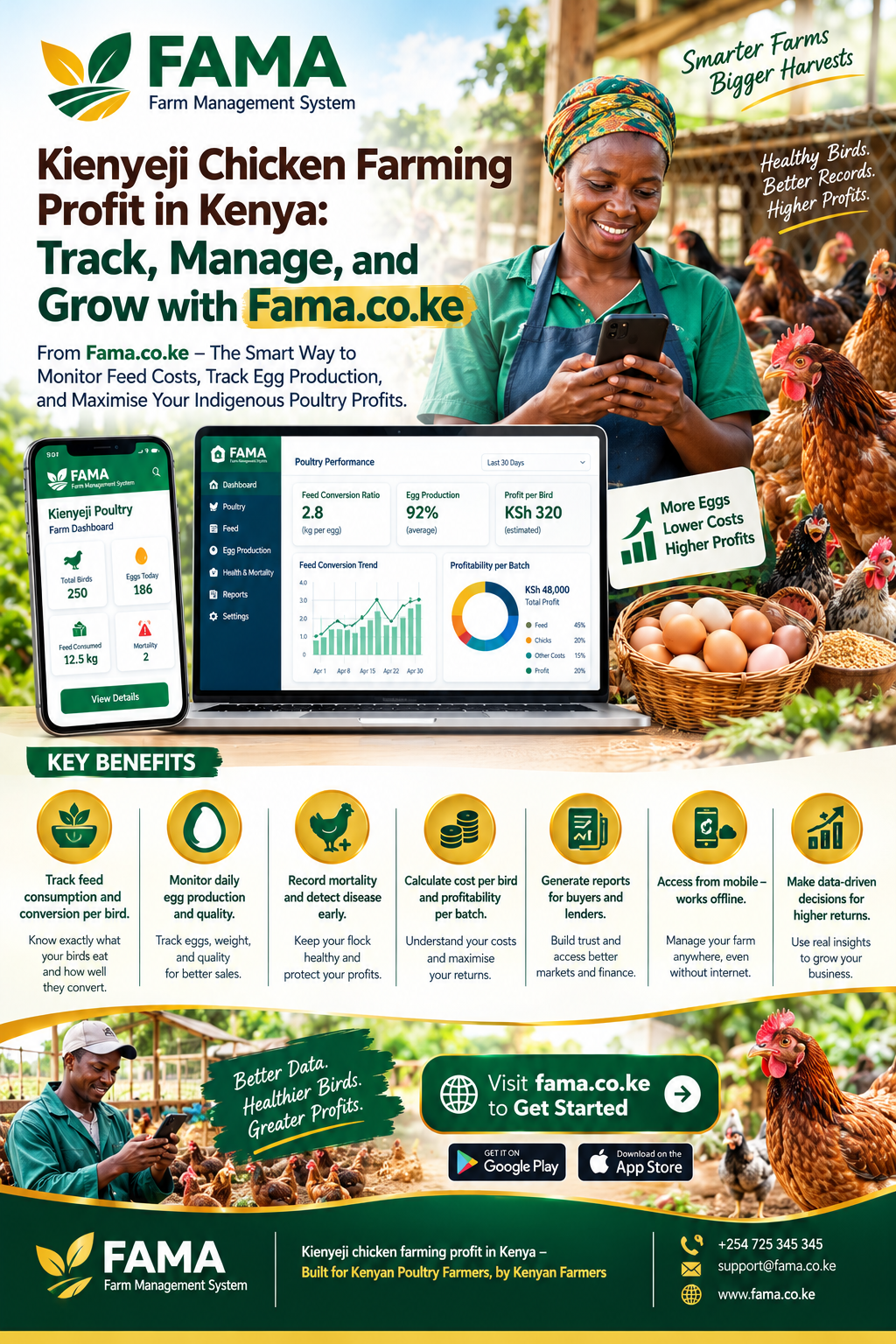
Kienyeji chicken farming profit in Kenya has become one of the most attractive opportunities for smallholder farmers seeking reliable income from low-capital livestock enterprises. Fama.co.ke provides an innovative platform that helps farmers track kienyeji chicken farming profit in Kenya through disciplined record-keeping, feed cost monitoring, and data-driven flock management. With improved Kienyeji chickens proving more resilient to disease and more profitable than pure village breeds, the adoption of kienyeji chicken farming profit in Kenya strategies has never been more important for farmers seeking sustainable returns.
The financial case for kienyeji chicken farming is compelling and well-documented. Homerange, a traditional chicken company specialising in KALRO improved kienyeji, reports that a poultry stock of 200 chickens has a production cost of Sh90,000 but generates sales income of Sh170,000, yielding Sh80,000 in profits. This is the essence of kienyeji chicken farming profit in Kenya—a clear margin between cost and revenue that can be calculated, tracked, and replicated. Improved Kienyeji chickens are more resilient to disease, adaptable to local conditions, and more profitable because they produce both meat and eggs.
Fama.co.ke‘s platform helps farmers master kienyeji chicken farming profit in Kenya by providing tools to record feed consumption, track growth rates, monitor egg production, and calculate profitability per batch. Feed costs are the largest expense in kienyeji production, with a 50kg bag of Kienyeji chicken mash costing Sh2,279, growers’ mash at Sh2,090, and layers mash at Sh2,125. With kienyeji chicken farming profit in Kenya integrated into a digital management platform, farmers can ensure that every shilling spent on feed delivers measurable returns.
The market environment supports kienyeji chicken farming profit in Kenya strongly. Kenya’s indigenous chicken commands premium pricing of KSh600-1,200 per dressed bird and KSh20-30 per egg, compared to commercial alternatives. A farmer in Nakuru sells fully grown improved kienyeji chicken weighing about a kilo at Sh300-450 depending on the number purchased, earning Sh300,000 gross monthly from his operation. This premium pricing is the foundation of kienyeji chicken farming profit in Kenya—consumers are willing to pay more for the taste and perceived health benefits of indigenous chicken.
The production economics of kienyeji chicken farming profit in Kenya begin with day-old chicks. A 1-day-old chick costs approximately Sh115, feeding costs Sh87 per month, vaccines Sh5, supplements Sh5, disinfectants Sh5, and heating Sh20, bringing the total to one month to Sh237. At one month, a chick is valued at about Sh300, already representing a return on the initial investment. This is the foundation of kienyeji chicken farming profit in Kenya—early value creation that compounds as the birds grow.
Egg production is the recurring revenue stream that makes kienyeji chicken farming profit in Kenya so attractive. Improved kienyeji hens produce over 200 eggs annually, with some maturing in as few as three months. At the current market rate of KSh20-30 per egg, each hen generates Sh4,000 to Sh6,000 per year from eggs alone. Homerange buys eggs from outgrower farmers at Sh10 each, providing a guaranteed market that reduces risk and stabilises income. This predictable egg revenue is central to kienyeji chicken farming profit in Kenya.
Meat production provides the second revenue stream. Improved kienyeji birds reach market weight in three to four months, weighing 1.5kg to 2.5kg under proper feeding. At maturity, birds sell for Sh1,200 to Sh1,800 each. Homerange buys mature chickens at an average price of Sh650, providing a ready market for farmers in their outgrower programme. A kienyeji chicken farming profit in Kenya analysis that combines both egg and meat revenue reveals the full profit potential of this dual-purpose enterprise.
Improved kienyeji breeds have transformed the profitability equation. KALRO Improved Kienyeji matures in four and a half months compared to the typical indigenous breed that takes up to six months. Sasso F1 delivers 2 to 2.5kg weight in just three months, with egg production starting at five months and yielding up to 240 eggs annually. Kenbro, developed by Kenchick Kenya, starts laying eggs at six months and thrives in free-range systems with minimal feed supplementation. Selecting the right breed is a foundational decision in maximising kienyeji chicken farming profit in Kenya.
Record-keeping is the discipline that separates profitable kienyeji farmers from those who merely keep chickens. Without records, a farmer cannot calculate feed conversion efficiency, identify which hens lay the most eggs, or determine the true cost per bird at market. Digital tools make kienyeji chicken farming profit in Kenya measurable rather than speculative, turning every feeding event and egg collection into data that guides management. Fama.co.ke offers daily farm records software designed for Kenyan poultry farmers, capturing feed consumption, mortality, egg production, and sales in one system that works offline and on basic smartphones. For farmers seeking comprehensive digital tools to track every aspect of their kienyeji enterprise, kienyeji chicken farming profit in Kenya from Fama.co.ke provides the infrastructure to plan, monitor, and grow a profitable indigenous poultry business.
Why Kienyeji Chicken Farming Profit in Kenya Outperforms Many Alternatives
Kienyeji chicken farming profit in Kenya compares favourably against broiler production for several structural reasons. Improved Kienyeji chickens are more resilient to disease, adaptable to local conditions, and thrive on locally available feeds and semi-free-range systems. Unlike broilers, which require expensive commercial feeds and intensive management, kienyeji birds can supplement their diet through foraging, reducing feed costs significantly.
The demand for kienyeji chicken in Kenya has been at a peak almost all-year-round, and available supply is “stressed beyond limits”. Middlemen have taken advantage of the situation to exploit consumers, buying chickens worth KSh600-800 and selling them for KSh1,000 or more. Farmers who sell directly to consumers or through organised outgrower programmes capture more of this value, directly improving kienyeji chicken farming profit in Kenya.
The health-conscious consumer shift is driving long-term demand. Lifestyle diseases are driving people away from broiler breeds, which are stimulated to grow fast. One cannot compare the taste of kienyeji with that of broilers, and the nutritional value of the local chicken breed is also quite high. This premium positioning supports the high prices that underpin kienyeji chicken farming profit in Kenya.
Cost Structure for Rearing 100 Kienyeji Chickens
Understanding the cost structure is essential for calculating kienyeji chicken farming profit in Kenya accurately.
Chick and Feed Costs
For 100 day-old chicks at KSh100 to KSh140 each, initial chick cost ranges from KSh10,000 to KSh14,000. Feed costs, including chick mash, growers mash, and layers mash, range from Sh58,000 to Sh77,000 through the production cycle. These two categories represent the majority of production costs in kienyeji chicken farming profit in Kenya.
Housing and Equipment
A simple, well-ventilated structure is enough for 100 birds. The house should protect chicks from cold, rain, and predators while allowing enough airflow to prevent ammonia buildup. Housing costs vary depending on whether existing structures can be modified or new construction is required.
Vaccination and Health
Vaccination costs are minimal but essential. The typical cost of vaccines is approximately Sh5 per bird per month, with supplements and disinfectants adding another Sh5 each. These small investments protect the flock and directly support kienyeji chicken farming profit in Kenya by preventing disease losses.
Revenue Streams That Drive Kienyeji Chicken Farming Profit in Kenya
Egg Revenue
At 240 eggs per year at Sh20 per egg, each hen generates Sh4,800 annually. For 100 hens, annual egg revenue reaches Sh480,000. Even at the wholesale price of Sh10 per egg offered by Homerange, 100 hens producing 200 eggs annually generate Sh200,000 per year. This recurring revenue is the backbone of kienyeji chicken farming profit in Kenya.
Meat Revenue
At 3 to 4 months, improved kienyeji birds weigh 2 to 3.5 kilograms and sell for Sh1,200 to Sh1,800 each. A farmer selling 100 birds at Sh1,200 each generates Sh120,000 from meat production alone. Combined with egg revenue, this demonstrates the dual-purpose strength of kienyeji chicken farming profit in Kenya.
Breeding Stock Revenue
Farmers who maintain superior genetics can sell breeding stock at premium prices. Mature improved kienyeji chickens sell for Sh800 fixed price in some markets. A Kirinyaga breeder supplying an average of 50 birds per week demonstrates the scale possible in kienyeji chicken farming profit in Kenya.
How to Maximise Kienyeji Chicken Farming Profit in Kenya
Choose the Right Breed
Improved breeds including KARI/KALRO Improved, Kuroiler, Rainbow Rooster, Sasso, and Kenbro are becoming popular due to faster growth rates, higher egg production of 150 to 300 eggs annually, and improved disease resistance. Sasso F1 is the leader for speed of growth, reaching 2 to 2.5kg in three months. Selecting the right breed is the first step in maximising kienyeji chicken farming profit in Kenya.
Manage Feed Efficiently
Feed represents the largest variable cost in kienyeji production. Farmers should track feed consumption per bird and adjust rations based on age and production stage. Improved kienyeji birds need slightly more consistent feeding than pure kienyeji to perform at their potential. Efficient feed management directly improves kienyeji chicken farming profit in Kenya.
Access Ready Markets
Homerange buys eggs at Sh10 each and mature chickens at Sh650, providing a guaranteed market for outgrower farmers. Big hotels in the country have reached out looking for regular supplies of kuku kienyeji. Accessing these ready markets reduces price risk and stabilises kienyeji chicken farming profit in Kenya.
Keep Records
Without records, farmers cannot know which hens are most productive, what their true cost per bird is, or which management practices deliver the best returns. Digital tools make kienyeji chicken farming profit in Kenya measurable and repeatable.
The Outlook for Kienyeji Chicken Farming Profit in Kenya
The outlook for kienyeji chicken farming profit in Kenya remains positive. Demand for indigenous chicken continues to rise, driven by health-conscious consumers and the superior taste of kienyeji meat and eggs. Government programmes are distributing improved chicks to farmers across counties, expanding the supply base and enabling more farmers to participate in kienyeji chicken farming profit in Kenya.
County governments including Siaya are distributing thousands of one-month-old improved kienyeji chicks to farmer groups, with training on feeding, vaccination, and flock management to ensure sustainability. These initiatives are building the technical capacity needed for kienyeji chicken farming profit in Kenya to be realised across the country.
Farmers using Fama.co.ke to track kienyeji chicken farming profit in Kenya and manage their feed costs will be best positioned to capture these opportunities. By understanding their break-even point, monitoring market trends, and applying proven management practices, they can transform kienyeji chicken farming from a subsistence activity into a genuinely profitable business. With the right tools and the right discipline, kienyeji chicken farming profit in Kenya becomes a practical, measurable outcome rather than an aspiration. For those ready to take the next step, kienyeji chicken farming profit in Kenya from Fama.co.ke provides the digital infrastructure to plan, track, and grow a thriving indigenous poultry enterprise. And for farmers committed to building sustainable income from kienyeji chickens, kienyeji chicken farming profit in Kenya offers a proven pathway to achieving it.
Frequently Asked Questions About Kienyeji Chicken Farming Profit in Kenya
How much profit can I make from 200 kienyeji chickens?
A poultry stock of 200 chickens has a production cost of Sh90,000 but generates sales income of Sh170,000, yielding Sh80,000 in profits. This represents a profit margin of approximately 47 per cent on the original investment.
How long does kienyeji chicken take to mature in Kenya?
Improved kienyeji chickens reach market weight in 3 to 4 months, averaging between 1.5kg and 2.5kg under proper feeding. Birds focused on egg production begin laying at 5 to 6 months, with annual output ranging between 150 and 280 eggs.
How much does a kienyeji egg sell for in Kenya?
Kienyeji eggs command premium prices, going for about Ksh53 each compared to Ksh23 for commercial eggs. Homerange buys eggs from outgrower farmers at Sh10 each, providing a guaranteed market for farmers in their programme.
What is the best kienyeji breed for profit in Kenya?
Sasso F1 delivers 2 to 2.5kg weight in just three months and yields up to 240 eggs annually, making it the leader for speed of growth. Kenbro is a dual-purpose breed known for good meat yield and steady egg laying. KARI/KALRO Improved Kienyeji combines local disease resistance with better growth rates.
How much does it cost to rear 100 kienyeji chickens in Kenya?
For 100 day-old chicks at KSh100 to KSh140 each, initial chick cost ranges from KSh10,000 to KSh14,000. Feed costs range from Sh58,000 to Sh77,000 through the production cycle. Total rearing costs for 100 birds typically range from KSh68,000 to KSh91,000 before housing.