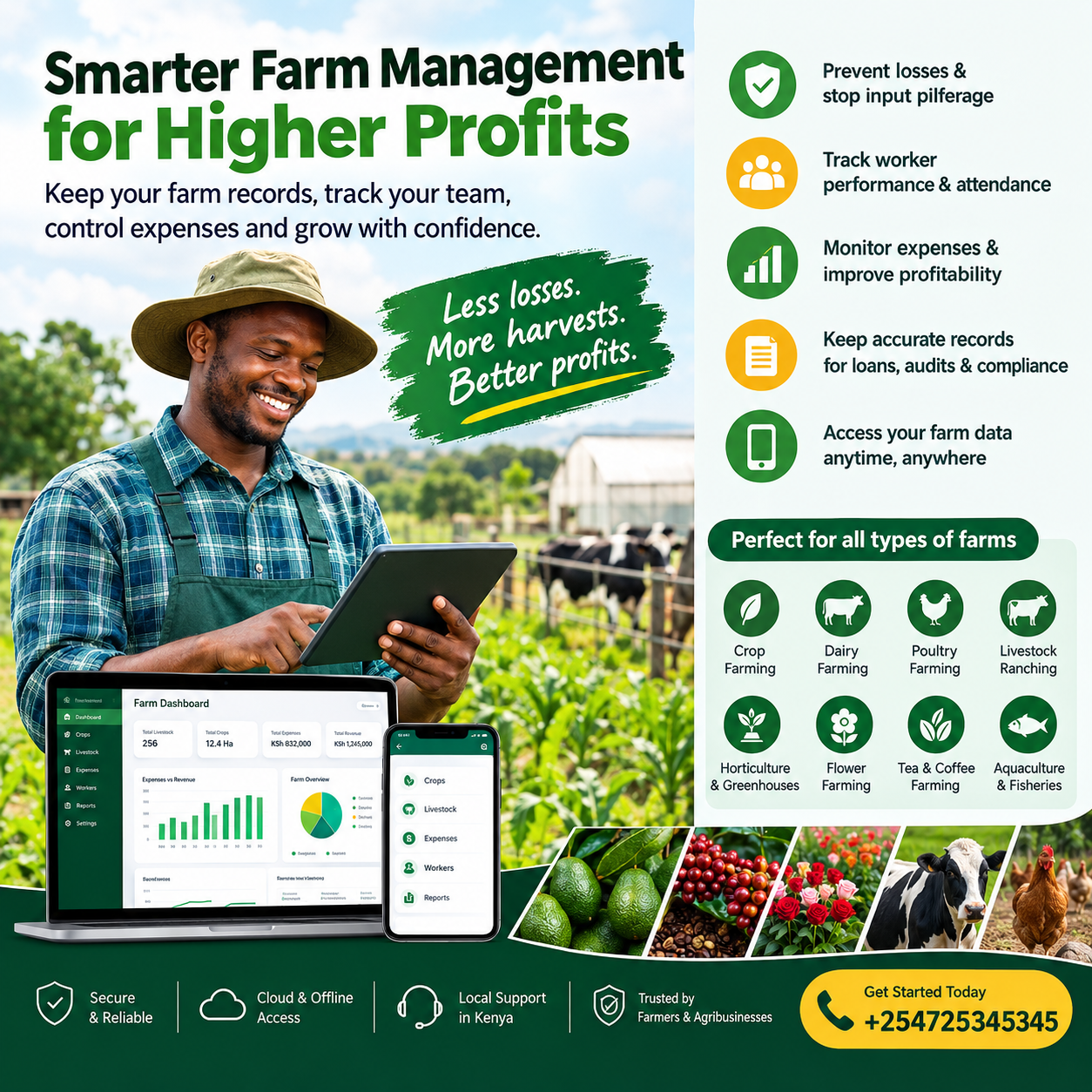
A greenhouse farm management system exists to solve the paradox that defines protected cropping: the most controlled environment in agriculture managed with the least controlled records. Inside a greenhouse, everything is engineered — the temperature, the humidity, the fertigation, the spacing, the varieties — and yet most Kenyan greenhouse growers still run the operation on memory, a notebook at the packing table, and chemical dosing by the capful. The structure is a precision instrument being operated like a guess.
The economics explain why this matters more than anywhere else in farming. A greenhouse represents the highest capital investment per square metre in agriculture — plastic, steel, drip lines, and seedlings costing hundreds of thousands of shillings before the first harvest — and it demands the fastest decision tempo: daily scouting, daily picking, and fertigation adjusted by the week. When a greenhouse farm management system is absent, every one of those decisions is made blind, and blind decisions on a high-cost structure are how greenhouse projects fail.
The pattern is familiar across the country. Tomatoes planted with optimism, thriving for the first month, then quietly declining as fertigation drifts, pests establish, and records were never kept of what worked. The first cycle often succeeds; the second declines; by the third, the grower is fighting diseases the previous cycles invited and cannot explain. A working greenhouse farm management system breaks that cycle by making every cycle’s data available to the next one — which is precisely what the structure was bought for.
The cost of running blind is specific and brutal. The fertigation mix that drifted for two weeks before anyone noticed; the whitefly population that established while scouting happened from memory; the picking crew that recorded generously while the actual crates told another story; the crop cycle that finished without anyone able to say whether it profited. A greenhouse farm management system surfaces each of these while the crop can still be saved — which is the entire difference between a greenhouse that compounds and one that consumes.
This guide examines the greenhouse farm management system question in full: why the timing is no accident, why greenhouse economics demand records, what the system actually is, the core features that separate genuine tools from generic farm apps, the benefits growers report, who needs it most, what each greenhouse scale demands, the number that changes everything, and how to choose, implement, and afford a system without disrupting the daily rhythm of protected cropping. By the end, running a greenhouse becomes a system rather than a hope.
The proven greenhouse farm management system principle is simple: a greenhouse is an investment that repays data, and it punishes the absence of it faster than any other farming system. Everything in this guide serves that single discipline.
Why the Timing Is No Accident
The urgency behind adopting a greenhouse farm management system is no accident. Kenya’s greenhouse sector has professionalised from every direction at once — export buyers demanding residue documentation and traceability, supermarket contracts specifying grades and delivery schedules, input costs climbing relentlessly, and lenders finally financing protected cropping but only against records. The greenhouse that once ran on the grower’s instinct now operates inside a market that asks for evidence.
The economics have sharpened the need further. Greenhouse inputs — fertigation salts, seed, chemicals, and packaging — cost multiples of open-field equivalents, which means waste that an open-field farmer absorbs becomes fatal at greenhouse scale. Growers who manage inputs through a greenhouse farm management system routinely cut fertigation and chemical spending visibly within one cycle — without yield suffering, because the waste was invisible until someone counted.
The tools completed the shift. Affordable smartphones reached every production zone, offline-capable apps handle the greenhouse where signal fails, and systems priced for Kenyan growers put record-keeping within reach of a single-tunnel operation. A greenhouse farm management system deployment now costs less than one month of fertigation salts — against losses it routinely prevents that dwarf the price.
Why Greenhouse Economics Demand Records
Greenhouse cropping is the most decision-dense form of agriculture: scouting every day, fertigation adjusted weekly, picking every two days, and each decision compounding into the next. A missed scouting window, a drifted fertigation mix, or a delayed spray is not one mistake — it is the start of a decline that shows in yield three weeks later. A greenhouse farm management system moves every one of those decisions onto a schedule the system carries, so nothing depends on whoever remembers.
The second reason is the structure itself. A greenhouse is a capital asset depreciating every season, and its economics only work if the crops inside it earn more than the structure consumes — a comparison that requires knowing both sides precisely. Only greenhouse farm management system records can state what each cycle truly earned against the tunnel’s real costs, and that single answer decides whether the investment compounds or quietly consumes.
The third reason is the disease environment. The warm, humid greenhouse is also the ideal disease and pest habitat, and the operations that stay clean are the ones that scout on schedule, rotate chemicals deliberately, and maintain hygiene between cycles — all of which are record-keeping disciplines. Growers who run their health management through a greenhouse farm management system report disease pressure falling within two cycles, because prevention became scheduled instead of reactive.
The fourth reason is the cycle-to-cycle learning. Every greenhouse cycle is an experiment the farm has already paid for — varieties, fertigation programmes, and planting densities all produced results. The farm that records them learns from them; the farm that does not re-runs the same experiment at full price every cycle. Over five cycles, the difference between a greenhouse farm management system farm and a memory farm is not marginal — it is the difference between a business and a gamble.
What the System Actually Is
At its core, a greenhouse farm management system is a digital system — mobile-first, increasingly paired with a web dashboard — that manages the full life of every tunnel: the plan, the planting, the fertigation, the scouting, the treatments, the harvest, the grading, and the sale, all connected in one record per structure. Think of it as the tunnel’s biography and the farm’s accountant combined, available at the greenhouse door and never too busy to log what the crop actually did.
The architecture follows one principle: every tunnel, cycle, input, task, and sale is an identified record that events attach to. A fertigation event attaches to a tunnel and a crop stage; a spray attaches to the same tunnel and its pre-harvest interval; a harvest attaches to the cycle; and the buyer attaches to the sale. A serious greenhouse farm management system is engineered so nothing is recorded twice and nothing is ever forgotten once.
The daily workflow shows the design intent. Morning: the day’s tasks are assigned — scouting to the assistant, picking crew to Tunnel 3, fertigation batch mixed and logged. Midday: harvest is weighed per tunnel per grade as crates come in. Evening: treatments logged with their intervals, fertigation consumption recorded, and the sales for the day entered with buyer and payment.
By nightfall, the owner opens the greenhouse farm management system and sees the whole operation: crop stages by tunnel, harvest against plan, fertigation on schedule, open tasks, and the orders due this week — one picture, no notebooks, nothing depending on memory.
The intelligence layer is what separates management systems from digital diaries. Quality greenhouse farm management system computes continuously: cost per kilogram per cycle, yield per square metre per tunnel, fertigation consumption against plan, spray intervals as live countdowns, and margins per buyer. The grower stops asking “how is the crop doing?” and starts seeing the answer while the crop can still be steered.
Alerts finish the system. Spray windows due, pre-harvest intervals closing, scouting overdue on any tunnel, harvest due for confirmed orders, and input stock running low — a capable greenhouse farm management system watches everything at once and reports each morning what needs attention, ranked and ready.
Core Features That Matter
Not every app deserves space on the grower’s phone. When evaluating a greenhouse farm management system, these are the capabilities that genuinely separate the useful from the decorative — each tested against the realities of protected cropping.
Tunnel and Cycle Planning
The foundation is the plan: every tunnel recorded with its size, and every cycle scheduled — crop, variety, planting date, expected harvest window, and the crop that follows. A greenhouse farm management system with real planning depth lets the grower stagger cycles deliberately across tunnels, spreading harvest across weeks instead of dumping it into one glut week, which is one of the highest-return practices in greenhouse growing.
The rotation record belongs here too: what grew in each tunnel, in which sequence, across cycles. Tomatoes follow brassicas; leafy greens follow legumes — rotation inside a tunnel is the cheapest disease management there is, and a greenhouse farm management system that remembers every tunnel’s history makes rotation decisions evidence-based instead of habitual.
Fertigation Management
Fertigation is the greenhouse’s engine, and the system should treat it with engineering seriousness: nutrient recipes defined per crop and per stage, dosing logged per tunnel, consumption reconciled against crop growth, and the salts stock reconciled against the recipe. A greenhouse farm management system with fertigation depth makes the nutrient bill negotiable — because the grower who knows consumption per stage stops dosing on instinct.
The recipe history is where the learning lives: which mix produced which yield at which stage, cycle after cycle. Growers who optimise through greenhouse farm management system records routinely find nutrient spending falling while yield holds — the waste was invisible until the recipes were counted.
Scouting and Pest Records
The warm, humid tunnel is the ideal pest habitat, and scouting is its early-warning system. Every scouting pass logged — pest counts, disease symptoms, beneficials present — with the location, the scout, and the date builds the farm’s epidemiological memory. A greenhouse farm management system with scouting records shows the grower pressure building before it explodes, and the treatments follow the evidence rather than the fear.
The treatment records complete the loop: every spray logged with product, rate, tunnel, and operator — with the pre-harvest interval computed as a live countdown per tunnel. Growers supplying buyers through greenhouse farm management system documentation describe audits becoming afternoon file exports rather than shipping-week scrambles.
Harvest Records by Grade
Every harvest weighed per tunnel, per picker, and per grade — Grade One, Grade Two, and discards — because the grade split is where the greenhouse’s true economics live. A greenhouse farm management system that captures grade-out percentages reveals what the tunnel actually sells versus what it grows: the gap that disease, pests, and grading discipline all hide inside.
The picker attribution matters as much as the tonnage. Crews recorded per tunnel per day with their actual crates turn labour into measurable productivity — and growers who run picking through greenhouse farm management system attribution report the same pattern as every farm that counted: output rises because effort became visible.
Labour and Task Management
Greenhouse work runs daily through small crews, and the system should assign and record it: tasks issued each morning, completions recorded, and piece-rates or hours computed per worker. A greenhouse farm management system with task depth turns supervision into a dashboard and gives every worker a documented record of the work they actually did — which protects them as much as it informs the owner.
The wage connection matters: piece rates computed from recorded crates, hours summed from recorded tasks, and the payroll assembled from the tunnel’s own entries. Growers who pay through greenhouse farm management system computation report disputes collapsing — the tally was made in the tunnel, not argued at month end.
Order, Buyer and Payment Records
Every sale recorded with buyer, grade, quantity, price, and payment builds the farm’s commercial memory: who pays on time, who takes which grade, which channel earns the margin. A greenhouse farm management system with buyer histories converts negotiation from mood to evidence — and the price improvements alone often justify the entire system.
Order tracking closes the loop: confirmed orders, quantities committed, harvests allocated against them, and delivery status per buyer. Growers who manage orders through greenhouse farm management system systems stop committing more than the crop will deliver — the over-commitment that quietly destroys buyer relationships one short delivery at a time.
Structure, Asset and Maintenance Records
The tunnel itself is an asset with a maintenance history: plastic replaced, drip lines flushed, gutters repaired, and the replacement schedule tracked against its expected life. A greenhouse farm management system with asset records turns maintenance from surprise into schedule — and the structure’s true cost per cycle finally includes its own upkeep.
The depreciation view matters at financing time: the structure’s capital cost, its expected life, and its earnings per cycle assembled from records. Growers presenting greenhouse farm management system asset and earnings files borrow against their structures on terms the undocumented grower never sees.
Financials per Cycle
Every shilling the tunnel consumes — salts, seed, chemicals, labour, packaging — and every shilling it earns should sit in one ledger per cycle. A greenhouse farm management system with integrated finance produces cost per kilogram, profit per cycle, and return per square metre automatically — and those numbers are what lenders, partners, and the grower’s own next decision actually price.
Reports That Steer the Crop
The reporting layer must answer the grower’s actual questions: yield per square metre, cost per kilogram, grade-out trends, fertigation consumption against recipe, and margin per buyer. A capable greenhouse farm management system generates these on demand from entries already made — and the weekly review of that report is where protected cropping becomes management rather than hope.
The Benefits Growers Report
The first benefit is the cycle-to-cycle learning. Growers running records through a greenhouse farm management system describe the change as finally getting answers they had paid for three times over: which variety earned its seed, which fertigation recipe produced, which density crowded the yield. Each cycle becomes cheaper to run because the previous one was recorded.
The second is input savings. Fertigation measured against recipes, chemicals dosed against scouting evidence, and packaging counted against sales routinely cut input spending visibly within one cycle. Growers using a greenhouse farm management system describe the first input report as quietly earning back the year’s subscription.
The third is disease pressure falling. Scheduled scouting, deliberate chemical rotation, and hygiene tracked between cycles break the decline cycle that kills greenhouse projects. Growers who run health management through a greenhouse farm management system report tunnels staying clean across consecutive cycles for the first time — because prevention became a schedule.
The fourth is labour that pays for work. Attribution and tallies convert the daily crew from attendance into productivity, and the wage bill stops growing faster than the harvest. Growers managing crews through greenhouse farm management system systems consistently report output per worker climbing within weeks of counting it.
The fifth is residue compliance without fear. Live PHI countdowns and complete spray files keep every consignment’s documentation current, which is what keeps supermarket and export contracts open. Growers supplying through greenhouse farm management system records describe the residue test as routine rather than gamble.
The sixth is market power. Documented yields, grades, and delivery performance move the grower from roadside spot selling toward contracts and premium channels. Sellers operating through greenhouse farm management system records consistently report better prices — not because their tomatoes are better, but because their documentation is.
The seventh compounds longest: the asset’s story. Every cycle’s earnings and costs accumulate into the structure’s documented history — the file that financiers, partners, and the next generation all need. Growers who sustain a greenhouse farm management system across five cycles own an asset with a provable record, which is a different class of property entirely.
Who Needs It Most
Commercial greenhouse growers with multiple tunnels need the system as their operating system, because the matrix of tunnels, cycles, and buyers exceeds any memory. An operation running eight tunnels with staggered cycles cannot be managed from a notebook — greenhouse farm management system consolidation is the only way one manager actually knows eight tunnels at once.
Single-tunnel smallholders benefit immediately, because their capital exposure is proportionally the largest: one structure holding the family’s entire investment. For them, a greenhouse farm management system costs less than one failed cycle — and prevents precisely the decline cycle that consumes smallholder greenhouses.
Export and contract suppliers need the system as their qualification: residue files, traceability, and delivery records are what programmes verify before committing volume. Growers serving documented supply chains through greenhouse farm management system records describe audits as routine because the records never stopped.
Investor-backed and absentee-owned greenhouse projects need the records as governance: capital deployed into structures requires consolidated visibility delivered live rather than reconstructed monthly. Greenhouse farm management system dashboards have become the standard instrument through which professional capital monitors greenhouse investments.
Family farms preparing for succession or financing complete the list. A greenhouse whose cycles and economics live in the founder’s memory is unfinanceable and uninheritable in any practical sense — and greenhouse farm management system records convert that private knowledge into a transferable, bankable asset.
Scale by Scale: What Each Operation Demands
The one-tunnel smallholder needs simplicity above all: fertigation logs, scouting records, harvest tallies, and the sales ledger — nothing more. A greenhouse farm management system for this scale works when entries take seconds and the alerts do the remembering, because the owner’s time is the scarcest input on the farm.
The multi-tunnel commercial grower needs the full system: staggered cycle planning, fertigation recipes, crew attribution, and integrated finance. At this scale, greenhouse farm management system records are what separate a managed greenhouse from a busy one — and the margin difference between the two is typically the operation’s entire profit.
Large greenhouse estates need the system as governance: multiple sites, multiple supervisors, section-level reporting, and owner oversight consolidated live. Deployments of greenhouse farm management system at this tier turn supervision across sites into a dashboard and give every supervisor a documented record of their section’s performance.
Greenhouse groups and co-operatives need shared standards: members’ records aligned on the same system so collective marketing, certification, and financing can build on comparable data. Groups aligned through greenhouse farm management system records consistently qualify for the contracts and bonuses their unaligned neighbours forfeit.
The Number That Changes Everything: Yield per Square Metre, Profit per Cycle
The single most clarifying figure in greenhouse growing is yield per square metre per cycle — the productivity metric that lets one tunnel be compared honestly against another, one variety against another, and this cycle against the last. Growers who track this through their greenhouse farm management system records discover the spread between their best and worst tunnels is usually enormous — and the spread is where the money lives.
The second number is profit per cycle: every input, labour, and the structure’s real cost, against the sales the cycle achieved. Only greenhouse farm management system records can state it honestly, and the honest answer routinely redirects the next cycle’s entire plan.
The third is the trend across cycles, because one cycle is weather and five are truth. Declining yield per square metre against rising costs is the early warning that the variety, the recipe, or the structure needs changing — and the grower who sees it through greenhouse farm management system trends changes course while changing course is still cheap.
Paper Notebooks vs Digital Systems
Paper is familiar, cheap, and better than nothing — but the greenhouse breaks it structurally. The fertigation log, the scouting book, the harvest tally, and the buyer ledger live in four notebooks that never reconcile, and the questions that matter — yield per square metre, cost per kilogram, PHI status — require all four at once. The greenhouse farm management system alternative answers those questions in seconds because the entries were connected the moment they were made.
Paper also cannot compute or survive. Totals, averages, and margins must be worked by hand with errors compounding quietly — and one torn page erases a cycle’s history. A greenhouse farm management system system calculates continuously, backs itself up beyond the farm, and never loses a fertigation record to a torn page.
Records and Financing
Ask any lender why greenhouse credit remains expensive, and the answer is always the same: applicants cannot demonstrate the structure’s economics. A greenhouse farm management system record base changes that conversation — yields per square metre, costs per cycle, sales reconciled — presented from data that matches the tunnels by construction.
Buyers follow the same logic. Contract buyers and programmes now audit the growers behind their supply, and the grower whose greenhouse farm management system documentation answers every question in an afternoon clears the audit that quietly ends a records-poor competitor’s contract.
How to Choose the Right System
Start with the farm’s actual needs rather than the feature list’s ambitions. List the three problems that hurt most — perhaps fertigation discipline, disease recurrence, or cycle profitability — and test whether the greenhouse farm management system candidate handles those three brilliantly, because a tool that does everything poorly is worse than one that does your priorities well.
Then insist on a trial during real operations. Hand the phone to whoever actually runs the tunnels, run one genuine week of entries, and verify that offline capture works at the greenhouse where signal fails — a greenhouse farm management system that only functions in good signal will die within a month.
Implementing Without Disrupting the Crop
Begin with the baseline: every tunnel mapped and sized, current cycles entered with planting dates, input stock counted once, and active buyers recorded. A few days on this foundation saves a cycle of corrections, because greenhouse farm management system records are only as trustworthy as the numbers beneath them.
Then launch at a natural boundary — a new cycle’s planting is ideal — and record forward rather than reconstructing history. Anchor entries to routines that already exist: tasks assigned at the morning round, harvests weighed at the packing table, fertigation logged at the tank. A greenhouse farm management system deployment that rides existing habits sustains itself.
Costs and Return on Investment
Pricing follows recognisable models: free tiers for single tunnels, modest monthly subscriptions scaled to tunnel count and users, and custom licensing for estates — with setup and training sometimes quoted separately. Model the total annual cost of each greenhouse farm management system candidate at your actual scale, and weigh it against what it will recover rather than against zero.
The return arrives through channels the tunnel already knows: input savings, disease cycles broken, labour attributed, contracts retained on clean files, and cycles planned from evidence. Across those channels, growers consistently report that a well-run greenhouse farm management system pays for itself within the first cycle — frequently within weeks, once the first input report lands.
The Future of Greenhouse Management
The technology is still accelerating. Sensors are joining records — temperature, humidity, and soil moisture feeding the same system as the fertigation logs — and advisory models increasingly predict disease windows and harvest dates from accumulated cycle data. Growers feeding clean records into today’s greenhouse farm management system platforms are building the histories that will make tomorrow’s tools accurate for their specific tunnels — and that history cannot be bought retroactively at any price.
Frequently Asked Questions
Is this worth it for one greenhouse tunnel? Yes — and especially there, because a single tunnel holds the family’s entire investment and forgives nothing. The greenhouse farm management system costs less than one failed cycle, and it prevents precisely the decline cycle that consumes first-time greenhouse growers.
Do I need sensors and gadgets for the system to work? No — records work from manual entries first, and sensors enhance later. The core of any greenhouse farm management system is the connected record: fertigation, scouting, harvest, and sales — and manual entries deliver all of it from a phone.
How does it help with disease problems specifically? Three ways: scouting on schedule catches pressure early, treatment records enable deliberate chemical rotation, and rotation histories prevent planting the same family back-to-back. Growers who run health through a greenhouse farm management system report disease pressure falling within two cycles.
Can it manage open-field crops alongside the tunnels? Yes — and it should. Genuine platforms run tunnels and open-field blocks side by side in one system, so the whole farm’s cycles, costs, and sales consolidate without forcing the two worlds apart.
How long before I see results? The first benefits arrive within weeks — fertigation on schedule, scouting recorded, harvests tallied. The deeper returns — input savings, disease control, cycle profitability, contract retention — build across two to three cycles of consistent greenhouse farm management system records, and compound from there.