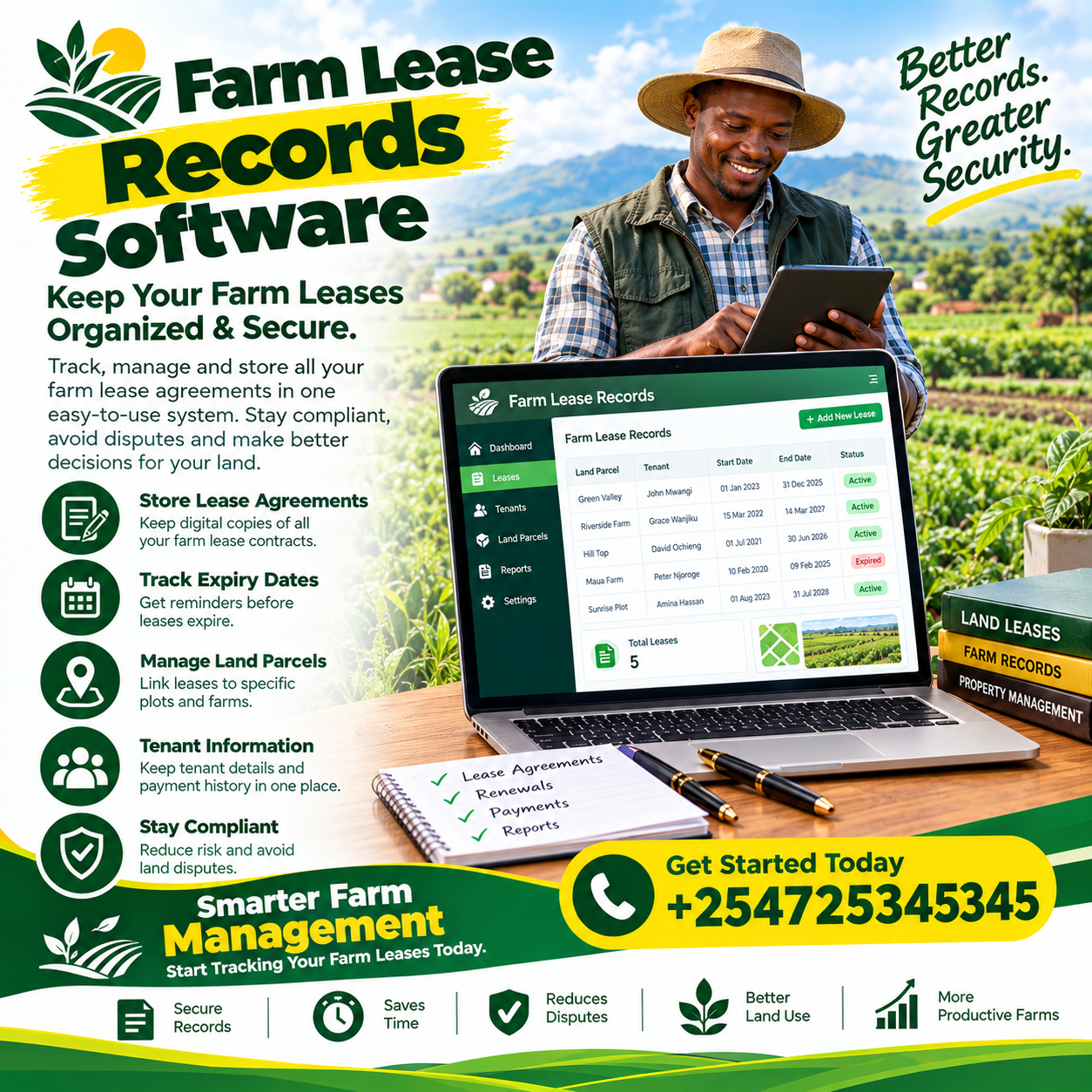
Farm lease records software is the digital system that manages the paperwork, payments, and deadlines of renting farmland — and it addresses one of the most under-managed corners of Kenyan agriculture. Thousands of farms operate on leased acres, yet lease management still runs on memory, folders, and a calendar nobody maintains.
That informality carries real risk. Agreements are stored where nobody can find them. Payment histories live in fragmented M-Pesa messages. Renewal deadlines pass unnoticed. Disputes arrive without evidence.
Software built for lease management changes the picture entirely. Agreements digitised, payments tracked against schedules, renewal alerts raised months ahead, and every document retrievable in seconds.
This case study follows a real-world pattern: a growing farm operating multiple leased blocks, the problems its paper lease files created, how it digitised, and what changed. Every lesson applies to any farm that rents land — or leases any asset.
This guide examines farm lease records software in full: what it does, the problems it solves, the features that matter, how implementation works, the results farms report, and how to choose a system that protects lease relationships the way it protects production records.
Table of Contents
ToggleThe Problem: Lease Management on Paper
The Farm and Its Leases
The farm in this pattern operates forty acres: ten owned — homestead, dairy, and core blocks — and thirty leased across three parcels from three different landowners. Two leases run five-year terms; one runs annually, renewed by conversation each season.
Eleven workers, three enterprises, and one owner who manages remotely half the week. The leased blocks produce the majority of the farm’s crops — which makes lease security, effectively, production security.
What the Paper System Looked Like
The lease files lived in three places: a folder in the owner’s home office, copies in the farm manager’s drawer, and the original documents with a relative who held the family’s papers. No single place held the complete picture.
Payments ran through M-Pesa and cash, recorded in the farm’s expense book — but never reconciled against each lease’s schedule. The farm lease records software question “is every lease current?” had no reliable answer.
Renewal dates lived in the owner’s head. The annual lease’s renewal “happened every year around the rains” — until the year the landowner’s son raised the rent verbally, weeks after the crops were planted.
The condition records — photographs of each parcel at entry, the boundaries agreed, the improvements added — existed for one lease only, because that landowner had once requested them. The other two leases had no entry documentation at all.
Improvement records were the deepest gap. The farm had sunk real money into leased land: a borehole share, irrigation lines, fencing on one parcel, and soil improvements across all three. What those investments were worth, and what the leases promised about them — unwritten, unrecorded, unprovable.
Why Paper Fails Specifically for Leases
Lease records differ from ordinary farm records in one structural way: they are legal instruments with dates that carry consequences. A missed planting note costs a season’s efficiency. A missed lease expiry can cost the land, the crops standing on it, and the improvements built into it.
Paper also fails leases through dispersion. The documents that matter are held by different people — the lawyer, the landowner, the family elder, the farm manager — and nobody holds the assembly. Every dispute, audit, or renewal becomes an archaeology exercise across five sources.
Time is the third failure. Lease documents age in folders: the agreement that was read at signing is never read again, while the clause that mattered — the renewal window, the escalation formula — sleeps until the month it detonates. A farm lease records software register keeps every clause’s consequence alive and dated, which is precisely what paper cannot do.
The Problems This Created
The first problem was the near-loss of a lease. The five-year term on the farm’s best block was expiring — and nobody noticed until the landowner’s call, three weeks after expiry, enquiring about “plans for the land.” The farm held over as a periodic tenant while scrambling to negotiate. The scare cost weeks of anxiety and a weaker negotiating position.
The second problem was the rent dispute. A disagreement arose over whether the year’s second instalment had been paid in full — the farm remembered one amount, the landowner remembered less. The M-Pesa messages existed but were scattered across two phones and a year of dates.
The third problem was the invisible improvement exposure. When the annual lease’s renewal wobbled, the farm had to calculate what it had invested in the parcel — and discovered nobody had kept the receipts, the photographs, or the value estimates together.
The fourth problem was administrative drag. Every lender conversation, every buyer audit, and every insurance renewal asked for lease documentation. The farm reconstructed its lease file each time — from memory, fragments, and folders that had drifted apart.
The fifth problem was succession anxiety. The family had begun discussing the farm’s long-term structure, and the leases — which produced most of its crops — existed nowhere as a coherent, inheritable record. What the next generation would receive was a set of relationships, not a managed portfolio.
The pattern across all five problems was identical: the farm’s lease relationships were sound, but its farm lease records software gap made every sound relationship fragile. The solution was not better relationships — it was better records.
The Decision to Digitise
The trigger was the renewal scare, and the farm’s response was characteristic of operations that learn: it fixed the process, not just the incident. The owner wrote down what lease management actually required — agreements findable, payments reconciled, deadlines alerted, documents centralised — and went looking for a system that could hold all of it.
The evaluation criteria were practical. The system had to sit inside the farm’s existing management platform rather than alongside it, because lease costs and payments belong with the rest of the farm’s records. It had to handle recurring schedules, attach documents, and raise alerts.
It had to serve the relationship too: payment receipts, statements for landowners, and a shared clarity that would make the farm the tenant every landowner prefers. The farm lease records software shortlist was evaluated against real scenarios — a payment due, a renewal approaching, a dispute arriving — rather than against feature lists.
The selection landed on the farm management platform the farm already ran, whose lease module covered agreements, schedules, documents, and alerts in one place. The decision’s logic was simple: the farm’s leases are farm records, and farm records belong in the farm’s system.
Implementation: From Folders to a System
Step One: The Lease Audit
The digitisation began with a complete lease audit — the farm’s first ever. Every lease, owned and leased, was laid out together: terms, dates, parties, rates, schedules, and every document that existed.
The audit surfaced what the folders had scattered: the expired option nobody had exercised, the unsigned renewal page, the boundary description that existed only in conversation. Each gap was closed during the audit itself — signatures obtained, terms confirmed, documents collected.
The audit took two days and produced something the farm had never held: one complete, current picture of every farm lease records software relationship it operated.
Step Two: Building the Digital Lease Register
Each lease entered the system as a structured record: the parties, the parcel with its location and acreage, the term dates, the rent with its schedule, the deposit, and the conditions. Every document attached — the agreement, the entry photographs, the receipts.
The register’s design principle was completeness per lease: one record holding everything the relationship required. The farm lease records software view that resulted gave the farm its first single-screen answer to “what do we hold, where, and on what terms?”
Step Three: Loading Schedules and Balances
Payment schedules were entered per lease: each instalment’s amount and due date. Opening balances were set from the audit — what had been paid, what remained owed — and the farm’s first true lease balance picture emerged.
The reconciliation that followed was quietly satisfying: every M-Pesa message and cash receipt from the past two years matched to its lease and its schedule. The farm lease records software history the farm had been carrying in fragments became a ledger.
Step Four: Setting the Alerts
Alerts were configured per lease: renewal warnings at twelve, six, and three months before expiry; payment reminders ahead of each instalment; and escalation notices for anything aging past its terms.
The alert design followed the lesson of the renewal scare: deadlines belong to systems, not to memories. The farm lease records software reminders now watch the calendar the farm used to watch imperfectly.
Step Five: The Landowner-Facing Discipline
The final step extended the system’s discipline outward. Every payment now generates a receipt; every landowner receives a statement on request; and the annual renewal conversation opens with a printed record of the relationship’s history.
The landowners’ reactions were uniform: appreciation. A tenant with documented payments, clear terms, and proactive communication is the tenant every landowner wants to keep — and farm lease records software practice made the farm exactly that.
The Implementation Diary: Two Days That Changed the Farm
Day one of the audit ran through the owned land first — the parcels the farm never worried about, and therefore never documented. Titles located, searches confirmed current, boundaries walked against the survey. The exercise found one surprise: an access path across the neighbouring parcel relied on goodwill nobody had ever written down. That afternoon, a right-of-way agreement was drafted and signed — the audit’s first permanent gain.
Day two ran through the three leases. Each landowner was visited in person, the lease reviewed together, the terms confirmed aloud, and the missing pieces — photographs, signatures, boundary descriptions — collected on the spot. Two of the three visits ended with the landowner remarking that no tenant had ever gone through their lease this carefully. Both remarks arrived as compliments.
The photographs taken during those visits became the register’s foundation layer: each parcel’s boundaries, improvements, water points, and access routes, dated and filed. The farm had farmed these blocks for years; it had never once held their picture. The farm lease records software register began with that gap closed.
The final audit afternoon assembled the register itself: every lease entered, every document attached, every schedule loaded, every alert armed. The owner’s closing note in the implementation diary captured the day’s product precisely: “for the first time, the farm’s land situation fits on one screen — and none of it is from memory.”
The Results: What Changed
Deadlines That Never Slip
The renewal alerts did their job in the first year: the annual lease’s renewal conversation opened eleven months before expiry, from the farm’s side, with the relationship’s full history presented. The renewal landed early, at a negotiated rate, with the term extended to three years.
The contrast with the previous year’s scramble was complete. Where the farm had once discovered expiry from a landowner’s call, it now initiates every farm lease records software deadline conversation — from strength, from evidence, from a calendar that never forgets.
The five-year leases received the same discipline: renewal windows diarised two years ahead, escalation formulas reviewed before their trigger dates, and the option pages — the ones the audit found unsigned — signed, registered, and filed where no future version of the farm can lose them.
Payments Reconciled and Undisputed
The payment discipline transformed the financial side. Every instalment is recorded against its schedule, receipted, and reconciled monthly — and the lease balance is a live figure rather than a recurring disagreement.
The rent dispute that once caused weeks of tension would today resolve in minutes: the schedule says what was due, the records say what was paid, and the balance states what remains. This is the dispute-prevention value of farm lease records software — arguments end where records begin.
The receipts changed the landowners’ side too. Each landowner now receives a receipt within a day of every payment — and the two who had previously kept no records of their own began requesting statements quarterly. The farm’s payment discipline upgraded the entire relationship’s record keeping, in both directions.
Documentation Always Ready
The administrative drag disappeared. Lender conversations, buyer audits, and insurance renewals now draw from a complete lease file generated in minutes — agreements, schedules, payment histories, and condition records, all current.
The farm’s lease documentation is now described by its lender as among the best-presented in its agricultural portfolio — a reputation built entirely on farm lease records software discipline.
Improvements Protected and Provable
The improvement register changed the farm’s negotiating position permanently. Every investment on leased land — the borehole share, the irrigation lines, the fencing — is recorded with its cost, its date, and its photographs.
When renewal conversations arrive, the register sits on the table: the farm’s investments are visible, valued, and provable. This is the leverage farm lease records software documentation gives a lessee — improvements argued from records rather than memory.
The Relationship Dividend
The deepest result was relational. All three landowners now describe the farm as their best tenant — payments punctual, communication proactive, records transparent. The farm’s lease renewals are no longer negotiated from anxiety but from standing.
The farm’s manager summarised the change: “the paper era made every landowner a potential problem; the system made every landowner a partner.” The farm lease records software dividend is trust — and trust is the cheapest lease security available.
Results Per Lease: Three Stories
The Annual Lease That Became a Three-Year Term
The annual lease — the farm’s most fragile relationship — received the system’s first renewal alert eleven months early. The conversation opened with the payment history, the condition photographs, and the improvement register on the table.
The landowner’s response surprised the farm: rather than the anticipated increase, he proposed the term extension himself. Three years, a fixed escalation, the improvements clause formalised in writing. The farm’s most exposed relationship became its most documented — the complete farm lease records software arc in one lease.
The Five-Year Lease That Hit Its Renewal Window
The best block’s lease — the one the farm nearly lost — reached its renewal window with everything in place: the schedule current, the balance at zero, the improvements valued, the option page signed. The renewal was granted without negotiation drama, on terms the records had quietly justified for two years.
The landowner’s broker, engaged for the first time in the process, reviewed the farm’s file and asked where it had been kept. The answer — one register, one system, one screen — was the moment the farm understood what its farm lease records software discipline had become: a professional credential.
The Lease With the Verbal Rent Rise
The third lease — the one where the landowner’s son had raised the rent verbally mid-season — was the audit’s hardest session. The raised rate had never been written into any document, and the farm had paid it for two seasons on goodwill alone.
The system’s arrival regularised it: the rate was written into the schedule, the arrears logic cleared, the escalation clause added, and both parties signed the updated schedule. The informal arrangement that had survived on memory became a documented term — the exact conversion farm lease records software exists to make.
The Landowners’ Perspective: What the Other Side Sees
The first landowner — the one whose lease became a three-year term — described the change from his side: “Before, I learned about my own land’s rent when the money arrived. Now I get a receipt the same day and a statement when I ask. I know exactly where I stand with this tenant, and that is worth more than the extra shillings another tenant once offered.”
The second landowner’s broker put it professionally: the farm’s file made his valuation and due-diligence work faster than any tenant relationship he had managed. The documentation did not just protect the tenant — it made the landlord’s own business easier, which is why both sides defend the farm lease records software arrangement.
The third landowner’s son — the one whose verbal rise had caused the friction — became the system’s unexpected advocate after the regularisation: “The schedule ended an argument my father and this farm were going to have eventually. Everyone knows the rate now, everyone knows the dates, and nobody has to remember anything.”
The pattern across all three perspectives is the lesson of this case study in one line: lease records do not create suspicion between parties — they create the shared facts that suspicion could never survive. This is the relational case for farm lease records software that no feature list captures.
Challenges Along the Way — and How They Were Solved
The first challenge was document collection — the agreements scattered across lawyer, family, and drawers. The audit’s two days solved it by visiting every holder in person, and the register’s completeness has made re-collection unnecessary since.
The second challenge was the landowners’ initial caution about documentation — one briefly wondered aloud whether records were preparation for a dispute. The receipts and statements answered it within a quarter: the records proved payments, not grievances, and the caution converted into the appreciation described above.
The third challenge was the improvement valuation — pricing a borehole share and aging irrigation lines for the register. The farm resolved it with dated costs from its own accounts plus current replacement estimates, and the register notes its valuation basis openly. Honest farm lease records software valuation, stated clearly, outperformed false precision.
The fourth challenge was habit: the first payment after go-live nearly went out unrecorded, out of routine. The manager’s Friday lease review — fifteen minutes, every week — caught it, and the routine has held since. Systems fail through habit gaps more than through software gaps, and this farm’s Friday review is the habit that keeps its farm lease records software register alive.
The Features That Made the Difference
The Complete Lease Register
The single-register design — every lease, every term, every document in one searchable place — is the system’s foundation. It replaced the folders, drawers, and memories that scattered the farm’s lease knowledge.
Schedules and Live Balances
Payment schedules with automatic balance tracking turned the rent relationship into a ledger. The farm knows, for every lease, what is due next and what remains — the figure that ends disputes before they start.
Multi-Level Alerts
The alert system watches every deadline: renewals at multiple warning points, payments ahead of due dates, and escalations for anything aging. Alerts are the operational heart of farm lease records software — the calendar the farm could never staff.
Document Attachment
Every agreement, photograph, receipt, and correspondence attached to its lease makes the file complete by design. Nothing lives separately, and nothing is lost.
Landowner Statements
Generated statements per landowner — payments made, balances remaining, terms — have become the farm’s relationship tool. The statements turned the farm from a tenant who pays into a tenant who communicates.
Integration With Farm Finances
Lease payments flow into the farm’s expense accounts automatically, tagged per enterprise and per block. The cost of farming on leased land is now visible in every profitability calculation — the integration that makes farm lease records software part of the farm’s financial truth rather than a side filing system.
Who Needs This Most
Tenant farms operating multiple leased blocks need lease records software structurally, because the more leases a farm holds, the more deadlines, balances, and documents multiply beyond memory. Operations like this farm’s — three leases, three landowners, staggered terms — are exactly where the discipline pays first.
Landowners leasing to multiple tenants need the mirror image of the same discipline: every tenant, every schedule, every receipt in one register. The farm lease records software landlord side runs the identical logic in reverse.
Farms seeking financing need it urgently, because lenders treat lease documentation as evidence of operational security. The farm whose lease file is current borrows on terms the folder-based farm never reaches.
Land agents and family estates managing inherited farmland complete the constituency: multiple parcels, multiple parties, and succession obligations make records the only practical management form. Estate-level farm lease records software registers have become standard practice among professional landholders.
The Economics: What Lease Digitisation Returns
The returns are concrete and repeated across operations like this one. Renewal security: the lease whose expiry is managed eleven months early is the lease that renews at negotiated terms rather than panic ones.
Dispute prevention: the rent disagreements that paperwork ends before they begin are worth more than their absence suggests — each one prevented is weeks of tension and relationship damage avoided.
Negotiating leverage: the improvement register and payment history convert renewal conversations from vulnerability to evidence. Financing access: the lease documentation that lenders reward is now a standing asset rather than a scramble.
Administrative recovery: the hours once spent reconstructing lease files for every external conversation return to actual management. Across these channels, the farm lease records software subscription is recovered many times over — and the relationships it protects are worth more than any single harvest.
The cost side deserves its own honest statement. The subscription sits inside the farm’s existing platform pricing; the implementation consumed two audit days and one Friday routine. The most expensive component was the audit’s discoveries — signatures chased, terms regularised — and every one of those discoveries was a problem the farm needed to solve regardless. The farm lease records software system did not create that work; it surfaced it while the fixes were still cheap.
Scaling Beyond Land: The Same Register for Other Leases
The farm’s success with land leases prompted the obvious extension: every asset the farm rents — the tractor hired seasonally, the cold-room space leased at the market, the vehicle on contract hire — entered the same register.
Each carries the same structure: terms, schedule, documents, alerts. The tractor’s seasonal hire now renews against a reminder rather than a scramble; the cold-room agreement’s renewal lands twelve months early with utilisation data attached; the vehicle’s contract terms are reviewed against its actual mileage before each renewal.
The extension cost an afternoon and closed the same gap across every rental relationship the farm holds. This is the quiet scaling argument for farm lease records software: the discipline built for land leases turns out to be the discipline every lease needs, and the register that started with three parcels now governs every agreement the farm signs.
Lessons for Other Farms
The first lesson is that lease management is farm management. The leases that produce the farm’s crops deserve the same records, alerts, and discipline as the crops themselves — and the farm that treats them as side paperwork eventually pays for the distinction.
The second lesson is that the audit comes first. The two-day lease audit that opened this farm’s digitisation surfaced gaps, closed them, and built the register on truth — the sequence every farm lease records software implementation should follow.
The third lesson is that alerts are the system’s heart. Deadlines missed were the farm’s original problem, and deadline alerts were its original solution. Everything else in the register serves the alerts.
The fourth lesson is that transparency strengthens relationships. The landowners who received statements and receipts did not become suspicious — they became allies. Documented farm lease records software practice is trust-building, not trust-testing.
The fifth lesson is that integration multiplies value. Lease payments flowing into farm finances, lease costs feeding enterprise profitability — the connections are what turn a lease register into farm intelligence.
The sixth lesson is the breadth one: the same register that protects land leases protects every lease the farm holds. Start with land because the stakes are highest, then extend — because the structure does not change, only the asset.
Frequently Asked Questions
What is farm lease records software?
A digital system that manages every aspect of farmland leasing — agreements, terms, payment schedules, balances, documents, and deadline alerts — in one structured register. A complete farm lease records software deployment answers, at any moment, exactly where every lease stands.
Do I need software if I only lease one block?
The disciplines matter more than the scale: one lease still carries dates, payments, documents, and improvement records worth managing properly. A structured farm lease records software register at one lease builds the habit that scales when the second and third arrive.
How does it prevent lease disputes
Through reconciliation and evidence: every payment recorded against its schedule, every term documented, every improvement photographed and valued. Disputes in farm lease records software managed relationships end at the record rather than at the argument.
Can it manage leases from the landowner’s side too?
Yes — the same register serves landlords tracking tenants, schedules, and receipts, with statements per tenant replacing memory-based collection. The farm lease records software logic is identical from both sides of the relationship.
How far ahead should renewal alerts be set?
Twelve, six, and three months before expiry is the professional standard — early enough to negotiate from strength, and layered so no single reminder is the only defence. This escalation pattern is what makes farm lease records software alerts genuinely protective rather than merely decorative.
Does the software replace my lawyer or the lease agreement?
No — it manages the records around the agreement, which remains the legal foundation drafted and reviewed by professionals. The farm lease records software system makes the agreement’s terms operational: scheduled, tracked, alerted, and evidenced.
How does lease software connect to farm finances?
Payments flow into expense accounts automatically, tagged per lease and per enterprise, so the cost of leased land appears in every profitability calculation. This integration is what makes farm lease records software part of the farm’s financial truth rather than a separate filing exercise.
What documents should be attached to each lease record?
The agreement with all schedules, entry photographs, boundary descriptions, payment receipts, improvement records with costs, and every renewal or variation document. A complete farm lease records software file is the farm’s defence and its negotiating asset in every future conversation.
Can it manage equipment and property leases too?
Yes — the same register structure governs any lease: machinery hire, cold-room space, vehicle contracts — terms, schedules, documents, and alerts per asset. The farm lease records software logic extends across every rental relationship the farm holds.
How long does implementation take?
The audit and register build typically run two to three days for a small portfolio, with schedules, balances, and alerts configured in the same window. Most farm lease records software implementations are measured in days because the records already exist — they simply need collecting and structuring.
What happens to my lease records if I stop using the software?
They should export completely — agreements, histories, and documents — because lease records are the farm’s long-term legal evidence. Confirm export capability before subscribing, and treat the farm lease records software exit test as seriously as the entry decision.
How does it help a farm seeking a loan?
Lenders assess operational security alongside production, and a current lease register — terms, balances, renewals secured — is exactly that evidence, presented in minutes. The farm lease records software documentation has become a financing credential in its own right.
What was the biggest single lesson from this case study?
That the audit surfaced problems the farm needed to solve regardless — expired options, unsigned pages, verbal rates — and the system’s role was to surface them while fixes were cheap. Every farm lease records software implementation plays that same role: it does not create the farm’s lease problems; it reveals them in time.
How do I start digitising my own leases?
Begin with the audit: lay out every lease with its documents, walk the gaps closed, build the register, load the schedules, and arm the alerts — two to three focused days for most farms. The farm lease records software journey started exactly there, and every farm that completes those steps holds what this farm now holds: every lease, current, on one screen.