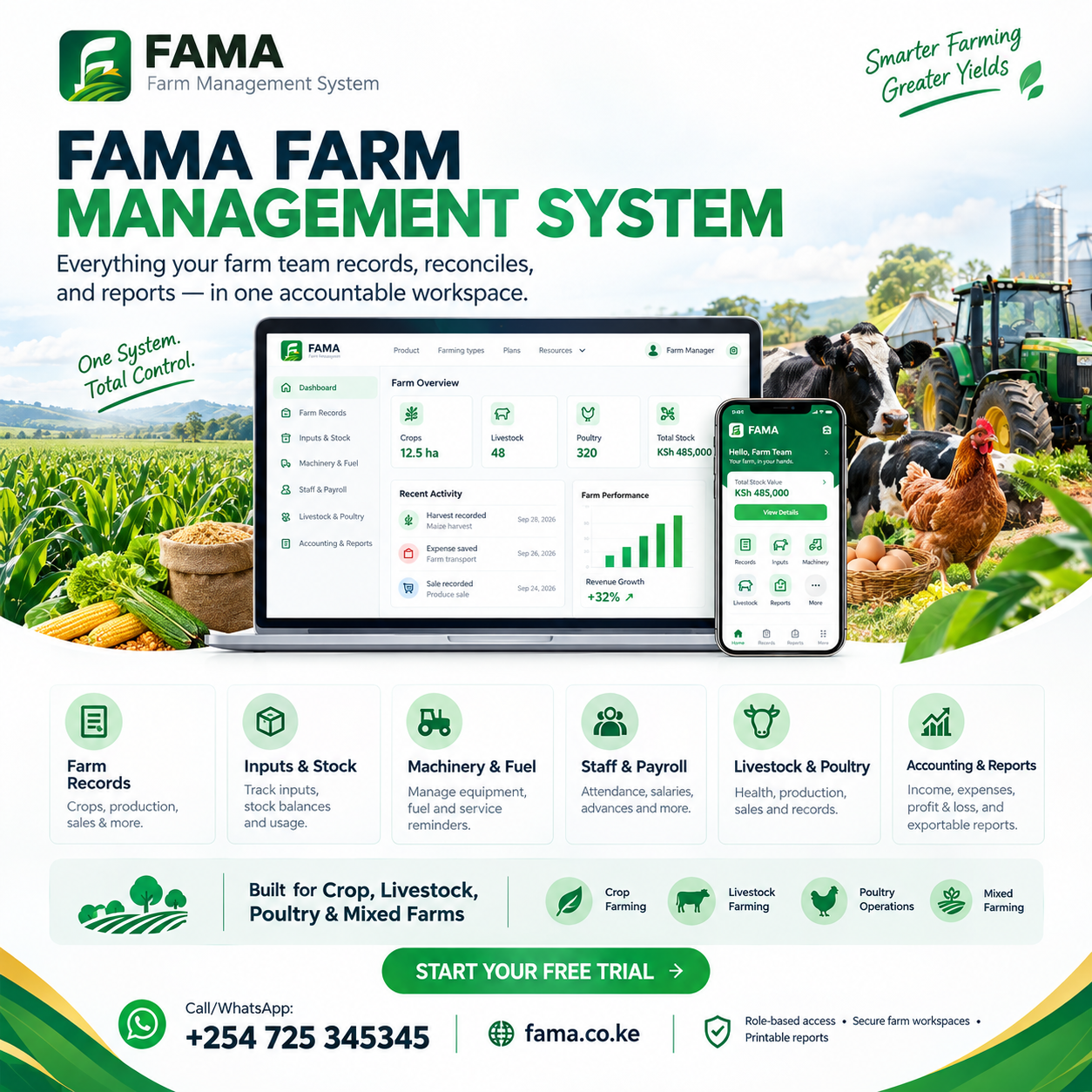
How to track crop production costs is the single most important financial skill any farmer can develop, because without accurate cost data, every decision about what to plant, when to sell, and where to invest is based on guesswork rather than facts. Fama.co.ke provides an innovative platform that makes how to track crop production costs simple and practical, helping farmers move from scattered receipts and memory to organized, verifiable cost records. Studies show that farmers who keep proper records increase their incomes by 26 per cent, yet seven out of ten commercial farmers in Kenya report having kept no records for their farm. This gap between record-keepers and non-record-keepers is the difference between profitable enterprises and struggling ones, and it is why learning how to track crop production costs has become essential for every serious farmer.
The consequences of not knowing how to track crop production costs are devastating and well-documented. A farmer in Kisumu running a 15-acre mixed farm lost KSh 840,000—almost his entire profit for the season—because he over-fertilized sections he couldn’t remember treating and missed early disease signs. One vegetable farmer in Kiambu invested KSh 180,000 but discovered she was selling at a loss because production costs exceeded market prices. Three smallholder farmers in Kiambu lost KSh 1.2 million last season because they trusted pen-and-paper ledgers to track inputs, labour, and harvests. These are not isolated cases—they are the predictable result of farming without cost data. Mastering how to track crop production costs prevents these losses by making every shilling visible and accountable.
Fama.co.ke‘s platform helps farmers understand exactly how to track crop production costs by providing tools to record, categorize, and analyze every expense against specific fields, crops, and seasons. Research has shown that there are immediate and positive returns from training in farm business skills, with increases in income of between 12 and 69 percent for participants. The ability to how to track crop production costs is the foundational skill that makes these gains possible, because farmers cannot improve what they do not measure.
The first step in how to track crop production costs is separating costs into their natural categories. Direct costs include seed, fertilizer, crop protection chemicals, labour, and machinery hire—these are expenses tied specifically to producing a particular crop. Indirect or overhead costs include land rent, equipment depreciation, insurance, and administrative expenses that support the whole farm rather than a single enterprise. Farmers who learn how to track crop production costs distinguish between these categories because direct costs are controllable per crop while overheads must be allocated fairly across enterprises. Without this distinction, farmers cannot know which crops are truly profitable.
The second principle in how to track crop production costs is recording expenses at the moment they occur, not reconstructing them weeks later. Memory fails, receipts get lost, and small expenses like transport, casual labour, and fuel add up to substantial sums that farmers routinely forget. One farmer in Nakuru discovered a KSh 380,000 discrepancy after cross-checking field notes against sales records—money that had simply vanished from his accounts because it was never recorded. A how to track crop production costs system that captures every transaction immediately eliminates this leakage.
Accurate costing requires linking every expense to a specific field or crop enterprise. When farmers know how to track crop production costs at the field level, they can identify which plots perform best and which are draining resources. A farmer who spent four seasons assuming maize was his best crop discovered through proper cost tracking that maize yielded KSh 23,000 profit per acre while sukuma wiki yielded KSh 67,000 per acre and beans actually lost money after labour costs. This is the power of how to track crop production costs — it reveals the truth that intuition hides.
Labour is often the largest and least-tracked cost in crop production. Farmers who learn how to track crop production costs record worker attendance, tasks performed, and wages paid against specific fields and activities. Without this discipline, payroll becomes a black hole where ghost workers and padded hours quietly drain profits. One tea cooperative in Nakuru lost 17 per cent of payroll to phantom workers, detected only after a government audit. Proper how to track crop production costs systems prevent such losses by tying every labour payment to verified work.
The final element of how to track crop production costs is comparing actual costs against budget and using the variance to improve future planning. Farmers who track their costs season after season build a database of historical performance that makes budgeting for the next season accurate rather than speculative. This continuous improvement cycle is what separates commercial farmers from subsistence producers, and it is the ultimate benefit of learning how to track crop production costs systematically.
Why Farmers Struggle to Track Crop Production Costs
The reasons farmers fail to track crop production costs are well understood. The lack of the right tools to keep farm records and a lack of knowledge in record keeping are the two biggest challenges reported by 68 per cent of farmers. Many farmers view farming as a retirement activity rather than a business, assuming they make a profit without proper records. This mindset, combined with the complexity of manual bookkeeping, leads to a widespread failure to track costs.
The complexity of crop production makes cost tracking particularly challenging. A single maize crop involves land preparation, seed, fertilizer, herbicides, pesticides, labour, transport, and harvesting costs spread across several months. Without a systematic method for capturing these costs, farmers rely on memory and estimates that are rarely accurate. The consequences of poor record-keeping are severe, particularly for smallholder farmers who face difficulties in meeting the stringent record-keeping requirements demanded by financial institutions when seeking credit.
Cash flow management is another area where the lack of cost tracking causes problems. Farmers cannot plan for lean seasons or forecast cash needs without understanding their cost structure. One farmer noted that prior to using digital tools, he was losing significant money because the farm manager could sell a pig and claim it died or mismanage inventory. Cost tracking prevents such losses across all farm enterprises.
Key Cost Categories to Track in Crop Production
Understanding what to track is the foundation of knowing how to track crop production costs effectively. The following categories capture the major expenses in most crop enterprises.
Seed and Planting Material
Seed costs vary from recycled farm-saved seed at minimal cost to certified hybrid seed at premium prices. For maize, certified seed costs approximately Sh300 per kilogram, while hybrid varieties command higher prices. Farmers must record the exact quantity, variety, and cost of all planting material, including costs of treating or preparing seed before planting.
Fertilizer and Soil Amendments
Fertilizer represents 40 to 50 per cent of variable costs in most cereal crops. Farmers should record basal fertilizer applications at planting, top-dressing applications during growth, and any organic amendments or lime applied to correct soil acidity. With subsidized DAP at Sh1,800 per 50kg bag and commercial prices at Sh3,200, the source of fertilizer significantly affects cost per acre.
Crop Protection Chemicals
Herbicides, fungicides, and insecticides form the crop protection budget. Potato farmers spend Sh8,000 to Sh14,000 per hectare on fungicides alone. Recording product names, quantities, application dates, and costs allows farmers to evaluate whether treatments delivered returns and to identify opportunities to reduce unnecessary applications.
Labour
Labour includes permanent employees, casual workers, and family labour. Each worker-hour should be recorded against specific tasks and fields. Labour costs range from Sh5,000 to Sh10,000 per acre for most crops, making it a significant expense that must be tracked with precision.
Machinery and Equipment
Ploughing, harrowing, planting, spraying, and harvesting costs must be captured whether equipment is hired or owned. When equipment is owned, costs include fuel, maintenance, depreciation, and operator labour. When hired, the contract fee is recorded. Land preparation costs in Kenya range from Sh4,000 to Sh7,000 per acre.
Irrigation and Water
Pumping costs, water charges, and irrigation labour must be tracked for irrigated crops. Drip irrigation adds capital costs that must be depreciated over the system’s life, plus ongoing maintenance and energy costs.
Transport and Marketing
Moving produce from farm to market or aggregation centre costs money that must be included in cost of production. Packaging materials, loading fees, and transport charges are all part of the cost structure that determines true profitability.
Overheads and Administration
Land rent, insurance, administrative costs, and finance charges must be allocated across enterprises. These overheads are often ignored by farmers, leading to an inflated sense of profitability.
Methods for How to Track Crop Production Costs
Several methods exist for tracking crop production costs, each suited to different farm sizes and management styles.
Manual Record Books
The simplest method involves a dedicated notebook where every expense is recorded with date, category, amount, and field reference. This approach works for very small farms but is prone to errors, loss, and difficulty in analysis. Monthly totals can be calculated by adding entries, but generating reports requires significant manual effort.
Spreadsheet Templates
Excel or Google Sheets templates allow farmers to record costs in structured tables that can be summed and analysed. This method improves on manual books but still requires discipline in data entry and is difficult to use in the field.
Dedicated Farm Accounting Software
Software built specifically for agriculture provides the most robust solution for how to track crop production costs. These platforms offer mobile data entry, automatic categorization, integration with M-Pesa, and report generation. Fama.co.ke provides these capabilities with offline functionality, making it practical for farmers in rural areas.
Hybrid Approaches
Many farmers combine methods, using mobile apps for field data capture and spreadsheets for analysis. The key is consistency—whatever method is used must be applied to every transaction without exception.
Step-by-Step Guide to Tracking Crop Production Costs
Following a structured process makes how to track crop production costs manageable even for first-time record-keepers.
Step 1: Establish Your Cost Categories
Before planting, define the cost categories you will use. Standard categories include seed, fertilizer, chemicals, labour, machinery, irrigation, transport, and overheads. Customize these to match your specific crops and farming system.
Step 2: Set Up Field and Crop Codes
Assign a unique code to each field and crop enterprise. This allows every expense to be attributed to the right production unit, enabling field-level profitability analysis.
Step 3: Record Every Expense Immediately
Capture each expense at the moment it occurs. Use a mobile app that works offline to record seed purchases, labour payments, chemical applications, and transport costs as they happen. Never rely on memory.
Step 4: Record Labour Daily
Labour is the most frequently mismanaged cost. Record worker attendance, tasks performed, and wages paid every day. Use biometric verification where possible to prevent ghost workers.
Step 5: Track Input Usage Against Fields
Record not just the cost of inputs but where they were applied. Knowing that 50kg of DAP went to Field A and 30kg to Field B is essential for accurate per-acre costing.
Step 6: Record Harvest Quantities
Capture the quantity harvested from each field and the date of harvest. This data is essential for calculating cost per kilogram and yield per acre.
Step 7: Record Sales and Revenue
Track every sale, including quantity, price, buyer, and date. This completes the revenue side of the profitability equation.
Step 8: Calculate Cost Per Unit
Divide total costs by total production to determine cost per kilogram or per bag. Compare this against selling price to determine profitability.
Step 9: Analyse and Compare
Review reports showing cost by category, cost per acre, cost per kilogram, and profit per enterprise. Compare against budget and previous seasons to identify trends and improvement opportunities.
Step 10: Use Data for Planning
Apply the insights from cost tracking to the next season’s planning. Adjust input rates, renegotiate supplier prices, change crop mix, or modify labour deployment based on what the data reveals.
Common Mistakes in Tracking Crop Production Costs
Even farmers committed to tracking costs make mistakes that undermine the value of their records. Understanding these pitfalls helps avoid them.
Forgetting Small Expenses
The KSh 200 for transport, the KSh 500 for casual labour, the KSh 300 for packaging—these small costs accumulate into thousands over a season. A farmer discovered that unrecorded transport and miscellaneous expenses represented 18 per cent of total costs.
Mixing Personal and Business Finances
When farm money and household money share the same account, cost tracking becomes impossible. Every transaction must be attributed to the correct purpose. Separating finances is the first discipline of knowing how to track crop production costs.
Recording Only Cash Transactions
Farm expenses often involve credit from suppliers, in-kind payments, and family labour. All these must be valued and recorded even when no cash changes hands.
Failing to Link Costs to Fields
Recording that fertilizer was purchased without recording where it was applied prevents field-level profitability analysis. Attribution is essential.
Ignoring Depreciation
Equipment loses value over time. Ignoring depreciation overstates profitability and leads to underinvestment in replacement machinery.
Recording Costs After the Season
Reconstructing costs months later guarantees inaccuracy. Costs must be recorded at the moment they occur.
How Fama.co.ke Helps You Track Crop Production Costs
Fama.co.ke provides the digital infrastructure to make tracking crop production costs simple, practical, and accurate.
Mobile Data Entry That Works Offline
The platform works offline, allowing farmers and field staff to record expenses in the field without waiting for network coverage. Data syncs automatically when connectivity returns, ensuring no transaction is lost.
Automatic M-Pesa Integration
Every M-Pesa transaction is automatically captured and matched to expense categories. This eliminates manual entry for the majority of farm payments, reducing errors and saving time.
Field-Level Cost Attribution
Every expense can be linked to a specific field, crop, or enterprise. This enables precise calculation of cost per acre and per kilogram for each production unit.
Labour and Payroll Tracking
The platform tracks worker attendance, tasks performed, and wages paid. Payroll is calculated automatically, eliminating ghost workers and payment errors.
Real-Time Cost Dashboards
Farmers can see their running costs by category, field, and enterprise at any time. This real-time visibility enables immediate corrective action when costs exceed budget.
Automated Reports
The platform generates profit and loss statements, cost per unit reports, and yield analysis that show exactly how profitable each crop and field is. These reports inform decisions on crop mix, input rates, and marketing.
KRA-Ready Documentation
All cost records are maintained in a format that supports KRA eTIMS compliance, ensuring that legitimate expenses are properly documented for tax purposes.
The Financial Impact of Tracking Crop Production Costs
The evidence that tracking crop production costs improves profitability is overwhelming and documented across multiple studies.
Increased Income
Studies show that farmers who keep records increase their incomes by 26 per cent. Research in Kenya indicates that farm business training, which includes cost tracking, leads to income increases of 12 to 69 per cent for participants.
Reduced Input Waste
Farmers who track costs identify waste and eliminate unnecessary spending. Field trials with decision support tools showed fungicide sprays dropped by half—from 12 to 6 per season—while maintaining yields. This 50 per cent reduction in chemical costs directly improves profitability.
Better Market Timing
Cost tracking reveals the true cost of production, enabling farmers to set minimum selling prices and time sales strategically. Alfred Mweti, a potato farmer in Meru, stores his crop for up to four months and sells when prices reach Sh3,000 per bag instead of Sh2,500 at harvest.
Improved Access to Credit
Financial institutions require documented financial histories before lending. Farmers who track costs build creditworthiness and access financing that is unavailable to those without records.
More Profitable Crop Choices
Cost tracking reveals which crops and fields are profitable and which are losing money. Farmers can then allocate resources to the most profitable enterprises.
The Future of Crop Cost Tracking in Kenya
The trajectory of crop cost tracking in Kenya points toward increasing digitization and integration with national systems. The Kenya Integrated Agriculture Management Information System (KIAMIS) has registered millions of farmers and provides a national infrastructure that farm-level tools can integrate with. As digital tools become more affordable and accessible, the practice of knowing how to track crop production costs will shift from a specialist skill to a standard practice.
The integration of AI-powered analytics will make cost tracking even more powerful. Predictive models will help farmers anticipate costs, forecast profitability, and optimize input decisions before planting. Real-time benchmarking will allow farmers to compare their performance against peers and identify improvement opportunities.
The continued expansion of mobile money and digital payment systems will reduce the effort required to capture transaction data. Automatic expense categorization and receipt scanning will further lower the barriers to accurate record-keeping.
Frequently Asked Questions About How to Track Crop Production Costs
What is the simplest way to track crop production costs?
The simplest method is a dedicated notebook where every expense is recorded immediately with date, category, amount, and field reference. However, digital tools like Fama.co.ke make the process much easier and provide automatic calculations and reports.
What are the main cost categories in crop production?
The main cost categories are seed and planting material, fertilizer and soil amendments, crop protection chemicals, labour, machinery and equipment, irrigation, transport and marketing, and overheads and administration.
Why do farmers fail to track production costs?
The lack of the right tools and lack of knowledge in record keeping are the two biggest challenges reported by 68 per cent of farmers. Many farmers view farming as a retirement activity rather than a business and assume they make a profit without proper records.
How does tracking costs improve profitability?
Tracking costs reveals where money is being wasted, enables accurate pricing, supports better crop choices, and builds records that access credit. Studies show that farmers who keep records increase their incomes by 26 per cent.
Can I track crop production costs without internet access?
Yes. Fama.co.ke works offline, allowing data recording without internet access. The platform syncs automatically when connectivity is restored, ensuring records are never lost.