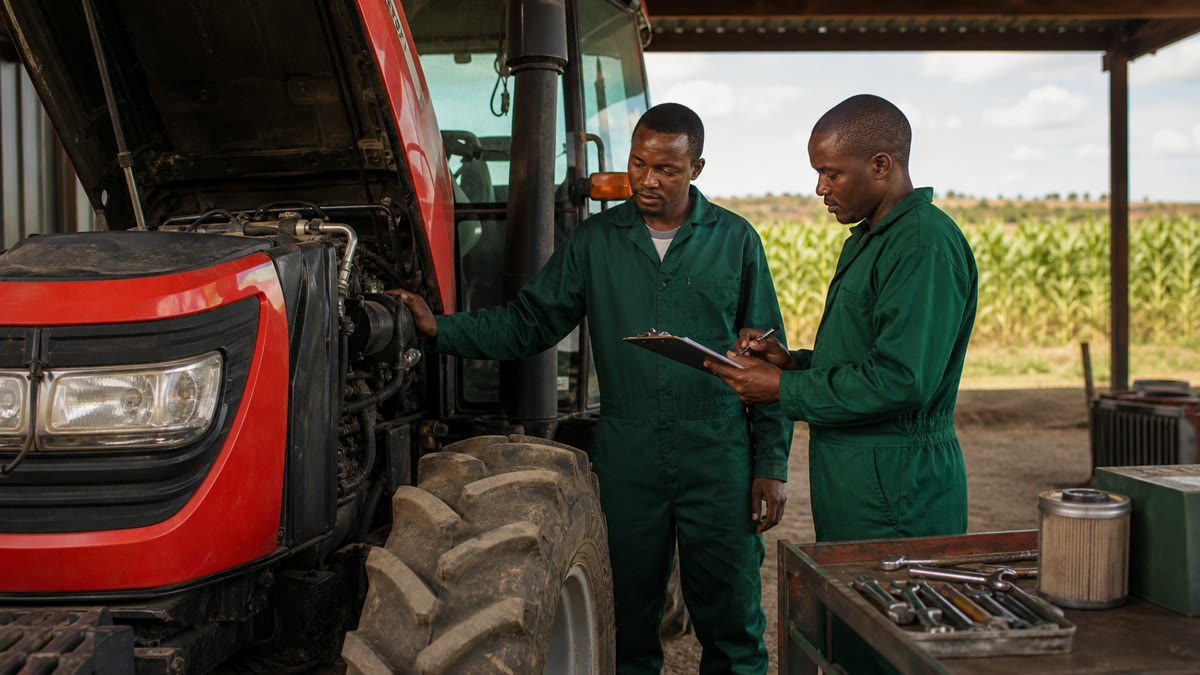
Farm machinery maintenance is the discipline that keeps every machine on a farm — tractor, implements, pumps, generators, vehicles — alive, productive, and covered, and its defining principle is completeness: no machine left untracked, no service left unrecorded, no warranty left to lapse unnoticed. Most farms maintain their tractor and forget everything else. The implements get serviced when they break, the pump gets attention when it stops, and the generator waits until the blackout it fails during.
That pattern of partial coverage is where machinery money dies. A farm’s machinery is a system, not a machine — and a system is only as reliable as its least-maintained component. The serviced tractor pulling an unserviced planter loses the planting day anyway.
Complete farm machinery maintenance coverage means every machine has a status: what was serviced, when, what is due next, what remains under warranty, and what its history says about its future. It means the farm manager can answer, for any machine, in under a minute: is this ready for the season?
This guide examines machinery maintenance in full: what complete coverage actually includes, why gaps cost more than farms calculate, how warranty and dealer service fit the picture, how service records build value, how to track status across a whole fleet, and the systems that make coverage automatic rather than heroic.
Table of Contents
ToggleWhat Complete Machinery Service Coverage Actually Means
Coverage is the difference between maintaining machines and maintaining a machine. Partial maintenance protects the tractor and exposes everything else; complete coverage protects the whole working system the season depends on.
A complete farm machinery maintenance programme gives every machine four things. A service schedule — the intervals at which it must be serviced, per its manual and its workload. A service history — the dated record of everything done to it since new.
A status position — where the machine currently stands against its schedule, and what is due next. And a coverage file — the warranty terms, dealer arrangements, and documentation that protect the farm’s rights when something fails.
The tractor typically has all four. The implements rarely have any — and the pumps, generators, and vehicles sit somewhere in between. Completing the picture across every machine is what turns scattered maintenance into managed farm machinery maintenance.
Coverage also has a time dimension. Machines need service before their season, not after their failure — so coverage means the planter is ready before planting week, the sprayer before the first spray, and the mower before the cutting window. Timing is the practical test of whether coverage is real.
Why Coverage Gaps Cost More Than Farms Calculate
The first cost is the season lost to the forgotten machine. The tractor serviced and ready, the planter with a seized metering unit, the sprayer with cracked seals — the bottleneck machine dictates the day, and the bottleneck is always the least-maintained one.
The second cost is warranty forfeited. Manufacturers condition warranty claims on documented servicing at stated intervals, and machines whose service history has gaps are machines whose claims get declined. Every lapsed farm machinery maintenance record on a machine inside its warranty years is money the farm paid for protection it can no longer use.
The third cost is resale value destroyed. The used market prices service history above almost everything else, and machines without records sell at twenty to forty percent discounts against identical documented ones. The gap in coverage is a discount taken silently at the sale.
The fourth cost is the breakdown cascade. Neglected machines fail in chains: a dry bearing seizes, the seizure damages the shaft, the shaft damages the drive, and a twenty-shilling grease session becomes a hundred-thousand-shilling repair. Coverage exists to intercept the first link.
The fifth cost is managerial blindness. Farms without coverage cannot see their fleet’s true condition, cannot budget maintenance accurately, and cannot decide rationally which machines to keep, service, or replace. The decisions get made by crisis instead — and crisis decisions are the most expensive kind.
The Full Machinery Set: What Needs Coverage
The Tractor
The tractor carries the deepest service requirements — engine oil and filters on hour intervals, hydraulics, transmission, cooling, electrics — and typically receives the most attention. The hour-based schedule, as covered in dedicated service planning, is the tractor’s backbone.
But even the tractor’s coverage extends beyond the engine: tyres, brakes, clutch, and three-point linkage all wear, and all belong in the farm machinery maintenance schedule with their own inspection points and replacement thresholds.
Tillage Implements: Ploughs and Harrows
Ploughs and harrows wear where they cut: discs, shares, points, and bearings consume themselves against soil every working hour. Their maintenance is consumption management — measuring wear, replacing cutting parts before performance degrades, and greasing bearings on schedule.
The worn disc that smears instead of cuts, the slack bearing that wobbles the gang — each degrades seedbed quality silently. Farms that inspect tillage farm machinery maintenance components before each season preserve both the implement and the seedbed it produces.
Planters: Precision That Demands Attention
The planter is the most precision-critical implement on the farm, and its maintenance is calibration: seed meters cleaned and tested, plates or rollers matched to the seed size, furrow openers replaced when worn, and the whole unit tested across a test run before planting week.
A planter maintained annually in the quiet weeks plants evenly; a planter pulled from the shed and loaded on planting morning plants gaps and doubles that the harvest will reveal too late. Pre-season farm machinery maintenance preparation is what makes planting precision real.
Sprayers: Seals, Nozzles and Calibration
Sprayers deteriorate chemically and mechanically: seals crack, pumps lose pressure, and nozzles wear — changing their output silently upward. The sprayer’s pre-season service is seal inspection, pump testing, nozzle replacement, and full calibration against a measured output.
The uncalibrated sprayer applies the wrong dose with perfect confidence, and the cost lands in wasted chemical, damaged crops, or failed control. Sprayer coverage is crop protection coverage — the two are the same farm machinery maintenance line item.
Mowers and Balers: The Hay Chain
Mower blades, guard plates, and drive belts determine cut quality; baler knotters, pick-up tines, and belts determine whether hay binds at all. Both machines concentrate their working year into a few weeks — which makes their pre-season service the only service that matters.
The baler that fails mid-hay-week fails at the moment its output is worth the most, and the repair queue at the dealer in hay season is the longest of the year. Hay farm machinery maintenance is done in the quiet months, or it is not done.
Pumps, Generators and Irrigation Equipment
The machines that run continuously — irrigation pumps, borehole pumps, generators — accumulate hours invisibly and fail expensively at the worst moments. Their coverage is hour-tracking and scheduled service like any tractor’s, plus fuel system and cooling care for generators.
The generator serviced monthly starts during the blackout; the generator ignored does not. Farms that discovered this during the first long outage reorganised their farm machinery maintenance priorities permanently.
Vehicles and Trailers
Delivery vehicles and trailers carry their own legal and safety obligations: brakes, lights, tyres, and serviceability. Their maintenance belongs in the same system as everything else, because the delivery that fails strands the produce and the sale together.
Warranty Coverage: The Protection You Paid For
Every new machine carries a warranty — typically one to two years or a stated hour limit — and the warranty’s value survives only inside its conditions. The core condition is almost universal: documented servicing at the manufacturer’s stated intervals, by authorised service where specified, with genuine parts.
The farm that services on schedule and files the records holds a warranty it can use. The farm that services late, undocumented, or with unrecorded work holds paper. This is why farm machinery maintenance records are not administrative decoration on new machines — they are the warranty’s activation key.
Warranty tracking also has dates and limits that expire quietly: the hours cap that arrives before the months cap on a busy machine, the coverage tiers that exclude wear items, and the expiry dates that pass unremarked. A coverage file that states every machine’s warranty end date prevents the surprise claim on the expired policy.
Where warranty is about to lapse, the professional move is the pre-expiry inspection: a full dealer check of everything covered, so latent faults are found and fixed under warranty rather than at the farm’s cost a month later. Operations that run this farm machinery maintenance habit before every warranty expiry routinely collect repairs they would otherwise have paid for.
Extended warranties and service contracts deserve evaluation on the same evidence basis: what they cost, what they cover, and what the machine’s own history says about its likely repair needs. For machines with strong histories, self-insurance through a maintenance fund often beats the contract — but the decision needs the records to make it honestly.
Service Records: The History That Pays Twice
The service record is the machine’s biography, and its completeness determines the machine’s value twice: in reliable operation today, and in resale price tomorrow. The record worth keeping states specifics — date, hour-meter reading, work performed, parts used with brands, and who performed the service.
Hand-written logbooks count. Digital records count more, because they cannot be lost to water, fire, or a drawer’s migration, and because they can be searched, totalled, and handed over with the machine. Operations that migrated their farm machinery maintenance records digitally report the resale difference directly: documented machines attract buyers, undocumented machines attract inspectors.
The history also diagnoses. A machine whose records show recurring bearing failures is telling its owner something specific; a machine whose fuel consumption has crept across seasons is reporting its engine’s decline. Records turn maintenance from reactions into readings.
Fleet decisions depend on the same histories. Which machines earn their keep, which cost more in repairs than their work justifies, which deserve replacement before the season — these are record-based decisions, and the farm without coverage makes them blind every budgeting cycle.
Tracking Coverage Across a Whole Fleet
The tracking problem grows with every machine added. One tractor and three implements can live in a logbook; eight machines across four sites, each with its own schedule, history, and warranty dates, cannot. Fleet coverage requires a system that holds every machine’s position simultaneously.
The manual fleet solution is the maintenance register: one file listing every machine, its service intervals, its last service, its next due point, and its warranty expiry — reviewed monthly, updated after every service. The register works until it doesn’t, and the “doesn’t” arrives exactly when the season gets busy.
The digital solution removes the arithmetic and the memory: every machine registered with its schedule, every service logged against its hours or dates, and the next-due position computed and alerted automatically. Fleet farm machinery maintenance tracking on structured systems reports the same result everywhere: machines stop falling through the gaps, because the gaps raise their own alarms.
The fleet view also exposes the pattern the register hides: machines chronically overdue, service costs concentrating in one unit, and implements whose maintenance has been skipped for two seasons running. Visibility of the pattern is what converts fleet maintenance from firefighting into scheduling.
Alerts complete the tracking layer: service-due reminders per machine, warranty-expiry warnings per unit, and pre-season preparation reminders timed to each machine’s season. The fleet that reminds its own manager is the fleet that arrives ready — and readiness is the entire commercial purpose of farm machinery maintenance.
Pre-Season Preparation: The Coverage Ritual
The pre-season service is maintenance timed to matter, and it follows the calendar backward from each machine’s season. Six weeks before planting: the tractor’s service, the planter’s calibration, the sprayer’s seals and nozzles. Six weeks before hay season: the mower’s blades and the baler’s knotters.
The ritual is a checklist per machine, executed in the quiet weeks when parts are available and dealers are unqueued. Every task completed pre-season is a season-day saved — and season-days are the scarcest resource in farming.
The pre-season review also surfaces the decisions the season will force: the implement too worn to serve another year, the repair worth doing versus the replacement worth making, the part to order before it becomes urgent. Coverage turns these into planned farm machinery maintenance decisions instead of mid-season emergencies.
The end-of-season close-out completes the ritual: machines cleaned, serviced before storage, fuels treated, batteries disconnected, implements under cover. The maintenance done at storage is the maintenance the next season doesn’t have to do in panic — and off-season neglect is where stored machines die quietly.
Budgeting for Complete Coverage
Maintenance budgeting starts with the rule of thumb: three to eight percent of each machine’s value per year, rising with age and workload. The fleet’s total follows — and the budget that funds it before the season services on schedule, while the budget funded from weekly cash skips services in the tight weeks.
The budget splits into predictable and unpredictable halves. Predictable: the scheduled services, whose quantities and costs the fleet’s schedule states in advance. Unpredictable: the repairs, whose fund is built from history — and whose history only exists where farm machinery maintenance records have been kept.
Consumables deserve their own line: oils, filters, grease, blades, discs, knotters, seals, nozzles. The spares shelf stocked before each season converts mid-season breakdowns from week-long waits into hour-long repairs, and the shelf’s cost is trivial against the downtime it prevents.
Dealer service versus local mechanics versus owner-servicing is a cost decision the records inform: routine services run locally for speed and economy, major services at dealers for expertise and warranty weight. The farm machinery maintenance operations that split deliberately capture both advantages.
Systems vs Paper for Machinery Coverage
The paper system — logbooks per machine, a fleet register, a wall calendar of due dates — holds coverage together at one-machine scale and dissolves beyond it. Its failures are structural: entries forgotten in busy weeks, histories scattered across books, warranty dates living in nobody’s memory.
The systemised alternative holds every machine’s position live: schedules per unit, services logged against hours, next-due computed automatically, warranties tracked to their expiry, and every history searchable from a phone. Operations that migrated farm machinery maintenance to structured systems describe the same discovery: the gaps they assumed were closed were open, and the alerts closed them permanently.
The integration advantage compounds the case: machinery records feeding the farm’s cost accounts, machinery hours feeding utilisation analysis, and maintenance costs feeding the replace-versus-repair decisions that every ageing fleet eventually faces. Coverage inside the farm’s management system serves decisions, not just filing.
Who Needs Complete Coverage Most
Farms running more than three or four machines need coverage structurally, because the tracking burden outruns memory at exactly that scale. Operations that industrialised their farm machinery maintenance across whole fleets run uptime percentages manual fleets cannot approach.
Contractors and hire operators carry the heaviest obligations, because their machines work the longest hours under paying customers, and a breakdown mid-contract costs the job as well as the repair. The contractors whose coverage is visible in records win the work, because buyers of machine services increasingly ask for exactly that evidence.
Farms with machines inside warranty need coverage’s records most urgently of that group, because the warranty’s value survives only inside its conditions. The new-machine years are precisely when farm machinery maintenance documentation is money in the bank.
Farms in hay, irrigation, and season-critical enterprises complete the priority list, because their machines concentrate their value into windows where downtime is unaffordable. For these operations, coverage is not an efficiency choice — it is the season’s insurance policy, written in service records instead of premiums.
Common Mistakes That Break Coverage
The first mistake is servicing the tractor and forgetting the implements — protecting the engine while the season’s bottleneck waits unserviced. Coverage means the whole set, and the set is what the season actually uses.
The second is the missing record — work done, nothing written — which forfeits the warranty, the resale value, and the diagnosis all at once. Every farm machinery maintenance service deserves its dated, specific entry, however small.
The third is pre-season preparation skipped for the season’s busyness — the quiet weeks used for anything except the machines that will define the loud ones. The pre-season ritual is the coverage system’s core, and skipping it converts maintenance into mid-season crisis management.
The fourth is warranty conditions ignored — servicing late, using unrecorded work, missing the expiry inspection — until a claim surfaces the gap. The coverage file that states every machine’s terms and dates prevents the entire category.
The fifth is budgeting maintenance from crises instead of schedules — funding repairs when they arrive and skipping services when cash is tight. The pre-funded farm machinery maintenance budget is what keeps the schedule intact through the tight weeks, and the tight weeks are always when the machines are needed most.
The Future of Machinery Coverage
Sensors and telematics are closing the tracking gap from the machine side: newer equipment logs its own hours, monitors its own fluids, and reports its own service needs to platforms that schedule the next milestone automatically. The farms whose farm machinery maintenance records are already digital will absorb that future without changing anything.
The deeper shift is verified maintenance as a market credential: machinery sold with complete digital histories commanding their premiums, service contracts priced from documented histories, and buyers and lenders reading coverage discipline as management quality. The fleets whose coverage is already complete are building exactly the evidence that economy will price.
Frequently Asked Questions
What does complete machinery service coverage mean?
Every machine on the farm — tractor, implements, pumps, generators, vehicles — carrying four things: a service schedule, a dated service history, a live status against that schedule, and a warranty or coverage file. Complete farm machinery maintenance means the manager can state any machine’s readiness in under a minute.
Why do implements need maintenance if the tractor is serviced?
Because implements wear where they work — discs, blades, meters, seals, knotters — and a serviced tractor pulling a failed implement loses the day anyway. The season runs on the whole set, which is why complete farm machinery maintenance covers every machine the season depends on.
How does maintenance affect my machine’s warranty?
Warranties condition coverage on documented servicing at stated intervals with genuine parts, and undocumented or late servicing voids the protection. Keeping complete farm machinery maintenance records during the warranty years is what turns the paper into usable protection.
How often should implements be serviced?
Before their season, every season: planters calibrated six weeks before planting, sprayers resealed and recalibrated before the first spray, mowers and balers serviced before the hay window. Season-timed farm machinery maintenance is the only implement schedule that matters, because implements concentrate their year into weeks.
How do I track service status across a whole fleet?
With a register or system holding every machine’s schedule, last service, next due point, and warranty expiry — reviewed monthly, or tracked digitally with automatic alerts. Fleet-scale farm machinery maintenance exceeds memory around the fourth machine, and structured tracking closes the gaps alerts would otherwise find.
Does service history really affect resale value?
Decisively — identical machines differ by twenty to forty percent in price on records alone, because buyers price unknowns pessimistically. Sellers holding complete farm machinery maintenance histories recover their record keeping several times over at the sale.
How much should I budget for machinery maintenance?
Three to eight percent of each machine’s value per year, rising with age and workload, split between scheduled services and a repair fund built from the fleet’s own history. Pre-funding the farm machinery maintenance budget before the season is what keeps services on schedule through the tight weeks.
What should be done before storing machinery at season’s end?
Clean everything, service before storage, treat fuel systems, disconnect batteries, cover implements, and record what was done — because the maintenance done at storage is the panic the next season doesn’t inherit. End-of-season farm machinery maintenance is where stored machines are saved from the quiet deaths that off-season neglect causes.