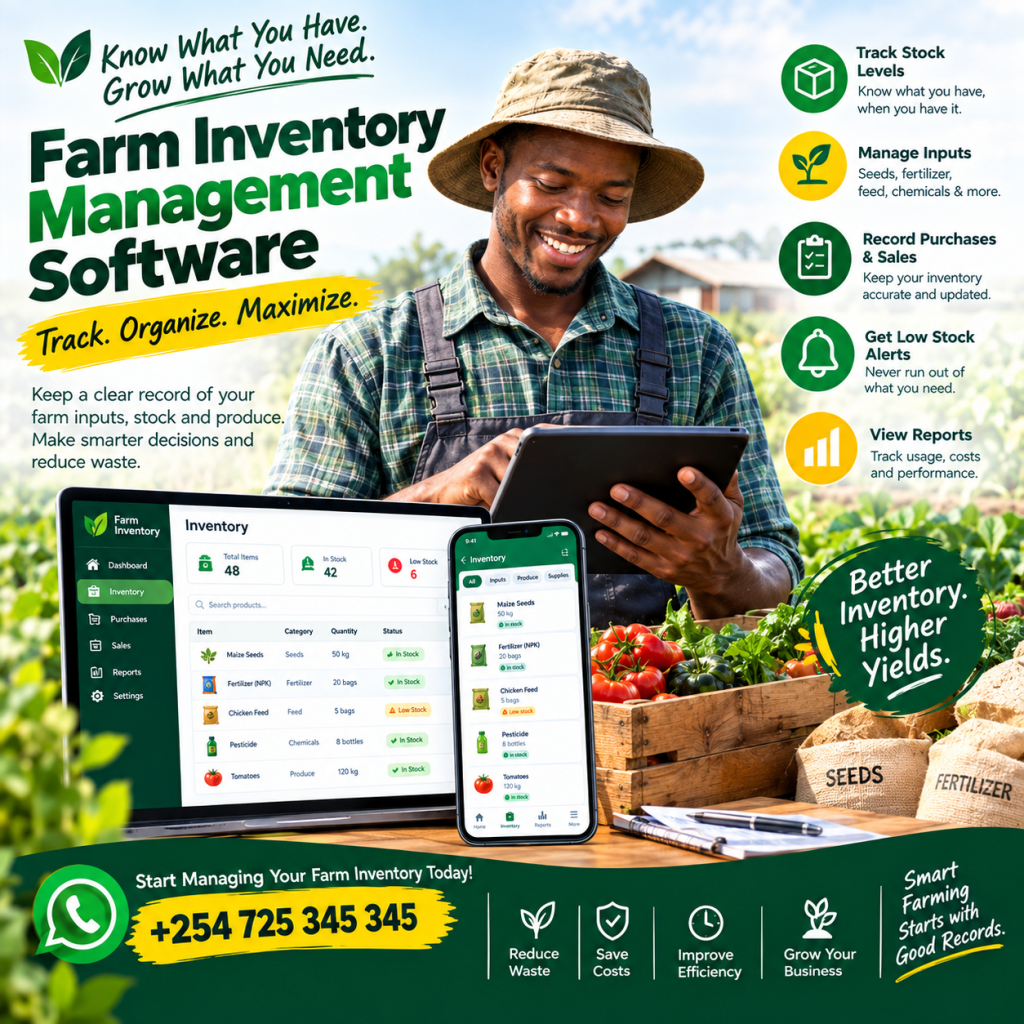
Farm inventory management software is the digital system that gives a farm complete, live control over everything it owns and uses — the fertiliser in the store, the feed in the godown, the chemicals on the shelf, the harvested produce awaiting sale, the tools, the fuel, the vaccines — with every receipt, issue, and balance recorded the moment it happens.
Inventory is the quietest profit killer in agriculture: inputs bought and never used, feed issued to nobody in particular, chemicals expiring on the shelf, produce shrinking between the store and the sale, and tools that walk away — each loss small enough to ignore individually and large enough, together, to consume a double-digit share of a farm’s annual margin.
Most farms respond to this problem with better intentions and another lock on the door, yet the leak persists, because the root cause is not dishonesty or carelessness but invisibility: stock that nobody counts, balances that nobody trusts, and usage that nobody records cannot be controlled by anyone.
A dedicated farm inventory management software platform ends that invisibility permanently, replacing the chalkboard, the notebook, and the guesswork with live balances, automatic deductions, expiry alerts, and a complete audit trail of who took what, when, and for which enterprise.
This guide examines farm inventory management software in full: why farm stock leaks money without a system, what the software actually does, the five types of inventory every farm must track, the features that matter, the benefits farms report after digitising, how to choose and implement the right system, and what the investment returns.
The timing of this shift is no accident, because the economics of farm inputs have changed. Fertiliser, feed, seed, and chemical prices have risen sharply in recent years, which means every wasted bag now costs dramatically more than it did five seasons ago — and at the same time, margins have compressed, so farms can no longer afford the quiet ten percent that used to disappear unnoticed.
The farms that have adopted farm inventory management software consistently describe the same first-month experience: the opening stocktake reveals discrepancies nobody expected, and the first weeks of disciplined recording reveal exactly where the farm’s inventory money has been going.
That revelation — uncomfortable, but decisive — is what turns inventory software from an administrative purchase into the most immediately profitable tool on the farm.
Why Farm Stock Quietly Disappears Without a System
The first leak is over-purchasing driven by blind stores. When balances are unknown or untrusted, the safe response is always to buy more than needed “just in case” — and across a season, this caution accumulates into shelves of duplicate inputs, fertiliser carried over past its best-by window, and feed bought twice because the first delivery could not be confirmed.
The capital tied up in these unnecessary purchases is real money doing nothing, and it is invisible until a proper farm inventory management software deployment forces the first honest stocktake.
Farms that digitise routinely discover they were holding thirty to fifty percent more stock than their operations required — capital that immediately becomes available for better uses once the store becomes transparent.
The second leak is usage that leaves no trail. On untracked farms, inputs are issued by hand and remembered by nobody: two bags of feed here, half a jerrican of chemical there, a bundle of seed packets passed to a worker for a field nobody recorded.
Individually trivial, these undocumented issues compound across a season into stock balances that never reconcile — and because there is no trail, nobody can distinguish waste from theft from simple forgetting.
A farm inventory management software system records every issue against the person who took it, the field or herd that consumed it, and the quantity actually used, which converts the store from a place where things vanish into a place where every movement is accounted for.
The third leak is expiry and deterioration, which hits farms harder than almost any other inventory-holding business. Chemicals lose effectiveness and legal compliance past their expiry dates; vaccines and animal medicines expire within months; seed vigour declines in storage; feed loses nutritional value and picks up moisture, mould, and weevils; and even fertiliser cakes and degrades when stored badly.
Without a system watching dates, expired stock is discovered only at the moment of use — after the crop has been sprayed with useless chemical or the animals have been given degraded feed — and the loss is doubled: the purchase price is gone, and the intended benefit is gone with it.
Quality farm inventory management software platforms track expiry dates from the moment stock is received and raise alerts weeks in advance, so the farm uses the oldest stock first and never again discovers a ruined shelf after the fact.
The fourth leak is theft and shrinkage, which thrive precisely on opacity. Farm stores are vulnerable places — often distant from the owner, opened by many hands, and holding valuable, portable, easily resold goods. The uncomfortable truth established repeatedly by farms that digitise is that untracked stores leak, and the leakage stops when tracking begins: not usually through confrontation, but through visibility itself.
When every receipt and issue in a farm inventory management software platform is attributed, timestamped, and reconciled against physical counts, the opportunities for quiet disappearance shrink to almost nothing — and the deterrent effect of that transparency protects honest workers as much as it protects the farm, because suspicion dissolves when records replace rumour.
What Farm Inventory Management Software Actually Is
At its core, farm inventory management software is a structured digital ledger for every physical item the farm holds: each product defined once — with its unit, its category, its supplier, its cost, and its storage location — and then tracked through its complete life on the farm, from purchase to issue to consumption or sale.
Where a notebook records scattered entries that must be totalled by hand, the software maintains live balances automatically: every delivery into the store raises the balance, every issue lowers it, and the current truth of the store is available on a phone at any moment, without counting, guessing, or walking to the godown.
The daily mechanic is built for real conditions. A worker draws feed for the dairy herd, opens the farm inventory management software app on a phone, picks the product, enters the quantity, tags it to the herd, and saves — under thirty seconds, fully offline where networks fail, syncing automatically when signal returns.
The receipt side is equally simple: the storekeeper receives a fertiliser delivery, records it with the supplier, the quantity, the unit cost, and a photo of the delivery note, and the balance updates instantly. Because recording is faster than forgetting, the record stays complete — and completeness is the property that makes every balance trustworthy.
Beneath the simple capture sits the intelligence layer. A capable farm inventory management software platform computes continuously from the entries: consumption rates per product per week, projected run-out dates, reorder points with automatic alerts, cost of stock consumed per enterprise per season, and variance between recorded usage and physical counts.
The system also carries valuation — what the current store is worth at cost — which turns the inventory from a pile of goods into a line on the balance sheet that the farm can actually see and manage.
The output layer completes the picture: stock reports for any period, consumption histories per field and per herd, supplier delivery records for dispute resolution, procurement lists generated from reorder alerts, and valuation summaries for the accountant or lender.
A well-fed farm inventory management software deployment produces in minutes the store reports that paper farms assemble once a year — badly, during stocktake season — and never quite trust afterward.
The Five Types of Inventory Every Farm Must Track
Inputs and Agro-Supplies
The first and largest category is consumable inputs: seed, fertiliser, manure, lime, chemicals, herbicides, and the consumables of irrigation and maintenance. These items share three dangerous properties — high cost, finite shelf life, and easy portability — which makes them the priority target of any inventory system.
A structured farm inventory management software deployment tracks each input from delivery to field application, with the batch number and expiry date captured at receipt and the destination field recorded at issue.
This chain matters for more than loss control: it is the traceability backbone that certification audits and buyer requirements increasingly demand, produced automatically as a by-product of ordinary stockkeeping.
Livestock Feed and Supplements
Feed is the largest recurring purchase on most animal enterprises and the most continuously consumed, which makes it the inventory category where discipline pays fastest.
A capable farm inventory management software platform tracks feed deliveries into store, issues to each herd and flock, and computes consumption per animal per day — numbers that simultaneously control the store, verify the feeding programme, and feed the cost-per-litre and cost-per-egg calculations that govern livestock economics.
Farms that track feed digitally discover within weeks the difference between the feed they buy and the feed their animals actually receive, and closing that gap is routinely one of the largest single savings of the entire digitisation.
Harvested Produce and Stock for Sale
The third category is the farm’s output held between harvest and sale: maize in the store, eggs in the cold room, graded vegetables in crates, milk in the cooler awaiting collection.
This inventory is unique because it is appreciating in volume daily and depreciating in quality simultaneously — which makes its tracking a race between collection and deterioration.
A proper farm inventory management software system maintains live produce balances by grade and by storage location, reconciles them against sales, and exposes the shrinkage between what was harvested and what was paid for — a gap that untracked farms absorb silently and digitised farms eliminate.
Tools, Equipment, and Assets
The fourth category is the durable inventory: hand tools, sprayers, knapsacks, wheelbarrows, irrigation fittings, spare parts, and small equipment. These items do not get consumed, which is exactly why they vanish — nobody records the issue of a spanner, and nobody misses it until it is needed.
A farm inventory management software deployment with an asset register solves this with simple mechanics: each tool defined once, issued against a worker or a site, and returnable through the same record. Farms that register their tools report the disappearance problem largely solving itself within a season, because tools with names attached come home.
Fuel, Oil, and Consumables
The fifth category is the running consumables: diesel, petrol, engine oil, grease, packaging materials, and the miscellaneous supplies that keep machinery and operations moving.
Fuel deserves special emphasis because it is the most liquid asset on the farm after cash — portable, valuable, untraceable once drawn — and untracked fuel records are where machinery costs quietly inflate.
A farm inventory management software system that logs every fuel draw against the machine and the activity converts fuel from an open tap into a measured input, and the consumption figures that emerge per tractor-hour or per delivery-run quickly expose both genuine efficiency opportunities and leakage.
Core Features That Matter
Real-Time Stock In and Out
The foundational feature is the live ledger: every receipt raises the balance, every issue lowers it, and the current position is always visible on a phone.
This sounds basic, but it is the feature that transforms the store from an annual mystery into a daily instrument — the farm manager planning next week’s operations consults the farm inventory management software dashboard instead of walking to the godown to count sacks, and the numbers are current because they update with every entry rather than at month-end.
Expiry and Batch Tracking
The second feature is date intelligence: every lot received carries its batch number and expiry date, the system issues oldest stock first automatically, and alerts fire weeks before any product reaches its expiry.
This feature alone justifies the entire subscription on farms holding chemicals, vaccines, or medicines, because a single avoided expiry loss — one crate of expired vaccine, one shelf of outdated chemical — often exceeds a year of software cost.
Operations that run farm inventory management software with disciplined batch capture report near-zero expiry losses within two seasons, a figure that paper-based stores simply cannot achieve because nobody can track dozens of dates in a notebook.
Reorder Points and Purchase Alerts
The third feature watches the future: minimum levels set per product, consumption rates computed from actual usage, and automatic alerts when stock approaches its reorder point. This ends the two chronic failure modes of unmanaged stores — the stockout that stalls operations mid-task, and the panic purchase at whatever price the town shop charges that afternoon.
Farms that let farm inventory management software drive their procurement report smoother operations and lower input bills simultaneously, because buying happens early, deliberately, and often directly from the source rather than urgently through intermediaries.
Valuation and Costing
The fourth feature is money: every item carries its unit cost, every issue carries its value, and the system computes the cost of stock consumed per enterprise, per field, per herd, and per season.
This is the bridge between the store and the profit-and-loss account — the mechanism that makes enterprise economics honest by charging each venture for what it actually consumed at actual cost.
Farms that connect their farm inventory management software consumption data to their enterprise accounts consistently discover cost distortions they had never suspected, and the corrected figures reshape pricing and planning decisions for seasons afterward.
Multi-Store and Multi-Site Support
The fifth feature matters wherever stock lives in more than one place: the main store, the feed godown, the chemical cabinet, the cold room, and the distant satellite store at the far block.
A capable farm inventory management software platform tracks each location separately while consolidating the whole, so transfers between stores are recorded as what they are — movements, not losses — and any site’s balance is checkable from anywhere.
Multi-site farms that digitise describe this consolidation as the end of an era: the days of phoning the far store to ask what it still holds are simply over.
Audit Trails and User Attribution
The sixth feature is accountability: every entry carries its author, its timestamp, and its context, so the record is not merely accurate but attributable.
This attribution changes behaviour quietly and profoundly — issues recorded against names are recorded carefully, quantities entered by identifiable hands are entered honestly, and discrepancies surface with their context attached rather than as anonymous mysteries.
Operations that run their stores through farm inventory management software with full attribution report that the store culture transforms within a season: not through policing, but through the simple, powerful fact that everything is now visible to everyone authorised to look.
Barcode, Label, and Counting Support
The seventh feature accelerates capture as scale grows: barcode or QR labels on products and batches, scanned at receipt and issue instead of typed; integration with scales where produce is weighed; and bulk-entry screens designed for busy delivery days.
These mechanics matter because recording speed determines recording completeness, and completeness determines whether the system’s numbers can be trusted.
Farms above a certain volume find that farm inventory management software platforms with scanning support sustain their recording discipline through peak seasons, while manual-entry systems quietly fall behind exactly when accuracy matters most.
Reports and Export
The final feature is the output layer: stock position reports, consumption histories, variance reports comparing recorded usage against physical counts, supplier delivery records, and valuation summaries — exportable in formats the accountant, the lender, and the auditor can use directly.
Judge any farm inventory management software candidate by whether it produces these specific reports without manual assembly, because the reports are where the record keeping converts into decisions, disputes won, and financing approved.
From Harvest to Sale: Managing Produce Inventory
Produce inventory deserves its own discipline because it behaves unlike any other stock: it arrives in bursts, it must move quickly, and every day of storage changes its quantity and its value.
A structured farm inventory management software deployment tracks produce from the moment of harvest — weights recorded per field, per variety, per picking — through grading, into storage, and out through sales, with every transition recorded and reconcilable.
The result is a complete chain of custody for everything the farm grows, from the field to the buyer’s payment.
The reconciliation this enables is the single most valuable produce control on the farm: harvested weights compared against graded weights, graded stock compared against sold quantities, and sold quantities compared against money received.
Each comparison exposes a specific, nameable gap — field losses, grading out-turn, storage shrinkage, unrecorded sales, unpaid invoices — and each gap becomes a manageable number instead of an invisible drain.
Farms that run this reconciliation through farm inventory management software routinely recover several percentage points of revenue in their first season, simply because the gaps became visible and visible gaps get closed.
Grading adds a layer the system must handle well: the same harvest becomes multiple stock lines — Grade A, Grade B, rejects — each with its own price and its own destination.
A capable farm inventory management software platform manages these transformations as recorded events, so the farm always knows how much of each grade it holds, how the out-turn percentage is trending, and which grades are building up unsold.
This visibility directly shapes harvest and sales decisions: the farm can see that Grade B is accumulating and push sales effort there before quality declines, rather than discovering a corner of unsellable stock at season’s end.
Storage losses complete the produce picture. Whatever the store — hermetic bags, cold room, ventilated shed — losses occur, and untracked stores record them as nobody’s problem.
When farm inventory management software tracks produce in and produce out with dates and weights, the storage loss percentage becomes a measured, improving number: the farm can compare storage methods, identify the batches and conditions that lose most, and invest its improvement effort where the data says the losses actually live.
Feed, Chemicals, and Medicine: The Inventory That Needs Extra Care
Three categories combine high value with high risk and deserve deliberately stricter handling inside the system. Feed is the continuous drain — consumed daily, purchased weekly, and stolen most easily in small repeated quantities that never individually alarm anyone.
The discipline that works is daily issue recording against each herd and flock, weekly reconciliation of consumption against the feeding programme’s plan, and monthly variance review: any gap between planned and recorded consumption surfaces within days rather than at the feed budget’s quarterly collapse.
Operations that maintain this rhythm in farm inventory management software report feed costs stabilising within a season, often for the first time in the farm’s history.
Chemicals carry a different risk profile: they are hazardous, regulated, expiry-sensitive, and increasingly subject to documentation requirements from buyers and certification schemes.
The system should record every chemical receipt with its batch and expiry, every issue with its target field and operator, and every application in a form that satisfies audit — pre-harvest intervals included.
This transforms chemical management from a compliance anxiety into a by-product of stockkeeping, and farms whose spray records live inside farm inventory management software pass buyer and certification audits that paper-based neighbours fail or scramble through annually.
Animal medicines and vaccines are the strictest category of all, combining expiry risk, cold-chain requirements, withdrawal-period obligations, and direct food-safety implications.
Every vial received should carry its batch and expiry into the system, every dose issued should link to the animal or flock treated, and the withdrawal clock should run automatically until sale is safe.
The farm inventory management software deployments that enforce this discipline protect the farm on two fronts simultaneously — the financial front, where expired and wasted medicine is pure loss, and the market front, where a single residue violation can close buyer relationships permanently.
The Benefits Farms Report After Going Digital
The first benefit is the opening stocktake itself, which functions as a full audit of the farm’s stored wealth. Counting everything once — properly, with the system’s structure guiding the count — reveals the accumulated discrepancies of years: stock that exists on no record, records that describe stock that no longer exists, and the margin between the two that nobody had ever quantified.
Farmers completing their first disciplined count inside farm inventory management software describe the experience as unsettling and then immediately valuable, because the farm’s true inventory position — often differing materially from every assumption — became the foundation for every balance that followed.
The second benefit is leakage control, and it compounds monthly. The attributed issues, the reconciled counts, the visible consumption patterns — together they close the gaps through which inventory money had been draining, and the recovery typically lands within the first quarter.
Owners who deployed farm inventory management software consistently report that leakage reduction alone repaid the software several times over in year one, before any of the softer benefits were counted.
The third is capital release. Transparent balances end the over-purchasing that blind stores force, reorder discipline right-sizes the stockholding, and capital that was frozen in duplicate and unnecessary inventory flows back into productive use.
Farms running farm inventory management software procurement routinely reduce their average stockholding by a quarter or more without any operational shortfall — a one-time release of working capital that many owners describe as the equivalent of discovering an interest-free loan they had already made to themselves.
The fourth is procurement intelligence. With consumption rates and cost histories accumulated, the farm buys on evidence: the right quantities at the right times from the suppliers whose delivery records the system has been quietly keeping.
Purchasing shaped by farm inventory management software data negotiates from a stronger position — verified volumes, documented quality issues, comparable prices — and the savings compound across every input line the farm buys.
The fifth is compliance made effortless. The batch records, expiry tracking, application histories, and traceability chains that certification schemes, buyers, and regulators demand are generated automatically by disciplined inventory recording — converting audit season from an annual crisis into a printing exercise.
Producers whose documentation flows from farm inventory management software records retain contracts through audit rounds that eliminate competitors whose paperwork cannot match their produce.
Who Needs Farm Inventory Management Software Most
Commercial crop farms with heavy input flows need the system most urgently, because their inventory turnover is continuous and their input values are large: fertiliser programmes, chemical schedules, and seed purchases running across dozens of fields consume the majority of operating budgets.
At this scale, a few percentage points of input leakage exceed any software cost many times over, and the farms that industrialised their stores through farm inventory management software run procurement and application with a precision their paper-era competitors still approximate.
Livestock and mixed farms carry the most continuously consumed inventory in agriculture — feed above all — and their economics depend on the feed-to-output relationship that only tracked stores can verify.
A dairy or poultry operation that manages feed through farm inventory management software knows its consumption per animal per day, catches waste and theft within days, and feeds its cost-per-litre and cost-per-egg calculations with genuine numbers rather than purchase invoices divided by hopeful estimates.
Agrovets, input dealers, and stockists form a distinct constituency with retail-grade needs: thousands of line items, expiry management, batch traceability, and point-of-sale integration.
For these businesses, farm inventory management software with retail capabilities is not an efficiency upgrade but the operating core of the business — every sale, every expiry, every reorder running through the same system that farmers use on the production side, just at commercial depth.
Cooperatives and aggregators manage the highest-stakes inventory in the sector: members’ produce, held in trust, graded centrally, and sold onward with revenue returned.
When an aggregation operation tracks collections, grades, and disposals through farm inventory management software, every kilogram is traceable in both directions — which is precisely what keeps member confidence intact, disputes short, and lender audits fast. The cooperatives that digitised their stores report the trust dividend as loudly as the financial one.
Absentee owners and professional managers complete the constituency. Owners investing from a distance need inventory visibility as much as production visibility — the store is where distance leaks first — and managers serving multiple properties need every client’s stock position behind one login.
The farm inventory management software deployments serving this category deliver the store report daily alongside the production report, both grounded in the same verified data, both trusted because neither depends on presence.
Farm Inventory Software vs Notebooks and Spreadsheets
The store notebook and the chalkboard are where farm inventory begins, and they deserve respect as starting points — but their limits are structural. Entries cannot be totalled, dated balances cannot be maintained, expiries cannot be watched across dozens of products, and the record dies with water, loss, or the departure of the person who kept it.
Every gap driving farms toward farm inventory management software traces to these structural limits, and none of them can be solved by writing more neatly.
Spreadsheets clear several hurdles and hit their own: they can total and list — until the farm needs live multi-user balances, offline field capture, expiry alerts, batch traceability, multi-store consolidation, and attribution per entry, at which point the workbook demands full-time maintenance nobody can spare.
The farmers who migrated from spreadsheet stores to farm inventory management software describe the same threshold: the moment the operation added a second store or a second user, the spreadsheet became the bottleneck instead of the tool.
Trust is the final and decisive difference. A spreadsheet updated from memory at month-end is a reconstruction, and reconstructions drift; a system updated at the point of receipt and issue is a record, and records reconcile.
When the physical count matches the system balance — and it does, on farms that feed their farm inventory management software honestly — the store becomes the farm’s most credible room: the one whose numbers the accountant, the lender, and the owner all accept without argument.
How to Choose the Right System
Fit to your inventory profile comes before every other criterion. A crop farm needs deep input and application tracking; a livestock farm needs feed and medicine depth; an agrovet needs retail-grade line-item management; an aggregator needs produce chain-of-custody.
Walk your actual stock movements through any candidate farm inventory management software during the trial — a chemical receipt with batch and expiry, a feed issue to a herd, a harvest into graded storage — and confirm the system handles each the way your farm actually works, because the tool that matches your reality will outperform a longer feature list that does not.
Offline capability must be tested, not claimed. Stores sit exactly where networks fail — back buildings, distant blocks, rural godowns — so insist on full offline capture with automatic sync, and verify it in a genuine no-signal corner of your own operation.
The farm inventory management software products that survive on real farms are built for store conditions first: hurried hands, dusty screens, and storekeepers recording between tasks rather than at desks.
Expiry, batch, and traceability depth is the differentiator that separates serious agricultural systems from generic stock apps with farm vocabulary.
Ask specifically how the candidate handles batch numbers, expiry alerts, withdrawal periods, and application-linked traceability — and judge the confidence of the demonstration, because vague answers here predict years of workarounds.
The farm inventory management software platforms built for agriculture demonstrate these flows natively, because they were designed around them.
Ease for the storekeeper decides whether the record stays complete. The person who receives deliveries and issues stock will feed the system daily, so their experience is the real evaluation: receipt entry should take under a minute, issues should take seconds, and the screens should make sense to a first-time user on day one.
The farm inventory management software selections that succeed are made by watching the actual storekeeper work, not by admiring the owner’s dashboard.
Support, pricing transparency, and data ownership complete the checklist. Evaluate the supplier’s responsiveness and agricultural understanding as seriously as the product; demand pricing that states your total annual cost plainly at your scale; and confirm in writing that your inventory history remains yours, exportable at any time.
A farm inventory management software vendor unclear on any of these points is telling you something — and the disciplined buyers listen, then keep shopping.
Implementing Without Disrupting Operations
Begin with the full stocktake, and treat it as an audit rather than a chore: count every item, in every location, with the system’s structure guiding the count — category by category, shelf by shelf — and record opening balances once, accurately.
This single disciplined day, repeated nowhere else, becomes the trusted foundation of everything the farm inventory management software platform will compute afterward, and it surfaces the discrepancies that every untracked store has been accumulating.
Configure the structure before the entries flow: every product defined with its unit, category, and storage location; minimum levels and reorder points set from real consumption estimates; every store location created; every worker’s access role assigned.
A day spent getting this structure right saves a season of corrections, because farm inventory management software histories are only as trustworthy as the definitions beneath them.
Launch with the two core loops — receipts and issues — and make completeness the only rule: every delivery recorded on arrival, every issue recorded at the moment it leaves, without exception, however small.
Defer advanced analytics until the basics are habitual, and supervise the first month closely: review entries daily, reconcile one physical count against the system balance weekly, and correct habits immediately. The first month of farm inventory management software use sets the store’s data culture for years, and it deserves disproportionate leadership attention for exactly that reason.
Run the first formal reconciliation at month one: count a sample of items physically, compare against system balances, and investigate every variance to its cause — recording error, timing gap, or genuine loss. This closing step converts the implementation from a software rollout into an operating discipline, and it is the moment owners typically see the system prove itself.
Farms that complete this first reconciliation cleanly report that farm inventory management software trust — among staff as much as management — was established in that single exercise and never had to be argued for afterward.
Integrations That Extend the System
The first integration tier connects the store to the money: purchase records flowing to the expense ledger at actual cost, consumption charged to the enterprises that used it, and supplier payment histories reconciling against M-Pesa and bank statements.
A farm inventory management software platform connected at this level makes the inventory and the accounts a single truth — the feed issued is the expense booked, with no re-entry and no reconciliation gap anywhere.
The second tier connects the store to the operation: harvest records feeding produce stock automatically, sales deducting from available balances in real time, application records in the field drawing down chemical and fertiliser stock, and procurement lists generating from reorder alerts directly into supplier orders.
The farm inventory management software deployments that planned for these connections from the start absorb each new capability at a fraction of the effort their retrofitting competitors spend — and the farm’s whole information system compounds in value with every link added.
Costs and Return on Investment
Pricing follows recognisable models: modest monthly subscriptions for small farms, tiered pricing by users, products, and locations for growing operations, and custom licensing for agrovets, cooperatives, and estates — with setup, stocktake support, and training sometimes quoted separately.
When comparing options, model the total annual cost of each farm inventory management software candidate at your projected scale, and treat any quotation that cannot state its totals plainly as one planning to find its revenue in your experience instead.
The return arrives through named channels: leakage recovered through attribution and reconciliation, expiry losses prevented by date intelligence, capital released from right-sized stockholding, procurement savings from evidence-based buying, and compliance contracts retained through audit-ready traceability.
Across these channels, farms consistently report that a well-run farm inventory management software deployment pays for itself within the first one to two seasons — frequently within the first quarter, once the opening stocktake and the first monthly reconciliation have done their revealing work.
The honest comparison is never against zero but against the status quo’s invisible invoice: the over-purchases nobody questioned, the expiries nobody saw coming, the issues nobody recorded, and the shrinkage nobody could trace.
Totalled across a year of rising input prices, that invoice dwarfs the subscription of farm inventory management software many times over — which is why the farms that run the numbers properly rarely remain undecided for long.
Frequently Asked Questions
Can farm inventory management software work offline in rural stores?
Yes — quality platforms are built offline-first for exactly the conditions where stores operate: receipts, issues, and counts are recorded on the device without signal and sync automatically whenever connectivity returns.
During any trial, test the offline behaviour of the farm inventory management software you are evaluating in a genuine no-signal corner of your own store, because claimed offline support and real offline capture are very different products in daily use.
How does the software prevent theft from the farm store?
Primarily through visibility and attribution: every issue is recorded against a named person, every balance is checkable at any time, and weekly reconciliations catch variances within days rather than at season’s end.
Farms that run farm inventory management software with full attribution report that leakage declines sharply within the first season — not through confrontation, but because recorded stock simply cannot disappear quietly, and everyone in the operation knows it.
Can it track expiry dates for chemicals and medicine?
Yes — batch numbers and expiry dates captured at receipt drive automatic oldest-first issuing and advance alerts before any product expires, which is one of the highest-return features for farms holding chemicals, vaccines, or animal medicines.
When evaluating any farm inventory management software candidate, demonstrate a real expiry scenario — a batch approaching its date, an alert firing, the issue sequence steering usage — because this capability separates genuine agricultural systems from generic stock apps.
Is it useful for a small farm, or only for large operations?
Worth scales with inventory value and leakage sensitivity, not acreage — a two-acre vegetable operation holding even modest chemical and seed stock loses more proportionally than a large estate when stores go untracked, and the over-purchasing that blind stores force bites harder on small budgets.
The right question is whether a ten percent input saving would change your season, and for almost every farm the answer is yes, which makes even the entry tier of farm inventory management software among the fastest-paying tools available.
How long does implementation take?
The full process — stocktake, configuration, team training, and the first supervised month of recording — typically spans three to four weeks, with the stocktake itself completed in one disciplined day.
The timeline depends less on the software than on stockkeeping readiness, which is why the audit-first approach described above is the strongest predictor of a fast, clean farm inventory management software go-live.
Can multiple stores and locations be managed in one system?
Yes — multi-store consolidation is a core capability of serious platforms: the main store, feed godown, chemical cabinet, cold room, and satellite stores each tracked separately, transfers recorded as movements rather than losses, and every site’s balance visible from anywhere.
When evaluating options, demonstrate your actual store structure end to end, because the depth of multi-location support is a defining strength of genuine farm inventory management software built for real farm geography.
What happens to my inventory records if I stop using the service?
Your records should remain your property, exportable in usable formats at any time — confirm this in writing before signing, and test the export during the trial period.
The reputable providers of farm inventory management software pass this test without hesitation, and the ability to leave cleanly is the strongest guarantee of fair treatment while you stay.