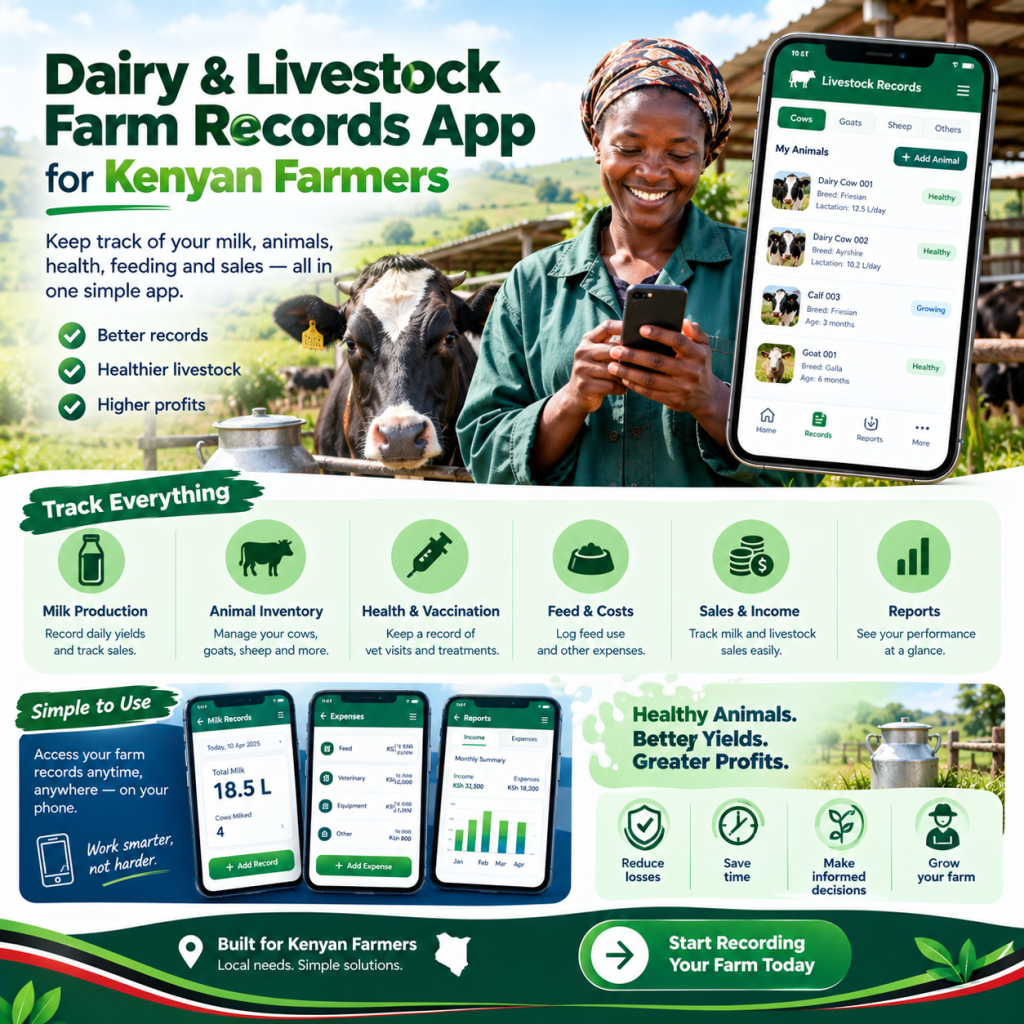
A dairy and livestock farm records app Kenya exists to give this country’s animal farmers something they have never truly had: a memory that never forgets.
Anyone who keeps animals knows the daily weight of detail — the cow that calved three months ago and is overdue for service, the heifer due for its vaccination, the goat that was treated and whose milk cannot be sold until Friday, the batch of chicks whose feed consumption is drifting upward. An animal farm is a living calendar with deadlines that cannot be postponed, and memory, however devoted, drops entries every single day.
Walk into any zero-grazing unit or cattle boma in this country and you will hear animals described by sight and name — “the tall brown cow,” “the one that kicks,” “Mama Njeri’s best milker.” That knowledge is real, but it lives in one head, and when that head belongs to an owner who is unwell, absent, or eventually gone, the farm stops knowing itself.
A dairy and livestock farm records app Kenya turns each animal from a name in memory into a profile with a lifetime of documented history that anyone on the farm can consult.
What has changed is not the animals but the economics around them.
Milk prices are set by processors with deductions and quality bonuses; dairy meal, silage, and veterinary drugs climb in price every year; and buyers of breeding stock now ask for vaccination and treatment histories before they pay a premium. An animal whose history cannot be shown is sold as a stranger, at a stranger’s price.
A dairy and livestock farm records app Kenya gives every animal a documented past — and a documented past commands a documented price.
The cost of not knowing is also specific and painful.
The heifer reared for two and a half years whose true rearing cost nobody can state; the cow kept for sentiment whose yield has never covered her feed; the missed heat that silently costs twenty-one days of a lactation cycle — these are the quiet losses that consume animal farms.
A dairy and livestock farm records app Kenya surfaces each of them, converting invisible losses into visible, correctable decisions.
This guide examines the dairy and livestock farm records app Kenya in full: why animal records decide profitability, what the systems actually are, the features that separate genuine tools from gimmicks, the benefits farms report after going digital, how records unlock financing and insurance, what the systems cost, and how to adopt one without disrupting a busy operation. By the end, the path from memory to managed data becomes a decision rather than a mystery.
Why the Timing Is No Accident
The timing of this shift is no accident. Kenyan livestock farming has been professionalising rapidly — co-operatives recording every litre delivered and paying accordingly, processors imposing quality deductions, insurers now offering livestock cover that demands proof of ownership and production, and lenders financing heifers against documented milk income.
Animals have become bankable assets, and bankable assets require paperwork — which is precisely what a dairy and livestock farm records app Kenya produces as a by-product of daily use.
Until recently, each stream of animal information lived in its own fragile place: the milk book at the parlour, the treatment card folded behind the drug shelf, the breeding dates pencilled on the wall calendar, and the owner’s memory for everything else.
The herd as a whole existed nowhere at all — and a herd that exists nowhere cannot be managed, insured, financed, or inherited.
A dairy and livestock farm records app Kenya ends that fragmentation by giving every animal one home: one profile, one timeline, one source of truth that travels in the pocket and survives the rain.
Why Animal Records Decide Everything in Livestock Farming
Livestock biology runs on a timetable humans cannot see from the outside. Oestrus returns every twenty-one days whether the farmer notices or not; gestation holds its roughly 280 days; lactation peaks and declines on its own curve; withdrawal periods tick down after every treatment.
Missed biological dates convert directly into money lost — a missed heat is three weeks of empty days, a missed drying-off compromises the next lactation, and a withdrawal ignored can get an entire can of milk rejected at the collection. A dairy and livestock farm records app Kenya carries this calendar so the farmer does not have to.
Animals also cannot report for themselves. A crop tells you how it is doing at harvest; a cow tells you nothing unless someone measured her along the way. Records are how livestock speak: yield per cow per day, weight gain per week, feed consumed per litre produced, treatments survived, calves delivered.
With a dairy and livestock farm records app Kenya, every animal’s economics become visible — and the difference between the herd’s stars and its passengers becomes a matter of data rather than impression.
Finally, the institutions around livestock now demand documentation. Co-operatives want delivery histories, buyers want vaccination records, insurers want production proof, and lenders want evidence that the animals generate the income the loan assumes.
A farmer holding a dairy and livestock farm records app Kenya answers every one of these requests in minutes, while others reconstruct their herd’s history from memory, receipts, and hope — usually after the money has already been declined.
What a Dairy and Livestock Farm Records App Actually Is
At its core, a dairy and livestock farm records app Kenya is a digital system — usually a mobile application, increasingly paired with a web dashboard — designed to manage the entire life of every animal on a farm: identification, production, breeding, health, feeding, and finance.
Think of it as the herd’s biography and the farm’s accountant combined: always available, never too busy, and never too tired at the end of a long day to record what actually happened.
The architecture is what separates genuine platforms from generic record books. A serious dairy and livestock farm records app Kenya is built around one principle: one animal, one record, for life.
From birth or purchase to sale or culling, every event — every weight, treatment, service, calving, and litre — attaches to the same identity, so the animal’s full economics accumulate in one place instead of scattering across books that never meet.
The daily workflow shows the design intent. Morning milking ends with yields entered per cow — thirty seconds of tapping — and the system updates each animal’s lactation curve.
Feed issued from the store is charged to the herd; a cow treated for mastitis is logged with her drug, dose, cost, and withdrawal clock; a young batch of chicks records its day’s mortality.
By evening, the owner opens the dairy and livestock farm records app Kenya and sees the whole animal enterprise — every animal, every event, every shilling — in one coherent picture no collection of notebooks ever produced.
The intelligence layer elevates the platform from a filing system to a management partner.
Capable systems compute continuously: calving intervals per cow, cost per litre including feed and labour, feed conversion per batch, growth rates per pen, and the projected milk income of the month ahead. Alerts watch the biological calendar — a service overdue, a vaccination due, a withdrawal ending, feed stock running low — so the dairy and livestock farm records app Kenya carries the deadlines that memory would inevitably drop.
Core Features That Matter
Not every app deserves space on the phone that runs an animal enterprise. When evaluating a dairy and livestock farm records app Kenya, these are the features that genuinely separate the useful from the frustrating.
Individual Animal Profiles
The spine of the whole system is the animal profile: identification by ear tag or name, breed, date of birth or purchase, parentage where known, photo, current status, and the complete event history beneath.
A dairy and livestock farm records app Kenya built around strong profiles makes every other feature possible — because production, health, breeding, and finance all hang from the same identity, and nothing about any animal ever has to be remembered twice.
Milk Production Recording
For dairy, the milk record is king. Yields should be captured per cow per day or per milking, organised into lactations, and displayed as curves that make problems visible within days — the cow whose production is drifting downward, the fresh cow peaking below expectation, the animal whose yield no longer covers her feed.
A dairy and livestock farm records app Kenya that pairs yields with feed data turns every milking into a profit measurement rather than just a chore.
Breeding and Reproduction Records
Reproduction is the engine of every livestock enterprise, and the records must carry its full detail: heat dates, services with the bull or semen identity, pregnancy diagnoses, expected calvings or farrowings, actual births, and the resulting intervals.
A dairy and livestock farm records app Kenya with a strong breeding module alerts on overdue services and upcoming calvings — converting the twenty-one-day cycle from a memory test into a managed schedule.
Health and Treatment Records
Every treatment should be logged the moment it happens: diagnosis, drug, dose, cost, who administered it, and — critically — the withdrawal period that governs when the animal’s milk or meat can re-enter the market.
A dairy and livestock farm records app Kenya with treatment tracking also builds the herd’s medical history, exposing recurring problems — the cow with repeat mastitis, the pen with persistent scours — that justify culling or management changes.
Vaccination and Deworming Calendars
Prevention is cheaper than treatment, but only if it happens on time. The system should maintain vaccination schedules per species and age group — FMD, lumpy skin disease, blackquarter, and rabies for cattle; Marek’s, Gumboro, and Newcastle for poultry — with due dates alerted in advance, plus deworming intervals for every grazing animal.
A dairy and livestock farm records app Kenya that carries the prevention calendar protects the enterprise from the outbreaks that wipe out a year of work in a fortnight.
Feed and Ration Management
Feed is the largest cost in livestock production, so the software must treat it with financial seriousness: rations defined per animal class, feed issued from inventory and charged to each herd or batch, and the daily cost of feeding each animal calculated as a running figure.
A dairy and livestock farm records app Kenya with feed management also tracks silage, hay, and concentrate stocks against consumption, so the dry season’s feed is planned in advance rather than bought in panic.
Weight and Growth Tracking
Weights convert biology into money. Regular weighing of young stock, fattening cattle, broilers, and pigs produces growth curves and average daily gains that reveal whether the feeding programme is earning its cost — and when animals reach their most profitable sale window.
A dairy and livestock farm records app Kenya that tracks growth over time lets the farmer sell on evidence rather than on the buyer’s estimate, and the difference at the sale shows up immediately.
Mortality, Sales and Culling Records
What leaves the herd matters as much as what it produces. Deaths should be recorded with causes, sales with prices and buyers, and culls with reasons — because these exits define the herd’s true composition and its trajectory.
A dairy and livestock farm records app Kenya that captures exits honestly reveals patterns memory hides: mortality clustering in one age group, culls concentrated in one bloodline, or sales that consistently happen later than the growth data says they should.
Financial Records per Herd
Every shilling tied to animals — feed, drugs, AI services, labour, transport — and every shilling they earn — milk, eggs, live sales, manure — should sit in one ledger per enterprise.
A dairy and livestock farm records app Kenya with integrated finance tags each transaction automatically, producing cost per litre, cost per egg, and cost per kilogram of gain without manual arithmetic, and presenting the bank-ready accounts that livestock lending now requires.
Offline Design and Alerts
Animals live where networks fail — in valleys, bomas, and outbuildings — so the software must capture entries offline and sync them automatically when coverage returns.
Its alert layer should watch every animal at once: services overdue, vaccinations due, withdrawals ending, weights due, feed reorders approaching.
A dairy and livestock farm records app Kenya built for field conditions turns the farmer’s mornings into a ranked list of what needs attention across the entire herd, rather than a search of memory.
The Benefits Farms Report After Going Digital
The first benefit is per-animal clarity — the discovery, almost without exception, that the herd’s internal economics differed from everyone’s impressions. Two or three animals carried the milking; several never earned their shed space; one bloodline outgrew the others every time.
Owners who see their first complete per-animal report from a dairy and livestock farm records app Kenya describe it as the most consequential document their farm ever produced, because every subsequent breeding, feeding, and culling decision inherited its clarity.
The second is leakage elimination. Animal farms leak in quiet places: milk drawn at the homestead and never recorded, feed issued to nothing, drugs consumed without an animal, co-op litres that never matched the shed’s own count. Unified tracking closes every hiding place, and farms running disciplined records through a dairy and livestock farm records app Kenya routinely recover several percent of their input spending within the first months — a sum that typically exceeds the software’s cost many times over.
The third is timing precision. The missed vaccination, the late service, the forgotten drying-off, the deworming that slipped a month — the biological failures that divided attention guarantees become rare when a dairy and livestock farm records app Kenya consolidates the entire animal calendar into one watched schedule, and each prevented failure pays for a season of software in a single stroke.
The fourth is culling discipline. Nothing improves a herd faster than removing the animals that do not pay, and nothing makes that decision harder than impression.
With yields, costs, and histories documented by a dairy and livestock farm records app Kenya, culling becomes evidence rather than sentiment — and herds typically change composition visibly within two lactations, with the animals that remain earning more per shed space than the ones they replaced.
The fifth is market access. Buyers of breeding stock, slaughter animals, and birds increasingly pay premiums for documented history — vaccinations current, treatments recorded, weights known, ages provable.
A farmer selling through a dairy and livestock farm records app Kenya presents each animal as a verified asset rather than a stranger, and verified assets command verified prices — frequently ten to twenty percent above the undocumented market.
The sixth is financing and insurance. Livestock lending has always collapsed on one question — how do we know the animals generate income? — and documented production is the answer.
Farmers presenting histories drawn from a dairy and livestock farm records app Kenya report faster, friendlier conversations with lenders and insurers alike: what was once declined as unverifiable becomes approvable on presentation of the records.
The seventh compounds the longest: continuity. Herds are built over generations, and their knowledge — which cow line produces, which bull’s daughters hold their yield, which pen fattens fastest — has always lived in the senior herdsman’s head.
A farm whose animals live inside a dairy and livestock farm records app Kenya inherits differently: the successor receives a database rather than a mystery, and the herd compounds instead of restarting with each transition.
Who Needs It Most
Smallholder dairy families — the backbone of Kenya’s milk — benefit most proportionally.
A family milking two or three cows is running a biological business on one phone and one memory, and a dairy and livestock farm records app Kenya gives that family the management infrastructure of a much larger operation: every animal profiled, every litre recorded, every deadline carried by the system rather than by whoever remembers.
Commercial dairy farms and ranches need the system as operational necessity.
An operation milking fifty cows or running five hundred head coordinates workers, treatments, services, and feed across sections where manual books cannot survive — and a dairy and livestock farm records app Kenya delivers control at that scale: every animal attributed, every worker’s section visible, and the consolidated picture assembled automatically for owners and lenders.
Poultry farmers form the third constituency, because poultry is batch mathematics: mortality against the running count, feed against weight gained, vaccination dates against the calendar.
A dairy and livestock farm records app Kenya that handles batches as fluently as individuals lets the poultry unit know — while the batch is still alive — whether it will pay at sale.
Co-operatives, aggregators, and farmer groups form the fourth.
Groups function on trust, and trust functions on records; the member whose deliveries, treatments, and sales are documented in a dairy and livestock farm records app Kenya becomes the one everyone backs for premium contracts, and the group that can show clean member data wins the buyer relationships that records-poor competitors cannot touch.
Veterinarians, AI technicians, and farm managers serving multiple clients complete the list.
professional responsible for five herds cannot hold five herds’ details in memory, and platforms that consolidate every client’s animals behind one login have redefined the profession: advice grounded in each herd’s measured economics, delivered from dairy and livestock farm records app Kenya data the professional and the client both trust.
Enterprise by Enterprise: What Each Species Demands
Dairy Cattle: The Lactation Engine
Dairy is where records pay back fastest, because every cow is a monthly invoice and a daily income.
A dairy and livestock farm records app Kenya tracking yield per cow per day reveals the herd’s true structure within weeks — the stars to breed from, the passengers to cull, the fresh cows peaking below expectation. Paired with feed data, it answers the industry’s defining question: what does this litre actually cost me?
Poultry: The Discipline of Batches
Poultry runs on batch mathematics, and the records must keep the count honest from day-old to sale: daily mortality against the running total, feed issued against weight gained, vaccinations against the programme.
A dairy and livestock farm records app Kenya that computes feed conversion per batch exposes exactly where the money goes — and lets the farmer price each batch from evidence while the buyer is still negotiating from guesswork.
Goats and Sheep: Small Animals, Real Economics
Small stock reward precise records precisely because their margins look small but multiply fast. Dairy goats need the same lactation discipline as cows; meat herds need weights, gains, and parasite control documented flock-wide.
A dairy and livestock farm records app Kenya handling small ruminants turns deworming intervals, kidding dates, and growth curves into managed schedules — and turns a flock that “just does fine” into a measured, improvable enterprise.
Beef and Fattening Units: Buying Weight, Selling Evidence
Fattening is a margin trade: buy light, feed heavy, sell heavy, and the entire profit lives in the spread.
A dairy and livestock farm records app Kenya that tracks purchase weights, feed issued, and sale weights computes the only number that matters — cost per kilogram of gain — per pen and per batch, so the next purchase decision is made from evidence instead of the market’s noise.
Pigs: Litters, Feed and Time
Pig farming is reproduction multiplied by feed conversion, and both demand records: farrowings with litter sizes and losses, weaning weights, growth to market, and feed consumed per kilogram gained.
A dairy and livestock farm records app Kenya built with pig depth manages the sow calendar — gestation, farrowing, weaning, re-service — and keeps the fattening house’s economics visible batch by batch to slaughter day.
Breeding Records: The Fertility Engine
Calving interval is the master metric of dairy, and it is decided by invisible events: the heat seen or missed, the service logged or forgotten, the pregnancy confirmed or assumed.
A dairy and livestock farm records app Kenya with strong breeding records watches every cow’s cycle, alerts on overdue heats and upcoming calvings, and keeps the semen, service, and diagnosis history of every female in one timeline — converting fertility from folklore into a managed number with a target, typically twelve to thirteen months.
The second half of the fertility engine is heifer rearing — the largest hidden cost in most dairy businesses. A heifer entering the milking herd has consumed two years of feed, treatments, and labour before producing her first litre, and most farms have never totalled that figure.
When a dairy and livestock farm records app Kenya accumulates rearing costs from birth to first calving, the farm finally knows what its own replacements truly cost — and can compare rearing against buying with numbers instead of habit.
Health Records and the Withdrawal Discipline
The treatment log carries a clock that most farms run by guesswork: the withdrawal period after every drug, during which milk or meat cannot legally or safely enter the market.
Milk from a treated cow delivered too early can get an entire can rejected at the collection — and repeated rejections cost a supplier his market.
A dairy and livestock farm records app Kenya that guards every withdrawal date converts that risk into a countdown the whole farm can see.
Complete health histories also become commercial assets. A herd with documented vaccinations, treatments, and outcomes sells breeding stock at a premium, reassures buyers of slaughter animals, and gives the visiting vet a case history instead of a shrug.
Farms that maintain treatment records through a dairy and livestock farm records app Kenya also start seeing disease patterns — mastitis clustering in one shed, scours in one age group — that point to management causes rather than bad luck.
Feed Economics: Where Livestock Profit Is Decided
Feed consumes sixty to seventy percent of livestock production cost, which means feed management is profit management.
Rations defined per animal class, feed issued and charged per herd, and the daily cost of keeping each animal fed — these are the entries that turn the feed bill from a monthly shock into a managed variable.
A dairy and livestock farm records app Kenya with feed economics also plans silage, hay, and concentrate stocks against consumption, so the dry season arrives as a schedule rather than a crisis.
The second feed discipline is conversion: feed in against product out, computed per batch and per class. Concentrate per litre of milk, kilogram of feed per kilogram of gain, trays of eggs per bag of mash — these ratios decide whether the feeding programme earns its cost, and they can only be computed from records.
A dairy and livestock farm records app Kenya that calculates conversion continuously lets the farmer test one ration against another with evidence — and the winning ration typically repays the year’s software fee on its own.
Paper Books vs Digital Records
Paper is familiar, cheap, and better than nothing — but its weaknesses compound in animal enterprises especially.
Notebooks get rained on in the parlour, torn, eaten by termites, or lost with the worker who kept them; a single misplaced exercise book can erase a lactation’s history, which is precisely the risk a dairy and livestock farm records app Kenya removes through backups stored safely beyond the farm.
Retrieval is the second failure: finding every treatment given to one cow across three years of handwriting sacrifices an evening, while the same query in digital records takes seconds.
Arithmetic is the deeper gap. Paper stores numbers; it calculates nothing — calving intervals, conversion ratios, cost per litre, and lactation totals must all be worked by hand, with errors compounding quietly — while a dairy and livestock farm records app Kenya performs every calculation automatically each time an entry lands.
Digital also enables what paper never can: several workers contributing entries from different phones while the owner sees the entire herd consolidated in real time.
Records and Financing: How Animal Data Unlocks Money
Ask any lender why livestock credit remains expensive, and the answer is always the same: applicants cannot demonstrate that the animals generate income.
A dairy and livestock farm records app Kenya changes that conversation completely, because a year of documented yields, sales, and costs is precisely the evidence a credit committee needs — and the same delivery histories that co-operatives already record now flow straight into the loan file instead of dying in the collection book.
The same logic governs livestock insurance, which has finally become available in Kenya but settles or stalls on one thing: proof.
Claims for dead or stolen animals go far more smoothly when ownership, value, and production history are documented, and policies are priced better for farmers whose records show disciplined management.
A dairy and livestock farm records app Kenya effectively pre-writes the insurance file and the loan application as a free by-product of daily recording.
How to Choose the Right App
Start by defining actual needs rather than imagined ones. List the three animal questions you struggle with most — perhaps heat detection, feed cost, or mortality in young stock — and test whether the dairy and livestock farm records app Kenya under consideration answers those three brilliantly, because a tool that does everything poorly is far worse than one that does your top priorities well.
Insist on a trial before committing, and hand the phone to whoever actually works with the animals — an app only the owner can operate will quietly die within a month.
Then examine the commercial terms with the same seriousness as the features. A responsive developer with an active update history predicts years of service, while an abandoned product becomes a digital graveyard for your herd’s history.
Confirm in writing that the farm’s entire animal database remains yours, exportable in full at any time — a dairy and livestock farm records app Kenya vendor unclear on that point is telling you something, and the disciplined buyers listen, then keep shopping.
Implementing Without Disrupting the Farm
Begin with an audit of the records the animals already generate — the milk book, the treatment cards, the wall calendar’s breeding dates, the co-op statements — and define what the new system must capture from day one.
Processes defined first and software configured second is the order that works; the reverse produces systems shaped by features rather than by the herd, and a dairy and livestock farm records app Kenya deployed that way fights its own users from the first week.
Load the foundation with care: every animal entered with age, breed, stage, and status; pregnant animals flagged with due dates; opening feed and cash balances counted once and recorded once.
Then launch from today forward rather than digitising years of history, anchor entries to routines that already exist — morning milking, evening feed — and supervise closely for the first thirty days, because the opening weeks set the farm’s data culture for years.
A dairy and livestock farm records app Kenya rewards consistency far more than exhaustive backdated entry: two honest minutes a day outrank a heroic weekend every time.
Costs and Return on Investment
Pricing follows recognisable models: free tiers with basic features for smallholdings, modest monthly subscriptions for growing herds, and custom licensing for commercial farms and institutions — with setup and training sometimes quoted separately.
When comparing options, model the total annual cost of each dairy and livestock farm records app Kenya at your projected scale, and treat any quotation that cannot state its totals plainly as one planning to find its revenue in your experience instead.
The return arrives through channels the farm already knows: leakage recovered from the shed and the store, biological failures prevented across the animal calendar, culling gains from per-animal clarity, premiums earned on documented stock, and financing won on auditable records.
Across these channels, farms consistently report that a well-run dairy and livestock farm records app Kenya pays for itself within the first lactation or flock cycle — frequently within months, once the first per-animal report redirects the farm’s feed and breeding decisions toward what actually earns.
The Future of Livestock Record Keeping
The technology is still accelerating. Artificial intelligence is beginning to read the records farms already keep — detecting oestrus in yield dips, flagging mastitis days before the milk changes, predicting the calving date within a narrower window, and recommending which heifers deserve the breeding budget.
Tomorrow’s dairy and livestock farm records app Kenya will not merely store the herd’s history; it will actively advise its future, and farms feeding clean data into today’s systems are building the histories that will make that advice accurate for their specific animals.
What will not change is the underlying principle: herds run on biology, and biology must be captured before it can be managed. The farmers building the habit today — two honest minutes a day in a dairy and livestock farm records app Kenya — are compiling the integrated histories that will power that advice, because the one input that cannot be bought retroactively is a lifetime of recorded animals.
Frequently Asked Questions
Do I need to identify every animal with a tag before starting?
Not immediately. The system works with names, descriptions, and photos, but ear tags or durable identifiers make daily entries faster and keep records unambiguous as the herd grows — most farms tag progressively and let the app’s profiles keep the two connected.
How much time does daily recording actually take?
Two to four minutes: yields or mortality after morning rounds, feed issued at the store, and any treatment when it happens. Farmers who anchor entries to existing routines — milking, feeding, closing the store — sustain the habit for years without effort.
Can one app handle dairy cows and poultry together?
Yes — and it should. Genuine platforms track individuals and batches side by side, sharing one inventory, one labour record, and one set of accounts, so the profit of one species no longer hides the losses of another.
What happens when an animal is sold or dies?
It is recorded as an exit with date, price or cause, and the animal’s complete history stays in the system — preserving the herd’s institutional memory, the sales evidence for buyers, and the mortality data that guides future prevention.
How long before the benefits show?
The first benefits appear within weeks — known stock, organised treatments, visible balances. The deeper returns arrive after one lactation or batch cycle, when calving intervals, conversion ratios, and per-animal profit become available to guide real decisions.