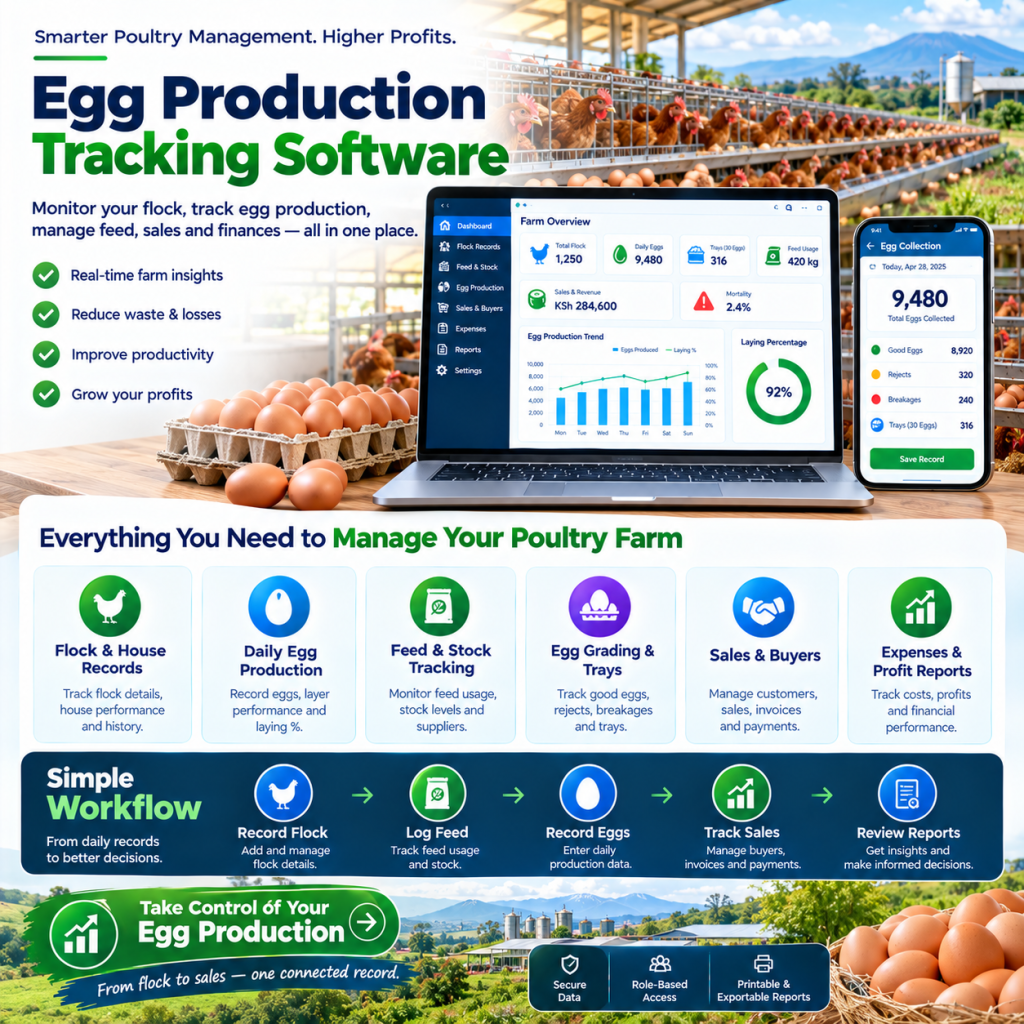
Egg production tracking software has become the difference between layer farms that earn predictable weekly income and layer farms that discover problems only when the egg basket comes up light.
Poultry keeping is one of Kenya’s most widespread agribusinesses — thriving in backyards, peri-urban plots, and commercial sheds alike — yet it is also one of the most silently leak-prone: a laying flock can slide from eighty-five percent production to sixty-five percent over three unnoticed weeks, feed conversion can quietly worsen, mortality can creep upward, and by the time the farmer senses something is wrong, thousands of shillings have already been lost. The discipline that prevents all of this is daily, structured record keeping — and that is precisely what egg production tracking software delivers: every egg collected, every bird lost, every kilogram of feed consumed, and every tray sold captured at the moment it happens, then converted automatically into the lay rates, costs, and trends that tell a farmer exactly how the flock is performing.
This guide examines egg production tracking software in full — why it matters, what it does, which features genuinely pay, how to interpret the numbers it produces, how it compares with the notebooks it replaces, what it costs, and how to implement it so the habit sticks from the very first week.
Why Egg Farmers Need Dedicated Tracking
The first reason is the speed at which problems develop in a laying flock. Unlike a maize crop that declines over weeks, a layer house can move from healthy to failing within days: a water line blocked at dawn shows up as a production dip within forty-eight hours, a feed formulation error reveals itself in shell quality within a week, and a disease outbreak announces itself in the mortality column before any bird looks visibly sick.
Farmers relying on memory and mental estimates detect these signals late; farmers using egg production tracking software detect them the same day, because the numbers on the dashboard diverge from the expected curve immediately and visibly.
The second reason is the economics of feed. Feed represents sixty-five to seventy-five percent of the total cost of egg production, which means the difference between a profitable flock and a losing one lives almost entirely in the feed ledger.
A egg production tracking software system tracks feed issued against eggs collected, computing feed conversion automatically — and the farmer who sees conversion worsening week by week can investigate feed quality, waste, or disease before the season’s margin disappears.
The third reason is flock decision-making. Every layer has a working life, and the most important financial questions in poultry are culling questions: which birds have stopped paying for their feed, which house is underperforming, which batch deserved its place and which did not. These decisions require per-house and per-batch production history — exactly the dataset egg production tracking software builds naturally as a by-product of daily recording — and without it, culling becomes guesswork that keeps unproductive birds eating profit for months.
The fourth reason is the market. Egg buyers — hotels, shops, schools, vendors — reward consistency above almost everything: the supplier who delivers the same quantity on the same days every week wins standing orders that casual suppliers never touch. A farmer who can forecast production accurately using egg production tracking software can commit to standing orders with confidence, collect deposits for planned supply, and plan hatch or restock timing against real demand cycles rather than hope.
What Egg Production Tracking Software Actually Is
At its core, egg production tracking software is a specialised digital record system designed around the daily rhythms of a layer operation: morning collection, feed issue, mortality check, grading, and sales. Where a notebook stores numbers in the order they were scribbled, the software stores them as connected data — eggs linked to the house and flock that laid them, feed linked to the same birds, mortality linked to dates and causes — so the system can compute the relationships between them automatically. That connectivity is the entire difference between storing records and understanding a flock.
The daily workflow is deliberately simple, because recording must survive busy mornings and hurried hands. The worker collects eggs, opens egg production tracking software on a phone, enters the count per house in a few taps, logs feed issued and any dead birds, and saves — under thirty seconds, fully offline where networks fail, syncing automatically when signal returns. Records made this easily get made every day, and daily records are the raw material of every insight the system produces.
Beneath the simple capture sits the intelligence layer. As entries accumulate, egg production tracking software computes hen-day production percentages, lay rates per house, feed conversion ratios, mortality rates, and cost per tray — continuously and without any manual calculation. The farmer opens the dashboard and sees not just today’s numbers but today’s numbers against the flock’s expected curve, which is what turns raw counts into early warnings.
The output layer completes the picture: reports for the bank, summaries for buyers, production histories for expansion planning, and audit-ready treatment and vaccination records for certification. A well-fed egg production tracking software deployment produces in minutes the documents that once took evenings of arithmetic — and because the reports draw from the same records the farm keeps anyway, they never drift from operational reality.
Core Features That Matter
Daily Egg Collection Records
The heart of the system is the daily collection log: eggs counted per house, per flock, per collection round, timestamped and attributed to whoever recorded them. Quality egg production tracking software makes this capture effortless — pick the house, enter the number, save — while silently building the production history that every other calculation depends on. Farms that record collection this way gain an unbroken production curve, and an unbroken curve is the single most diagnostic tool in layer management: every problem, from water failure to disease onset, announces itself first as a bend in that line.
The collection record also protects revenue directly. Eggs collected in the morning, counted again at grading, and reconciled against sales tell the farmer precisely where breakages, losses, and informal “borrowing” occur along the chain — and egg production tracking software deployments routinely surface leakage between nest and sale that the farm had absorbed unknowingly for years.
Flock and Batch Records
Beyond daily counts, the system should track the birds themselves: flock name or batch number, breed, source hatchery, arrival date, number of birds placed, and the house each batch occupies. This structure is what allows egg production tracking software to compute performance per batch rather than per farm — and per-batch performance is what makes breeding-source and hatchery decisions evidence-based, because batches from different sources can be compared on identical metrics season after season.
Age tracking within flock records matters just as much. A flock’s expected production depends entirely on its age in weeks, so the software should know every batch’s age and display its performance against the breed’s expected laying curve. Farmers using age-aware egg production tracking software stop comparing their point-of-lay pullets against a neighbour’s peak flock and start judging each flock against its own correct standard — which is the only comparison that means anything.
Feed Tracking and Conversion
Feed deserves its own module, not a line in a general ledger. A capable egg production tracking software deployment records every feed delivery into store, every issue to every house, and computes feed consumed per bird per day, feed cost per tray produced, and feed conversion ratio per flock per week. These three numbers are the financial pulse of any layer operation, and they are invisible in any system that does not connect feed to eggs automatically.
The feed module also exposes waste in its many disguises: spillage from damaged feeders, over-feeding beyond recommended grams per bird, stale feed losing nutritional value in storage, and outright pilferage from the store. Farmers who track feed inside egg production tracking software consistently report recovering several percent of their largest cost line within the first months — which alone frequently pays for the software many times over.
Mortality and Health Records
Deaths must be recorded daily, with counts, dates, and suspected causes, because mortality trends are among the earliest and most actionable signals in poultry keeping. A egg production tracking software system turns scattered losses into a visible trend line: a spike concentrated in one house points to localised trouble, a slow steady climb across all houses points to feed or water, and a sudden jump points to acute disease or predation — three completely different problems requiring three completely different responses.
Treatment and vaccination records complete the health picture: every medication administered, every vaccination given, with dates, dosages, batch numbers, and withdrawal periods tracked automatically. This module of egg production tracking software protects food safety and market access simultaneously — because buyers and certification schemes increasingly demand documented treatment histories, and because selling eggs from birds still inside a withdrawal period is a risk no farm should ever run unknowingly.
Lay Rate Analytics and Production Curves
The analytical layer is where the software earns its name. Hen-day production percentage — eggs laid divided by birds alive, expressed as a percentage — is the universal language of layer performance, and quality egg production tracking software computes it continuously per flock, per house, and per farm, displaying each flock’s actual curve against the breed’s expected standard. The farmer sees at a glance whether the flock is on track, ahead, or slipping — and slipping is visible weeks before it would be visible in the collection basket.
Persistence analysis extends the value across the laying year. Modern hybrids are expected to hold high production for ten to twelve months with a gradual, predictable decline; flocks that fall off that curve early are telling the farmer something about lighting, feed, disease history, or heat stress. Farms that study their curves inside egg production tracking software learn to read these signals and adjust management mid-cycle — rescuing performance that untracked flocks simply surrender.
Grading, Inventory, and Sales Linkage
Eggs change state between nest and customer — collected, graded, packed into trays, stored, sold — and the software should track every transition. A full-featured egg production tracking software deployment maintains live inventory of graded stock, so the farmer always knows how many trays of each size are on hand, how many are committed to standing orders, and how much can still be sold before tomorrow’s collection arrives.
Sales linkage closes the commercial loop: every tray sold recorded against its buyer, price, and payment status, feeding the same receivables and buyer histories that dedicated sales systems manage. Farms that run grading, inventory, and sales inside one egg production tracking software platform gain a complete chain of custody from nest to payment — which is what makes shrinkage, price drift, and forgotten credit structurally impossible rather than merely unlikely.
Alerts and Automated Reports
The final feature tier is the watching layer: alerts when production drops below threshold, when mortality spikes, when feed conversion worsens, when a vaccination falls due, when graded stock is running short against committed orders. A egg production tracking software system configured with sensible thresholds effectively stands guard over the flock around the clock, catching the deviations that human attention — distracted, seasonal, and finite — reliably misses.
Automated reports complete the toolkit: weekly production summaries, monthly profit-and-loss per flock, treatment histories for auditors, and buyer statements on demand. Owners who run their layer operations on egg production tracking software describe the reporting benefit as the surprise they least expected — the documents the farm constantly needs at the bank, the buyer’s office, or the board meeting simply exist, always current, without anyone building them.
The Benefits Farms Report After Going Digital
Early problem detection is the benefit that saves the most money, and it arrives within the first weeks of use. The farmer who watches lay rate, feed conversion, and mortality on a live dashboard intervenes on day two of a problem instead of week three — and in layer keeping, that timing difference is routinely worth thousands of shillings per incident. Owners using egg production tracking software consistently name the first caught production dip as the moment the system proved itself, because the dip was corrected while it was still a wobble rather than a collapse.
True cost per tray is the second benefit, and it transforms pricing and negotiation. When feed, labour, treatments, and depreciation are all attributed automatically, egg production tracking software produces the exact cost of every tray produced — and farmers who know their true cost stop selling at panic prices during gluts, because they know precisely which prices are profitable and which are subsidised by hope.
Better flock decisions follow directly from the data. Culling becomes arithmetic instead of sentiment: birds and batches that no longer cover their feed cost are identified precisely, underperforming houses are diagnosed from their histories, and hatchery or breed choices are made on season-over-season comparisons. Farms that make these decisions through egg production tracking software records steadily upgrade their flocks’ productivity — compounding improvement that untracked operations never achieve because they never measure.
Feed optimisation is the third structural gain. With conversion ratios visible per house and per week, the farm can test feeder adjustments, ration changes, and feeding schedules against measured outcomes rather than tradition — and every tenth of a point saved on conversion flows almost entirely to margin. Operators who treat their egg production tracking software feed data as an experimental laboratory consistently run leaner, healthier flocks than neighbours spending the same money blind.
Access to finance arrives as the quieter, life-changing benefit. A year of clean production records — lay rates, mortality, feed conversion, sales, and profit per flock — is exactly the evidence package lenders now demand from poultry borrowers, and farms presenting it report faster approvals and better terms. The layer farmer who unlocked expansion capital through egg production tracking software documentation joins a growing cohort for whom records, not collateral, opened the credit door.
Labour accountability completes the benefit set. Collection counts, feed issues, and mortality records attributed to named workers transform supervision from suspicion into evidence — and behaviour improves simply because performance is visible. Managers running teams through egg production tracking software report the same pattern as every other digitised farm: the records change the work, not just the paperwork.
Who Needs It Most
Smallholder and small commercial layer keepers may benefit most proportionally, because at small scale every lost tray and every wasted feed bag bites hard. A farmer running two hundred to two thousand birds through egg production tracking software from a single phone gains the lay-rate intelligence that was once the preserve of commercial estates — and that intelligence is what converts backyard habits into genuine agribusiness performance.
Commercial layer operations need the software as operational infrastructure: multiple houses, staggered flocks of different ages, dozens of workers, and buyers expecting daily consistency. At this scale, manual coordination collapses within weeks, and the farms that industrialised their records through egg production tracking software run on systems rather than presence — every house visible side by side, every flock judged against its own curve, every deviation caught the day it appears.
Hatcheries and pullet-rearing operations tracking brooding and growing performance before point of lay gain the same discipline earlier in the bird’s life. Growth rates, feed conversion, and mortality during the rearing phase predict laying performance later, so operations that track rearing inside egg production tracking software place their flocks into production with verified quality — and can prove that quality to the farmers buying their pullets and day-old chicks.
Egg aggregators, distributors, and cooperatives completing the constituency need chain visibility rather than flock data: eggs collected from many small producers, graded centrally, sold onward, and revenue returned. When an aggregation business runs collections, grading, and member payments through egg production tracking software, every tray is traceable in both directions — which is precisely what keeps member trust intact and disputes short.
Absentee owners and professional managers form the fastest-growing category. Owners investing in poultry from a distance need live production visibility rather than weekly verbal reports, and managers serving multiple farms need every client’s flocks behind one login. The egg production tracking software deployments serving this category have redefined what professional poultry management means: evidence delivered daily, from anywhere, on the same numbers everyone trusts.
The Key Metrics Every Farmer Should Track
Hen-day production percentage is the master metric: eggs collected divided by hens alive, as a percentage, tracked daily and displayed against the breed’s expected curve. Any serious egg production tracking software deployment makes this number unmissable, because it summarises the entire flock’s condition — nutrition, health, environment, and management — into a single comparable figure that moves within hours of anything going wrong.
Feed conversion ratio is the financial metric: kilograms of feed consumed per kilogram of eggs — or per dozen — produced, tracked per flock and per week. Farms that watch conversion inside egg production tracking software catch the silent drift that turns profitable flocks marginal: worsening ratios signal feed quality problems, feeder waste, disease pressure, or heat stress long before any single symptom would announce itself.
Mortality rate, expressed weekly and cumulatively per flock, is the health metric — and its pattern matters more than its total. A egg production tracking software system recording daily losses with suspected causes turns mortality from a vague anxiety into a diagnostic signal: where the losses cluster, when they accelerated, and whether the curve matches disease, mismanagement, or predation.
Cost per tray and margin per tray are the commercial metrics that everything else ultimately serves. Farms that track their full cost chain through egg production tracking software know, every week, what a tray truly costs to produce and what it truly earns — which is the knowledge that decides expansion timing, price negotiation, and whether a given season deserved its reputation.
Managing the Laying Cycle With Software
The laying cycle has a shape, and software turns that shape into a managed schedule. A flock moves through point of lay around eighteen to twenty weeks, climbs to peak production near twenty-eight to thirty-two weeks, holds a high plateau for months, then declines gradually toward the end of a productive year. Egg production tracking software that knows each flock’s position on this curve can manage the cycle deliberately: lighting programmes adjusted as birds come into lay, feeding density matched to production stage, and depopulation or moulting timed against the economics the data reveals.
The transition points are where tracking earns the most. The point-of-lay window, when young flocks are most sensitive to stress and disease, is the phase where early recording catches problems that would otherwise echo through the whole cycle — and farms that watch their pullets closely through egg production tracking software during these weeks consistently report stronger, more persistent peaks than those that begin recording only when the eggs start paying.
End-of-cycle decisions benefit equally. When a flock’s declining curve falls below the point where eggs cover feed plus overheads, the data names the date — and the farmer who replaces flocks on evidence rather than emotion runs a younger, more productive, more profitable flock profile year after year. This disciplined turnover is one of the clearest separating habits between commercial performers and perpetual strugglers, and it is only possible with the history egg production tracking software accumulates.
Egg Production Tracking Software vs Notebooks and Spreadsheets
The exercise book deserves its historical respect — it started every farm’s journey — but its limits are structural. Entries cannot be totalled or trended, percentages must be computed by hand and are therefore rarely computed at all, and the book cannot survive water, loss, or the departure of the person who wrote it. Every gap driving farmers toward egg production tracking software traces to these structural limits, and none of them can be solved by writing more neatly.
Spreadsheets clear several hurdles and hit their own: daily counts in one file, feed in another, sales reconciled by hand in a third — with every connection between them maintained by manual re-entry that collapses under real farm volume. The farmers who migrated from spreadsheets to egg production tracking software describe the same threshold: the moment a second flock, a second house, or a second worker entered the picture, the spreadsheet became the bottleneck instead of the tool.
Timeliness and attribution widen the gap decisively. A spreadsheet updated in the evening is a transcription of a morning that has already blurred; a phone record made at the nest box is the event itself. And a shared spreadsheet records no author, while egg production tracking software timestamps and attributes every entry — turning records from shared assumptions into auditable facts, which is what disputes, lenders, and buyers all ultimately require.
How to Choose the Right System
Fit to your operation comes before every other criterion. A farmer with four houses and staggered flocks needs age-aware curve analysis; a farmer with one house and five hundred birds needs speed and simplicity; a farmer grading and distributing needs inventory depth. Walk your actual daily routine — collection, feed, mortality, grading, sale — through any candidate egg production tracking software before committing, because the system that matches how your farm actually works will outperform a longer feature list that does not.
Offline capability and mobile reality must be tested, not claimed. Poultry houses sit exactly where networks fail, so insist on full offline capture with automatic sync, and test it in a real no-signal corner of your own farm during the trial. The egg production tracking software products that survive on real farms are built for coop conditions first: hurried hands, dust, early mornings, and workers recording between tasks rather than at desks.
Ease for the people who will feed it decides adoption. The collection records will come from your workers, not from you, so hand them the trial phone and watch a real morning’s recording — if it feels natural, you have a system; if it feels like paperwork, keep shopping. The egg production tracking software deployments that thrive are those chosen by the thumbs of daily users rather than the admiration of owners.
Support, pricing transparency, and data ownership complete the checklist. Evaluate the supplier’s responsiveness and poultry understanding as seriously as the product; demand pricing that states your total annual cost plainly at your scale; and confirm in writing that your production history remains yours, exportable at any time. A egg production tracking software vendor unclear on any of these points is telling you something — and the disciplined buyers listen, then keep shopping.
Implementing Without Disrupting the Flock
Begin with an audit of what the farm currently tracks, however informally — the notebook by the door, the feed store chalkboard, the memory of whoever does the counting — and define what the new system must capture from day one. This audit becomes the configuration blueprint for your egg production tracking software deployment: processes defined first, software configured second, never the reverse.
Load the foundation carefully: every flock with its age, breed, source, and bird count; every house with its capacity and current occupants; opening feed stock counted and recorded; every active egg buyer with terms and prices. A day spent getting this foundation right saves a month of corrections, and the egg production tracking software deployments that start clean build trustworthy histories from their very first week.
Launch with the core loops — daily collection, feed issue, mortality — and defer grading, inventory, and advanced analytics until the basics are habitual. Train on real work: today’s actual collection, this week’s actual feed delivery, not demonstration examples. Then supervise the first thirty days closely, reviewing entries daily and correcting habits immediately, because the first month of egg production tracking software use sets the farm’s data culture for the years that follow.
Integrations That Extend the System
The financial integrations come first: M-Pesa reconciliation matching egg payments to sales automatically, accounting exports feeding the bookkeeper without re-entry, and buyer statements generated on demand. A egg production tracking software platform connected at this level stops describing the operation and starts operating it — the tray sold is the tray reconciled.
The operational integrations extend the reach: feed mill delivery records updating stock automatically, weather data contextualising production dips during heatwaves, and SMS or WhatsApp notifications alerting owners to deviations while they are away. The egg production tracking software deployments that planned for these connections from the start absorb each new capability at a fraction of the effort their retrofitting competitors spend.
Costs and Return on Investment
Pricing follows recognisable models: modest monthly subscriptions for small flocks, tiered pricing by flock count and users for growing operations, and custom licensing for commercial and aggregating businesses — with setup and training sometimes quoted separately. When comparing options, model the total annual cost of each egg production tracking software candidate at your projected scale, and treat any quotation that cannot state its totals plainly as one planning to find its revenue in your experience instead.
The return arrives through named channels: recovered feed waste, caught production dips, leakage eliminated between nest and sale, better culling decisions, firmer prices through known costs, and standing orders won through reliable supply. Across these channels, farms consistently report that a well-run egg production tracking software deployment pays for itself within the first one to two production cycles — frequently within the first quarter once the feed conversion reports start driving changes.
The honest comparison is never against zero but against the status quo’s invisible invoice: the dip nobody caught, the feed nobody counted, the trays nobody recorded, and the credit nobody chased. Totalled across a year, that invoice dwarfs the subscription of egg production tracking software many times over — which is why the layer farmers who run the numbers properly rarely remain undecided for long.
Common Mistakes to Avoid
The first mistake is recording eggs but ignoring feed, which captures half the equation and misses the half where the money lives. The feed-to-egg relationship is the financial engine of the entire enterprise, and farms that activate only the collection module of their egg production tracking software system forfeit the highest-value insights it was built to deliver.
The second is winning the software and losing the team: rollout imposed without explanation, training rushed, and the workers closest to the records left feeling surveilled rather than supported. Adoption succeeds when the team sees the system solving their problems — disputes settled by records, fair feeding calculations, credit for accurate work — and the owners who succeed with egg production tracking software treat implementation as leadership work, while the ones who fail treat it as an IT purchase.
The Future of Egg Production Technology
Artificial intelligence is moving into the poultry record layer: production forecasts from flock history, disease-risk predictions from early curve deviations, and feeding recommendations tuned to each house’s measured performance. Farms feeding clean daily data into egg production tracking software today are building the training sets that will make these predictions accurate for their specific flocks — early recording discipline is quite literally tomorrow’s advantage.
The deeper wave is data-verified supply: buyers and institutions increasingly sourcing eggs from producers whose volumes, treatment histories, and food-safety records are documented and auditable. The farms whose production lives already live inside egg production tracking software will be first through every door that economy opens — because in data-verified agriculture, the farm with the best records gets the best terms.
Frequently Asked Questions
What is a good lay rate for layers in Kenya?
A well-managed commercial flock should reach eighty-five to ninety-five percent hen-day production at peak and hold seventy-five percent or better deep into the laying year, with the exact curve depending on breed and age. When your egg production tracking software dashboard shows your flock trailing its expected curve for more than a few days, treat it as a management signal worth investigating — feed, water, heat, disease, or stress are the usual suspects, and the data tells you which.
Does egg production tracking software work without internet?
Yes — quality platforms are built offline-first for exactly the conditions poultry houses operate in: counts, feed issues, and mortality are recorded on the device without signal and sync automatically whenever connectivity returns. During any trial, test the offline behaviour of the egg production tracking software you are evaluating in a genuine no-signal corner of your farm, because claimed offline support and real offline capture are very different products in daily use.
Can it manage multiple flocks and houses at once?
Yes — multi-flock and multi-house management is a core capability of serious systems, with each flock tracked against its own age and expected curve while the farm dashboard consolidates everything. When evaluating options, demonstrate your actual structure — staggered ages, separate houses, different breeds — because the depth of multi-flock support separates genuine poultry platforms from generic trackers wearing an egg production tracking software label.
How does the software help reduce feed costs?
By computing feed conversion continuously and exposing waste wherever it occurs — overfeeding, spillage, poor ration changes, or theft from the store — so corrections happen in days rather than seasons. Farmers who manage feeding through egg production tracking software data consistently report recovering several percent of their largest cost line, which is typically enough to cover the software several times over before any other benefit is counted.
Is it worth it for a small flock of a few hundred birds?
Worth scales with margin sensitivity, not flock size — a five-hundred-bird operation losing even five percent of production to unnoticed problems loses more annually than the software costs, and the feed savings alone frequently justify the subscription. The right question is whether catching one production dip early would pay for a year of egg production tracking software — and for almost every laying flock in the country, the honest answer is yes.