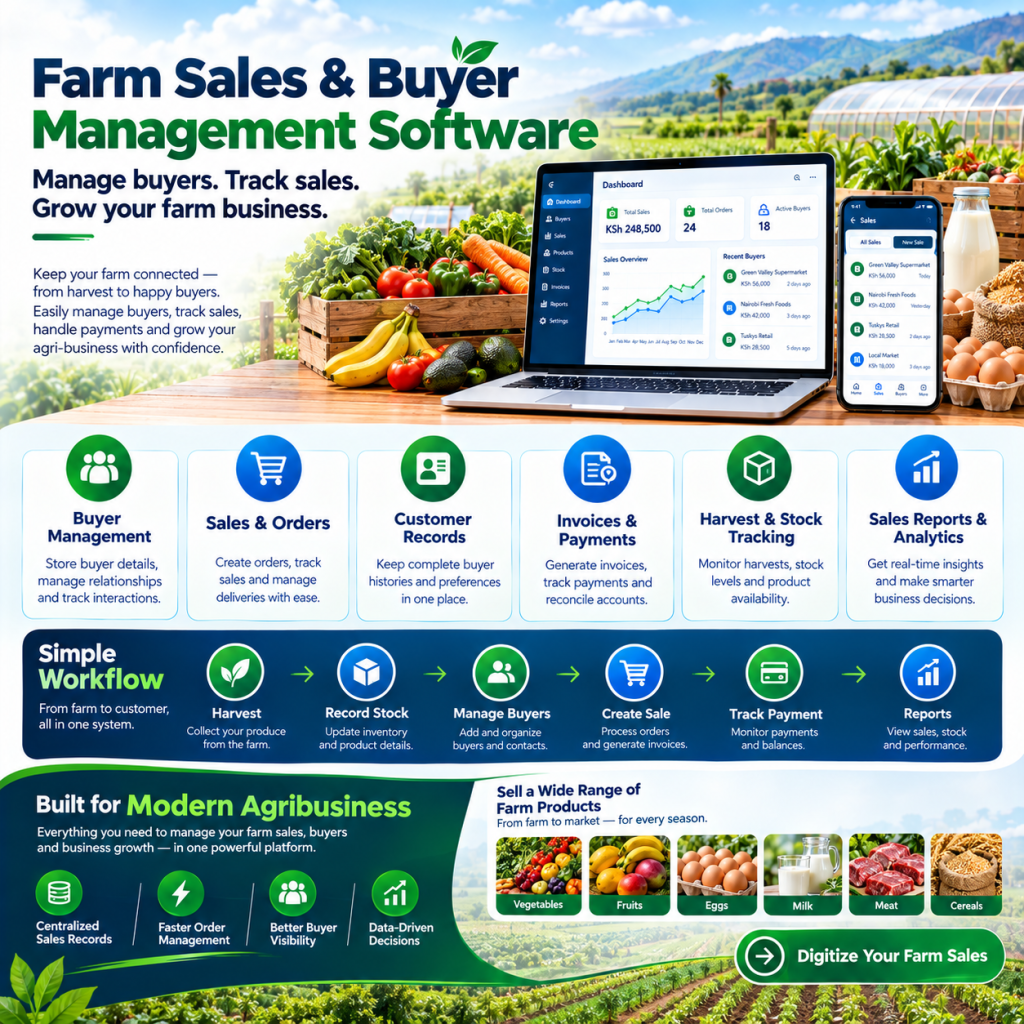
Farm sales and buyer management software is the digital system that organises every buyer, order, delivery, invoice, and payment a farm makes into one connected platform.
It exists for a simple reason: the selling side of agriculture, where more money is silently lost than anywhere else, has long run on exercise books, WhatsApp chats, and fading memory.
A farm can grow the finest tomatoes, milk the best cows, or grade the cleanest eggs, yet if its sales live in one person’s phone and its payments are reconciled by guesswork, the enterprise leaks revenue at every transaction.
Production usually receives professional attention — planting calendars, feeding schedules, spray programmes — while selling is left to improvisation.
This is precisely the gap that farm sales and buyer management software closes: nothing sold goes unrecorded, nobody owed goes unfollowed, and no buyer relationship depends on a single employee’s memory.
The scale of the losses this software prevents surprises most farmers when they first measure it.
Unrecorded farm-gate sales that never reach the books, deliveries made on verbal orders that are later disputed, prices quoted inconsistently to the same buyer, credit extended and quietly forgotten, and payments received but never matched to invoices — each leak is small, and together they routinely consume a double-digit share of a farm’s revenue.
When farms install farm sales and buyer management software and see their first complete sales picture, the revelations mirror what record keeping revealed about costs years ago: some buyers are far more valuable than assumed, some channels lose money quietly, and some receivables have been aging so long they were effectively written off without anyone noticing.
This guide examines farm sales and buyer management software in full: what it actually is, the features that matter, the benefits farms report after adopting it, who needs it most, how to choose and implement the right system, what it costs, and where the technology is heading.
Whether you sell vegetables to three hotels, milk to a cooperative, eggs to fifty households, or maize to a national buyer, the principles here apply — because selling is a system, and systems run on software.
Why Farm Sales Leak Money Without a System
The first leak is the unrecorded sale. On most farms, produce sold at the gate, handed to a passing broker, or delivered to a neighbour is captured in memory or a pocket notebook — and memory-based revenue is revenue that shrinks. Studies of small agribusinesses consistently show that a meaningful percentage of cash sales go unrecorded, and unrecorded sales cannot be banked, analysed, or defended.
A farm sales and buyer management software deployment records every transaction at the moment it happens, from a fifty-shilling bunch of kale to a five-tonne contracted delivery, and that completeness is the foundation everything else builds on.
The second leak is the buyer relationship held in one person’s head or handset. On many farms, the person who knows every buyer, every preference, and every price agreement is the owner or one trusted worker — and when that person travels, falls ill, or leaves, the relationships leave too. Buyers are assets built over years, and losing their history to staff turnover is losing capital.
A farm running farm sales and buyer management software owns its buyer relationships institutionally: contacts, preferences, price history, and payment behaviour all live in the system, so any trained team member can serve any customer seamlessly.
The third leak is pricing inconsistency. Without a system, the same produce sells to the same buyer at different prices depending on the day, the mood, and who is doing the selling — and discounts get granted in the moment with no record and no authority trail.
This inconsistency costs money in two directions: prices drift down through informal concessions, and disputes arise when buyers remember different terms than the farm does. A farm sales and buyer management software platform enforces agreed price lists per buyer and per product, records every deviation with a reason, and turns pricing from a daily improvisation into a managed policy.
The fourth leak is credit that quietly becomes bad debt. Farm produce is routinely delivered on the promise of payment next week, and without records, next week has no witness — no aging report, no follow-up reminder, no evidence trail if the relationship sours.
Farms extending credit through farm sales and buyer management software systems know exactly who owes what, how long it has been outstanding, and what the farm’s total exposure is at any moment, which transforms collection from awkward confrontation into routine administration.
What Farm Sales and Buyer Management Software Actually Is
At its core, farm sales and buyer management software is a specialised combination of customer relationship management, order processing, invoicing, payment tracking, and sales analytics — engineered around the realities of agricultural trade rather than generic retail.
It understands things ordinary business software does not: that produce is perishable and availability changes daily, that prices swing with seasons and quality grades, that buyers range from walk-in households to contract institutions, and that payments arrive through M-Pesa, bank transfer, and cash in the same week. This agricultural grounding is what separates it from generic tools repurposed for farms.
The daily workflow shows the design intent clearly. A buyer calls in an order; the farm records it against that buyer’s profile with products, quantities, and agreed prices. On delivery day, the system generates the delivery note, which the buyer signs; the invoice follows automatically; and when payment arrives — M-Pesa, bank, or cash — it is matched against the invoice, closing the loop.
A complete farm sales and buyer management software cycle therefore leaves no loose ends: every order becomes a delivery, every delivery becomes an invoice, and every invoice becomes either money received or a visible, aged receivable demanding follow-up.
The deeper capability is the connection to production. Because sales software sits alongside — or inside — the farm’s records, it knows what has been harvested, what is in the store, and what the coming week’s production will likely be.
This means the farm can promise delivery dates based on actual availability rather than optimism, avoid the reputation damage of failed commitments, and plan harvests against confirmed demand instead of hopeful estimates. A farm sales and buyer management software platform linked to production turns selling from a reactive scramble into a planned operation.
The final property is the single source of truth. When sales live in one system, the owner, the manager, the storekeeper, and the delivery rider all work from the same numbers: today’s orders, this week’s deliveries, outstanding payments, and each buyer’s standing. With role-based access, each person sees exactly what their work requires — and nothing in the commercial history of the farm depends on who happens to be present. This is what allows a farm sales and buyer management software deployment to serve a farm as infrastructure, the way accounting serves it as compliance.
Core Features That Matter
Buyer and Customer Records
The heart of the system is the buyer database: every customer’s contact details, location, delivery preferences, product interests, price agreements, and complete transaction history in one profile.
Quality farm sales and buyer management software goes beyond a contact list — it shows each buyer’s purchase frequency, average order size, payment reliability, and lifetime value at a glance, so the farm knows precisely who its best customers are and who is drifting away. This visibility alone changes how farms treat their markets.
The relationship record extends to the details that win loyalty: a hotel that wants delivery before seven, a vendor who prefers medium-grade fruit, a household that orders every Friday.
When these preferences live inside farm sales and buyer management software rather than in one worker’s memory, service quality stops depending on who answers the phone — and buyers notice the difference immediately, because they are served with the same attentiveness every time.
Orders, Invoicing, and Deliveries
Order capture should be fast enough for a phone call and structured enough to prevent disputes: products, quantities, agreed prices, delivery date, and delivery location recorded in under a minute.
From that order, a quality farm sales and buyer management software system generates the paperwork automatically — delivery notes for the rider, invoices for the buyer, and picking lists for the store — so the administrative cost of professionalism drops to seconds.
Farms that produce clean, consistent invoices report that buyers take them more seriously within weeks.
Fulfilment tracking completes the loop: which orders are pending, which are dispatched, which were delivered and confirmed, and which slipped.
On a busy farm juggling dozens of daily deliveries, this visibility prevents the classic failure of the missed or forgotten order — the one that costs a buyer relationship far more than the produce was worth.
Operators running fulfilment through farm sales and buyer management software catch problems while they are still recoverable, because an undelivered order is visible the same day it fails.
Payments and Reconciliation
Payment tracking is where sales software earns its keep daily. Every payment received — M-Pesa to the farm paybill, bank transfer, or cash handed to the driver — should be recorded and matched to its invoice, leaving a live picture of what is paid and what is owed.
A farm sales and buyer management software platform with proper reconciliation eliminates the chronic ambiguity of farm trade, where money arrives without reference numbers and nobody can say with certainty which delivery it settles.
The reconciliation habit compounds into financial strength: the farm’s sales records agree with its bank and M-Pesa statements, discrepancies surface within days rather than at year-end, and the books a lender or accountant sees reflect reality.
Farms that reconcile through farm sales and buyer management software routinely report recovering revenue they had written off mentally — old receivables surfaced, duplicated payments identified, and short payments caught before they became habit.
Pricing, Contracts, and Buyer Credit
Pricing control starts with structured price lists: per product, per grade, per buyer category, effective from specific dates, with seasonal adjustments recorded in history.
Within a capable farm sales and buyer management software system, every quotation and invoice draws from these lists by default, and any deviation requires a recorded reason — which ends the silent price erosion that informal selling always develops.
Contract management extends the same discipline to institutional buyers: agreed volumes, delivery schedules, contracted prices, and fulfilment progress tracked against each agreement.
For farms supplying schools, hotels, exporters, or processors on standing contracts, this module of farm sales and buyer management software becomes the difference between honouring commitments smoothly and discovering shortfalls at delivery time.
Credit control completes the commercial toolkit: credit limits per buyer, automatic flags when orders would exceed them, and aging reports that keep every outstanding shilling visible and pursued.
Linking Sales to Production
The feature that distinguishes agricultural sales software from generic invoicing tools is the bridge to the field. Harvest records, store balances, and production plans feed the sales side, so availability is always current and promises are always honest.
A farm sales and buyer management software deployment connected to production can answer the buyer’s hardest question — “can you deliver fifty crates on Thursday?” — with a verified yes or no, rather than a hopeful maybe.
The traceability that flows back is equally valuable: every sale links to the batch, field, and harvest date that produced it. When a buyer questions quality, when an export audit demands origin records, or when the farm wants to know which fields’ produce commands the best prices, the answers live in the data.
Operations that maintain this two-way link through farm sales and buyer management software gain a quality feedback loop that improves both growing and selling simultaneously.
Analytics and Reporting
The analytical layer converts transaction records into commercial intelligence: sales by buyer, by product, by channel, and by period; price trends across seasons; receivables aging; and profitability by market.
A farm sales and buyer management software platform with strong reporting shows the farm which buyers deserve more capacity, which products to expand, and which months to plan production against — turning the selling season from a recurring surprise into a forecastable cycle.
The reporting output also serves external audiences: statements for buyers on request, sales summaries for accountants, and transaction histories for lenders evaluating the farm’s commercial health.
Farms that present clean, software-generated sales records in financing negotiations consistently report smoother processes, because documented, reconciled revenue is the strongest evidence a borrower can offer — and it is exactly the evidence a farm sales and buyer management software platform produces as a by-product of ordinary trade.
The Benefits Farms Report After Adopting It
The first benefit is revenue recovery, and it arrives within weeks. Completeness of recording plugs the unrecorded-sale leak, reconciliation surfaces the short payments, and aging reports revive the forgotten receivables — together routinely worth several percent of annual revenue.
Owners who deployed farm sales and buyer management software describe the first month’s reports as an audit they never knew they needed, and the recovered amounts typically exceed the year’s software cost before any other benefit is counted.
The second is pricing power. With buyer histories, price trends, and product performance visible, the farm negotiates from evidence rather than feel — knowing what each buyer paid last season, what the market averaged, and what its best channels clear.
Sellers using farm sales and buyer management software consistently report firmer prices and fewer damaging concessions, because data-backed confidence changes the tone of every negotiation.
The third is professional credibility. Clean invoices, accurate statements, punctual deliveries, and consistent pricing signal an operation that can be trusted with contracts — and institutional buyers reward that signal with standing orders.
Farms that upgraded their commercial face through farm sales and buyer management software frequently win larger buyers specifically because their paperwork finally matched their produce quality.
The fourth is relationship permanence. Buyer knowledge institutionalised in the system survives staff changes, ownership transitions, and growth into multiple sites — so the farm’s market is an asset it owns, not a network that walks out the gate.
This durability is why established agribusinesses treat their farm sales and buyer management software database as among their most valuable properties, rivalled only by land and reputation.
Who Needs It Most
Horticulture and produce growers selling to multiple buyers face the sharpest need, because their trade combines perishable stock, daily deliveries, seasonal price swings, and dozens of relationships.
For these operations, farm sales and buyer management software functions as the commercial nervous system: matching today’s harvest to today’s orders, tracking which buyer took what at which price, and keeping every delivery’s paperwork clean for buyers who audit their suppliers.
Dairy, egg, and other daily-production enterprises live on standing orders and route deliveries, where the discipline of recurring schedules matters more than one-off transactions.
A farm sales and buyer management software deployment managing standing orders, route sheets, and daily quantities ensures the milk rounds and egg runs are complete, billed, and paid — with every shortfall and every short payment visible immediately rather than accumulating into monthly mystery.
Aggregators, cooperatives, and outgrower schemes need sales management at the highest volume and the highest trust stakes: produce collected from hundreds of members, sold to institutional buyers, and revenue returned to farmers.
When an aggregation business runs its purchases, sales, and member payments through farm sales and buyer management software, every transaction is traceable in both directions — which is precisely what keeps member confidence intact and lender audits short.
Absentee owners, professional farm managers, and consultants complete the constituency. Owners investing from a distance need commercial visibility as much as production visibility, and managers serving multiple properties need each client’s sales picture behind one login.
The farm sales and buyer management software deployments serving this category have redefined professional farm management: the commercial report arrives daily with the production report, and both are grounded in the same verified data.
Managing Buyers as Assets
The strategic shift the software enables is treating buyers as managed assets with measurable value, rather than as a crowd of transactions.
Purchase history inside farm sales and buyer management software lets the farm compute each buyer’s lifetime value — and once that number is visible, the economics of retention become obvious: keeping a good buyer costs a fraction of finding a new one, and the data shows exactly which relationships justify investment.
Segmentation follows naturally from the data. Buyers sort themselves into tiers by volume, reliability, payment behaviour, and price sensitivity — and the farm’s capacity, produce quality, and credit terms should follow those tiers deliberately.
Operations that segment through farm sales and buyer management software stop giving their best treatment to their loudest buyers and start giving it to their most valuable ones, which is among the quietest but most profitable reallocations a farm can make.
Service discipline completes the asset-management approach. Response times to enquiries, order accuracy rates, delivery punctuality, and complaint resolution all become measurable when the workflow runs through farm sales and buyer management software — and measurable service is improvable service.
Farms that track these metrics report the same pattern: service quality rises simply because it is being watched, and rising service quality feeds directly back into buyer retention.
Sales Channels the Software Manages
Direct and farm-gate sales benefit first, because this channel leaks most. Every household sale, every passing-broker transaction, and every community order recorded through farm sales and buyer management software captures revenue that memory-based selling silently sheds — and the accumulated history reveals patterns even in small trade: which days sell, which products move, and which regulars deserve standing-order convenience.
Wholesale, broker, and market-agent channels gain structure and protection.
Volumes, prices, and payment terms recorded per agent through farm sales and buyer management software turn informal relationships into documented trade — and the documentation changes behaviour on both sides, because agents honour recorded terms more faithfully than remembered ones, and disputes resolve on evidence rather than volume of complaint.
Institutional and contract channels — schools, hotels, hospitals, exporters, processors — demand the full professional workflow: contracted volumes, scheduled deliveries, consistent documentation, and clean payment trails.
This is the channel where farm sales and buyer management software pays its largest dividends, because institutional buyers select and retain suppliers on exactly the reliability the software makes visible, and they terminate suppliers whose paperwork cannot support their own audits.
Farm Sales Software vs Spreadsheets and the Sales Book
The traditional sales book deserves respect as history, but its limits are structural: entries cannot be totalled, buyers cannot be analysed, receivables cannot age, and the book itself cannot survive water, loss, or departure with its author.
Every capability gap driving farms toward farm sales and buyer management software traces to these structural limits, and none can be solved by writing more neatly.
Spreadsheets clear some of those hurdles and hit their own: orders in one file, buyers in another, payments reconciled manually in a third — with every connection maintained by re-entry that collapses under daily volume.
The farms that migrated from spreadsheets to farm sales and buyer management software describe the same threshold: the moment daily orders exceeded one person’s capacity to hold the system in their head, the spreadsheet became the bottleneck instead of the tool.
Attribution and growth widen the gap decisively. A shared spreadsheet records no author and enforces no process, so errors propagate silently and accountability dissolves; a proper system timestamps every entry, enforces the workflow, and scales by adding buyers and orders as records rather than as new architecture.
This is why operations that digitised early on farm sales and buyer management software foundations expanded smoothly, while spreadsheet-based sellers hit a ceiling exactly when their market success demanded more capacity.
How to Choose the Right System
Fit to your selling pattern comes before every other criterion. A farm with five institutional contract buyers needs contract and credit depth; a farm selling to two hundred households needs speed and simplicity; a farm mixing both needs flexibility.
Walk your three most common sale types — a standing order, a walk-in sale, a credit delivery — through any candidate farm sales and buyer management software before committing, because the system that matches how you actually sell will outperform a longer feature list that does not.
Payments and local reality must be tested, not claimed. The system should handle M-Pesa naturally, record cash and bank transactions cleanly, work offline where networks fail, and run properly on the phones your team already carries.
A farm sales and buyer management software product that treats mobile money as an afterthought will fight your daily operations, so test the payment flow end to end during any trial — with a real transaction, not a demonstration.
Ease for the whole team decides adoption. Delivery riders, storekeepers, and office staff will feed the system daily, so their experience is the real evaluation: orders should be capturable in seconds, screens should make sense to non-specialists, and roles should limit each person to what their work requires.
The farm sales and buyer management software deployments that thrive are those chosen for the thumbs and eyes of daily users, not for the owner’s admiration of dashboards.
Support, transparency, and data ownership complete the checklist. Evaluate the supplier’s responsiveness and local understanding as seriously as the product; demand pricing that states totals plainly at your scale; and confirm in writing that your buyer database and sales history remain yours, exportable at any time.
A farm sales and buyer management software vendor unclear on any of these is telling you something — and the disciplined buyers listen, then keep shopping.
Implementing Without Disrupting Trade
Begin with an audit of how sales actually flow today: who takes orders, how deliveries are arranged, where payments land, and what currently gets recorded versus what does not.
This map becomes the configuration blueprint for your farm sales and buyer management software deployment — processes defined first, software configured second — and it surfaces the informal rules and habits that must be preserved, because buyers should feel continuity, not upheaval.
Load the foundation with care: every active buyer with correct contacts and terms, every product with prices and units, and opening balances for anything owed in either direction.
Then launch with the core loops only — order capture, delivery confirmation, and payment recording — deferring advanced modules until the basics are habitual.
Farms that phase their farm sales and buyer management software rollout this way build momentum through early wins, while those that activate everything in week one typically stall in the confusion.
Train on real trade and supervise the first month closely: every session uses actual orders and actual buyers, and the first thirty days include daily reviews of entries, immediate correction of habits, and visible recognition of good ones.
The first month of a farm sales and buyer management software implementation sets the farm’s commercial data culture for years — and it deserves disproportionate leadership attention for exactly that reason.
Integrations That Extend the System
The financial integrations come first: M-Pesa reconciliation matching payments to invoices automatically, accounting exports feeding the bookkeeper without re-entry, and bank feeds closing the loop between sales records and banked cash.
A farm sales and buyer management software platform connected at this level stops describing the business and starts operating it — the sale recorded is the sale reconciled.
The operational integrations extend the reach: inventory and harvest records feeding live availability, SMS and WhatsApp notifications updating buyers on dispatch, and weighbridge or grading data attaching to deliveries where volumes justify it
. The farm sales and buyer management software deployments that planned for these connections from the start absorb each new capability at a fraction of the effort their retrofitting competitors spend.
Costs and Return on Investment
Pricing follows recognisable models: modest monthly subscriptions for small operations, tiered pricing by users and volume for growing farms, and custom licensing for aggregators and groups — with setup, training, and data migration sometimes quoted separately.
When comparing options, model the total annual cost of each farm sales and buyer management software candidate at your projected scale, and treat any quotation that cannot state its totals plainly as one planning to find its revenue in your experience instead.
The return arrives through named channels: recovered unrecorded revenue, collected aged receivables, eliminated short payments, firmer prices through data-backed negotiation, and standing orders won through professional presentation.
Across these channels, farms consistently report that a well-run farm sales and buyer management software deployment pays for itself within the first one to two seasons — frequently within the first quarter once the receivables aging report does its work.
The honest comparison is not against zero but against the status quo’s invisible invoice: the sales nobody recorded, the debts nobody chased, the prices conceded without authority, and the buyers lost to forgotten commitments.
Totalled across a year, that invoice dwarfs the subscription of farm sales and buyer management software many times over — which is why the farms that run the numbers properly rarely remain undecided for long.
Common Mistakes to Avoid
The first mistake is buying more system than the farm will feed: every module activated, every metric tracked, until recording becomes a burden the team quietly abandons and the software decays into an expensive contact list.
Choose the farm sales and buyer management software configuration for the decisions it will change this season, and expand only when a genuine new need appears — the system should chase the farm, never the reverse.
The second is winning the software and losing the team: rollout imposed without explanation, training rushed, and the riders and storekeepers closest to the data left feeling surveilled rather than supported.
Adoption succeeds when the team sees the system solving their problems — disputed deliveries resolved, commissions computed fairly, orders never forgotten — and the owners who succeed with farm sales and buyer management software treat implementation as leadership work, while the ones who fail treat it as an IT purchase.
The Future of Farm Sales Technology
Artificial intelligence is moving into the commercial layer: demand forecasting from buyer history, price recommendations from market trends, and churn prediction that flags drifting buyers before they leave.
Farms feeding clean transaction data into farm sales and buyer management software today are building the training sets that will make these predictions accurate for their specific markets — early data discipline is quite literally tomorrow’s selling advantage.
The deeper wave is data-verified trade: marketplaces matching verified sellers to buyers, financing extended against documented sales history, and contracts awarded on proven delivery performance rather than relationships alone.
The farms whose commercial lives already live inside farm sales and buyer management software will be first through every door that economy opens — because in data-verified agriculture, the farm with the best records gets the best terms.
Frequently Asked Questions
Does farm sales and buyer management software work with M-Pesa?
Yes — quality platforms are built around Kenyan payment reality, recording M-Pesa payments against invoices automatically, reconciling them with your statements, and flagging any unmatched money for follow-up.
During any trial, run a real M-Pesa transaction through the farm sales and buyer management software you are evaluating end to end, because claimed payment support and genuinely smooth reconciliation are very different products in daily use.
Is this software useful for a small farm, or only for big operations?
Useful scales with transaction volume, not acreage — a small farm making ten sales a day across fifty buyers has exactly the complexity the software solves, and the recovered leakage and collected receivables often matter proportionally more at small scale.
The right question is whether forgotten orders and untracked debts would change your income, and for almost every selling farm the answer is yes, which makes even the entry tier of farm sales and buyer management software among the highest-return commercial investments available.
Can it track buyer credit and outstanding debts?
Yes — credit limits per buyer, automatic flags when orders exceed them, invoice aging reports, and follow-up reminders are core features of any serious farm sales and buyer management software deployment, and they transform collection from awkward confrontation into routine administration backed by exact figures and delivery records.
How is this different from accounting software?
Accounting software records money after the fact for compliance and reporting, while farm sales and buyer management software runs the commercial operation itself — capturing orders, managing buyers, generating deliveries and invoices, tracking credit, and analysing selling performance — then feeds clean, reconciled records downstream to the books.
Farms need both, but the selling side lives in farm sales and buyer management software, because that is where the daily decisions, relationships, and recoverable revenue actually sit.