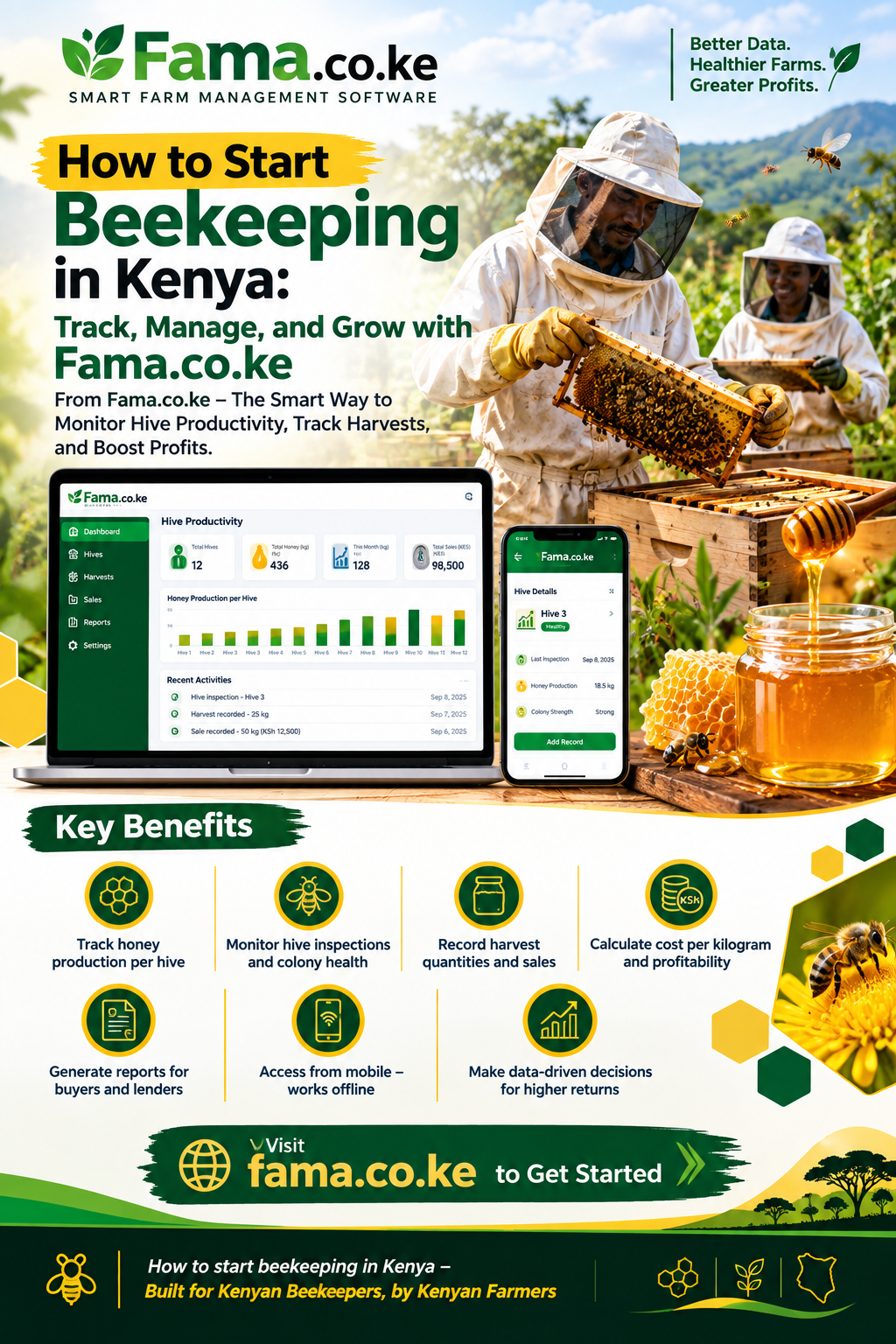
How to start beekeeping in Kenya is one of the most rewarding agricultural questions a farmer can ask, offering a venture that requires minimal land, low capital, and produces one of the highest-value products per kilogram in Kenyan agriculture. Fama.co.ke provides an innovative farm management platform that helps beekeepers track how to start beekeeping in Kenya through disciplined record-keeping, hive productivity monitoring, and data-driven apiary management. Kenya’s national honey production is estimated at 19,000 metric tonnes against a demand exceeding 43,000 metric tonnes, and this clear gap represents an immediate opportunity for new beekeepers to enter a market where demand consistently outstrips supply. Understanding how to start beekeeping in Kenya begins with recognising that this is not a marginal activity—it is a strategic value chain with the capacity to drive food security, biodiversity conservation, and sustainable livelihoods at scale.
The financial case for beekeeping is compelling. A standard Langstroth hive can produce between 10 and 25 kilograms of honey per year, and with current market prices ranging from Sh500 to Sh1,200 per kilogram for pure, well-packaged honey, each hive can generate between Sh5,000 and Sh30,000 annually. Honey currently fetches between Sh600 and Sh900 per kilogram depending on quality and market demand, making beekeeping one of the most profitable enterprises for many smallholder farmers. Peter Wekesa from Lugari Sub-County started with five Kenya Top Bar hives three years ago and today owns 25 hives, collecting between 200 and 300 kilogrammes of honey each season. This is what how to start beekeeping in Kenya looks like when done properly—a steady, climate-resilient income stream that requires relatively little land and minimal labour.
The first step in learning how to start beekeeping in Kenya is training and knowledge acquisition. Before investing any money, enroll in beekeeping training programmes offered by reputable institutions. KALRO’s Apiculture and Beneficial Insects Research Institute trains farmers on improved beekeeping, beneficial insects farming, and sustainable production. The Kenya Agricultural and Livestock Research Organization has developed comprehensive training modules covering apiary establishment, hive management, colony establishment, honey harvesting, value addition, and marketing. Learning directly from experienced local beekeepers through mentorship is equally invaluable. This how to start beekeeping in Kenya guide recommends completing at least one formal training course before purchasing your first hive.
Choosing the right location is the second critical decision in how to start beekeeping in Kenya. The apiary should be at least 50 metres away from the homestead, public roads, public grounds, schools, and social places. KALRO recommends maintaining a distance of 200 to 300 metres from public amenities and a radius of 2 to 3 kilometres from the next apiary to avoid competition for forage. The hives should be in a shaded place away from direct sunlight, in a spacious area that allows bees to easily fly in and out. Water must be available within a three-kilometre radius, and flowers should be present as they contain nectar, the essential ingredient in honey production. The apiary should be free from disturbances, noise, and protected from strong sun and wind. Good apiary site selection is fundamental to how to start beekeeping in Kenya successfully.
Hive selection determines your production ceiling, and this how to start beekeeping in Kenya guide recommends modern hives over traditional options. Most Kenyan beekeepers prefer the Kenya Top Bar hive at 41 per cent and the Langstroth hive at 36 per cent. The Langstroth beehive uses a multi-layered structure and removable frames to encourage bees to build their hives in an orderly fashion, making it easy to harvest honey. Farmers can purchase the Langstroth beehive at Sh5,000 per hive, fitted with beeswax to attract bees. A farmer can collect 20 to 30 kilogrammes of honey per harvest from a Langstroth, as opposed to traditional log hives which yield between 10 and 15 kilogrammes. The Langstroth hive is the most attractive to migrating bee swarms, followed by the traditional log hive, and then the Kenya Top Bar hive. This how to start beekeeping in Kenya guide recommends Langstroth hives for farmers intending to keep bees as a business.
Understanding the cost structure is essential for how to start beekeeping in Kenya. The minimum investment for honey bee farming to start with five hives is approximately Sh30,000 to Sh50,000. A Langstroth hive costs approximately Sh5,000, a Kenya Top Bar hive costs Sh4,000, and a log hive costs Sh1,500. Essential equipment includes a bee suit at approximately Sh6,000, a smoker at Sh1,000, a hive tool at Sh350, gum boots at Sh900, and a honey extractor at Sh120,000 if harvesting at scale. The total establishment costs for 50 hives typically range from Sh200,000 to Sh400,000. This how to start beekeeping in Kenya guide recommends starting with five hives to learn the craft before scaling.
Colony establishment is where many beginners struggle, and this how to start beekeeping in Kenya guide outlines proven methods. Different ways can be used to encourage bees to enter an empty hive. One is the use of swarm nets which are fixed high up on trees to trap bees. A catcher box with beeswax can also be used to attract bees. Once the bees have occupied the catcher box, they can be transferred to the main hive by placing the main hive in a higher position with the catcher box connected by a sloping board, as bees naturally move upward. A few puffs of smoke are then used to drive the bees into the hive. Established live bee colonies can also be purchased for Sh5,000 to Sh15,000 each. Understanding colony establishment is central to how to start beekeeping in Kenya efficiently.
Hive management requires regular attention, and this how to start beekeeping in Kenya guide covers the essentials. In a colony, worker bees number about 60,000, drones are approximately 300, and there is only one queen whose function is to lay fertile eggs and keep the colony together. Approximately five to seven drones are required to mate the queen, who then lays between 1,500 and 2,000 eggs per day. Regular inspections ensure the queen is laying, the colony has sufficient stores, and there are no signs of disease or pest infestation. Various pests that attack bees include the wax moth, bee louse, and honey badgers. To control pests, infected combs should be removed and burnt, except for honey badger where the hive is suspended using wires. This how to start beekeeping in Kenya guide emphasises that healthy colonies produce more honey and require fewer interventions.
Honey harvesting is the payoff moment, but timing and technique matter enormously. Honey should be harvested only when capped by the bees, ensuring proper moisture content and quality. Harvesting four times a year is possible in well-managed apiaries, with some farmers harvesting up to 200 kilograms per season and 800 to 1,000 kilograms per year. The honey extractor allows for clean harvesting without destroying the comb, enabling the bees to reuse it and saving them the energy of rebuilding. Harvesting at night or early morning reduces bee agitation and improves safety. Proper harvesting techniques protect both the beekeeper and the colony, ensuring sustainable production year after year.
Marketing channels for honey and bee products are expanding rapidly, reinforcing the profitability of [how to start beekeeping in Kenya]. Savannah Honey has opened venom and honey collection centres in Eldoret and Kakamega, paying Sh500 per kilogram to contracted farmers, with payment within 24 hours by cash, M-Pesa, or bank transfer. The company is recruiting up to 7,000 contract farmers in a nationwide beekeeping campaign, collecting bee venom, propolis, royal jelly, pollen, and honey. For bee venom, Savannah pays Sh4,000 per kilogram to contracted farmers, buying royal jelly for Sh38,000 per kilogram, bee pollen at Sh6,800 per kilogram, and propolis for Sh1,900 per kilogram. Farmers producing over 150 kilograms of any product have their transport costs covered. This [how to start beekeeping in Kenya] guide recommends engaging with established buyers before scaling production.
Value addition dramatically increases returns from beekeeping in Kenya. A single kilogramme of honey currently sells at Sh800, bee pollen at Sh6,800, and propolis at Sh1,300. Beeswax sells for Sh800 to Sh1,500 per kilogram, propolis can fetch between Sh3,000 and Sh5,000 per kilogram, and pollen sells for Sh2,000 to Sh4,000 per kilogram. For specialised operations, royal jelly commands a premium price of Sh15,000 to Sh25,000 per kilogram. A youth who turned beekeeping from a hobby into an agribusiness venture now earns about Sh700,000 annually, harvesting up to 200 kilograms of honey per season and between 800 and 1,000 kilograms per year. This demonstrates the full profit potential of [how to start beekeeping in Kenya] when combined with value addition.
Beekeeping also contributes to crop production through pollination, creating an additional indirect financial benefit. Bees play a vital role in pollinating crops such as avocados, beans, sunflower, pumpkins, and indigenous vegetables, leading to improved yields and better-quality produce. Nearly one-third of food crops depend on insect pollination, making healthy bee populations critical for biodiversity conservation and food production. Farmers who integrate beekeeping with crop production benefit doubly—from honey sales and from increased yields. This integration is a key advantage of [how to start beekeeping in Kenya] that many beginners overlook.
Record-keeping is the discipline that determines whether beekeeping in Kenya becomes profitable or merely a hobby. Without records, a beekeeper cannot identify which hives produce the most honey, when colonies need inspection, or what the true cost per kilogram of honey is. Digital tools make [how to start beekeeping in Kenya] measurable rather than speculative, turning every hive inspection and harvest into testable management action. Fama.co.ke offers daily farm records software designed for Kenyan farmers, capturing hive productivity, harvest quantities, feed costs, and sales transactions in one system that works offline and on basic smartphones. Reports generated from this data show cost per kilogram, hive performance trends, and profitability that guide informed management.
The future of beekeeping in Kenya is bright. The livestock subsector demonstrated robust growth, with honey production up 13.5 per cent and beeswax increasing by 25.8 per cent, reflecting expansion in apiculture. Kenya has a production capacity of over 100,000 metric tonnes of honey and 10,000 metric tonnes of beeswax annually, yet current production is far below this potential. The government is encouraging the private sector to take a leading role in driving sectoral growth, with apiculture recognised as a strategic value chain with the capacity to drive food security, biodiversity conservation, and sustainable livelihoods at scale. For farmers who master [how to start beekeeping in Kenya] with proper training, modern hives, and disciplined management, the opportunity to build a profitable, climate-resilient enterprise has never been greater.
Why Beekeeping in Kenya Is a Smart Investment
Beekeeping in Kenya offers unique advantages over other livestock ventures. Bees require minimal land, with five hives occupying less space than a single dairy cow. Labour demands are low once colonies are established, making beekeeping ideal for women, youth, and part-time farmers. Beekeeping is relatively resilient to climate change compared to maize farming, which has become increasingly vulnerable to erratic rainfall and prolonged dry spells. Bees also enhance crop production through pollination, creating a multiplier effect that benefits the entire farm.
The demand-supply gap is the strongest argument for entering the sector. Kenya produces 19,000 metric tonnes of honey against demand exceeding 43,000 metric tonnes. In Migori County, production is only 1 metric tonne while consumption stands at 50 metric tonnes. This gap means beekeepers have a ready market for every kilogram they produce, often at premium prices. With global demand for natural honey and bee products rising, Kenyan beekeepers are finding new opportunities in export markets as well.
Training and Capacity Building for Beekeeping in Kenya
KALRO ABIRI is training farmers in Baringo County on improved beekeeping under the BRAINS Project, focusing on apiculture, beneficial insects farming, and integrated pest management. The training is being conducted in six sub-counties and targets women, young farmers, and other players across the agricultural value chain. The programme encourages farmers to combine crop farming with beekeeping enterprises as part of efforts to diversify household incomes and reduce dependence on a single source of agricultural revenue.
County governments are also actively supporting beekeeping. The County Government of Kakamega has intensified farmer training on modern hive management, colony establishment, honey harvesting, value addition, and marketing. The county has also distributed modern beehives, protective gear, and honey harvesting equipment to organised farmer groups. For beginners learning how to start beekeeping in Kenya, these government and institutional programmes provide affordable access to knowledge and equipment.
Common Challenges and How to Overcome Them
Beekeeping in Kenya faces several challenges that beginners must anticipate. Kenyan beekeepers had an average of 36.6 per cent livestock decrease in 2021-2022, with higher decreases during the dry and hot season at 31.9 per cent than during the wet and cold season at 20.2 per cent. The perceived causes of losses in order of significance include issues beyond the beekeeper’s control such as theft, drought, and bushfire, absconding, and pests mainly wax moth.
Cultural taboos, restrictive traditions, negative attitudes, and limited access to financial institutions and loans constrain many potential beekeepers, particularly women and youth. Contributing factors include deep-rooted cultural restrictions, inadequate technical support, weak marketing systems, bee diseases, and environmental challenges such as drought and deforestation. To overcome these challenges, farmers should join beekeeping associations, access training programmes, and adopt modern hive management practices that reduce colony losses. Providing water supplementation during the hot and dry season reduces honey bee colony losses.
Making Beekeeping in Kenya a Reality
Beekeeping in Kenya is proven, repeatable, and accessible. The evidence is in the honey sales, the breeding stock prices, and the household incomes built from small apiaries. Bees offer minimal land requirements, low labour demands, and high-value products, while remaining resilient under drought and contributing to crop pollination. Modern hives and training programmes have removed the technical barriers that once limited production.
Fama.co.ke provides the digital infrastructure to track every kilogram of honey, every hive inspection, every pest treatment, and every sale. Start your journey with the right tools and the right knowledge. Visit fama.co.ke to learn more about how farm management software can support your beekeeping venture.