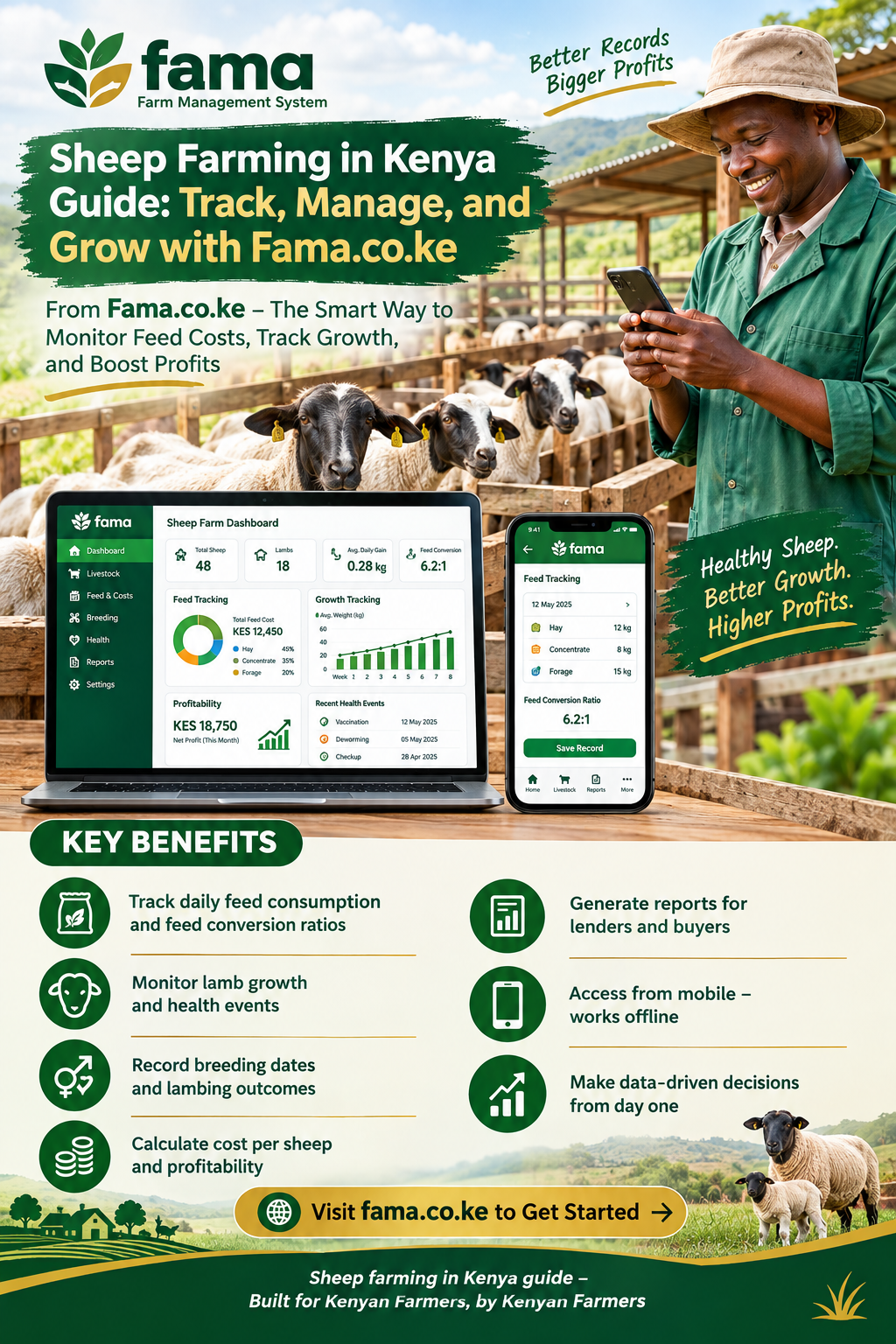
Sheep farming in Kenya guide is the essential starting point for farmers who want to move away from unpredictable cattle rearing into a livestock enterprise with faster returns and lower land requirements. Kenya’s national sheep flock numbers approximately 19 million head, distributed across the arid and semi-arid lands that make up roughly 80 per cent of the country’s land mass and across the cooler highlands where wool sheep have a long history. Annual slaughter of around 9.5 million animals produces approximately 47 million kilograms of mutton. Fama.co.ke provides an innovative farm management platform that helps farmers track sheep farming in Kenya guide through disciplined record-keeping, feed cost monitoring, and data-driven flock management. This sheep farming in Kenya guide provides the technical and financial roadmap you need to build a profitable sheep enterprise.
The financial case for entering sheep production is compelling. A farmer with 50 ewes can expect 75 to 100 lambs every year, and each lamb sold at 6 months brings 8,000 to 12,000 shillings, meaning total revenue from lamb sales alone reaches 600,000 to 1.2 million shillings. The profit margin ends up between 40 and 60 percent after subtracting costs. For beginners seeking a clear sheep farming in Kenya guide, these numbers demonstrate why sheep have become one of the most attractive livestock ventures in the country. The profit you can make from each acre is often higher than what you would get from cattle, and the initial money needed to start is lower.
The market environment supports sheep farming in Kenya strongly. Mutton fetches between KSh 600 and KSh 1,100 per kilogram in Nairobi and other major urban markets, with seasonal premiums during Ramadan, Eid, Christmas, and school holiday periods. Butchers across the country report that mutton sells faster than beef, which tells you that demand is growing while supply remains limited. The export market for Kenyan mutton is also growing, especially in Middle Eastern countries that import large amounts of sheep meat, and Kenya has trade agreements that give farmers access to these markets. Understanding sheep farming in Kenya guide begins with recognising that demand is already there—what is missing is organised production.
Breed selection is the single most influential decision in sheep farming in Kenya guide. The Dorper breed is the best choice for farmers who want to produce mutton commercially, having adapted well to Kenyan conditions over the years. Dorper sheep reach market weight quickly, attaining 40 kilograms in just four months, making them very economical to produce. Research has put their daily weight gain at around 90 grammes, and with good nutrition this can be increased and market weight attained even faster. A mature Dorper ram can weigh between 80kg and 114 kg with the ewes weighing 57kg to 80 kg, and this high yield in meat has attracted many farmers eager to raise sheep and make profits quickly. This sheep farming in Kenya guide recommends Dorper as the commercial breed of choice for most Kenyan conditions.
The Red Maasai is the indigenous Kenyan breed kept by pastoralist communities for generations, and it is uniquely tolerant of internal parasites, trypanosomiasis, and the bluetongue virus, making it the breed of choice for low-input, disease-pressured environments. Crossbreeds of Dorper and Red Maasai combine the size and growth of the Dorper with the disease resilience of the Red Maasai and are increasingly preferred by commercial operations in mixed environments. The Merino is the wool specialist, concentrated in the cooler central highlands including the Mount Kenya region, parts of Laikipia, and Nyandarua. The Hampshire Down, an English breed introduced as a terminal sire, produces a heavier carcass with good lean-meat percentage and is used in crossbreeding programmes. A complete sheep farming in Kenya guide must consider which breed matches your environment, market, and management capacity.
The cost of starting sheep farming is more accessible than many beginners expect. Young ewes are around KSh 10,000 to KSh 15,000, mature breeding ewes are around KSh 15,000 to KSh 30,000, while quality breeding rams can cost considerably more. A breeding ram currently costs between Sh25,000 and Sh40,000 with ewes selling from Sh10,000 to Sh15,000. For beginner farmers, Bernard Wagitu of Amagoh Dorpers recommends starting with one ram and 10 ewes, which gives a manageable learning curve. For such farmers, he advises a starter stock of local and South African Dorper crosses, with rams costing Sh25,000 and ewes costing Sh15,000. Farmers with rearing experience can purchase progenies of pure South African Dorpers which cost Sh70,000 for a ram below a year old and Sh100,000 for one older than a year. This sheep farming in Kenya guide recommends starting small and scaling as experience grows.
Feed is the largest controllable cost in sheep farming in Kenya guide. Dorper sheep have good feed conversion efficiency and are not selective grazers, meaning they will flourish even on relatively poor-quality feeds. They do well on natural pastures, although farmers may offer supplementary feeding during scarcity or based on nutritional requirements, and they are hardy and perform well in low ecological zones. When breeding ewes are well managed through proper feeding, disease and parasite control, they will bear twinning from the third lambing. They should be properly flushed—fed well before mating to increase the chances of twinning. KALRO has developed a sheep fattening recipe that shortens the time sheep take to reach maturity by 2.5 years. The Wonder Feed rears Dorper sheep in a feedlot, reducing the time taken to reach the market weight of 46Kg from three years to 6.5 months. The formulation includes 39.8 per cent maize grain, 45.8 per cent lucerne hay, smaller amounts of wheat bran, molasses, cottonseed, and mineral supplements including dicalcium phosphate, limestone, and a mineral premix. In just 6.5 months the sheep exceeded the 45kg target by one kilo, and by seven months they achieved a live weight of over 50kg.
Housing for sheep can be simple and cost-effective. A 100-hectare ranch carrying 800-1,200 head needs an initial fencing budget of KSh 2-4 million depending on terrain and fence specification, while the total capital outlay for a 100-ewe intensive unit runs KSh 1.5-3 million. For zero grazing systems, a raised, well-ventilated shed with adequate floor space per animal is essential. The Dorper breed’s flexibility allows farmers to adapt their flocks to specific production goals and market requirements, and they tolerate both hot and cold weather conditions, making them suitable for Kenya’s diverse climate.
Health management is critical, and this sheep farming in Kenya guide emphasises disease prevention from day one. Reported disease occurrence is high, with 71.9% of respondents in Mandera County reporting Peste des Petits Ruminants (PPR) in sheep flocks. The Ministry of Agriculture has launched a Sh6.2 billion plan aimed at eradicating PPR, a viral disease affecting sheep and goats, first detected in Kenya in 2006 in Turkana County. Internal parasites are another significant challenge, and there is clear evidence that in the sub-humid zone of coastal Kenya, Red Maasai sheep are more resistant to endoparasites than the introduced Dorper breed. Regular deworming, vaccination against PPR and other common diseases, and clean housing reduce losses. Dorper sheep have good resistance to diseases and parasites compared to many other breeds, which is one reason they have become so popular.
Breeding management follows a predictable cycle that beginners can master. A ewe can produce lambs every 8 months under good management, and a farmer can sell a fattened lamb when it is 6 to 9 months old. Dorper sheep have a long breeding season and good mothering ability, making them excellent for commercial production. Proper flushing—feeding ewes well before mating—increases twinning rates and lamb survival. Keeping accurate breeding records is essential to avoid inbreeding and to track which ewes and rams produce the best offspring.
Record-keeping is the discipline that separates profitable sheep farmers from those who merely keep sheep, and this sheep farming in Kenya guide treats it as the core of the enterprise. Without records, a farmer cannot know the true cost per kilogram of mutton produced, cannot identify ewes that consistently produce twins, and cannot detect disease outbreaks early. Feedlot operators like Jackson Naikuni, who has farmed livestock for more than 40 years, estimate the cost of production at about Sh9,000 per sheep, and he expects to generate about Sh1.5 million revenue from the sale of 100 Dorper sheep within three months, making a profit of close to Sh600,000. He achieves this because he uses the feedlot system, which saves time, space, and other resources required under conventional systems. Digital tools make sheep farming in Kenya guide measurable rather than speculative, turning every breeding decision and feed change into testable management action.
Marketing channels for sheep farmers in Kenya are well-established. Direct sales to butchers and nyama choma joints capture strong margins. Farmers can sell to the Kenya Meat Commission for mutton processing. Export channels to Middle Eastern countries offer premium prices for quality mutton. A mature ram can weigh between 80kg and 114 kg, and this high yield in meat has attracted many farmers eager to raise sheep and make profits quickly. The Dorper Breeders Society of Kenya provides networking and market linkage opportunities for farmers seeking to sell breeding stock. Demand for breeding ewes has been rising far beyond the supply, with farmers from neighbouring countries like Tanzania flocking to Kenya to buy ewes.
The future of sheep farming in Kenya guide is bright. KALRO has developed community breeding programmes for dairy cows, beef animals, sheep and goats that adapt to the impacts of climate change, and developing better breeds of sheep will help them yield higher profits. County governments like Nakuru are distributing Dorper rams to enhance sheep breeds and productivity in the region, handing over 65 Dorper rams to farmer groups to improve local genetics. With demand for mutton growing, supply remaining limited, and improved breeds and feeding technologies now available, farmers who enter the sector with proper knowledge and disciplined management have a genuine opportunity to build profitable, sustainable sheep enterprises. For those seeking comprehensive digital tools to support their journey, sheep farming in Kenya guide from Fama.co.ke provides the infrastructure to plan, track, and grow a successful sheep flock. Visit fama.co.ke to learn more about how farm management software can support your sheep farming venture, and use this sheep farming in Kenya guide as your roadmap to building a thriving sheep enterprise. With the right breeds, disciplined feeding, and proper record-keeping, sheep farming in Kenya guide transforms from a question into a measurable business outcome. For farmers who want to track every lamb, every kilogram of feed, and every shilling of profit, sheep farming in Kenya guide from Fama.co.ke offers the digital infrastructure needed to succeed. With the right knowledge and the right tools, sheep farming in Kenya guide can become a rewarding business reality.
Frequently Asked Questions About Sheep Farming in Kenya Guide
What is the best sheep breed for commercial farming in Kenya?
The Dorper breed is the best choice for farmers who want to produce mutton commercially. Dorpers reach market weight quickly, attaining 40 kilograms in just four months, and have good resistance to diseases and parasites. For low-input, disease-pressured environments, the Red Maasai or Dorper-Red Maasai cross is preferred.
How much does it cost to start sheep farming in Kenya?
Young ewes are around KSh 10,000 to KSh 15,000, mature breeding ewes are around KSh 15,000 to KSh 30,000, while quality breeding rams can cost considerably more. A starter stock of one ram and 10 ewes with local and South African Dorper crosses costs approximately Sh25,000 for the ram and Sh15,000 per ewe.
How long does it take for a sheep to reach market weight?
Dorper sheep attain 40 kilograms in just four months under good management. KALRO’s Wonder Feed reduces the time taken to reach the market weight of 46Kg to 6.5 months in a feedlot system, compared to three years for traditional slow-maturing breeds.
What do sheep eat in Kenya?
Dorper sheep do well on natural pastures and are non-selective grazers. Supplementary feeding may be offered during scarcity. KALRO’s Wonder Feed formulation includes maize grain, lucerne hay, wheat bran, molasses, cottonseed, and mineral supplements to accelerate growth in feedlot systems.
How do I prevent diseases in my sheep flock?
Vaccinate against Peste des Petits Ruminants (PPR), deworm regularly for internal parasites, and maintain clean, dry housing. Dorper sheep have good resistance to diseases and parasites compared to many other breeds, but regular veterinary care is still essential.