Farm Machinery Repair Cost Tracking Software Kenya answers a hard ownership question: how much is each tractor, harvester, pump, generator, vehicle or implement really costing the farm? A repair invoice by itself is not enough. Management also needs the asset, failure, date, downtime, labour, spare parts, fuel context and previous repair history.
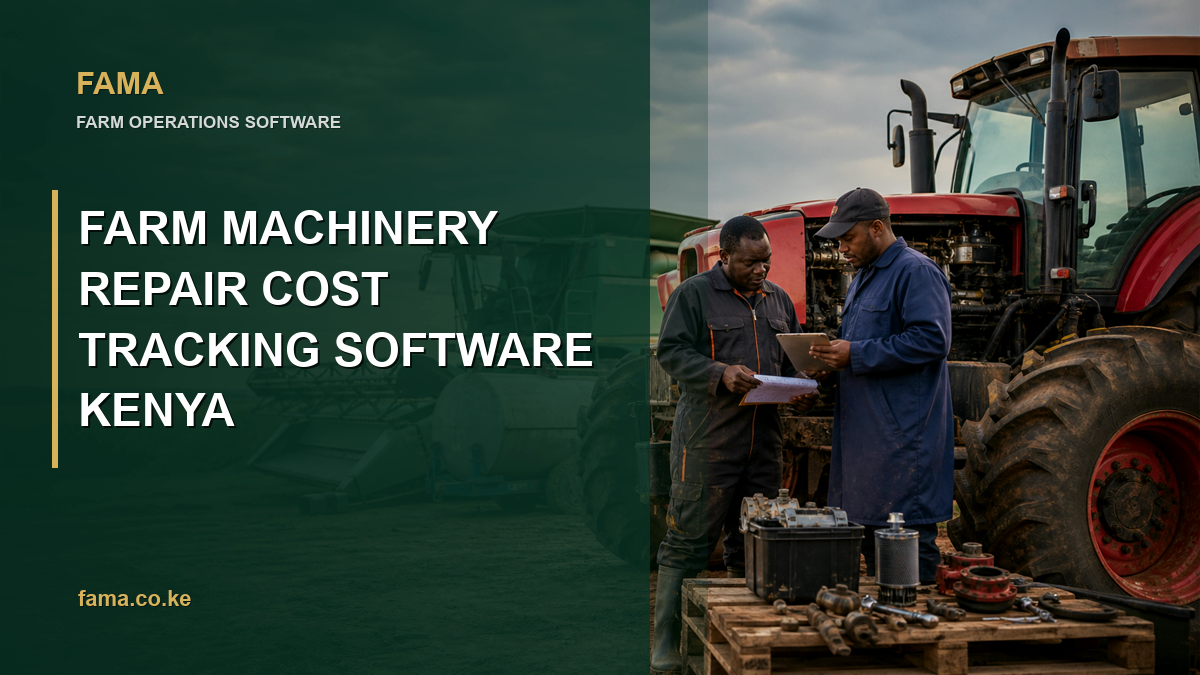
FAMA can organize machinery, fuel, repair and spare-parts records alongside farm operations and accounting. This gives the owner a practical cost history for each machine. It does not require the farm to pretend that every breakdown was predictable, and it does not promise automatic telematics. The value comes from consistent records entered by the people who operate, maintain, approve and pay for machinery work.
Review one machine’s true history
Bring a tractor identifier, service notes, fuel records, three recent repair bills and the jobs it performed. FAMA can be demonstrated around that evidence.
Why repair costs disappear inside general expenses
Many farms record “tractor repair†as one cashbook line. That proves money was spent but does not explain which tractor failed, what part was replaced, whether the same fault has happened before or how long the machine was unavailable. A second farm may keep service details with a mechanic while accounts holds invoices and the manager tracks work in WhatsApp. None of those records alone supports a repair-versus-replace decision.
Machinery cost tracking brings the evidence under one asset identity. The registration number, farm code, serial number or other agreed identifier should appear across fuel, service, repair and spare-parts records. A clear identifier prevents expenses for two similar tractors from being mixed.
Records that make machinery decisions stronger
Asset register
Begin with the machine name, identifier, type, acquisition information available to management, responsible operator and current status. Implements and engines that incur meaningful cost should also have consistent identities. The register is the anchor for every later transaction.
Fuel usage
Fuel is often the largest recurring machinery cost. FAMA supports machinery and fuel records so management can see fuel against the right asset and operating purpose. The farm should agree whether it records litres issued, hours worked, distance, field job or another practical measure. A variance may indicate hard work, idling, poor maintenance, a recording error or misuse; it should trigger review rather than an automatic accusation.
Service and repair history
Each repair should describe the symptom, diagnosis, action taken, date, provider and cost. Scheduled service should be distinguishable from an unexpected breakdown. Over time, the history shows whether the same component repeatedly fails and whether preventative service is actually being performed.
Spare parts
Filters, belts, bearings, tyres, batteries and specialist parts can tie up cash or stop work when unavailable. FAMA supports spare-parts records within machinery operations. Link a part issue to the asset and repair purpose so it does not disappear as an unexplained store movement.
Downtime and farm impact
A low invoice can still be expensive if a machine fails during planting or harvesting. Record when the machine became unavailable and when it returned to service. Management can then discuss the lost time, hired replacement, delayed work or overtime caused by the breakdown, even when those effects are not captured as one automatic software figure.
Cost measures worth reviewing
- Repair cost by asset: direct repair labour and parts recorded for the machine.
- Fuel use by asset and job: litres connected to the work the machine performed.
- Repeat-fault frequency: how often a similar problem returns after repair.
- Downtime: the period between failure and return to useful work.
- Preventative versus emergency work: whether spending is planned service or breakdown response.
- Cost by operating period: monthly, seasonal or annual totals using the farm’s complete records.
These measures are management aids, not automatic mechanical diagnoses. A qualified technician should assess safety and technical condition. The accounting treatment of assets, repairs and capital improvements should be agreed with the farm’s accountant.
A tractor repair workflow using FAMA records
- Operator reports the fault. Record the machine, symptom, location, meter reading if used and time work stopped.
- Supervisor confirms priority. Decide whether the machine is safe to move, should be isolated or needs a technician on site.
- Repair is authorized. Record the provider, expected work and the person approving the cost under the farm’s process.
- Parts are issued or purchased. Connect each material cost to the machine and repair.
- Work is completed and tested. Record what was done, completion date and any follow-up service recommendation.
- Accounts records the expense. Match the bill to the repair evidence and correct asset.
- Management reviews recurrence. Compare the event with past breakdowns, fuel use and downtime.
Repair again, overhaul or replace?
That decision depends on more than age. Management should consider repair frequency, parts availability, safety, downtime during critical work, operator practice, fuel use, expected future workload and the cost of a suitable replacement. FAMA can organize the farm’s own history so the discussion is based on evidence. It should not be presented as an automatic replacement calculator unless that exact capability has been demonstrated.
For example, two tractors may each incur KES 300,000 in repairs. One may have delivered heavy work with little downtime while the other repeatedly failed during urgent field operations. The total alone is not enough. The underlying events explain the difference.
Implementation checklist for machinery cost tracking
- Give every machine and major implement one permanent identifier.
- Load active assets and useful recent history; do not import unverified duplicates.
- Agree which fuel and operating measures workers can record reliably.
- Define who can report a fault, authorize repair, issue parts and approve payment.
- Require repair descriptions that another manager can understand later.
- Reconcile spare-parts stock and supplier bills with repair records.
- Review downtime and recurring failures at least monthly during active seasons.
Frequently asked questions
Does FAMA connect repairs with farm expenses?
FAMA includes machinery, repair, spare-parts, income and expense capabilities. The setup should demonstrate how the farm’s chosen records flow into its reports.
Can FAMA diagnose a tractor fault?
No. Diagnosis and safe repair require competent technical personnel. FAMA organizes the operating and cost record.
Does it include GPS or automatic engine data?
Do not assume an integration. Buyers who require telematics should state the exact device and data requirement during the demonstration and obtain written confirmation.
Where can I review the module?
See FAMA machinery and fuel management, the wider farm management system and the existing farm equipment maintenance software guide.
Continue the large-farm controls series
- Large Farm Management Software Kenya
- Farm Input Leakage Control Software Kenya
- Farm Staff Advances and Deductions Software Kenya
- Farm Supplier Purchase Tracking Software Kenya
FAMA is Powered by Zama Systems. The platform supports practical farm operations and management records for Kenyan agribusinesses. Product fit should always be confirmed against the buyer’s real workflow during a demonstration.
Turn daily farm work into management evidence
Map the people, records and decisions that matter most, then test FAMA with a complete real-world scenario.