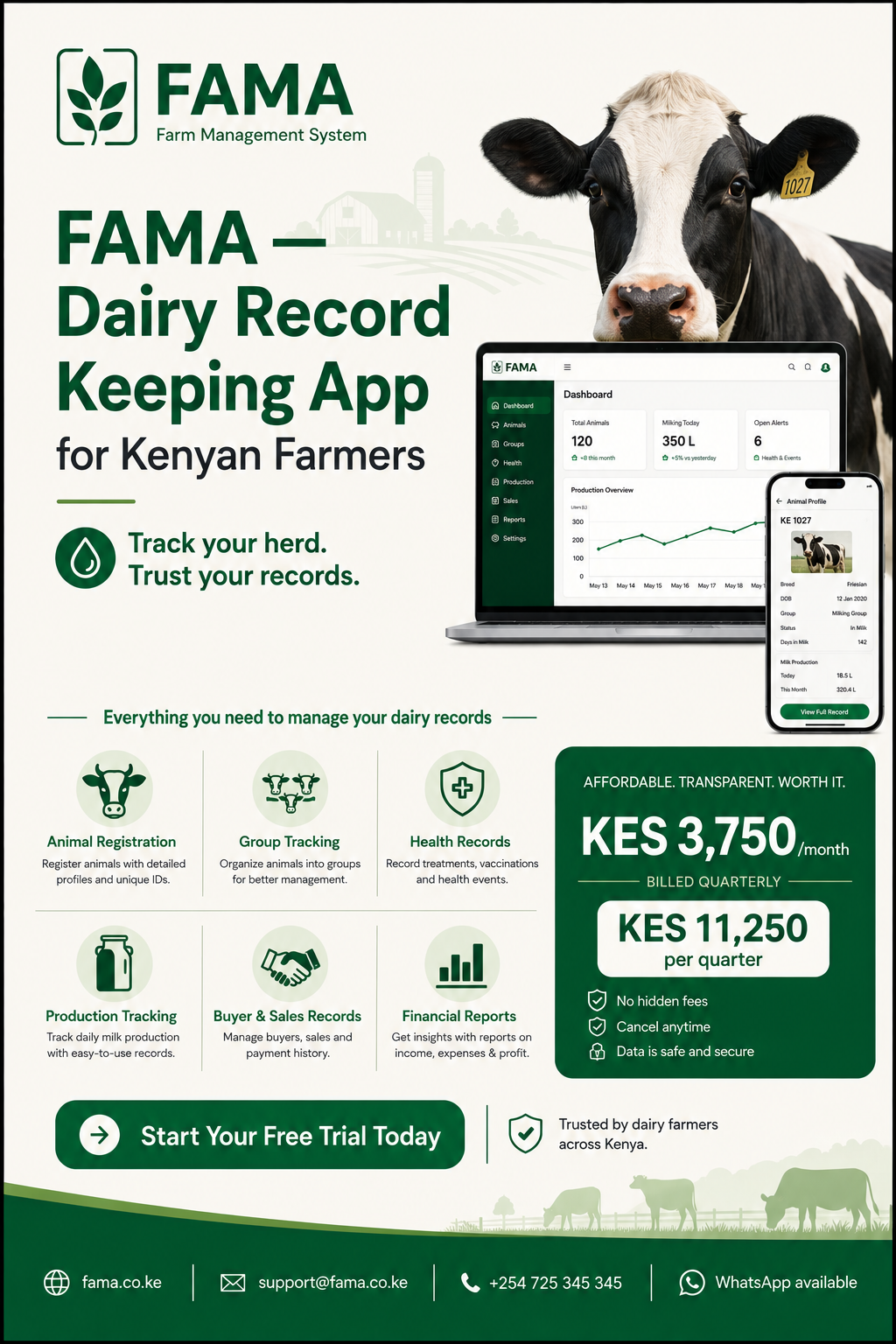
Dairy record keeping app for Kenyan farmers is one of the most searched phrases among dairy owners trying to move away from notebooks and guesswork toward a system that actually protects their herd’s profitability. If you have been looking for a dairy record keeping app for Kenyan farmers that captures animal records, production, health work, and sales in one place, FAMA (fama.co.ke) is built to do exactly that. FAMA is a SaaS farm management platform designed around the real structure of Kenyan farm operations, and its livestock management module makes it a genuine dairy record keeping app for Kenyan farmers who want reliable, centralized herd information instead of scattered notebooks, memory, and guesswork. This article explains why FAMA works so well as a dairy record keeping app for Kenyan farmers, how its livestock features fit daily dairy operations, and how the wider platform supports the rest of the farm business around the herd.
Why Dairy Farmers Need a Dedicated Record Keeping System
Dairy farming is unlike most other agricultural enterprises because it runs on a daily rhythm. Cows are milked every day, fed every day, and monitored for health every day. Every one of those daily events carries information that matters — how much milk was produced, which animal needs attention, which buyer took delivery, and how much was earned. Without a structured system, this daily flow of information is either lost entirely or scattered across notebooks that are hard to search and easy to misplace. This is precisely the gap a dairy record keeping app for Kenyan farmers is meant to close, and it is exactly the gap FAMA was built to close for dairy operations across the country.
A proper dairy record keeping app for Kenyan farmers needs to do more than store numbers. It needs to connect animal identity to production, connect production to sales, and connect sales to farm income — all while remaining simple enough for a farm manager or store keeper to use every single day without training in software or accounting. FAMA’s livestock management module was designed with exactly this daily reality in mind, which is why it functions as a complete dairy record keeping app for Kenyan farmers rather than a generic add-on bolted onto unrelated farm software.
What FAMA’s Livestock Management Module Covers
FAMA’s livestock management features form the core of why the platform works so well as a dairy record keeping app for Kenyan farmers. The module is built around the actual lifecycle of animals on a working farm, and it includes:
- Animal registration — every cow can be registered individually, giving the farm a permanent digital identity record instead of relying on ear tags and memory alone.
- Group tracking — animals can be organized into groups, which is useful for dairy herds managed by lactation stage, breed, or paddock.
- Health work records — treatments, checks, and health-related activity are logged against the animal, building a history that a farm manager or buyer can refer back to.
- Production records — output from each animal or group can be captured over time, giving the farm a clear production history rather than a vague seasonal estimate.
- Buyer details — the people and businesses purchasing milk or animals are recorded alongside the transaction, so the farm always knows who it is selling to.
- Livestock sales — sales of milk, animals, or related produce are logged directly, connecting production to income in the same workspace.
Together, these features are what make FAMA a genuine dairy record keeping app for Kenyan farmers rather than a general-purpose farm tool with livestock as an afterthought. Every part of the dairy operation — from the individual animal to the final sale — is represented inside the same system.
Starting With the Animal: Registration and Identity
The foundation of any dairy record keeping app for Kenyan farmers has to be the animal itself. Without a reliable way to identify and register each cow, every other record — health, production, sales — becomes disconnected and unreliable. FAMA allows farms to register animals individually, creating a digital identity that stays with that animal for as long as it is part of the herd.
This matters more than it might first appear. A dairy farm with even a modest herd of twenty or thirty cows can quickly lose track of which animal is which once records are kept only on paper or in memory. A dairy record keeping app for Kenyan farmers solves this by giving every animal a permanent digital profile that staff, managers, and owners can refer to at any time. When health work, production, or sales records are logged, they attach directly to that animal’s profile, building a complete individual history rather than a vague herd-wide guess.
Organizing the Herd With Group Tracking
Beyond individual animal registration, FAMA supports group tracking — a feature that is especially valuable for dairy operations where cows are commonly managed in groups based on lactation stage, age, breed, or location on the farm. A dairy record keeping app for Kenyan farmers that only tracks animals one by one, with no way to view them as a herd or sub-herd, quickly becomes difficult to use at scale.
Group tracking inside FAMA allows a farm manager to view production or health trends across a group rather than having to check every individual animal separately. This is particularly useful during busy periods, when a quick group-level view can highlight a problem — a drop in group production, for example — that might otherwise be missed until it shows up in the following month’s numbers. For any dairy record keeping app for Kenyan farmers to be genuinely useful on a working farm, it needs to support both the individual animal view and the group-level view, and FAMA is built to handle both.
Health Work: Building a Reliable History
Health records are one of the most valuable — and most commonly lost — pieces of information on a dairy farm. When health work is written on scraps of paper or simply remembered, it becomes almost impossible to answer basic but important questions later: which animals have had recent treatment, which ones are due for follow-up care, or whether a particular health issue has recurred across the herd.
FAMA logs health work directly against each animal’s record, meaning any dairy record keeping app for Kenyan farmers built on this platform gives farm managers a searchable history rather than a fading memory. Over time, this history becomes genuinely useful for herd management decisions — spotting patterns, catching recurring issues early, and having a clear record to refer to when discussing an animal’s condition with anyone involved in its care. This is a core reason FAMA stands out as a dependable dairy record keeping app for Kenyan farmers who take herd health seriously.
Production Records: Turning Daily Output Into Usable Data
At the heart of any dairy operation is production — and at the heart of any serious dairy record keeping app for Kenyan farmers is the ability to capture that production accurately, animal by animal or group by group, over time. FAMA’s production records allow farms to log output consistently, building a picture of how each animal or group is performing across weeks and months rather than relying on a single end-of-season impression.
This kind of consistent production tracking changes how a dairy farm makes decisions. Instead of guessing which part of the herd is contributing the most, a farm owner using this dairy record keeping app for Kenyan farmers can look directly at the production history and make informed choices about feeding priorities, breeding decisions, or which animals may need closer attention. Production data that used to live only in a milking record book now lives inside the same system as sales, health, and farm accounting — connected, searchable, and reliable.
Buyers and Sales: Closing the Loop From Cow to Cash
A dairy record keeping app for Kenyan farmers is only half useful if it stops at production and never connects to income. FAMA closes this loop by recording buyer details and livestock sales directly inside the same platform. When milk or animals are sold, the transaction is logged against the buyer, giving the farm a clear record of who purchased what, and when.
This matters for a simple but important reason: dairy farms often sell to multiple buyers — cooperatives, processors, local traders — and without a structured record, it becomes difficult to know which buyer is reliable, which pays on time, and which relationship is actually the most valuable to the farm. A proper dairy record keeping app for Kenyan farmers should make this visible at a glance, and FAMA does exactly that by keeping buyer and sales information inside the same workspace as production and health records.
How the Wider FAMA Platform Supports Dairy Operations
While livestock management is the core of why FAMA functions as a dairy record keeping app for Kenyan farmers, dairy farms rarely operate in isolation from the rest of the farm business. FAMA’s other modules — built for the same farm account — extend naturally around the herd.
Inputs and Stock
Feed, supplements, and other dairy inputs are tracked through FAMA’s inputs and stock module, recording purchases, suppliers, and stock balances. For a dairy record keeping app for Kenyan farmers to be genuinely complete, it needs to connect what goes into the herd — feed and inputs — with what comes out — milk and sales. FAMA keeps both sides of that equation inside the same system.
Staff, Salaries, and Advances
Dairy farms depend heavily on consistent daily labour — milking, feeding, cleaning, and herd monitoring all require reliable staff. FAMA’s staff module handles attendance, salary slips, advances, and deductions, so the people responsible for daily herd care are managed inside the same dairy record keeping app for Kenyan farmers that tracks the animals themselves.
Accounting and Reports
Every dairy farm needs to know, clearly, whether the herd is actually profitable. FAMA’s accounting and reporting module captures income, expenses, and cashbook entries, and produces printable profit-and-loss reports. Because livestock sales and input costs already live inside the same platform, a dairy record keeping app for Kenyan farmers built on FAMA can generate a genuine financial picture of the dairy enterprise without needing a separate spreadsheet pulled together at the end of the season.
Machinery and Fuel
Where dairy operations use machinery for feed preparation, transport, or general farm work, FAMA’s machinery and fuel module tracks service reminders, repair costs, and fuel use, keeping this cost visible alongside the rest of the dairy operation’s expenses.
Roles Built Around the Dairy Farm Office
FAMA recognizes distinct roles that map onto how a dairy farm’s team actually works, which strengthens its position as a genuinely usable dairy record keeping app for Kenyan farmers rather than a single-login tool that everyone has to share.
- Farm Owner — full access to all modules, reports, users, and account settings.
- Farm Manager — runs day-to-day operations, including fields, inputs, machinery, and land reports.
- Accountant — manages income, expenses, salaries, and financial reports.
- Store Keeper — controls inventory, input purchases, and stock reports.
- Staff Supervisor — records attendance and labour work.
For a dairy farm, this typically means the person handling daily milking and herd checks can log health and production records without needing access to payroll, while the accountant reviews the financial side without needing to touch herd data directly. This role separation keeps a dairy record keeping app for Kenyan farmers organized and accurate, because each person only records what they are directly responsible for.
A Typical Week Using FAMA as a Dairy Record Keeping App
To see how this works in practice, it helps to walk through a typical week on a dairy farm using FAMA.
Monday — The farm manager checks the herd and logs any health work needed for animals that showed signs of illness over the weekend. This becomes part of each animal’s permanent history inside the dairy record keeping app for Kenyan farmers the farm relies on.
Tuesday to Friday — Daily production is recorded against individual animals or groups, building a running picture of herd output across the week. Feed and input purchases are logged by the store keeper as they arrive, connecting cost directly to the herd being fed.
Saturday — Milk or animal sales are recorded against the relevant buyer, closing the loop between what the herd produced and what the farm actually earned.
End of the week — The farm owner or accountant reviews a quick report covering production, input costs, and sales, giving a clear weekly snapshot rather than waiting until the end of the month to understand how the dairy enterprise is performing.
This weekly rhythm is exactly what a dairy record keeping app for Kenyan farmers should support — not a once-a-season data dump, but a steady, daily habit that keeps records accurate and useful all year round.
What Dairy Farms Lose Without Structured Records
It is worth being direct about what is at stake for dairy farms that continue relying on notebooks or memory instead of a proper dairy record keeping app for Kenyan farmers.
- Lost animal history. Without individual records, it becomes difficult to track which animals have had health issues, treatments, or declining production over time.
- Inaccurate production tracking. Daily milking totals that are never recorded properly make it impossible to identify which animals or groups are actually performing well.
- Unclear buyer relationships. Without recorded sales history, it is hard to know which buyers are the most reliable or profitable to work with.
- Disconnected costs and income. Feed and input costs that are tracked separately from milk sales make it nearly impossible to calculate whether the dairy enterprise is truly profitable.
- No searchable history. Paper records are difficult to search, easy to lose, and impossible to share reliably between farm staff, managers, and owners.
Every one of these risks is exactly what a proper dairy record keeping app for Kenyan farmers is meant to prevent, and each one is addressed directly inside FAMA’s livestock, inputs, and accounting modules.
Security and Reliability for Dairy Farm Data
Herd records represent real value — years of health history, production patterns, and buyer relationships — so the platform holding them needs to be secure. FAMA uses authenticated, role-based access and keeps each farm account isolated, meaning no user outside the farm can view its animal, production, or sales records. For a dairy record keeping app for Kenyan farmers to be trustworthy, this kind of structural security is not optional, and it is built into FAMA by default rather than offered as a premium extra.
Getting Started With FAMA for Your Dairy Herd
Setting up FAMA as a working dairy record keeping app for Kenyan farmers does not require a long onboarding process. A farm owner can register animals into the system, assign roles to staff responsible for milking, herd checks, and sales, and begin logging daily activity right away. Because the platform mirrors how a real dairy farm office already operates, there is little need for retraining — the person doing herd checks logs health work, the person handling sales logs buyer and transaction details, and the accountant reviews the resulting reports.
Support is available directly through fama.co.ke by email, phone, or WhatsApp, which is useful for dairy farms that want quick answers while getting their herd records set up for the first time. Once the initial registration is complete, the daily habit of recording production, health work, and sales becomes the backbone of a dairy record keeping app for Kenyan farmers that only gets more valuable the longer it is used, because the animal history and production trends build up over time.
Why Consistency Matters More Than the Software Itself
It is worth saying plainly: a dairy record keeping app for Kenyan farmers is only as useful as the consistency with which it is used. A system that captures perfect records for two weeks and then goes untouched for a month provides very little value. FAMA is designed to make daily recording quick enough that it fits naturally into a farm’s existing routine — the farm manager logging health checks while walking through the herd, the store keeper logging feed purchases as deliveries arrive, the person handling sales logging buyer details as milk leaves the farm.
Farms that build this habit get the most out of FAMA as a dairy record keeping app for Kenyan farmers, because the value of the system compounds. A single week of production records tells you very little. A year of consistent production, health, and sales records tells you exactly which animals are worth keeping, which buyers are worth prioritizing, and whether the dairy enterprise as a whole is genuinely profitable.
Comparing Paper Records to a Digital Dairy Record Keeping App for Kenyan Farmers
It helps to lay the two approaches side by side. On a dairy farm relying on paper, a milking book might record daily volumes, but it rarely connects that volume back to a specific animal’s ongoing history. A separate notebook might track health treatments, if they are recorded at all. Sales are often remembered roughly, with receipts kept loosely or not kept at all. By the time the farm owner wants to know whether the herd made a profit for the month, they are stitching together numbers from several different sources, some of which may already be missing or damaged.
A dairy record keeping app for Kenyan farmers changes this by design. Every entry — a health check, a day’s production, a sale to a buyer — is captured once, inside the same system, attached to the correct animal or group. There is no stitching together required at the end of the month, because the report the owner wants is already built from records that were entered accurately as the week unfolded. This is the practical difference that separates a dairy record keeping app for Kenyan farmers from the paper-based habits it is meant to replace: not just digitizing the same information, but connecting it in ways that make it genuinely useful for decisions.
Common Questions About Using FAMA as a Dairy Record Keeping App for Kenyan Farmers
Is FAMA specifically built for dairy farms, or is livestock just one small feature? Livestock management is a core module inside FAMA, covering animal registration, group tracking, health work, production records, buyer details, and livestock sales. This makes FAMA a genuine dairy record keeping app for Kenyan farmers rather than a general farm tool with a minor livestock add-on.
Can I track more than one herd or group of cows separately? Yes. FAMA supports group tracking, so dairy farms can organize animals by lactation stage, breed, or location, giving both an individual-animal view and a group-level view inside the same dairy record keeping app for Kenyan farmers.
Does FAMA connect milk sales to farm income automatically? Yes. Livestock sales and buyer details are recorded directly inside the platform, and this connects to FAMA’s accounting module, giving dairy farms a genuine financial picture rather than a rough estimate.
Can more than one person on the farm use the system? Yes. FAMA supports distinct roles — Farm Owner, Farm Manager, Accountant, Store Keeper, and Staff Supervisor — so the person handling daily herd checks, the person managing sales, and the accountant reviewing reports can all work inside the same dairy record keeping app for Kenyan farmers without stepping on each other’s records.
How secure are the herd records stored in FAMA? FAMA uses authenticated, role-based access with farm accounts kept isolated from one another, so herd records stay private to the farm that owns them.
Do I need training to start using FAMA for my dairy herd? The platform is built to match how a dairy farm office already works, so onboarding is generally straightforward — register the herd, assign roles, and begin logging daily health, production, and sales activity.
Why the Details Matter for Long-Term Herd Management
A dairy record keeping app for Kenyan farmers becomes more valuable the longer it is used, because the real insight comes from patterns that only appear over time. A single animal’s production dip might mean nothing on its own, but if that same animal has a documented history of similar dips following certain health events, that pattern becomes genuinely useful information for a farm manager making breeding or culling decisions. This is the kind of insight that paper records almost never surface, simply because paper is hard to search and even harder to compare across months or years.
By keeping animal registration, group tracking, health work, and production records together in the same dairy record keeping app for Kenyan farmers, FAMA makes this kind of long-term pattern recognition possible for farms of any size — not just large operations with dedicated data teams. A smallholder dairy farmer with a handful of cows benefits from the same structured history as a larger operation managing dozens of animals, because the underlying system works the same way regardless of herd size.
Bringing It All Together on One Farm Account
One of the quiet strengths of using FAMA as a dairy record keeping app for Kenyan farmers is that the herd is never managed in isolation from the rest of the farm. The same account that holds animal records also holds input purchases, staff attendance, machinery costs, and financial reports. This means a farm owner reviewing the dairy enterprise’s performance is not looking at livestock numbers in one place and feed costs in another — everything sits inside a single, connected workspace.
For farms that also grow crops or run other enterprises alongside dairy, this integration matters even more. A dairy record keeping app for Kenyan farmers that only tracks the herd, with no connection to the rest of the farm’s finances, leaves the owner to manually combine numbers from separate systems. FAMA avoids this by design, keeping the dairy enterprise’s records inside the same platform as everything else the farm manages.
Practical Habits for Getting the Most From FAMA as a Dairy Record Keeping App for Kenyan Farmers
Adopting a dairy record keeping app for Kenyan farmers is only the beginning. Farms that get the most value out of FAMA tend to build a small set of habits into their daily routine rather than treating the system as an occasional task.
Log health work at the moment it happens. The most reliable dairy record keeping app for Kenyan farmers is only as good as the discipline behind it. A health check or treatment logged immediately, while the details are fresh, is far more accurate than one reconstructed from memory at the end of the day. Farm managers who make this a habit build a far more trustworthy animal history over time.
Record production daily, not weekly. Waiting until the end of the week to estimate production totals introduces errors that compound over months. A dairy record keeping app for Kenyan farmers works best when production is logged as it is measured, animal by animal or group by group, so the resulting history reflects what actually happened rather than a rough weekly average.
Assign the right role to the right person. FAMA’s role structure exists so that the person doing herd checks, the person managing sales, and the accountant reviewing reports each have access to exactly what they need – no more, no less. Setting this up correctly from the start keeps a dairy record keeping app for Kenyan farmers organized as the farm team grows.
Review reports regularly, not just at year-end. Even though FAMA calculates totals automatically, the real value comes from farm owners and managers actually looking at the reports on a regular basis – weekly or monthly, rather than only checking in once a year. A dairy record keeping app for Kenyan farmers is a decision-making tool, not just an archive, and it only functions as one if the reports are actually reviewed.
Keep buyer records up to date. As buyer relationships change — a new cooperative, a new local trader, a change in pricing — keeping this information current inside the system ensures that sales records stay accurate and that the farm always has a clear picture of where its income is coming from.
Why FAMA Fits Kenyan Dairy Operations Specifically
It would be easy to assume that any generic livestock software could serve as a dairy record keeping app for Kenyan farmers, but the details matter. FAMA was built around the structure of Kenyan farm offices the roles, the reporting needs, and the day-to-day realities of managing a herd alongside inputs, staff, and machinery on the same account. This is different from adapting broad, internationally built software that was never designed with the specific rhythms of Kenyan dairy farming in mind.
A dairy record keeping app for Kenyan farmers needs to reflect how farms in Kenya are actually run: mixed enterprises where dairy often sits alongside crops or other livestock, staff structures that include both permanent employees and casual labour, and buyer relationships that range from cooperatives to local traders. FAMA’s modules: livestock, inputs, staff, machinery and accounting — are built to reflect exactly this kind of operation, which is why the platform functions so naturally as a dairy record keeping app for Kenyan farmers rather than a foreign tool retrofitted for local use.
The Long-Term Value of Consistent Herd Records
Perhaps the most important thing to understand about any dairy record keeping app for Kenyan farmers is that its value increases the longer it is used. A single month of records tells a farm owner very little beyond a basic snapshot. A full year of consistent animal, health, production, and sales records tells a much richer story — which animals have been reliably productive, which have had recurring health issues, which buyers have been the most consistent and profitable to work with, and whether the dairy enterprise as a whole has grown or declined.
This is the real reason to invest in a proper dairy record keeping app for Kenyan farmers rather than continuing with informal, paper-based habits. It is not simply about replacing a notebook with a screen — it is about building a searchable, connected history that becomes more valuable with every week it is maintained. FAMA is built for exactly this kind of long-term use, giving dairy farms in Kenya a system that grows more useful over time rather than one that only captures a temporary snapshot.
If your search for a dairy record keeping app for Kenyan farmers keeps leading you back to fama.co.ke, it is because the platform was built around the real daily structure of a working dairy operation — animal registration, group tracking, health work, production records, buyer details, and livestock sales, all connected to the rest of the farm’s inputs, staff, and accounting inside one secure workspace.
FAMA does not treat livestock management as an afterthought bolted onto generic farm software. It treats the herd as the center of the dairy business, and builds every supporting record — feed costs, staff attendance, buyer relationships, and financial reports — around that center. For dairy farmers who want a reliable, role-based, and secure dairy record keeping app for Kenyan farmers, FAMA offers exactly that: a single place to register animals, track their health and production, record every sale, and see a clear financial picture of the herd at any time.
The path from scattered paper records to a structured system does not need to be complicated or expensive. It starts with registering the herd, assigning the right roles to the right people, and building the daily habit of logging health work, production, and sales as they happen. Over time, that habit turns into a searchable history that supports better breeding decisions, better health management, and a clearer understanding of which parts of the dairy enterprise are genuinely profitable.
Visit fama.co.ke to start registering your herd and see why FAMA continues to be the dairy record keeping app for Kenyan farmers who want their records to be as reliable as the animals they depend on.