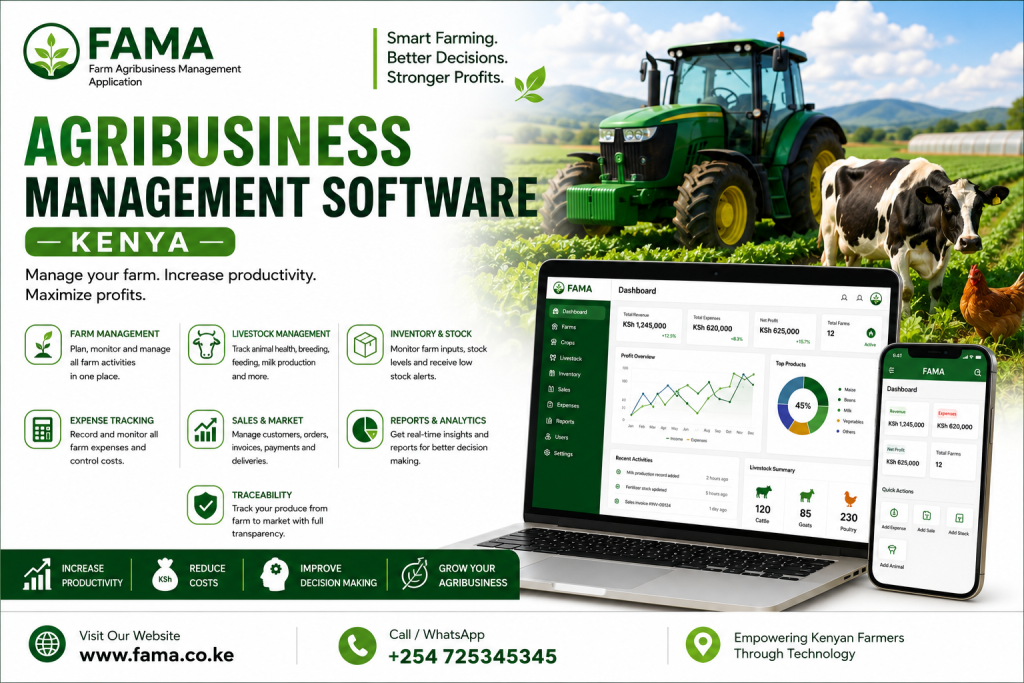
Agriculture Management System Kenya
The agricultural sector remains one of the most important pillars of Kenya’s economy. From smallholder farmers to large commercial farms, agriculture contributes significantly to food security, employment, and national income. However, managing modern farming operations using notebooks, spreadsheets, and manual records has become increasingly difficult.
This is where an Agriculture Management System Kenya comes in.
An Agriculture Management System helps farmers, agribusiness owners, cooperatives, livestock keepers, and agricultural organizations manage operations digitally. From crop planning and livestock tracking to financial reporting and inventory management, modern software provides farmers with the tools needed to improve productivity and profitability.
At Fama (fama.co.ke), we provide innovative agriculture management solutions designed specifically for Kenyan farmers and agribusinesses.
For inquiries, call +254 725345345.
What Is an Agriculture Management System?
An Agriculture Management System is a software platform designed to help farmers and agribusinesses automate, monitor, and manage daily agricultural activities.
Instead of relying on paper records, farm managers can access real-time information about:
- Crop production
- Livestock management
- Farm expenses
- Inventory levels
- Employee activities
- Sales and revenue
- Farm equipment utilization
- Supplier management
- Customer management
- Production forecasting
The goal is to help farms make better decisions based on accurate data.
Why Agriculture in Kenya Needs Digital Transformation
Kenyan farmers face numerous challenges including:
- Rising production costs
- Climate variability
- Labor management difficulties
- Poor record keeping
- Post-harvest losses
- Market fluctuations
- Input wastage
- Financial tracking problems
Many farms lose money simply because important information is not available when needed.
An Agriculture Management System Kenya provides a centralized platform where all farm operations can be monitored and controlled efficiently.
1. Improved Farm Record Management
One of the biggest challenges facing farmers is poor record keeping.
Many farmers struggle to track:
- Planting dates
- Harvest records
- Fertilizer applications
- Livestock vaccinations
- Farm expenses
- Sales transactions
An Agriculture Management System stores all records digitally, making them easy to retrieve whenever required.
Benefits include:
- Faster reporting
- Better accountability
- Historical farm analysis
- Easier compliance with agricultural standards
Digital records eliminate the risk of losing important farm information.
2. Better Crop Management
Crop farming requires careful planning and monitoring.
A good Agriculture Management System Kenya allows farmers to manage:
Crop Planning
Farmers can schedule:
- Land preparation
- Planting activities
- Fertilizer applications
- Irrigation schedules
- Pest control programs
Crop Monitoring
The system enables users to monitor:
- Crop growth stages
- Input usage
- Yield expectations
- Disease outbreaks
This improves productivity while reducing waste.
3. Efficient Livestock Management
Livestock farmers face numerous management challenges.
Tracking hundreds of animals manually can be difficult.
An Agriculture Management System helps manage:
Animal Registration
Each animal can have:
- Identification number
- Breed information
- Date of birth
- Ownership records
Health Monitoring
Farmers can track:
- Vaccinations
- Treatments
- Disease incidents
- Veterinary visits
Breeding Records
The system records:
- Mating schedules
- Pregnancy status
- Calving records
- Breeding performance
This improves herd productivity significantly.
4. Accurate Financial Management
Many farms operate without clear financial visibility.
Farm managers often struggle to determine:
- Actual production costs
- Profit margins
- Revenue streams
- Expense categories
An Agriculture Management System Kenya helps track:
Farm Expenses
Examples include:
- Seeds
- Fertilizers
- Pesticides
- Labor
- Fuel
- Equipment maintenance
Revenue Tracking
Farmers can monitor:
- Produce sales
- Livestock sales
- Milk sales
- Contract farming income
This allows better budgeting and financial planning.
5. Inventory Control and Stock Management
Agricultural inputs are expensive.
Without proper stock control, farms may experience:
- Theft
- Wastage
- Overstocking
- Stock shortages
An Agriculture Management System provides inventory management features that track:
- Seeds
- Fertilizers
- Chemicals
- Animal feeds
- Farm equipment
- Spare parts
Managers receive accurate stock reports and can make informed purchasing decisions.
6. Labor and Workforce Management
Managing farm workers can be challenging, especially on large farms.
The software helps track:
Employee Attendance
Monitor:
- Daily attendance
- Working hours
- Overtime
Task Management
Assign tasks such as:
- Planting
- Weeding
- Harvesting
- Irrigation
Payroll Support
Generate labor reports that simplify salary calculations.
This improves accountability and workforce productivity.
7. Improved Decision Making Through Data Analytics
Successful farming depends on data-driven decisions.
An Agriculture Management System Kenya generates reports that help managers understand:
- Production trends
- Yield performance
- Profitability
- Resource utilization
- Seasonal patterns
With better insights, farms can improve efficiency and profitability.
8. Increased Productivity and Efficiency
Automation reduces manual work and improves operational efficiency.
Instead of spending hours compiling reports, managers can access information instantly.
Benefits include:
- Faster workflows
- Reduced paperwork
- Better communication
- Improved planning
- Higher productivity
This enables farms to focus more on production and growth.
9. Enhanced Traceability and Compliance
Food safety regulations are becoming increasingly important.
Consumers and regulators want transparency in food production.
An Agriculture Management System helps maintain traceability records including:
- Input usage history
- Harvest records
- Storage information
- Distribution records
This is particularly important for:
- Export farms
- Agribusiness companies
- Food processors
- Cooperatives
Traceability improves trust and market access.
10. Scalability for Growing Farms
As farms expand, manual management becomes more difficult.
An Agriculture Management System Kenya grows with the business.
Whether managing:
- 5 acres
- 50 acres
- 500 acres
The system provides centralized control over all operations.
This makes expansion easier and more sustainable.
Key Features of a Modern Agriculture Management System Kenya
When choosing farm software, look for features such as:
Farm Dashboard
Provides a complete overview of farm activities.
Crop Management Module
Tracks crop production from planting to harvest.
Livestock Management Module
Monitors animal health, breeding, and productivity.
Financial Management
Tracks income, expenses, and profitability.
Inventory Management
Controls stock movement and input usage.
Employee Management
Monitors labor activities and attendance.
Reporting and Analytics
Generates management reports for better decision-making.
Mobile Accessibility
Allows access from smartphones and tablets.
Who Needs an Agriculture Management System?
The software is ideal for:
Commercial Farms
Manage large-scale crop and livestock operations.
Smallholder Farmers
Improve record keeping and farm planning.
Agricultural Cooperatives
Coordinate member activities efficiently.
Dairy Farms
Track milk production and animal health.
Poultry Farms
Monitor bird performance and production costs.
Horticultural Farms
Manage crops, labor, and export compliance.
Agribusiness Companies
Improve operational efficiency and profitability.
Benefits of Using Agriculture Management Software in Kenya
Organizations that adopt farm management software enjoy:
- Increased profits
- Better record keeping
- Reduced wastage
- Improved productivity
- Enhanced decision making
- Greater accountability
- Better resource utilization
- Simplified reporting
- Improved traceability
- Sustainable growth
These benefits contribute directly to long-term agricultural success.
Why Choose Fama for Agriculture Management System Kenya?
At Fama, we understand the unique challenges faced by Kenyan farmers and agribusinesses.
Our solutions are designed to provide:
- User-friendly interfaces
- Localized farm management tools
- Crop management modules
- Livestock management modules
- Financial reporting
- Inventory control
- Employee management
- Mobile accessibility
- Scalable architecture
- Reliable technical support
We work with farms of all sizes across Kenya.
Future of Agriculture Management Systems in Kenya
The future of farming is digital.
Emerging technologies such as:
- Artificial Intelligence (AI)
- Internet of Things (IoT)
- Smart irrigation
- GPS tracking
- Drone technology
- Predictive analytics
are transforming agricultural operations worldwide.
Farmers who adopt digital management systems today will be better positioned to compete in tomorrow’s agricultural economy.
Conclusion
The agricultural industry is becoming increasingly data-driven. Farms that continue relying on manual processes risk inefficiencies, losses, and missed opportunities.
Investing in an Agriculture Management System Kenya enables farmers and agribusinesses to improve productivity, reduce costs, increase profitability, and make better decisions.
Whether you manage crops, livestock, poultry, dairy operations, or mixed farming enterprises, a modern agriculture management solution can help streamline operations and support sustainable growth.
If you are looking for a reliable Agriculture Management System Kenya, Fama provides comprehensive solutions tailored for the Kenyan agricultural sector.
Contact Us
Fama
Website: https://fama.co.ke
Phone: +254 725345345
Talk to us today and discover how digital farm management can transform your agricultural business.