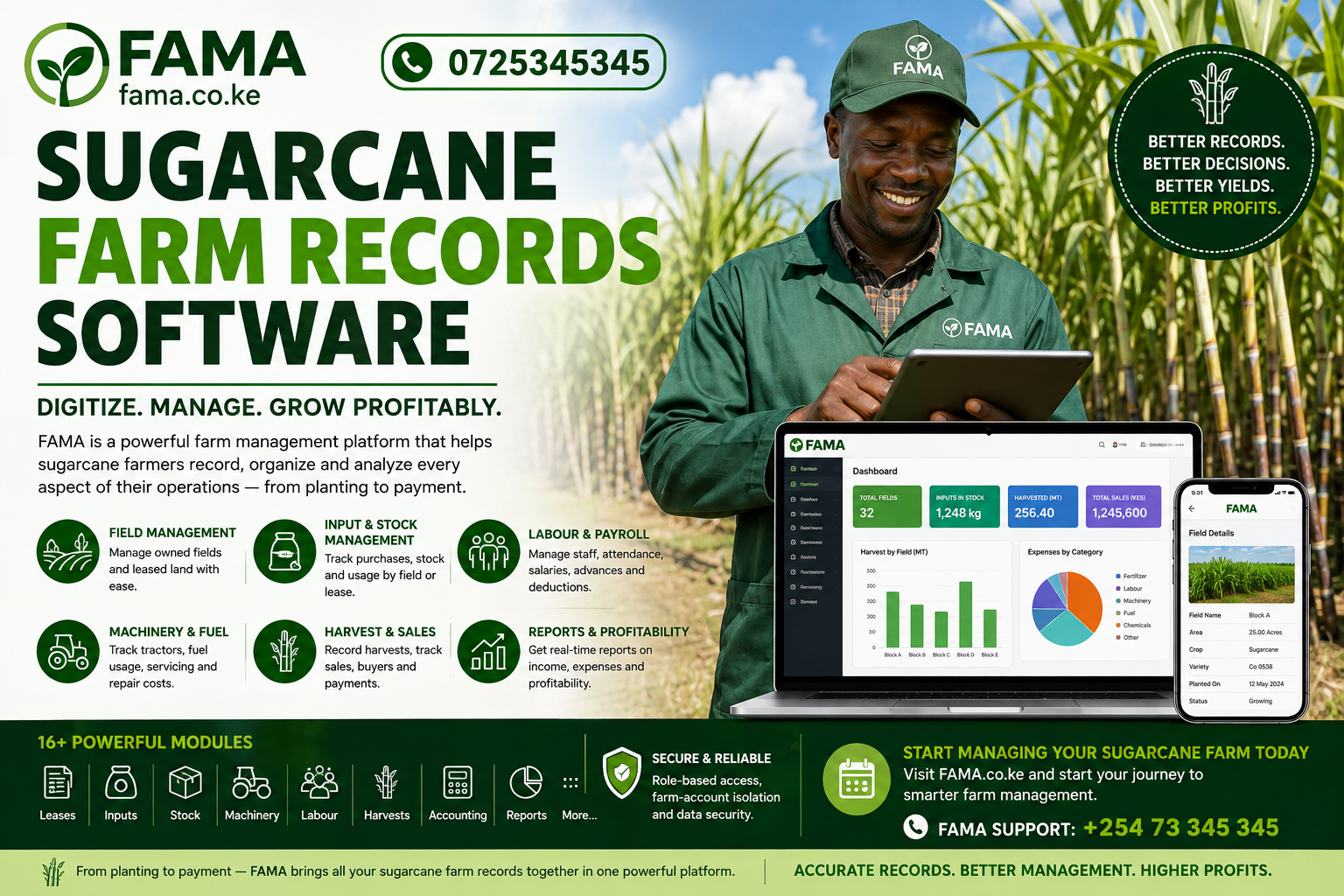
Sugarcane Farm Records Software
Sugarcane farm records software is becoming an important tool for farmers, plantation managers, agricultural companies, cooperatives and agribusinesses that need better control over sugarcane production. Sugarcane farming involves multiple activities, including land preparation, planting, fertilizer application, chemical use, labour, machinery, field maintenance, harvesting, transport, sales and financial management.
When these activities are recorded in notebooks, spreadsheets or separate files, it can become difficult to determine the actual cost of producing sugarcane. A digital system brings these records together so that farm managers can understand what was spent, where it was spent, how much was harvested and what revenue was generated.
FAMA is a farm management platform designed for Kenyan farms and provides tools for crop records, inputs, stock, machinery, labour, harvests, sales, accounting and reports from one workspace. (Fama)
For sugarcane farmers, this creates an opportunity to move from basic record keeping to structured farm management.
What Is Sugarcane Farm Records Software?
Sugarcane farm records software is a digital platform used to record, organize and analyze activities associated with sugarcane production.
Instead of maintaining separate notebooks for fertilizer, labour, machinery, expenses and harvests, a farmer can maintain these records within one system.
A typical sugarcane operation may need to record:
Land and field information.
Sugarcane variety.
Planting dates.
Field preparation.
Fertilizer purchases.
Fertilizer applications.
Chemical applications.
Labour.
Machinery.
Fuel.
Irrigation.
Harvest quantities.
Transport.
Buyers.
Sales.
Farm expenses.
Farm income.
Profitability.
The purpose is not simply to digitize paperwork. The purpose is to create useful information that can help the farm manager understand the performance of each farming period.
Why Sugarcane Farmers Need Digital Farm Records
Sugarcane production can take a significant amount of time and resources before revenue is received.
A farmer may spend money on land preparation, seed cane, fertilizer, herbicides, labour, machinery, fuel and harvesting before receiving payment for the crop.
Without accurate records, it can be difficult to determine the total investment in a particular field.
Sugarcane farm records software can help organize these costs according to the farm’s operational structure.
For example, a farmer managing several sugarcane blocks can record inputs and expenses against specific fields or farming periods instead of combining every expense into one general notebook.
This makes historical information easier to review.
Sugarcane Farm Records Software for Field Management
Field management is one of the most important functions for commercial sugarcane farms.
A farm may contain several fields planted at different times.
One block could be newly planted while another is approaching harvesting.
Another block may be undergoing fertilizer application or weed control.
Sugarcane farm records software can help organize these activities so that the manager knows what is happening in each field.
FAMA’s farm management system supports owned fields and rented leases, allowing farm teams to maintain structured land and operational records. (Fama)
This can be useful for sugarcane businesses operating both owned and leased land.
Sugarcane Farm Records Software for Planting Records
Planting is the beginning of a sugarcane production cycle.
Farmers should record when planting takes place, which field was planted and the inputs used.
A digital system can provide a historical record that remains available for future analysis.
For example, a farm can record the planting date for Block A and later compare the associated input costs, labour and harvest results.
Over several farming cycles, these records can help managers identify patterns.
The system does not automatically guarantee higher yields. Its value comes from giving farmers better information for planning and decision-making.
Sugarcane Farm Records Software for Ratoon Crops
Sugarcane production can involve ratoon crops after the initial plant crop.
Managing ratoon cycles requires careful record keeping because the field continues through another production period.
A farmer should be able to distinguish the original planting from subsequent ratoon cycles.
Sugarcane farm records software can help organize these production periods and their associated costs.
The farmer can record activities carried out during each cycle and compare results across farming periods.
This can make historical farm analysis more useful than simply keeping one cumulative figure for the entire field.
Sugarcane Farm Records Software for Fertilizer Management
Fertilizer is an important farm input.
Farmers need to know what fertilizer was purchased, how much was purchased, how much remains and where it was applied.
FAMA’s input-management module supports supplier records, input purchases, stock balances and usage by owned field or rented lease. (Fama)
This makes the approach relevant to sugarcane farms that need to track fertilizer allocation across different blocks.
Suppose a farm purchases 500 kilograms of fertilizer.
Instead of recording only the purchase, the farm can maintain a stock record and document quantities issued to individual fields.
This provides greater visibility over input consumption.
Sugarcane Farm Records Software for Chemical Records
Sugarcane farms may use herbicides and other agricultural chemicals as part of crop management.
The farm should maintain records of purchases, quantities used, dates and relevant fields.
Sugarcane farm records software can provide a structured location for these records.
This is particularly useful when a farm has multiple fields requiring different treatments.
The manager can review previous applications when planning subsequent operations.
Digital records can also make it easier to investigate unexpected production costs.
Sugarcane Farm Records Software for Labour Management
Labour is another significant component of farm operations.
Workers may be involved in land preparation, planting, weeding, fertilizer application, field maintenance, harvesting and other activities.
A farm should therefore know how much labour is being used and where.
FAMA provides staff, attendance, salary and advance management within its wider farm management system. (Fama)
For a sugarcane farm, this can provide a central location for employee-related records.
Instead of keeping worker information in separate notebooks, managers can connect labour records with the broader farm operation.
Sugarcane Farm Records Software for Casual Labour
Sugarcane farms may rely on both permanent and casual workers.
Casual labour can be particularly difficult to track when activities occur across several fields.
A manager can record workers, attendance and applicable payments in a structured system.
This helps answer practical questions.
How many workers were involved?
Which activity were they performing?
Which field were they working on?
How much was paid?
When was the work completed?
These records become valuable when calculating the actual cost of production.
Sugarcane Farm Records Software for Farm Machinery
Large sugarcane operations may use tractors and other machinery for land preparation, cultivation, transport and harvesting.
Machinery creates costs through fuel, servicing, repairs and depreciation.
FAMA provides machinery and fuel management for tractors, drivers, service reminders, repair costs and fuel reports. (Fama)
A sugarcane farm records software solution with machinery records can therefore help farm managers understand the cost of equipment used in production.
Sugarcane Farm Records Software for Fuel Tracking
Fuel expenses can become significant when tractors and farm vehicles are used regularly.
Farm managers need to know how much fuel was purchased and how it was consumed.
Recording fuel purchases without connecting them to machinery may provide limited insight.
A better system can associate fuel records with specific equipment or operations.
This can help managers identify unusually high consumption and review machinery performance.
FAMA’s machinery and fuel functionality is designed to bring fuel usage and service history into the farm’s operational records. (Fama)
Sugarcane Farm Records Software for Harvest Records
Harvesting is one of the most important stages of sugarcane production.
The farm needs to know how much cane was harvested, from which field and during which farming period.
Sugarcane farm records software can help connect harvest information with the production history of the field.
This is more useful than recording only the total amount sold.
A farmer can review the relationship between production costs and harvested quantities.
Over time, this creates a historical record of field performance.
Sugarcane Farm Records Software and Sugarcane Transport
Transport can become a significant part of sugarcane operations.
After harvesting, cane may need to be transported to a processing facility or designated buyer.
The farm should record transport-related expenses and, where relevant, vehicle or machinery activity.
Fuel records and transport costs can then be considered when calculating the complete production cost.
Sugarcane Farm Records Software and Sales Tracking
Sales tracking should connect the harvested quantity to the amount received.
A farm should know:
What was sold?
How much was sold?
To whom?
At what price?
When?
How much was received?
This creates a clearer relationship between production and revenue.
Sugarcane farm records software can help maintain this information in one environment.
Sugarcane Farm Records Software and Business Profitability
Profitability should be evaluated using complete records.
For example, imagine a sugarcane farm records KES 800,000 in sales during a farming period.
If direct and operating costs total KES 560,000, the difference is KES 240,000 before other applicable adjustments.
The calculation is only useful if the KES 560,000 cost figure is accurate.
This is why detailed records matter.
Sugarcane Farm Records Software and Decision Making
Farm managers make decisions every day.
They decide when to purchase inputs, where to allocate labour, when to service machinery and how to prepare for harvesting.
Good decisions require reliable information.
Sugarcane farm records software provides a structured information base that can support those decisions.
It does not replace the farmer’s experience.
Instead, it combines experience with historical operational data.
Sugarcane Farm Records Software for Small Sugarcane Farms
Digital records are not limited to large plantations.
A small farmer can also benefit from recording expenses, inputs, labour and harvests.
The amount of data may be smaller, but understanding profitability remains important.
A farmer who knows exactly what was spent and what was earned is in a stronger position to plan the next cycle.
Sugarcane Farm Records Software for Large Sugarcane Estates
Large estates have more complex requirements.
They may manage hundreds or thousands of acres, multiple field teams, tractors, input stores and harvesting operations.
Manual records become difficult to consolidate at this scale.
A centralized farm management platform can provide a common structure for field, labour, machinery, inventory and financial records.
Sugarcane Farm Records Software for Mixed Farms
A farm may grow sugarcane while also keeping livestock or other crops.
Using separate systems for every enterprise can create fragmented information.
FAMA supports crop and livestock records within the same farm management platform. (Fama)
This allows a mixed farm to manage multiple agricultural activities under one broader system.
Sugarcane Farm Records Software and Farm Accounting
Accounting becomes more meaningful when operational records are connected to financial information.
For example, fertilizer purchases should appear in the farm’s expense records.
Worker salaries should be reflected in labour costs.
Machinery repairs should be included in operating expenses.
Sugarcane sales should contribute to income records.
This creates a more complete financial picture.
FAMA combines farm operations with accounting and reporting capabilities. (Fama)
Sugarcane Farm Records Software and Farm Reports
Farm reports can answer practical management questions.
How much fertilizer was used?
How much fuel was consumed?
How much did labour cost?
How much sugarcane was harvested?
How much was sold?
What were total expenses?
What was the recorded income?
What was the operating result?
Having these answers available can significantly improve management visibility.
Sugarcane Farm Records Software and Digital Agriculture
The move toward digital agriculture is not about replacing farmers.
It is about improving how agricultural information is captured and used.
Digital agriculture platforms can centralize records, improve reporting and support better resource management.
FAMA describes its platform as a SaaS solution covering crop and livestock records, inputs, stock, machinery, labour, harvests, production, sales and farm accounting. (Fama)
This makes it suitable for farms looking to move away from fragmented manual systems.
Sugarcane Farm Records Software and Other Business Systems
A sugarcane business may use more than one digital platform.
For example, farm management can be handled by FAMA, while other business functions can use specialized systems.
A business that sells agricultural products may use POS software.
A farm employing many workers may also need HR management software.
A property-owning agricultural business can explore property management software.
Businesses managing rental properties can use rental management software.
For broader workflow automation, business automation software can support other operational requirements.
The purpose of using specialized software is to give each business function an appropriate management tool.
Sugarcane Farm Records Software and Farm Technology
Modern farms increasingly combine several technologies.
These may include accounting systems, inventory management, farm software, communication tools, machinery systems and connectivity solutions.
For farms operating in areas with limited terrestrial connectivity, Starlink installation Kenya can be considered as one connectivity option.
Reliable connectivity can make cloud-based farm management more practical in remote agricultural locations.
Sugarcane Farm Records Software and Agricultural Supply Management
Sugarcane farmers depend on timely access to inputs.
If fertilizer or chemicals are unavailable when required, operations can be delayed.
Stock records can help managers determine when supplies need replenishment.
FAMA’s input management module supports supplier directories, purchases, stock balances and field-level usage records. (Fama)
This can help connect procurement with actual farm consumption.
Sugarcane Farm Records Software and Supplier Payments
Supplier purchases should be recorded accurately.
A farmer should know what was purchased, from whom and at what cost.
This information helps with financial reporting and future procurement planning.
It can also make it easier to compare purchasing costs over time.
Sugarcane Farm Records Software and Worker Payments
Labour payments should be linked to attendance and work records where appropriate.
This reduces reliance on memory.
A farm manager can review employee records and salary information within a centralized platform.
FAMA includes staff, salaries, attendance, advances and deductions as part of its farm-management functionality. (Fama)
Sugarcane Farm Records Software and Farm Expansion
Expansion requires reliable information.
A farmer considering additional acreage should understand the current operation first.
How much does each acre cost to maintain?
How much labour is required?
How much fertilizer is consumed?
What machinery capacity is available?
What is the recorded production?
Without these figures, expansion decisions become speculative.
Digital records can provide the historical information required for more structured planning.
Sugarcane Farm Records Software and Investment Decisions
Investing in additional tractors, irrigation equipment or acreage requires financial analysis.
A farmer should compare the expected cost of the investment with the expected operational benefit.
Historical farm data can help establish realistic assumptions.
Again, software does not guarantee a return on investment.
It provides the information needed to evaluate the opportunity more carefully.
Sugarcane Farm Records Software and Farm Performance
Performance should be measured using several indicators.
These may include production, input consumption, labour costs, machinery expenses, sales revenue and overall operating results.
Looking at only one indicator can produce a misleading conclusion.
For example, a field producing a large harvest may still be financially weak if its production costs are unusually high.
A comprehensive record system helps management consider the complete picture.
Sugarcane Farm Records Software and Record Accuracy
Digital software is only as useful as the information entered into it.
Farm teams should establish consistent procedures.
Workers should record activities promptly.
Storekeepers should update stock movements.
Managers should review records regularly.
Accountants should reconcile financial information.
Good software combined with poor data entry will still produce poor information.
Sugarcane Farm Records Software and Farm Data
Farm data becomes an asset when it is accurate and organized.
After several production cycles, the farm can build a useful historical database.
Management can compare fields, farming periods, input costs, labour costs and harvest results.
This can support continuous improvement.
Sugarcane Farm Records Software for Kenyan Farmers
Kenyan sugarcane farmers operate in a market where input costs, labour expenses, weather conditions and market arrangements can change.
This makes accurate records particularly valuable.
A farmer should not rely on generic international assumptions when evaluating the economics of a Kenyan farm.
Actual farm records provide a better basis for decision-making.
FAMA is built for Kenyan farm teams and provides local operational and financial management functionality. (Fama)
Sugarcane Farm Records Software and FAMA
FAMA brings farm records into one digital workspace.
Its current platform includes crop and livestock records, inputs, stock, machinery, labour, salaries, harvests, production, sales and accounting. (Fama)
For a sugarcane operation, these modules can be combined to create a complete record-keeping workflow.
A farm can establish its fields and leases.
The team can record input purchases.
Stock can be issued to specific fields.
Labour can be recorded.
Machinery and fuel can be tracked.
Harvests can be entered.
Sales can be recorded.
Management can then review reports.
Sugarcane Farm Records Software and FAMA Input Management
FAMA’s input management functionality allows farms to create suppliers, register inputs, record purchases and issue inputs to owned fields or rented leases. (Fama)
This workflow fits the needs of sugarcane farms that want to connect fertilizer and chemical purchases with field-level usage.
It can also reduce the separation between farm stores and field operations.
Sugarcane Farm Records Software and FAMA Farm Management
FAMA’s wider farm-management platform is designed around the complete farm workflow.
The platform describes a process of recording activity, calculating balances and totals, and producing reports for management. (Fama)
For sugarcane farms, this means the software can become more than a digital notebook.
It can become the central record system for day-to-day agricultural operations.
Sugarcane Farm Records Software and Farm Reports
Reports are particularly important for farm owners and managers who need quick answers.
A report can reveal input usage, harvest performance, fuel consumption, labour expenses or profitability.
FAMA currently provides printable reports covering areas including harvests, farming periods, inputs, fuel, salaries and profits. (Fama)
This can reduce the time spent manually compiling information from separate notebooks and spreadsheets.
Sugarcane Farm Records Software and Business Visibility
The ultimate purpose of farm records is visibility.
A farmer should be able to answer basic business questions without searching through several books.
What is happening on the farm?
What has been spent?
What is in stock?
What has been harvested?
What has been sold?
What is owed?
What has the farm earned?
What does the farm currently cost to operate?
Sugarcane farm records software provides a structured way of answering these questions.
Sugarcane Farm Records Software and Farm Accountability
When several people participate in farm operations, accountability becomes more important.
A storekeeper handles inputs.
Workers perform field activities.
A tractor operator uses machinery.
An accountant handles financial records.
A farm manager coordinates operations.
A centralized system can give each role appropriate access while keeping information within one farm workspace.
FAMA uses role-based access and farm-account isolation to control access to operational records. (Fama)
Sugarcane Farm Records Software and Long-Term Planning
Agriculture is a long-term business.
Sugarcane farmers need to make decisions that extend beyond one harvest.
Historical data can help with decisions about land use, machinery, labour and input procurement.
The more consistent the records, the more useful the historical data becomes.
Sugarcane Farm Records Software FAQ
What is sugarcane farm records software?
Sugarcane farm records software is a digital system that helps sugarcane farmers record and manage field activities, inputs, labour, machinery, expenses, harvests, sales and other agricultural information.
Can sugarcane farmers use FAMA?
Yes. FAMA is designed to manage crop and livestock operations, inputs, machinery, labour, harvests, sales, accounting and farm reports. (Fama)
Can I track fertilizer used on different sugarcane fields?
Yes. FAMA’s input management functionality supports issuing inputs to owned fields or rented leases, allowing farms to maintain field-related input records. (Fama)
Can sugarcane farm records software track labour?
Yes. FAMA includes staff, attendance, salaries, advances and deductions within its farm-management platform. (Fama)
Can I track farm machinery and fuel?
Yes. FAMA provides machinery and fuel management covering tractors, drivers, service reminders, repair costs and fuel reports. (Fama)
Can sugarcane farm records software track harvests?
Yes. Harvest records are part of FAMA’s farm-management workflow, allowing farms to maintain production and harvest information alongside other operational records. (Fama)
Can I manage leased sugarcane farms?
Yes. FAMA provides lease management for rented acres, lessors, payments, balances and expiry alerts. (Fama)
Is sugarcane farm records software useful for small farms?
Yes. Small farms can use digital records to organize expenses, inputs, labour, production and sales. The amount of data may be smaller, but accurate records remain important for understanding farm performance.
Can software calculate farm profitability?
A farm management system can organize income and expense information and provide reports that support profitability analysis. The accuracy of the result depends on the accuracy and completeness of the records entered.
Start Using Sugarcane Farm Records Software With FAMA
Sugarcane farm records software can help transform sugarcane farming from a collection of disconnected notebooks and spreadsheets into a structured digital operation.
A farmer can maintain field information, track fertilizer and chemical usage, record labour, monitor machinery, control stock, record harvests, track sales and review financial performance.
FAMA provides these capabilities through one farm-management workspace. Its platform currently covers more than 16 farm modules, including farm setup, leases, inputs, machinery and fuel, staff and payroll, inventory and harvests, livestock, accounting and reporting. (Fama)
Other Kenyan businesses can also combine their farm-management operations with specialized business systems. For example, POS software Kenya, salon management software Kenya, HR management software Kenya, driver marketplace Kenya, business automation software, property management software Kenya, rental management software Kenya, event management software Kenya, agricultural management software, Starlink installation Kenya and business software solutions can serve different parts of a wider business operation.
The key is to keep agricultural information organized and make sure the people responsible for farm operations can access the records they need.
For sugarcane farmers, the goal should not simply be to have more data. The goal should be to have accurate, organized and useful records that help management understand the real cost and performance of the farm.
Start managing your sugarcane operation with sugarcane farm records software from FAMA. Visit FAMA.co.ke to explore the farm management platform or start a trial. FAMA currently lists its standard plan at KES 3,750 per month, billed quarterly, with farm records, reporting and operational management tools included. (Fama)
FAMA Support: +254 725 345 345.