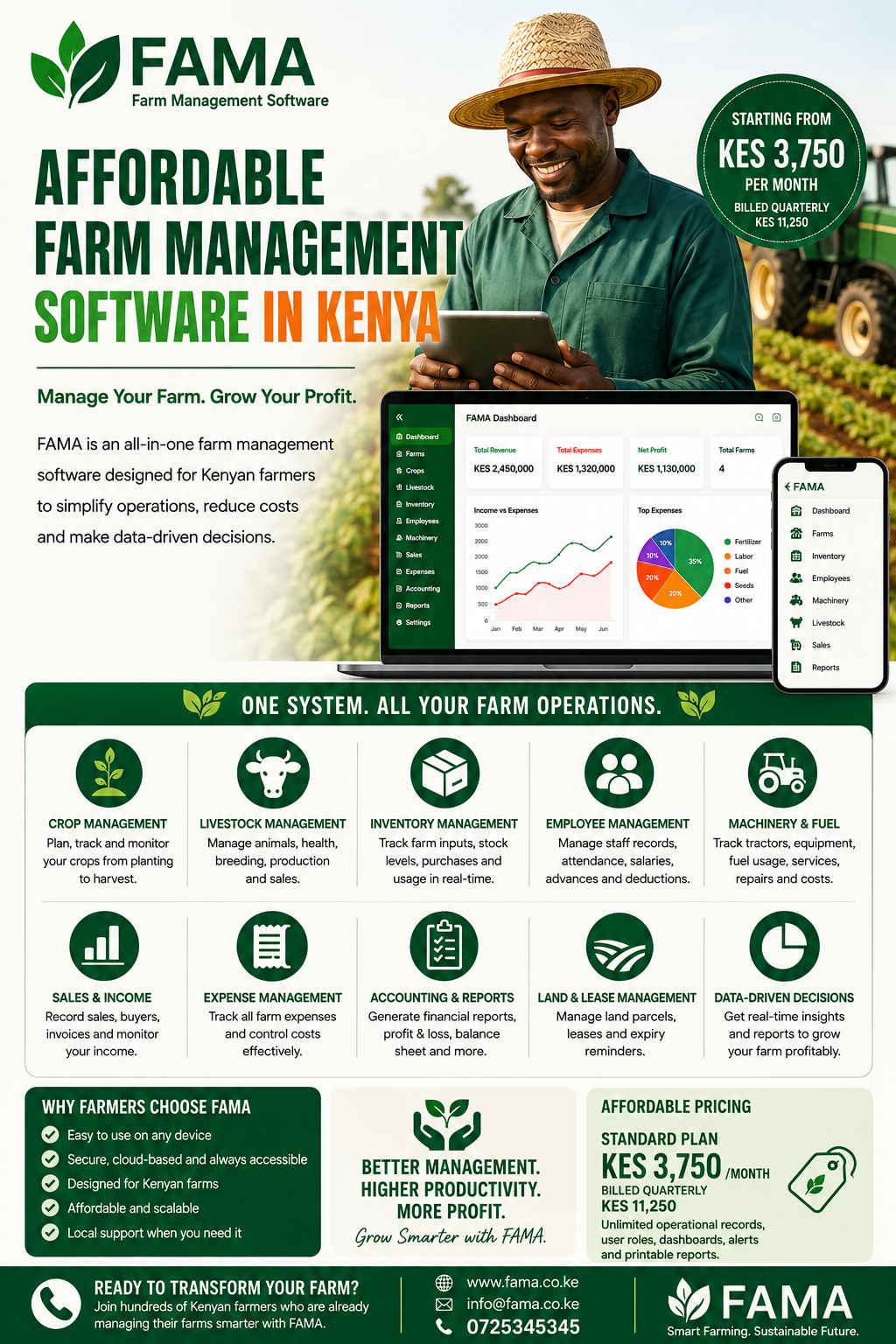
Affordable farm management software in Kenya is becoming an increasingly important solution for farmers, farm owners, farm managers, and agribusinesses looking to manage their agricultural operations more efficiently. As farms grow, keeping track of crops, livestock, employees, farm inputs, machinery, expenses, harvests, sales, and inventory using notebooks or disconnected spreadsheets can become difficult. A centralized farm management system can bring these activities together and give the farm owner a clearer view of what is happening across the business.
Agriculture is a major business sector in Kenya, and like any other business, a farm requires proper planning, accurate records, financial control, and efficient resource management. Farmers need to know how much they are spending, what resources they have available, how much they are producing, and whether their farming activities are generating a profit.
This is where affordable farm management software in Kenya can make a significant difference.
Farm management software helps farmers move away from scattered paperwork and manual calculations toward organized digital records. Instead of keeping separate notebooks for farm inputs, workers, expenses, harvests, livestock, and sales, farmers can manage these activities from one centralized platform.
For farmers who want to modernize their operations without investing in expensive enterprise systems, choosing affordable farm management software in Kenya can be a practical step toward better organization, accountability, and financial visibility.
What Is Farm Management Software?
Farm management software is a digital platform designed to help farmers manage different activities involved in running an agricultural business.
Depending on the software, farmers can use a farm management system to manage:
- Crop production
- Livestock
- Farm inputs
- Inventory
- Employees
- Labour
- Salaries
- Machinery
- Fuel
- Land leases
- Harvests
- Sales
- Income
- Expenses
- Accounting
- Farm reports
The biggest advantage is that these activities can be brought together into one system.
For example, a farmer may purchase fertilizer for a particular crop. Instead of keeping the receipt in a folder and writing the transaction in a notebook, the purchase can be recorded digitally. The farmer can then track the quantity purchased, stock available, amount used, and associated cost.
When the crop is eventually harvested and sold, the farmer can compare the production and sales information against the expenses incurred.
This creates a clearer picture of the farm’s financial and operational performance.
A platform such as FAMA is designed around this centralized approach, bringing crop and livestock records, inputs, stock, machinery, labour, salaries, harvests, production, sales, and accounting into one workspace. FAMA Farm Management Software
Why Farmers Need Affordable Farm Management Software in Kenya
Managing a farm has become increasingly complex.
A farmer may have to manage employees, farm inputs, machinery, livestock, rented land, suppliers, customers, harvests, and financial transactions at the same time.
When a farm is small, a notebook may be enough.
However, as the business expands, manual record keeping can become inefficient.
Imagine a commercial farm with several fields, multiple tractors, dozens of employees, large input purchases, livestock, and several customers.
The owner may want to know:
- How much fertilizer was purchased?
- How much fertilizer remains?
- How much was spent on labour?
- How much fuel was used?
- How much did machinery maintenance cost?
- How much was harvested?
- How much produce was sold?
- How much money was received?
- How much did the farm spend?
- Was the farming period profitable?
Answering these questions using several notebooks and spreadsheets can take considerable time.
With affordable farm management software in Kenya, these records can be maintained in a centralized digital environment.
This gives farm owners and managers better access to information and can make decision-making more efficient.
The Problems With Manual Farm Record Keeping
Many farmers in Kenya still depend on traditional record-keeping methods.
Paper records have advantages. They are inexpensive, familiar, and easy to start.
However, manual records can become problematic when the farm becomes more complex.
Scattered Information
One notebook may contain expense information while another contains employee records.
The storekeeper may maintain separate stock records, while the accountant keeps another spreadsheet.
Important receipts may be stored in folders.
This creates multiple sources of information.
When the farm owner needs a specific figure, employees may have to search through different records.
Farm management software can bring this information into one centralized platform.
Manual Calculations
Farms involve many calculations.
Managers may need to calculate:
- Total expenses
- Input costs
- Labour costs
- Stock balances
- Sales
- Income
- Production costs
- Profitability
When these calculations are performed manually, errors can occur.
A small error in a stock balance or expense calculation can affect other records.
Digital farm management systems can automate many calculations and help maintain updated balances.
Difficulty Tracking Inventory
Farm inputs can represent a substantial investment.
A farm may have seeds, fertilizer, pesticides, animal feed, tools, spare parts, and other supplies in storage.
Without proper inventory management, it can be difficult to determine what is actually available.
A digital system can record purchases, stock received, stock issued, and remaining balances.
This creates greater visibility and accountability.
Difficulty Monitoring Employees
Managing farm workers manually can also become challenging.
A farm may employ permanent workers, casual labourers, supervisors, drivers, storekeepers, and managers.
Keeping accurate records of attendance, salaries, advances, and deductions becomes more difficult as the number of employees increases.
Farm management software can help organize employee information and reduce administrative work.
Limited Visibility for Farm Owners
Many farm owners do not spend every day on the farm.
The farm may be located in a different town or county from where the owner lives.
This means the owner depends on managers and employees to provide updates.
A centralized farm management platform can make it easier for authorized users to access current farm information.
Important Features of Affordable Farm Management Software in Kenya
When searching for affordable farm management software in Kenya, farmers should look at the features available rather than focusing only on the price.
The right software should address the actual needs of the farm.
1. Crop Management
Crop production involves many different activities.
Farmers need to manage land preparation, planting, inputs, labour, crop maintenance, harvesting, storage, and sales.
Farm management software can help organize these activities.
For example, a farmer growing maize can record the farming period, inputs used, labour expenses, harvest quantity, and sales.
This information can help the farmer understand the total cost of producing the crop.
Over time, farmers can also compare different farming periods.
They may discover that one crop variety generated better returns or that input costs increased significantly during a particular season.
2. Livestock Management
Not every agricultural business focuses entirely on crops.
Kenya has many dairy farms, poultry farms, cattle farms, sheep and goat farms, pig farms, ranches, and mixed farms.
These businesses need reliable livestock records.
Depending on the system, farm management software can help track:
- Animals
- Animal groups
- Production
- Feed
- Health activities
- Buyers
- Livestock sales
Having livestock records within the same platform as financial and farm records can make management easier.
FAMA’s published features include livestock management, including animal and group records, health activities, production, buyers, and livestock sales. FAMA livestock management features
3. Farm Input Management
Inputs are essential to agricultural production.
They may include:
- Seeds
- Fertilizer
- Herbicides
- Fungicides
- Insecticides
- Animal feed
- Veterinary products
- Packaging materials
- Tools
Farmers need to know how much they purchased, how much was used, and what remains.
An affordable farm management software in Kenya solution can help farmers maintain digital records of these transactions.
For example, FAMA provides functionality for recording input purchases, suppliers, stock balances, and input usage on farming operations. FAMA farm inputs and stock management
4. Inventory Management
Inventory management is one of the most important features for a commercial farm.
Suppose a farm purchases 100 bags of fertilizer.
The farm needs to know:
- When the fertilizer was purchased
- Who supplied it
- How much was purchased
- How much was issued
- Where it was used
- How much remains
A digital inventory system can create a clear record of these movements.
The basic process becomes:
Purchase → Receive → Issue → Monitor → Reorder
This can help reduce unnecessary purchases and improve stock accountability.
5. Labour Management
Labour is another major cost for many farms.
A digital system can help farmers manage employee information, attendance, salaries, advances, and deductions.
This can make payroll administration more organized.
It can also help managers understand the amount being spent on labour.
For example, if labour costs increase significantly from one farming period to another, management can investigate why.
6. Machinery Management
Machinery is an important investment for commercial farms.
Tractors, vehicles, irrigation equipment, pumps, harvesters, and other equipment require ongoing maintenance.
Farm management software can help track:
- Tractors
- Machinery
- Drivers
- Fuel
- Repairs
- Maintenance
- Service schedules
- Machinery costs
FAMA’s published machinery features include tractor and driver records, service reminders, repair costs, and fuel reporting. FAMA machinery management
This can help farm owners understand the actual cost of operating agricultural machinery.
7. Fuel Management
Fuel can become a significant expense for farms that use tractors, vehicles, generators, and irrigation equipment.
Without proper fuel records, it can be difficult to determine whether fuel is being used efficiently.
Farm management software can help record fuel purchases and usage.
Over time, these records can help farm managers understand fuel consumption and investigate unusual increases.
8. Land and Lease Management
Land is one of the most important assets in agriculture.
Some farmers own their land, while others lease additional acreage.
Managing multiple leases manually can be challenging.
Farm management software can help record:
- Landowners
- Acres
- Lease agreements
- Payments
- Balances
- Lease periods
- Expiry dates
FAMA includes lease management for rented acres, lessors, payments, balances, and expiry alerts. FAMA lease management
This can make it easier for farmers to keep track of leased agricultural land.
Farm Accounting and Affordable Farm Management Software in Kenya
A farm is a business, and financial management is essential.
Farm owners need to know how much money is being spent and how much revenue is being generated.
Affordable farm management software in Kenya can help connect farm operations with financial records.
For example, when a farmer purchases fertilizer, the purchase can be recorded as an expense and the fertilizer can also be reflected in inventory.
When the fertilizer is used, the stock balance can be updated.
Later, when the crop is harvested and sold, the farmer can record the sales revenue.
This creates a connection between:
Inputs → Production → Harvest → Sales → Financial performance
That connection can provide valuable information for decision-making.
Tracking Farm Expenses
Farm expenses can include:
- Seeds
- Fertilizer
- Chemicals
- Labour
- Fuel
- Machinery repairs
- Transport
- Land leases
- Animal feed
- Veterinary services
- Utilities
- Other operating expenses
When these costs are properly recorded, the farm owner can better understand the true cost of running the operation.
Tracking Farm Income
Farm income may come from:
- Crop sales
- Livestock sales
- Milk
- Eggs
- Poultry
- Fruits
- Vegetables
- Other agricultural products
Recording sales and income helps the farm compare revenue with operating expenses.
FAMA’s accounting functionality includes income, expenses, cashbook entries, profit and loss, and printable reports. FAMA accounting features
The Importance of Farm Reports
Recording information is only the first step.
Farmers also need to understand the information.
This is why reporting is an important feature when selecting affordable farm management software in Kenya.
A good reporting system should help answer practical questions.
For example:
- How much did the farm spend?
- How much was spent on labour?
- How much fertilizer was purchased?
- How much fertilizer remains?
- How much fuel was used?
- How much was harvested?
- How much was sold?
- What was the total income?
- Was the farm profitable?
FAMA provides printable and exportable reports covering areas such as leases, inputs, fuel, salaries, attendance, harvests, farming periods, and profitability. FAMA farm reports
This allows farm records to become useful management information.
How Affordable Farm Management Software Can Help Reduce Farm Costs
One of the strongest reasons for adopting affordable farm management software in Kenya is the potential to improve cost control.
Farm businesses can lose money in many different ways.
Some losses are obvious.
Others are hidden within everyday operations.
For example, a farm may experience:
- Stock shortages
- Excessive fuel consumption
- Unnecessary purchases
- Payroll errors
- Machinery downtime
- Uncontrolled expenses
- Poor record keeping
A digital management system can make these areas more visible.
The software does not automatically eliminate losses, but it gives management better information for identifying and addressing them.
Better Inventory Control Can Reduce Waste
When farmers know exactly what they have in stock, they can make better purchasing decisions.
This can reduce unnecessary purchases and help prevent shortages.
Better Fuel Records Can Improve Accountability
Recording fuel purchases and consumption makes it easier to identify unusual usage.
Better Labour Records Can Improve Payroll Accuracy
Accurate attendance and salary records can reduce payroll errors and improve accountability.
Better Expense Records Can Improve Budgeting
When farmers know how much they have spent historically, they can make better budgets for future farming periods.
What Makes Farm Management Software Affordable?
The word “affordable” means different things to different farms.
A smallholder farmer and a large commercial farm may have completely different technology budgets.
Therefore, farmers should consider value rather than price alone.
An affordable system should provide the features the farm actually needs without unnecessary complexity.
It should also have transparent pricing.
For example, FAMA currently lists its Standard Plan at KES 3,750 per month, billed quarterly at KES 11,250. The published plan includes unlimited operational records per farm account, farm owner and staff roles, dashboards, alerts, and printable/exportable reports. FAMA pricing
When comparing software, farmers should ask whether the quoted price includes the functions they need.
Affordable Does Not Mean Cheap
There is an important difference between cheap software and affordable software.
Cheap software has a low price.
Affordable software provides strong value for the money being spent.
For example, one platform may have a low monthly subscription but charge separately for:
- Additional users
- Accounting
- Inventory
- Reports
- Support
- Data exports
Another platform may include several of these features in one subscription.
The second platform could therefore provide better overall value.
This is why farmers should compare the total cost of the software, not just the advertised monthly price.
How to Choose Affordable Farm Management Software in Kenya
Before choosing a system, farmers should identify the most important problems they want to solve.
Ask questions such as:
Do we have difficulty managing inventory?
Are labour records difficult to maintain?
Do we struggle to understand farm profitability?
Are machinery and fuel expenses difficult to track?
Are harvest and sales records scattered?
Once these challenges have been identified, farmers can compare software based on the features that address them.
Consider Ease of Use
The system should be easy enough for employees to understand.
A complicated platform may not deliver value if employees avoid using it.
Consider User Roles
Different employees should have appropriate access.
A storekeeper may need inventory access, while an accountant may need financial access.
Consider Reporting
Make sure the software can turn farm data into useful reports.
Consider Security
Farm records contain valuable business information.
Farmers should understand how their data is protected.
FAMA states that its platform uses authenticated routes, role-based access, tenant isolation, and validated forms as part of its security controls. FAMA security information
Consider Scalability
The farm may grow.
The software should be able to support additional employees, activities, and records as the business expands.
Why FAMA Is an Option for Farmers Looking for Affordable Farm Management Software in Kenya
FAMA is a farm management SaaS platform designed to help Kenyan farms manage their operations from one centralized system.
Its published features cover important areas such as:
- Farm leases
- Inputs
- Inventory
- Machinery
- Fuel
- Staff
- Salaries
- Harvests
- Livestock
- Sales
- Accounting
- Reports
This centralized approach can reduce the need to maintain multiple disconnected systems. FAMA Farm Management System
For farmers searching for affordable farm management software in Kenya, having multiple farm functions in one platform can make administration easier and provide better visibility.
FAMA’s published Standard Plan is currently KES 3,750 per month when billed quarterly, with quarterly billing listed at KES 11,250. FAMA pricing plans
Benefits, Costs, and How to Choose the Right System
Affordable farm management software in Kenya can help agricultural businesses move beyond paper records, disconnected spreadsheets, and manual calculations. As farms become larger and more complex, having accurate information about crops, livestock, workers, inventory, machinery, expenses, harvests, and sales becomes increasingly important.
A farm management system is not simply a digital notebook. When implemented properly, it can become a central management tool that connects daily farm activities with financial performance.
For a Kenyan farmer, the goal of using affordable farm management software in Kenya should be to gain better control of the farm while keeping technology costs within a practical budget.
This second part of the article looks at the major benefits of farm management software, how it can improve productivity and cost control, what farmers should consider when comparing prices, and how to determine whether a particular system provides good value.
Benefits of Affordable Farm Management Software in Kenya
There are many reasons farmers are moving toward digital farm management.
The most important benefit is visibility.
When farm information is properly recorded and organized, owners and managers can understand what is happening across the business.
Instead of relying on assumptions, they can use actual records to make decisions.
1. Better Farm Record Keeping
Accurate records are the foundation of good farm management.
A farmer may need to keep records for years, especially when comparing different farming seasons or evaluating the performance of different crops.
Paper records can become difficult to organize over time.
A digital farm management system allows farmers to maintain records in one centralized location.
Information can include:
- Farming periods
- Crop activities
- Livestock
- Inputs
- Employees
- Expenses
- Sales
- Harvests
- Machinery
- Inventory
- Fuel
- Land
- Financial transactions
This makes it easier to find information when it is needed.
For example, a farmer who wants to know how much was spent on fertilizer during the previous season can retrieve the relevant information without searching through multiple files.
2. Improved Financial Management
A farm is a business, and financial management is essential.
Farm owners need to understand how much they spend and how much they earn.
Without proper records, it can be difficult to calculate the true cost of production.
Affordable farm management software in Kenya can help farmers record both operational and financial information.
Expenses can include:
- Seeds
- Fertilizer
- Chemicals
- Labour
- Fuel
- Machinery repairs
- Transport
- Land
- Animal feed
- Veterinary services
- Utilities
Income can come from:
- Crop sales
- Livestock sales
- Milk
- Eggs
- Poultry
- Fruits
- Vegetables
- Other agricultural products
When income and expenses are recorded systematically, the farm owner can get a clearer understanding of profitability.
FAMA’s published accounting features include income, expenses, cashbook entries, profit and loss, and printable reports. FAMA accounting features
3. Better Inventory Control
Inventory is one of the areas where farms can experience significant losses.
A farm may purchase large quantities of fertilizer, seeds, chemicals, animal feed, tools, and other supplies.
Without proper stock management, the farm may not know exactly what is available.
Affordable farm management software in Kenya can help farmers monitor inventory from purchase to usage.
For example:
Stock purchased → Stock received → Stock issued → Remaining balance
This creates a clear record of inventory movement.
Farm managers can identify when supplies are running low and plan purchases accordingly.
Better inventory management can also help reduce unnecessary purchases.
4. Improved Labour Management
Labour is a significant expense for many agricultural businesses.
A farm may have permanent employees, casual workers, supervisors, drivers, managers, and other staff.
Managing all these employees manually can take considerable time.
Farm management software can help organize employee records and payroll-related information.
Depending on the platform, farmers may be able to manage:
- Employee profiles
- Attendance
- Salaries
- Advances
- Deductions
- Payroll records
This creates a more organized approach to workforce management.
It can also help farm owners understand how much they are spending on labour during different farming periods.
5. Better Machinery Management
Machinery is an important investment for commercial farms.
Tractors and other agricultural equipment require fuel, servicing, repairs, spare parts, and regular maintenance.
If machinery costs are not properly recorded, it can be difficult to determine how much a particular machine is actually costing the farm.
Farm management software can help record:
- Machinery
- Tractors
- Drivers
- Fuel
- Repairs
- Maintenance
- Service schedules
- Machinery-related expenses
FAMA’s published machinery functionality includes tractor and driver management, service reminders, repair costs, and fuel reporting. FAMA machinery management
This information can help managers plan maintenance and understand machinery costs.
Affordable Farm Management Software in Kenya for Small Farms
There is a common misconception that farm management software is only useful for large commercial farms.
That is not necessarily true.
Small and medium-sized farms can also benefit from organized digital records.
A small farm may still have:
- Employees
- Inputs
- Expenses
- Livestock
- Crops
- Harvests
- Customers
- Sales
- Equipment
Even when the number of transactions is relatively small, establishing proper records can make management easier.
As the farm grows, the importance of those records increases.
Starting with affordable farm management software in Kenya can help a growing agricultural business develop better management habits from an early stage.
Affordable Farm Management Software in Kenya for Commercial Farms
Large farms have even greater reasons to adopt digital systems.
A commercial agricultural business may manage multiple fields, hundreds of employees, several tractors, large inventories, multiple farming periods, and numerous buyers.
The volume of information can quickly become difficult to manage manually.
A centralized farm management platform allows different departments to work with the same system.
For example:
Farm Owner
The owner can monitor overall farm performance, financial information, and reports.
Farm Manager
The manager can focus on daily farm operations and production activities.
Accountant
The accountant can manage income, expenses, salaries, and financial records.
Storekeeper
The storekeeper can manage inventory and stock movements.
Role-based access can help ensure that employees have access to the information required for their responsibilities.
FAMA’s platform includes different user roles, including farm owner, farm manager, accountant, and storekeeper. FAMA user roles
How Farm Management Software Can Improve Farm Productivity
Productivity is not only about producing more crops or livestock.
It is also about using available resources efficiently.
A farm can have high production but still perform poorly if resources are being wasted.
Farm management software can help improve productivity by providing better information about how resources are being used.
Monitoring Input Usage
Farmers need to know whether inputs are being used efficiently.
If fertilizer consumption increases significantly without a corresponding improvement in production, the farm manager may need to investigate.
Digital records make these comparisons easier.
Monitoring Labour
Managers can compare labour requirements across different farming periods.
This can help with planning and budgeting.
Monitoring Machinery
Machinery records can help managers understand how frequently equipment is being used and how much is being spent on repairs and fuel.
Monitoring Production
Harvest and production records can help farmers compare results over time.
These comparisons can support better planning for future farming periods.
How Affordable Farm Management Software in Kenya Can Help With Cost Control
Cost control is critical in agriculture.
Farmers have little control over some external factors, such as market prices and weather conditions.
However, they can improve how they manage their internal costs.
Affordable farm management software in Kenya can help provide visibility into those costs.
For example, a farm manager may discover that fuel expenditure has increased significantly.
Instead of simply accepting the higher expense, management can examine fuel records and determine whether the increase is related to:
- More machinery usage
- Longer working hours
- Transport
- Irrigation
- Increased fuel prices
- Inefficient equipment
- Unusual consumption
Without records, it is difficult to investigate.
With records, management has information to work with.
Understanding the True Cost of Farming
One of the most important advantages of digital farm records is the ability to understand the true cost of production.
Consider a farm producing vegetables.
The farmer may spend money on:
- Seeds
- Fertilizer
- Chemicals
- Labour
- Irrigation
- Fuel
- Packaging
- Transport
- Land
- Machinery
If only seed and fertilizer costs are considered, the farmer may underestimate the actual cost of production.
A comprehensive farm management system can help bring these costs together.
This can help farmers make better pricing and production decisions.
Farm Management Software and Profitability
Profitability is not determined only by sales.
A farm can generate significant revenue and still make a small profit if expenses are too high.
Farmers therefore need to consider both sides:
Revenue – Expenses = Profit
This simple calculation becomes more useful when the underlying information is accurate.
Farm management software can help farmers track revenue and expenses throughout the farming period.
This means the farmer does not necessarily have to wait until the end of the year to begin understanding the financial performance of the farm.
Farm Reports and Management Decisions
Reports are one of the most useful functions of farm management software.
A report can transform hundreds or thousands of individual transactions into understandable information.
For example, instead of looking at every fuel transaction separately, a manager can review total fuel expenditure.
Instead of reviewing individual sales receipts, the owner can review total sales.
Instead of manually counting inventory records, management can review current stock balances.
FAMA’s reporting features cover areas including leases, inputs, fuel, salaries, attendance, harvests, farming periods, and profit. FAMA reports
How Much Does Affordable Farm Management Software in Kenya Cost?
The cost of farm management software varies depending on the provider and the features included.
Some providers use monthly subscriptions.
Others may charge annually.
Pricing can also depend on:
- Number of users
- Number of farms
- Number of acres
- Modules
- Transactions
- Support
- Additional features
Farmers should therefore compare the complete pricing structure before choosing a platform.
For example, FAMA currently publishes a Standard Plan priced at KES 3,750 per month, with quarterly billing of KES 11,250. FAMA pricing
The published plan includes unlimited operational records per farm account, user roles, dashboards, alerts, and printable/exportable reports.
The important point is that farmers should evaluate the price in relation to the features and business value provided.
Cheap Farm Software vs Affordable Farm Software
The cheapest software is not always the most affordable.
This distinction is important.
Imagine Software A costs KES 2,000 per month but charges extra for accounting, inventory, additional users, and reports.
Software B costs KES 3,750 per month but includes many of these features.
Although Software A has the lower advertised price, Software B may provide better overall value.
This is why farmers should ask:
What am I getting for the price I am paying?
When evaluating affordable farm management software in Kenya, consider the total cost rather than only the starting subscription.
What Should Be Included in Affordable Farm Management Software in Kenya?
A good system should provide features that address practical farm management needs.
At minimum, many commercial farms should consider software that provides:
Farm Records
The system should allow the farm to organize important operational information.
Inventory
Farmers should be able to track stock purchases, usage, and balances.
Labour
Employee records, attendance, and salary information can improve workforce management.
Machinery
The software should ideally support machinery, fuel, maintenance, and repair records.
Crop Management
Farmers should be able to organize crop activities and farming periods.
Livestock
Mixed and livestock farms should consider platforms that support livestock records.
Sales
The system should allow farmers to record produce and livestock sales.
Accounting
Income and expenses should be easy to record and review.
Reports
Management should be able to turn farm data into useful reports.
Cloud-Based Farm Management Software in Kenya
Cloud-based software has changed the way businesses access digital tools.
Instead of installing software on a single computer, cloud platforms can allow authorized users to access information through an internet-connected device.
This can be particularly useful for farmers who manage operations from different locations.
For example, a farm owner may be in Nairobi while the farm manager is working on the farm.
A cloud-based system can allow authorized users to access the same farm records.
However, farmers should consider internet availability and the platform’s technical requirements before selecting a cloud-based solution.
Advantages of Centralized Farm Management
Using one platform for different farm activities can reduce duplication.
Instead of having one system for inventory, another for accounting, and another for employee records, a centralized farm management platform can connect these functions.
This can provide several advantages.
One Source of Information
Employees can work from a common set of records.
Less Repeated Data Entry
Information does not have to be repeatedly transferred between different systems.
Easier Reporting
Management can access information from different areas of the farm.
Better Accountability
User roles can help identify who is responsible for particular activities.
Better Historical Data
Farmers can compare current performance with previous farming periods.
How to Implement Affordable Farm Management Software in Kenya
Buying software does not automatically improve farm management.
Implementation is important.
Farm owners should establish a clear process for introducing the system to employees.
Step 1: Identify Farm Management Problems
Before choosing software, list the farm’s biggest challenges.
For example:
- Poor inventory control
- Difficult payroll management
- Missing expense records
- Poor machinery tracking
- Unclear profitability
- Disorganized harvest records
The software should address these problems.
Step 2: Select the Relevant Features
Do not pay for unnecessary functionality.
Choose a platform that provides the features the farm actually needs.
Step 3: Train Employees
Employees should understand how and when to use the system.
Step 4: Establish Responsibilities
Decide who is responsible for entering different types of information.
Step 5: Maintain Accurate Records
Information should be entered promptly and accurately.
Step 6: Review Reports Regularly
Farm management should use reports to monitor performance and identify problems.
Why Data Accuracy Matters
Farm management software is only as useful as the information entered into it.
If employees enter incorrect information, the reports generated by the system may also be incorrect.
For this reason, farms should establish simple data-entry procedures.
For example:
When stock arrives, record it.
When stock is issued, record it.
When a sale is made, record it.
When an expense occurs, record it.
When employees attend work, record attendance.
Consistent data entry creates reliable records.
Common Mistakes When Choosing Farm Management Software
Farmers should avoid several common mistakes.
Choosing Only Based on Price
The cheapest option may not provide the features needed.
Selecting Software With Too Many Unnecessary Features
More features do not always mean better software.
The platform should match the farm’s requirements.
Ignoring Ease of Use
If employees find the system difficult, adoption can suffer.
Failing to Consider Future Growth
The farm may expand and require more users or additional functionality.
Not Checking Reports
Reporting is essential for turning records into management information.
Failing to Train Employees
Even excellent software can fail if employees do not know how to use it.
Questions to Ask Before Choosing Affordable Farm Management Software in Kenya
Before subscribing to a platform, ask the provider:
- Is the software designed for agricultural businesses?
- Does it support Kenyan farms?
- Can it manage crops?
- Can it manage livestock?
- Can it track farm inputs?
- Does it include inventory management?
- Can it manage employees?
- Does it support salaries and payroll records?
- Can it track machinery?
- Can it monitor fuel?
- Can it manage land leases?
- Can it track harvests?
- Can it record sales?
- Does it include accounting?
- Are reports included?
- How many users can access the platform?
- Are there additional charges?
- How is farm data protected?
- Can the system grow with the farm?
- Is support available?
These questions can help farmers make a more informed decision.
Why FAMA Can Be Considered by Kenyan Farmers
For farmers specifically searching for affordable farm management software in Kenya, FAMA provides a centralized platform for managing agricultural operations.
Its published modules cover several important areas of farm management, including leases, inputs, inventory, machinery, fuel, staff, salaries, harvests, livestock, sales, accounting, and reports. FAMA farm management platform
The platform also provides different user roles, allowing farm owners, managers, accountants, and storekeepers to work according to their responsibilities. FAMA user roles
Its published Standard Plan is KES 3,750 per month, billed quarterly at KES 11,250, providing a predictable subscription structure for farms evaluating their technology budgets. FAMA pricing plans
For a farm that wants to move from disconnected records to one centralized management platform, this approach can simplify administration and improve access to farm information.
The Long-Term Value of Farm Management Software
The value of farm management software should not be measured only by its monthly subscription.
Farmers should also consider the time and resources saved.
For example, if farm employees spend several days each month compiling reports manually, digital reporting can reduce administrative work.
If inventory discrepancies are regularly occurring, better stock records can improve accountability.
If the owner struggles to understand profitability, financial reports can provide better visibility.
If machinery maintenance is being forgotten, digital reminders can help managers stay organized.
These benefits can make the software valuable even when the subscription represents an additional monthly expense.
Implementation, Profitability, FAQs and Final Guide
Affordable farm management software in Kenya can provide farmers with a practical way to organize their agricultural operations, control costs, manage resources, and make decisions using accurate information. However, choosing software is only the first step. The real value comes from how effectively the farm implements and uses the system.
A farmer may have access to excellent technology, but if employees do not enter information correctly, inventory is not updated, expenses are missing, or reports are never reviewed, the software will not deliver its full potential.
For this reason, successful digital farm management requires a combination of the right technology, accurate records, trained employees, and consistent management practices.
This final part explores how farmers can successfully implement affordable farm management software in Kenya, how digital records can contribute to profitability, mistakes to avoid, frequently asked questions, and the key factors farmers should consider before choosing a farm management system.
How to Successfully Implement Affordable Farm Management Software in Kenya
Introducing new software to a farm does not have to be complicated.
The process can be divided into several practical steps.
1. Identify the Farm’s Biggest Challenges
Before purchasing software, farm owners should identify the areas where they currently experience the most problems.
These may include:
- Poor inventory control
- Unclear farm expenses
- Difficult payroll management
- Missing sales records
- Poor machinery tracking
- Unclear production costs
- Disorganized crop records
- Difficulty managing livestock
- Lack of reliable reports
Once these problems have been identified, it becomes easier to select the appropriate software.
For example, if inventory is the biggest problem, the farmer should prioritize software with strong stock management features.
If profitability is the main concern, accounting and reporting should be important considerations.
2. Choose Software That Matches the Farm
Not every farm needs the same software.
A small vegetable farm may have very different requirements from a large commercial mixed farm.
Farmers should consider:
- Farm size
- Number of employees
- Number of users
- Crops grown
- Livestock kept
- Number of farming locations
- Machinery used
- Inventory requirements
- Accounting needs
- Reporting requirements
The best affordable farm management software in Kenya is therefore not necessarily the cheapest platform available.
It is the platform that provides the right combination of functionality, usability, and price.
3. Start With Essential Modules
Farmers do not necessarily need to implement every feature on the first day.
A practical approach is to begin with the most important functions.
For example, a farm could initially implement:
Employees + Inventory + Expenses + Sales
Once employees become comfortable with these areas, the farm can introduce additional functions such as machinery, livestock, leases, harvests, and advanced reporting.
This gradual approach can make the transition easier.
4. Train Farm Employees
Employees are an important part of successful software implementation.
The people entering information into the system need to understand:
- What information to enter
- When to enter it
- Where to enter it
- Who is responsible for each record
- How to correct mistakes
- How to access relevant reports
Training does not have to be complicated.
The focus should be on the functions employees actually use.
For example, a storekeeper may only need training on inventory and stock movements, while an accountant may need training on expenses, income, salaries, and financial reports.
5. Assign Clear Responsibilities
One of the advantages of modern farm management software is the ability to give different users different responsibilities.
For example:
Farm Owner
Reviews overall performance and financial information.
Farm Manager
Oversees day-to-day agricultural operations.
Accountant
Manages financial transactions and accounting records.
Storekeeper
Manages inventory and farm inputs.
Supervisor
Records relevant operational information.
Clear responsibilities help reduce duplication and improve accountability.
6. Enter Accurate Information
Accurate data is essential.
If incorrect information is entered into the system, the resulting reports may also be inaccurate.
Farm employees should therefore be encouraged to record activities promptly.
For example:
When fertilizer is purchased, record it.
When fertilizer is issued, record it.
When a sale occurs, record it.
When an expense is paid, record it.
When workers attend, record attendance.
When machinery receives maintenance, record the service.
This creates a reliable digital history of the farm.
7. Review Reports Regularly
A common mistake is to use software only for data entry.
Farmers should also use the information to make decisions.
Management can review reports weekly, monthly, or after important farming activities.
Reports can help answer questions such as:
- What did we spend this month?
- How much stock remains?
- How much did we spend on fuel?
- How much did we spend on labour?
- How much was harvested?
- How much was sold?
- What is the farm’s current financial position?
This turns farm management software from a record-keeping tool into a decision-making tool.
How Affordable Farm Management Software in Kenya Can Improve Profitability
Profitability is one of the main reasons agricultural businesses invest in management systems.
However, it is important to understand that software does not automatically make a farm profitable.
Instead, it provides information that can help farmers identify opportunities, reduce waste, control costs, and make better decisions.
Understand Where Money Is Going
Farm expenses can quickly become difficult to track.
A farm may spend money on:
- Fertilizer
- Seeds
- Chemicals
- Labour
- Fuel
- Machinery
- Repairs
- Transport
- Land
- Animal feed
- Veterinary services
- Packaging
When these expenses are properly categorized and recorded, farm owners can understand where their money is going.
This can help identify areas where costs may need to be reviewed.
Reduce Unnecessary Inventory Purchases
Poor inventory management can cause unnecessary expenditure.
If a farmer does not know how much fertilizer, feed, chemicals, or other supplies remain, they may purchase products that are already available.
Digital inventory management provides better visibility.
Before making a new purchase, the storekeeper or farm manager can check the current balance.
This can help reduce unnecessary purchases and improve stock planning.
Improve Fuel Accountability
Fuel is an important operating cost for farms that use tractors, vehicles, generators, pumps, and other equipment.
Without reliable records, it can be difficult to identify unusual fuel consumption.
With digital records, managers can compare fuel purchases and usage over time.
If fuel expenditure suddenly increases, management can investigate the reason.
The increase may be legitimate, but accurate records make it easier to determine what is happening.
Improve Machinery Maintenance
Machinery breakdowns can be expensive.
A tractor that breaks down during planting or harvesting can cause delays and additional costs.
Regular maintenance can help reduce unexpected problems.
Farm management software can help farmers maintain service records and reminders for machinery.
This can make maintenance planning more organized.
FAMA’s published machinery functionality includes service reminders, tractor and driver management, repair costs, and fuel reporting. FAMA machinery management
Understand Labour Costs
Labour is an important component of farm expenditure.
Farm management software can help track employee records, attendance, salaries, advances, and deductions.
This can give managers a clearer picture of labour expenditure.
It can also help reduce administrative work associated with manually preparing payroll information.
Compare Farming Periods
One of the long-term benefits of digital records is the ability to compare different farming periods.
For example, a farmer can compare:
Season 1
- Input costs
- Labour costs
- Harvest
- Sales
- Profit
with:
Season 2
- Input costs
- Labour costs
- Harvest
- Sales
- Profit
These comparisons can help identify trends.
If production increased while costs remained stable, the farmer may want to understand what contributed to the improvement.
If costs increased without an increase in production, management may need to investigate.
Affordable Farm Management Software in Kenya and Data-Driven Farming
The future of agriculture is increasingly connected to data.
Farmers can collect information about production, inputs, labour, livestock, machinery, inventory, sales, and finances.
But data only becomes valuable when it can be organized and interpreted.
This is where farm management software can help.
Instead of asking:
“How much fertilizer did we use?”
the farmer can ask:
“How much fertilizer did we use, what did it cost, where was it used, and what production did it contribute to?”
That is a much more useful management question.
Digital records can therefore support a transition from simple record keeping to data-driven farm management.
Why Centralized Farm Management Is Important
A farm may use several different tools to manage its operations.
For example:
- Excel for expenses
- A notebook for inventory
- Another spreadsheet for employees
- Paper receipts for purchases
- WhatsApp for communication
- A separate system for accounting
The problem with this approach is that information becomes fragmented.
A centralized farm management platform can bring multiple functions together.
This can reduce duplication and make it easier to connect operational information with financial information.
For example:
Input purchase → Inventory → Farm activity → Harvest → Sale → Financial report
When these processes are connected, farmers can gain a more complete understanding of their operations.
What Makes the Best Affordable Farm Management Software in Kenya?
There is no single system that is perfect for every farmer.
However, there are several characteristics that farmers should look for.
Easy to Use
Employees should be able to understand the system without requiring advanced technical skills.
Comprehensive
The software should provide the functions the farm actually needs.
Affordable
The subscription should fit within the farm’s budget.
Scalable
The system should be capable of supporting the farm as it grows.
Secure
Farm records should be appropriately protected.
Accessible
Authorized users should be able to access information when required.
Useful Reports
The system should convert farm data into information that management can understand.
Reliable Support
Farmers should have a way to obtain assistance when they encounter problems.
Why FAMA Is Worth Considering
For farmers searching for affordable farm management software in Kenya, FAMA provides a centralized solution designed for farm operations.
Its published functionality covers several areas of agricultural management, including:
- Farm leases
- Inputs
- Inventory
- Machinery
- Fuel
- Employees
- Salaries
- Harvests
- Livestock
- Sales
- Accounting
- Reports
This allows different areas of the farm to be managed within one platform. FAMA Farm Management Software
FAMA also provides different user roles, allowing farm owners, farm managers, accountants, and storekeepers to have appropriate access to the system. FAMA user roles
Its published Standard Plan is currently KES 3,750 per month, billed quarterly at KES 11,250. The published plan includes unlimited operational records per farm account, user roles, dashboards, alerts, and printable/exportable reports. FAMA pricing
For farmers who want to move away from scattered records and bring important farm functions together, this centralized approach can provide practical value.
Common Mistakes to Avoid When Using Farm Management Software
Even after choosing affordable farm management software in Kenya, farmers can make mistakes that reduce the value of the system.
Not Entering Data Regularly
If employees wait several weeks before updating records, the information may no longer accurately represent the farm’s current position.
Allowing Multiple Systems to Continue Forever
If employees continue relying on notebooks and spreadsheets indefinitely, the farm may have conflicting records.
Management should establish which system is the official source of information.
Not Reviewing Reports
Data entry without analysis limits the value of software.
Farm owners should regularly review reports.
Giving Everyone Full Access
Employees should generally have access appropriate to their responsibilities.
Role-based access can help improve accountability.
Not Training Employees
Training should be part of the implementation process.
Choosing Software Only Because It Is Cheap
Price is important, but functionality and value are equally important.
Frequently Asked Questions About Affordable Farm Management Software in Kenya
What is affordable farm management software in Kenya?
Affordable farm management software in Kenya refers to digital platforms that help farmers manage agricultural operations while keeping technology costs within a practical range.
These platforms may include tools for crops, livestock, inventory, employees, machinery, expenses, sales, accounting, and reporting.
Why should farmers use farm management software?
Farmers can use software to improve record keeping, manage resources, monitor expenses, track inventory, manage employees, monitor production, and generate reports.
The main benefit is improved visibility into the farm business.
Is farm management software suitable for small farms?
Yes.
Small farms can benefit from organized digital records just as larger farms can.
A small farm may begin with basic functions and expand its use of the system as the business grows.
Is farm management software useful for large commercial farms?
Yes.
Large farms often have more employees, equipment, fields, inputs, livestock, customers, and transactions.
Centralized digital management can help reduce administrative complexity.
Can affordable farm management software in Kenya manage livestock?
Some platforms can manage both crops and livestock.
Farmers should check whether the software supports the livestock activities relevant to their business.
FAMA, for example, publishes livestock management functionality covering animal and group records, health work, production, buyers, and livestock sales. FAMA livestock management
Can farm management software manage inventory?
Yes.
Inventory functionality can help farmers track purchases, stock balances, issues, and usage.
This is particularly useful for farms that manage large quantities of fertilizer, chemicals, feed, seeds, tools, and other supplies.
Can farm management software manage employees?
Yes.
Depending on the platform, farmers can manage employee records, attendance, salaries, advances, and deductions.
Can farm management software track machinery and fuel?
Many agricultural management systems provide machinery and fuel functionality.
FAMA’s published features include tractor and driver management, service reminders, repair costs, and fuel reporting. FAMA machinery features
How much does farm management software cost in Kenya?
Pricing varies depending on the software provider and the features included.
Farmers should compare subscription costs, user limits, modules, reports, support, and additional charges.
FAMA currently publishes a Standard Plan at KES 3,750 per month, with quarterly billing of KES 11,250. FAMA pricing plans
Is the cheapest farm management software the best option?
Not necessarily.
Farmers should compare value rather than price alone.
A slightly more expensive platform may provide more features and eliminate the need for several separate tools.
Can farm management software improve profitability?
Software does not guarantee profits.
However, it can provide better information about expenses, inventory, labour, machinery, production, and sales.
This information can help farmers identify inefficiencies and make better financial decisions.
Can farm owners access their farm records remotely?
Cloud-based farm management platforms can allow authorized users to access farm information remotely, depending on the software and internet availability.
This can be particularly useful when farm owners and managers are in different locations.
The Future of Affordable Farm Management Software in Kenya
Kenyan agriculture is becoming increasingly technology-driven.
Farmers are looking for better ways to manage costs, improve productivity, monitor resources, and understand profitability.
As farms become more business-oriented, accurate digital records are likely to become increasingly important.
The future of farm management is not simply about producing more.
It is also about managing resources efficiently.
A farmer who knows the cost of production can make better decisions than a farmer who is relying on estimates.
A farmer who knows the current inventory balance can plan purchases more effectively.
A farm owner who understands labour and machinery costs can make better operational decisions.
A manager who can quickly access production and sales information can respond faster to problems.
This is the potential value of digital farm management.
Why Farmers Should Start Digitizing Their Records
Some farmers may postpone adopting software because they believe their farm is too small or that manual records are still sufficient.
However, digital record keeping can become more valuable as the farm grows.
Starting early gives the farm an opportunity to establish good management practices.
Instead of waiting until the business has thousands of transactions and multiple employees, farmers can begin building organized digital records earlier.
This can make future growth easier to manage.
Affordable Farm Management Software in Kenya: Final Checklist
Before choosing a farm management platform, use this checklist.
Farm Operations
- Does it manage crops?
- Does it support livestock?
- Can it track farming periods?
- Can it record harvests?
Inventory
- Can it track inputs?
- Can it record purchases?
- Can it monitor stock?
- Can it track stock usage?
Employees
- Can it manage employee records?
- Can it track attendance?
- Can it manage salaries?
- Can it record advances and deductions?
Machinery
- Can it track tractors?
- Can it manage drivers?
- Can it track fuel?
- Can it record repairs?
- Can it provide service reminders?
Finance
- Can it record expenses?
- Can it record income?
- Can it track sales?
- Does it provide profit and loss information?
Reporting
- Can reports be generated easily?
- Can reports be printed?
- Can information be exported?
Users
- Does it support different user roles?
- Can access be controlled?
Cost
- Is the pricing transparent?
- Are there additional charges?
- Does the subscription include the features you need?
Growth
- Can the system support the farm as it expands?
- Can additional employees or operations be accommodated?
Affordable farm management software in Kenya can be an important investment for farmers who want to improve the way they manage their agricultural businesses.
A farm is more than a place where crops and livestock are produced. It is a business that requires financial planning, resource management, employee management, inventory control, production monitoring, and accurate record keeping.
When these activities are managed manually, important information can become scattered.
A modern digital platform can bring them together.
With the right affordable farm management software in Kenya, farmers can manage important areas such as crops, livestock, inputs, inventory, employees, salaries, machinery, fuel, land leases, harvests, sales, expenses, accounting, and reports from a centralized system.
The greatest benefit is not simply having digital records.
The greatest benefit is having better information for better decisions.
Farm owners can understand where their money is going.
Farm managers can monitor operations.
Storekeepers can control inventory.
Accountants can manage financial records.
Employees can work according to clearly defined responsibilities.
Management can review reports and identify areas that need attention.
For Kenyan farmers considering digital transformation, FAMA provides a centralized farm management platform with published functionality covering operations, inventory, machinery, fuel, staff, salaries, leases, livestock, harvests, sales, accounting, and reporting. FAMA official website
Its published Standard Plan is currently KES 3,750 per month, billed quarterly at KES 11,250, giving farms a defined subscription cost when evaluating their technology budget. FAMA pricing
Ultimately, the best affordable farm management software in Kenya is the one that fits the farm’s needs, is easy for employees to use, provides accurate and useful information, and delivers enough value to justify its cost.
As Kenyan agriculture continues to modernize, digital farm management can help farmers move away from scattered records and toward a more organized, transparent, and data-driven approach to running their businesses.
For farmers who want better control of their operations, improved financial visibility, stronger accountability, and more organized farm records, investing in affordable farm management software in Kenya can be an important step toward building a more efficient and sustainable agricultural business.