Table of Contents
ToggleIntroduction: The Rise of Smart Farming Software in Kenya
Agriculture remains the backbone of Kenya’s economy, contributing significantly to GDP, employment, and food security. However, traditional farming methods are no longer enough to meet the growing demand for food, climate challenges, and market competition. This is where smart farming software in Kenya comes in.
Smart farming software uses digital tools, data analytics, automation, and mobile technology to help farmers and agribusinesses improve productivity, reduce losses, and maximize profits. From small-scale farmers in rural areas to large commercial farms, technology is transforming how agriculture is managed.
At Fama Systems (fama.co.ke), we focus on delivering modern agritech solutions that help farmers make data-driven decisions, track farm operations, and increase efficiency.
In this comprehensive guide, we explore everything you need to know about smart farming software in Kenya, including features, benefits, use cases, pricing factors, and why it is becoming essential for modern agriculture.
What is Smart Farming Software?
Smart farming software is a digital system designed to manage agricultural activities using technology. It integrates various tools such as:
- Farm record management systems
- Weather forecasting tools
- Livestock tracking systems
- Crop monitoring dashboards
- Inventory and input management systems
- Financial and expense tracking modules
In simple terms, it is a complete farm management system that replaces manual record-keeping and guesswork with real-time data and automation.
With smart farming software, farmers can monitor their farms from anywhere using a smartphone, tablet, or computer.
Why Smart Farming Software is Important in Kenya
Kenya’s agricultural sector faces several challenges:
1. Climate Change and Unpredictable Weather
Rainfall patterns are no longer reliable. Smart farming software integrates weather forecasting to help farmers plan better.
2. High Cost of Inputs
Fertilizers, seeds, and feeds are expensive. Without proper tracking, farmers lose money due to waste or mismanagement.
3. Poor Record Keeping
Many farmers still rely on handwritten notes, which leads to poor decision-making.
4. Pest and Disease Outbreaks
Without early detection systems, entire farms can be destroyed.
5. Market Fluctuations
Farmers often sell at low prices due to lack of market information.
Smart farming software solves these problems by providing real-time insights and automation tools.
How Smart Farming Software Works
Smart farming systems work by collecting data from different farm activities and analyzing it to provide useful insights.
Step 1: Data Collection
Information is collected from:
- Farm workers
- Sensors (if available)
- Manual input via mobile or desktop
Step 2: Data Storage
All farm data is stored securely in a cloud-based system.
Step 3: Data Analysis
The system analyzes:
- Crop performance
- Animal productivity
- Costs vs profits
- Resource usage
Step 4: Reporting and Recommendations
The software generates reports and suggestions to improve efficiency.
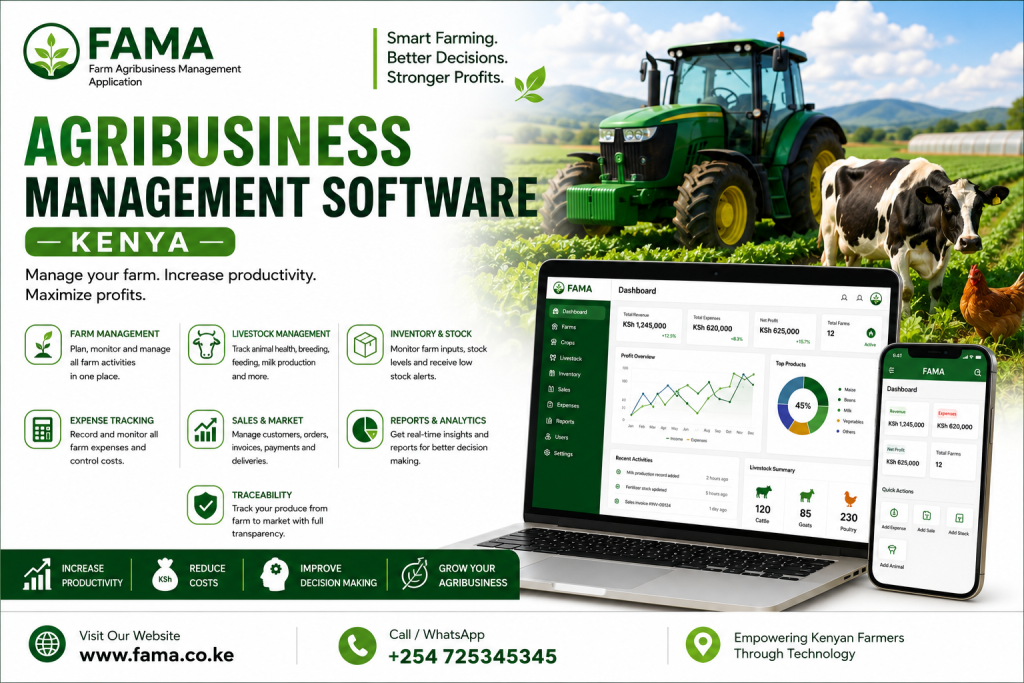
Key Features of Smart Farming Software in Kenya
A good smart farming system should include the following features:
1. Crop Management System
Tracks planting dates, growth stages, fertilization schedules, and harvest timelines.
2. Livestock Management
Manages animal health records, breeding cycles, vaccination schedules, and milk production.
3. Farm Inventory Management
Tracks seeds, fertilizers, feeds, pesticides, and equipment.
4. Expense and Financial Tracking
Helps farmers monitor income and expenses to determine profitability.
5. Weather Forecast Integration
Provides real-time weather updates to guide farming decisions.
6. Pest and Disease Alerts
Early warning systems help prevent crop and livestock losses.
7. Market Price Updates
Shows current market prices to help farmers sell at the right time.
8. Mobile Access
Farmers can manage their farms using smartphones anywhere, anytime.
9. Reporting Dashboard
Visual charts and reports make it easy to understand farm performance.
Benefits of Smart Farming Software in Kenya
1. Increased Productivity
Farmers can optimize planting, feeding, and harvesting schedules.
2. Reduced Losses
Early detection of diseases and better resource management reduce waste.
3. Better Decision Making
Data-driven insights replace guesswork.
4. Cost Efficiency
Helps farmers control input costs and improve profitability.
5. Time Saving
Automates manual tasks like record keeping and reporting.
6. Improved Market Access
Farmers can track prices and sell at the best time.
7. Scalability
Suitable for small, medium, and large-scale farms.
Smart Farming Software for Different Farming Types in Kenya
1. Crop Farming
Used for managing maize, wheat, tea, coffee, vegetables, and fruits.
2. Livestock Farming
Supports dairy farming, poultry farming, goat farming, and beef production.
3. Greenhouse Farming
Helps control irrigation, temperature, and crop cycles.
4. Agribusiness Companies
Used for managing multiple farms, suppliers, and customers.
5. Cooperatives
Helps groups of farmers manage shared resources and finances.
Role of Technology in Modern Kenyan Agriculture
Technology is reshaping agriculture in Kenya through:
- Artificial intelligence in farming decisions
- Mobile-based farm management
- IoT sensors for soil monitoring
- Drone technology for crop inspection
- Cloud computing for data storage
Smart farming software acts as the central system that connects all these technologies.
Challenges Facing Adoption of Smart Farming Software in Kenya
Despite its benefits, adoption still faces challenges:
1. Low Digital Literacy
Some farmers are not familiar with technology.
2. Internet Access
Rural areas may have limited connectivity.
3. Initial Setup Costs
Some systems may require investment in devices.
4. Resistance to Change
Farmers used to traditional methods may hesitate to adopt new systems.
However, with proper training and affordable solutions like those from Fama Systems, adoption is increasing rapidly.
Why Choose Fama Smart Farming Software (fama.co.ke)
At Fama Systems, we design software tailored specifically for Kenyan farmers and agribusinesses.
What Makes Us Different:
- Locally built for Kenyan agriculture
- Easy-to-use interface
- Mobile-friendly design
- Affordable pricing for farmers
- Customizable features
- Reliable support and training
Whether you are managing a small farm or a large agribusiness, our solution is designed to help you grow.
Smart Farming Software Features Offered by Fama Systems
Our platform includes:
- Farm record management
- Livestock tracking system
- Crop production monitoring
- Financial reporting tools
- Inventory management
- Staff and labor tracking
- Automated alerts and reminders
We ensure that every farmer has access to tools that simplify farming operations.
The Future of Smart Farming in Kenya
The future of agriculture in Kenya is digital. Over the next few years, we expect:
1. Full Automation of Farms
Smart sensors and AI will manage irrigation and feeding systems.
2. Data-Driven Agriculture
Farmers will rely on analytics instead of guesswork.
3. Increased Use of Mobile Farming Apps
Most farm management will be done via smartphones.
4. Integration with Financial Services
Farmers will access loans and insurance based on farm data.
5. Expansion of Agritech Startups
More companies like Fama Systems will emerge.
SEO Keywords Used in This Article
- Smart farming software Kenya
- Farm management system Kenya
- Agritech software Kenya
- Digital farming solutions Kenya
- Livestock management software Kenya
- Crop management software Kenya
- Agriculture software Kenya
- Farm record keeping software Kenya
Frequently Asked Questions (FAQ)
1. What is smart farming software?
It is a digital system that helps farmers manage farm activities using technology and data.
2. Who can use smart farming software in Kenya?
Small-scale farmers, large commercial farms, agribusinesses, and cooperatives.
3. Is smart farming software expensive?
No. Many solutions, including Fama Systems, offer affordable packages.
4. Do I need internet to use it?
Yes, but some features can work offline and sync later.
5. Can it work for livestock farming?
Yes, it supports dairy, poultry, and other livestock systems.
Conclusion
Smart farming software is transforming agriculture in Kenya by making farming more efficient, profitable, and data-driven. As climate change, market pressures, and production costs increase, farmers need reliable digital tools to stay competitive.
At Fama Systems (fama.co.ke), we are committed to empowering farmers with modern technology that simplifies farm management and boosts productivity.
If you are ready to transform your farming operations, get in touch today.
📞 Contact: +254 725345345
🌐 Website: fama.co.ke